St. Augustine was founded in 1565 and is the oldest continuously occupied European settlement in the continental United States, which gives it an urban fabric with two distinct historic layers a few streets apart — and both of them want the same light. The older layer is Spanish colonial and its material is coquina: a limestone made of compressed shell fragments, quarried locally on Anastasia Island, pale and porous and soft enough to cut with a saw. A coquina wall at close range is a visible mass of shell, which is a texture found almost nowhere else in this library.
It needs raking light to show — under a frontal midday sun it reads as a flat pale surface, and at a low angle the shell structure catches and the whole wall acquires depth. The newer layer is the 1880s, when Henry Flagler developed the town as a winter resort and commissioned a group of Spanish Renaissance Revival hotels. Three survive, and their construction is the thing worth knowing: they were built of poured concrete with coquina as the aggregate, among the earliest large-scale uses of the material in America.
That gives a pale, faintly warm, subtly speckled surface that is neither stone nor stucco, and it allowed forms masonry would not — thick walls with deep-set openings, arcades, towers and courtyard plans, all cast rather than laid. The deep reveals are the photographic consequence and they are a gift: a window at the bottom of a thick cast wall is collimated by the thickness, so the light arrives as a defined directional beam with a rapid falloff rather than spreading across the room. That is a snoot built into the architecture, and it is the best portrait light in any of these buildings.
Respect the falloff — one step back drops a stop, three steps and the subject is unlit — so positions are precise rather than approximate. The courtyards are the other inheritance: an open-topped room lit by the sky and by its own walls, changing completely as the sun crosses, and in pale coquina concrete the bounce is efficient and faintly warm. Stand a subject three or four metres out from a sunlit courtyard wall, not one metre; further out the wall subtends a wide angle and wraps.
Two of the three hotels also carry substantial Tiffany stained glass, original to the schemes rather than added later, which means coloured light is a designed feature of the interiors. Light through stained glass takes that colour completely, and no white balance recovers a face lit red or gold without wrecking everything else in frame. So there are two coherent approaches and the middle fails: commit, placing someone deliberately in a coloured patch and letting the cast be the point; or keep faces entirely clear and photograph the glass as its own subject. A face half in a green patch and half in neutral light reads as a mistake.
The patches move predictably, and working out where they will be at the hour of the ceremony is worth fifteen minutes. The glass reads best from outside at night with the interior lit — glowing colour against a dark facade — which is the only condition in which it registers from the street. The trees are the Gulf South signature and St. Augustine has them throughout. Live oak is the dominant shade tree: evergreen, broad, dense and low-crowned, holding its leaves year-round, so it casts genuine solid shade with no dapple in January as in July.
That is unusual in this library, where most canopies vanish for half the year, and it makes a live oak the reliable midday position at any time. The trade is that the canopy is dark, several stops below open ground, so a subject under one with sunlit ground beyond is a four-stop frame needing a fill or a deliberate silhouette. Spanish moss hangs from the limbs in grey-green translucent streamers and glows when backlit against a low sun — one of the most distinctive details the region offers.
Sabal palm, the state tree, gives almost no useful shade because the crown is high and the fronds sparse, but it is a strong graphic vertical against open sky. Three closing notes. The Florida year runs opposite to most of this library and the reversal is emphatic: December through April is the season — mild, dry, sunny, with a December noon sun of about thirty-seven degrees that models rather than flattens, and evergreen planting so that a January frame looks much like an October one. This is exactly why Flagler built here and the reason is unchanged.
June through September is the constraint, with afternoon temperatures in the nineties and dewpoints in the mid-to-high seventies, which for a party in formal clothing outdoors is a welfare matter. But the humidity has a mostly favourable photographic effect: water vapour scatters light and fills shadows, so a sunlit courtyard in July carries perhaps two and a half stops less contrast than the same sun angle in Arizona — soft shadow edges, eye sockets holding detail, midday genuinely workable. The costs are a pale washed sky and hazed long lenses.
Florida receives more lightning than anywhere else in the United States and the afternoon convection is near-daily in summer, so a covered alternative must genuinely exist; hurricane season runs June through November. And the twilight is very short — about twenty-two minutes of civil twilight, among the briefest here — so the end of the day needs its two or three frames known in advance and walked to rather than discussed. The narrow colonial street plan shortens it further at street level, which is worth establishing on foot.
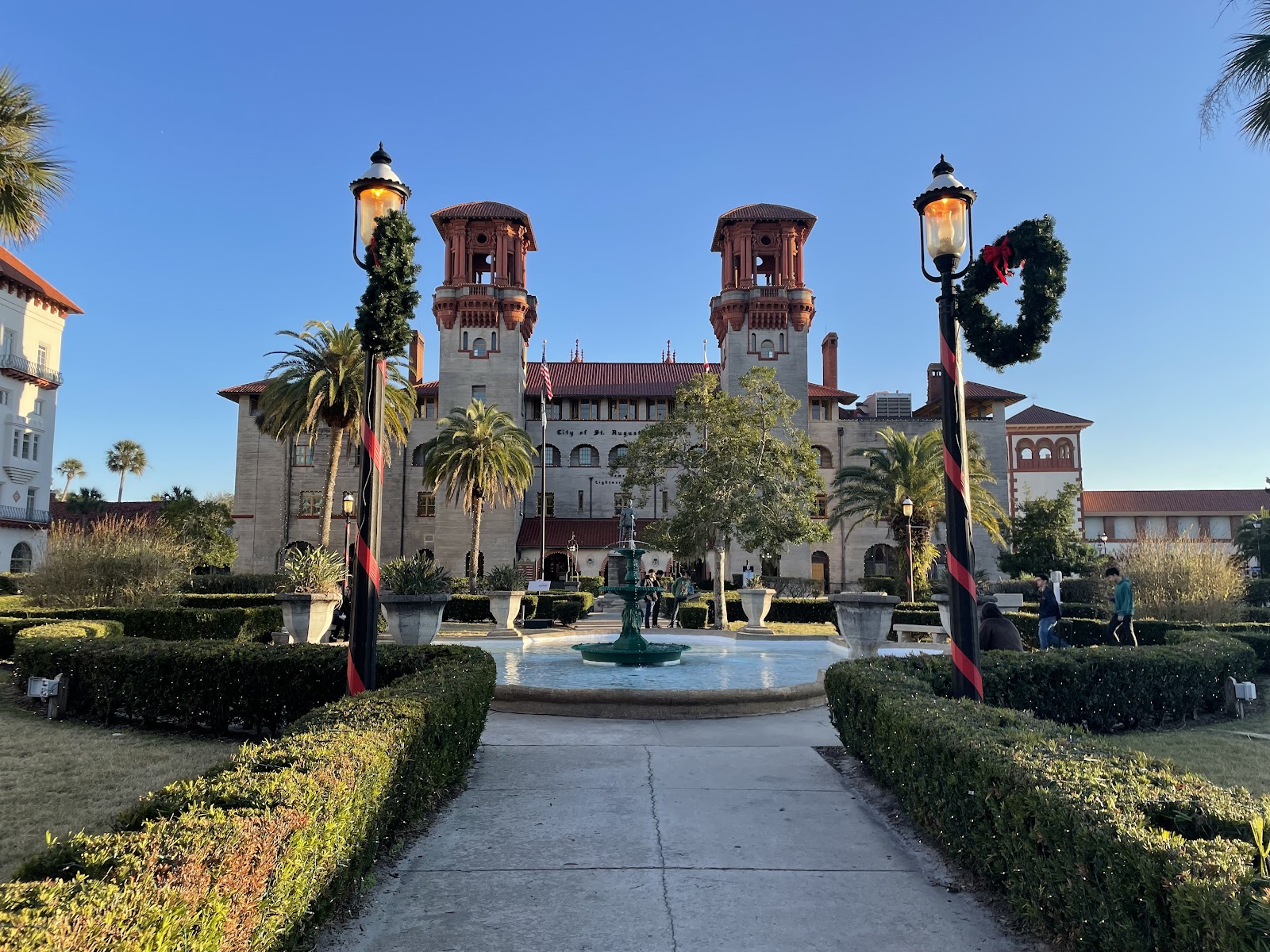
The Casa Monica Hotel, St. Augustine: One Frame, and How It Is Made
An 1888 Spanish Renaissance Revival hotel in St. Augustine — and the only one of Flagler's three still working as a hotel.
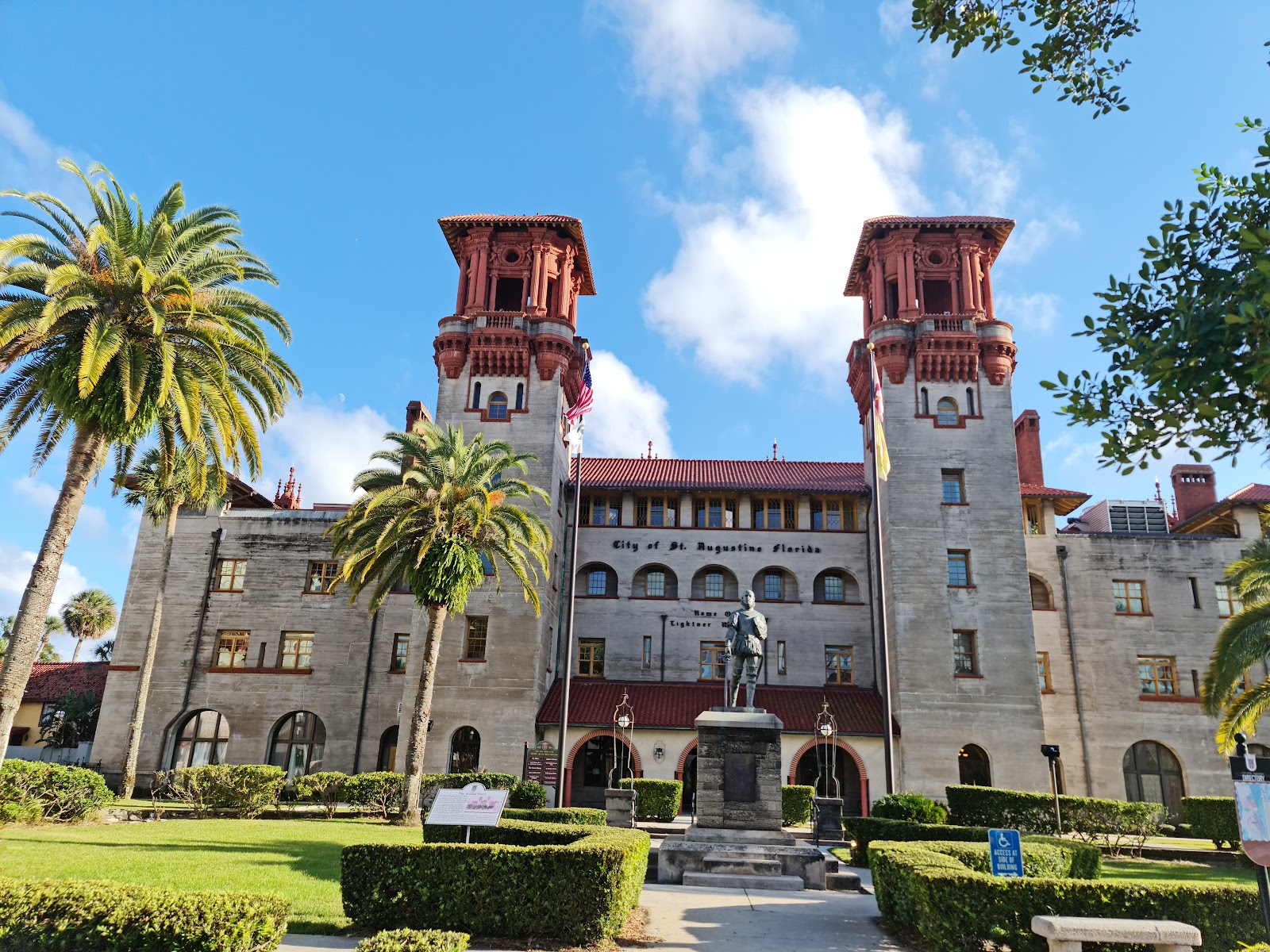
The Lightner Museum, St. Augustine: The Problem, and Four Ways Out of It
A museum in a former 1888 hotel in St. Augustine — including the largest indoor pool of its era, now a gallery.
The Ponce de Leon Hotel, St. Augustine: A Walk Through the Building
An 1888 Spanish Renaissance Revival hotel in St. Augustine — poured concrete, Tiffany glass, and a courtyard plan.