A lift-served mountain is organised vertically, and reading the elevation bands is the whole planning job at a venue of this kind. The base is a village at the bottom of a valley: buildings, plazas, lift terminals and accommodation, with the least sky of anywhere on the property and the earliest sunset, because a slope immediately to the west takes the light long before the horizon does.
On the valley floor the effective sunset can be thirty to fifty minutes before the printed time, which is the single most consequential scheduling fact at any mountain-base venue — go and look at the western skyline from the position you intend to use, judge the ridge height, and bring the whole evening forward, including the ceremony, because that is a planning decision rather than an adjustment.
The compensation is that the peaks stay lit after the village is in shade: for a quarter of an hour the mountain above glows warm while the streets are cool and blue, which gives a couple in soft even light with a lit slope behind them. Compress it hard, because at twenty-four millimetres the lit mountain is a band at the top of the frame and at a hundred and thirty-five it fills the background. The mid-mountain, ten minutes up a lift, is conifer with aspen groves through it and cut ski runs between.
The aspens are the reason to go: they grow in clonal stands so whole groves turn together, and a stand of white trunks with gold leaves — late September into the first week of October at these elevations — is one of the best photographic environments in the American West. Outside that fortnight the trunks alone are a superb graphic background at any season, including bare against snow.
The cut runs are the other asset and they are worth understanding as landscape: a ski trail is a strip of open ground driven through forest, so it is a corridor with dark walls either side and open sky above — a natural composition — and in summer it is a wildflower meadow, because it is open ground at altitude that is mown rather than grazed. Conifer is the darker constant: tall, narrow, widely spaced, and poor shade because the crowns are high, so useful as verticals rather than as canopy.
The upper mountain at or near the treeline is open ground with the only genuine long view on the property, and the weather up there is not the weather at the base — colder by several degrees, considerably windier, and sometimes inside cloud when the village is clear. That makes a summit session a five-minute operation with positions chosen in advance and coats carried up, because a couple comfortable at the base will be cold at the top in a wind.
Two facts govern everything else. The first is altitude, and at two thousand metres and above it is genuinely felt: guests arriving from sea level will be breathless on slopes, dehydrate faster in very dry air, and find alcohol markedly stronger than expected, while sunburn happens far faster with snow or pale ground reflecting ultraviolet upward. For the camera, thin dry air means shadows hard and four or five stops below the lit subject with almost no fill available — whatever you want, you bring — along with a deeply saturated sky and extraordinary clarity over distance, so a long lens at stacked ridge lines is genuinely usable.
The second is that a ski resort has an operating calendar, running a winter season and a summer season with genuine gaps between them during which lifts do not turn and much is closed. So the first question at any venue of this kind is not aesthetic: it is which lifts are running on the date and what is open, because the upper mountain may simply be unreachable in October or May. Ask also whether a wedding party may ride, when, and how many at a time, because a lift has a capacity and a schedule and a wedding is a guest of the operation.
Utah's other distinctive feature is its snow, and it is worth a note because it is unusual. Cold dry air and a long fetch over a large inland lake produce exceptionally low-density snow — deep, dry, light powder rather than the wet snow of a maritime range. Photographically that has two effects: low-density snow holds on branches in a way wet snow does not, so a conifer after a storm is genuinely laden and sculptural; and it blows, which means ground blizzards and spindrift off ridges, and a lens pointed into it collects snow on the front element rather than shedding water.
Snow is also the best natural fill light there is, reflecting a very high proportion of what falls on it so the ground throws light upward into faces and fills eye sockets with no card at all — the exact opposite of the desert. Two technical notes: a mostly white scene reads as mid-grey and comes back one to two stops under, so add compensation and check a histogram; and snow in shade is genuinely blue because it reflects a blue sky, which at altitude is a deep one, so the effect is strong and should be left rather than neutralised.
The towns below these mountains are often the best exterior asset and they are worth the descent. A nineteenth-century mining settlement has a main street of period commercial buildings in timber and brick, painted, with the shopfronts, cornices and false fronts of that region and period — a completely different material world from a ski village, and warm where mountain rock and snow read cold. Mining towns are also built on slopes, which gives gradient: a subject standing uphill of the camera separates from the background by geometry alone, and the street itself climbs, giving a frame a built-in leading line.
Mining remains on the hillsides are a third register — weathered timber and rusted iron at close range in raking light, with a mountain behind — with two firm cautions: mine structures and workings are genuinely dangerous, with unstable timber, open shafts and contaminated ground, and a great many are on private land or closed for exactly those reasons, so ask what is legally and safely accessible, take the answer literally, and never take a wedding party onto or into anything.
Season by season, late June into early September is a genuinely good summer at altitude: warm dry days, cold nights, wildflowers on the open slopes and cut runs, lift access, and long evenings, with July afternoons pleasant rather than hot.
Two summer hazards apply — afternoon thunderstorms build over the range most days through July and August, carrying real lightning risk above the treeline and stopping lifts, so know how long the ride down takes; and wildfire smoke has become a recurring August and September feature across the interior West, capable of filling a valley for days and removing the long views entirely, which at a venue whose upper-mountain asset is a view is the specific cost.
Late September into the first week of October is the best-looking window of the year and it is short: aspen gold, the clearest air, cold still mornings, thin crowds, and sunset around seven putting the end of the day at a civil hour, with early snow a gift rather than a problem. Confirm the lifts are turning, because that fortnight may fall in the operating gap. Winter is the mountain's main season, with excellent light and severe constraints: sunset before five, temperatures well below freezing, altitude on top, and a party in formal clothing limited to minutes outdoors.
And one logistical warning for January in particular: some Utah mountain towns host major international events in that month which fill accommodation entirely, with substantial effects on traffic and prices, so check the dates early. October into November and April into June are the closed shoulders — lifts down, restaurants shut, the mountain a mixture of mud and old snow — and spring at altitude is later than people expect, with snow lingering into June on north-facing ground.
Civil twilight at this latitude runs about twenty-nine minutes in midsummer, and at altitude the afterglow is longer and more strongly coloured than that suggests, so budget eighteen to twenty usable minutes — remembering that in a valley a good part of it arrives after the direct sun has already gone behind the ridge.
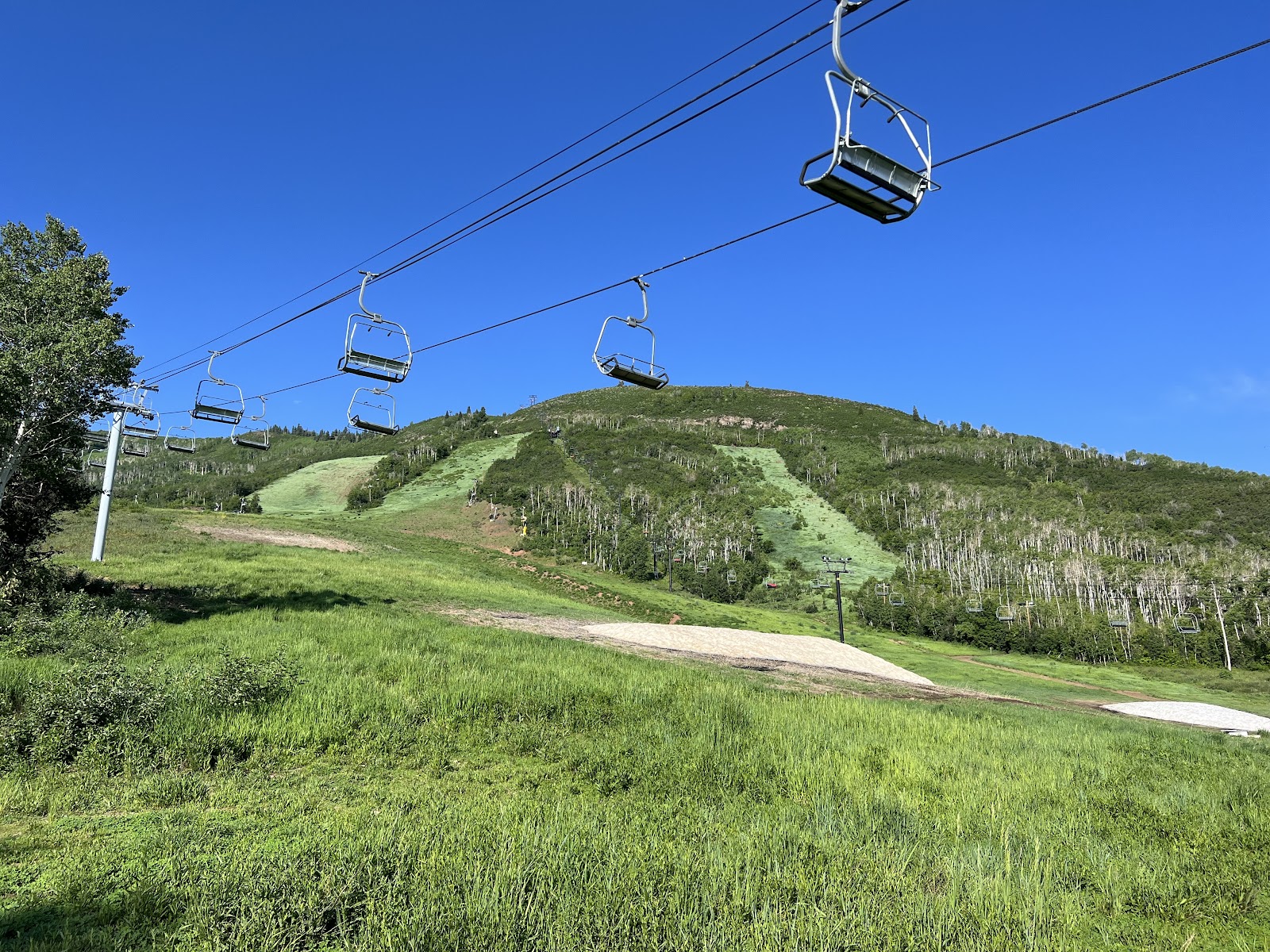
The Park City Mountain Resort, Park City: The Venue’s Own Logic
A ski resort above a nineteenth-century silver-mining town — a mountain organised by elevation, with lifts to move between bands.