Northern Virginia sits in the Washington metropolitan area on the tidal Potomac, and its photographic value is concentrated in eighteenth-century port architecture rather than in the venues that most weddings actually book. That distinction is worth making explicitly, because a modern hotel in this region is very often a short drive from a historic district rather than in it — and the plan therefore has two halves in two places, with a travel cost attached that has to be budgeted rather than discovered.
Establish the actual distance and travel time in writing, and put the round trip on the timeline as a real number: a wedding party of a dozen in formal clothing making a vehicle transfer is roughly a forty-minute commitment for a twenty-minute session. Alexandria's Old Town is the district in question and it is one of the better historic quarters in the country to photograph in. It is a dense grid of Federal-era brick townhouses — two and three storeys, flat-fronted, with fanlights, shutters, iron railings and steps — and the consistency is what makes it work: street after street of the same period and the same material.
Brick is the friendliest surface a photographer can be given, being warm, matte, finely textured, holding its colour in shade rather than going blue the way stone does, and taking low raking light so that every joint registers. Light it from the side, always, because frontal light flattens the bond pattern entirely. The narrow streets are also the midday answer: a canyon of two- and three-storey buildings with a high sun overhead puts a band of open shade along one side, and that band is good directional portrait light at the worst hour of the day.
Parts of the district retain cobbled or stone-set paving, which is superb wet in raking light and grey lumps dry at midday, and which gives a frame a textured foreground that a modern pavement cannot. And the commercial street descending to the river has a built-in leading line with a destination at the bottom of it.
The waterfront is the fourth element and it comes with two regional facts. The Potomac here is a tidal river, broad and slow, with a working and recreational frontage — piers, boats, a promenade — and a tidal range approaching a metre, which changes the relationship between a pier and the water and exposes or covers a narrow foreshore. It is not the governing factor it would be on the open coast, but it is worth a glance at a table if a specific low position matters.
More significantly, this region's building height restrictions mean nothing tall stands anywhere near, so the sky is most of the frame if you want it — which makes the waterfront the place for a dusk composition with real colour in it, rather than a strip of sky between towers. And then there are the aircraft. A major airport sits a short distance up the Potomac and its principal approach follows the river, which means aircraft pass low and frequently over this part of Virginia.
That is a genuine consideration for any outdoor ceremony, because an unamplified officiant will be interrupted repeatedly and it is the venue's to manage rather than the photographer's. It is also occasionally a gift: a large aircraft passing low over the river behind a couple is a frame available here and almost nowhere else, and at dusk with landing lights against a coloured sky it is genuinely striking. They come every few minutes, so if it is going to be in the picture, make it a decision rather than an accident. One further regional caution concerns the spring.
The Washington area's blossom season is a major event that fills accommodation across the metropolitan area, congests roads and packs the riverside, which turns travel time between a hotel and a historic district into a variable rather than a fixed number. Check the expected peak, which shifts each year, and either avoid it or book very early. Virginia's northern tier sits at about thirty-nine degrees north in a humid mid-Atlantic climate, which gives civil twilight of roughly twenty-nine minutes in midsummer with a usable balance point of twelve to fifteen.
The midsummer noon sun reaches about seventy-four and a half degrees, high enough to be difficult on open ground from about eleven to three, and the midwinter noon sun sits near twenty-eight degrees and rakes brick from late morning to mid-afternoon — the best exterior light of the year, lasting hours rather than minutes.
Humidity is the defining summer condition: July dewpoints around seventy-two fill shadows by roughly two stops against a dry climate, softening shadow edges and keeping detail in eye sockets so that open shade at midday is genuinely workable, at the cost of a pale washed sky, haze across the river, and a lens that fogs within seconds moving from a heavily air-conditioned building into that air — recurring on any day that makes a round trip.
Late September into early November is the strongest window: the humidity drops out so brick reads crisply, temperatures suit walking, sunset lands around six so the balance point falls at a civil hour, and the region's colour comes through the second half of October in street trees and along the riverside. Late March into May is the other good window, mild and lengthening, with the blossom caveat attached.
Summer works with the middle of the day given to interiors, and the half hour after a thunderstorm clears is the best exterior light of the year: washed air so the river opens up, wet brick and wet cobbles several tones darker and far more saturated, reflections doubling everything, and a low sun under a broken ceiling into a narrow street. Wet Old Town is a considerably better place than dry Old Town.
Two autumn hazards are worth naming: the remnants of tropical systems reach this region in September and October with sustained wind and rain rather than a passing shower, and the low-lying Alexandria waterfront is known for tidal flooding in those conditions — both travel and access problems more than photographic ones, and both reasons the indoor capacity matters. Winter is short and mild by continental standards, with occasional substantial snow that snarls the region badly when it comes. Sunset before five puts the balance point during cocktails and therefore on the timeline by name.
In exchange: the clearest air of the year, a low sun raking brick through the whole middle of the day, bare street trees letting facades read cleanly, an empty historic district, and modern interiors entirely unaffected by the season. Snow on eighteenth-century brick and cobbles is as good as this city looks, and it happens rarely enough to be worth dropping everything for.
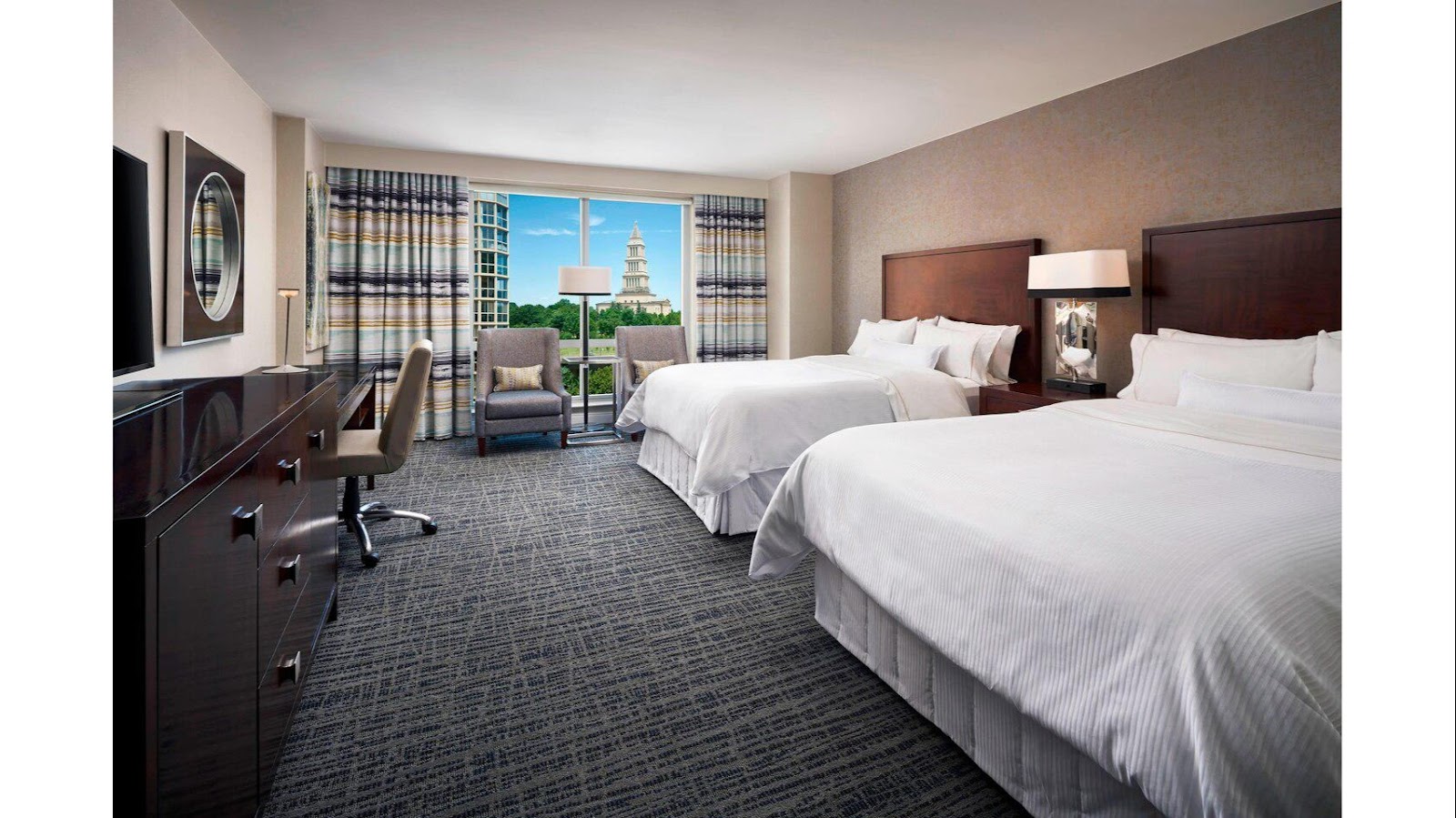
The Westin Alexandria, Alexandria: Suits and Does Not Suit
A modern full-service hotel in Alexandria — not in Old Town, which is the first thing to establish.