South Dakota's eastern city is built on a rock that is worth knowing about, because it is unlike any other stone in this library. Sioux quartzite is a metamorphosed sandstone, extremely hard, and it is genuinely pink — a warm rose-to-purple rather than a grey with a hint of colour. The Big Sioux River drops through a gorge of it in a series of stepped ledges, the gorge walls are made of it, and the city's older buildings are faced in it, because it was quarried locally and there was little else.
For a photographer that is a gift, because almost every rock in this collection is cool: grey limestone, grey granite, dark basalt, all of which go blue in shade and need warming afterwards. Pink quartzite does the opposite — it holds warmth in shade, saturates strongly in low light, and sits against green-brown river water and a blue sky as a three-colour composition with nothing muddy in it. It also has a behaviour worth exploiting: being hard, it fractures into angular blocks with flat faces rather than weathering into rounded forms, so a ledge is a set of planes and edges.
Light it from the side and those edges throw hard shadows and the rock reads as architecture rather than as geology; light it frontally and it is a pink surface with no structure. Wet quartzite is better still, going several tones darker and dramatically more saturated, which means the spray zone near a falls is where the stone looks its best — with two cautions attached, because wet quartzite is hard and smooth-faced and genuinely slippery, and people are injured at falls like this regularly. Stay on designated paths, keep a wedding party off the rock entirely, and do not step down toward the water for a better angle.
The water itself gives a choice that should be made rather than defaulted: a fast shutter freezes a drop into distinct masses of white droplets, reading as force and texture, while a slow one of a quarter-second up to a couple of seconds on a tripod renders it as a smooth veil and makes the angular rock look harder by contrast. For the long version in daylight a neutral density filter is essential, because without one it is not achievable at any usable aperture.
And the flow varies enormously through the year, which changes the subject completely: spring melt and early-summer rain put a great deal of loud white water through the gorge, while late summer and autumn can reduce it to channels between exposed ledges, showing far more of the rock. In winter the falls partly freeze, building ice on the ledges while water still moves through the middle — white ice on pink rock with dark moving water, which is the version almost nobody photographs.
Nineteenth-century industrial remains at the falls, built of the same stone, are worth knowing about: a ruined quartzite structure beside moving water is a strong subject, and the same material squared and coursed instead of fractured makes a deliberate contrast between worked and natural stone. Photograph it close and raking for the masonry, and wide for the relationship between building and river.
Two practical matters apply to any falls session — a city's principal landmark is busy on any fine day and at weekends especially, and a permit is very likely required for a wedding group or for commercial photography, which is not waived by a wedding, so ask the city and ask early. Downtown's quartzite-faced buildings extend the material into the streetscape, which means exterior frames in town sit naturally beside frames at the gorge. The climate is the most extreme continental one in this collection and it needs planning rather than assuming.
Sioux Falls sits at about forty-three and a half degrees north in the middle of the continent, a long way from any moderating ocean, so the annual range is enormous: summer afternoons into the low thirties and winter nights well below minus twenty. The latitude gives a useful number, though — civil twilight runs roughly thirty-two minutes in midsummer with a usable balance point of fourteen to seventeen, among the longer dusks in this library and generous enough for two positions at the gorge if both are decided in advance.
The midsummer noon sun reaches about seventy degrees, low enough that even a clear midday has direction in it, and the midwinter noon sun sits near twenty-three degrees and rakes stone from late morning to mid-afternoon, which matters here more than usual because a low sun on angular pink quartzite is the best light the city offers and in winter it lasts for hours rather than minutes.
Wind is the constant: the Plains are open and the wind is sustained rather than gusty, blowing for hours or days, which makes a veil at an outdoor ceremony a genuine problem, a lightstand a hazard and an unamplified officiant inaudible past the third row — and at a falls it carries spray considerably further than expected. Find the lee of any building or rock mass, sandbag everything, and ask the venue what the wind does.
Season by season, late May into June is the first good window, with everything green, the river running high and impressive, and long evenings with sunset after nine by late June — and it is also the wettest and most storm-prone part of the year, because this region sits in an active corridor for severe convection with supercells that arrive fast and carry damaging wind, large hail and a tornado risk. Any outdoor element in that window needs a covered alternative that genuinely exists, is reachable in minutes and has a known capacity.
September into mid-October is the strongest window and the one to recommend: the convection season winds down, the humidity drops out so the air is exceptionally clear, temperatures are comfortable, the light is low through the whole afternoon, and the region's colour comes through late September and early October carried by cottonwood, ash and maple along the river — which against pink rock is a genuinely good combination — with sunset around seven putting the balance point at a civil hour.
July and August are hot and humid by Plains standards, with dewpoints that surprise people this far north because the surrounding agricultural landscape generates a great deal of moisture, and afternoon convection is frequent; the falls are usually at their lowest then, which shows the rock and reduces the water. Winter is long, severe and genuinely photogenic, and it is the season nobody books: months below freezing, substantial snow, and a low sun raking everything through a short day, with ice building on pink ledges at the falls.
Snow is the best natural fill light there is, reflecting a very high proportion of what falls on it so the ground throws light upward into faces — and it fools a meter, reading as mid-grey and coming back one to two stops under, so add compensation and check a histogram, while snow in shade is genuinely blue because it reflects a blue sky and should be left rather than neutralised.
Against winter: at minus twenty with wind a party in wedding clothes has minutes rather than an hour, with wind chill as the operative number, so a falls session in January is three frames and a walk back — and blizzards close roads and ground flights across this region, which is a genuine travel problem meaning a winter date deserves a contingency that assumes some people cannot get here at all. April and early May are the hardest months to plan, with late heavy snow normal, break-up leaving everything brown and wet, and the river high and muddy.
And the half hour after a storm clears on the Plains is exceptional, with something specific to open country in it: the air washes to clarity, wet quartzite goes dark and saturated, standing water reflects, and a low sun comes under a departing storm base — which on flat land means a lit foreground against a black sky, often with a rainbow, because the storm is moving away and the sun is behind you.
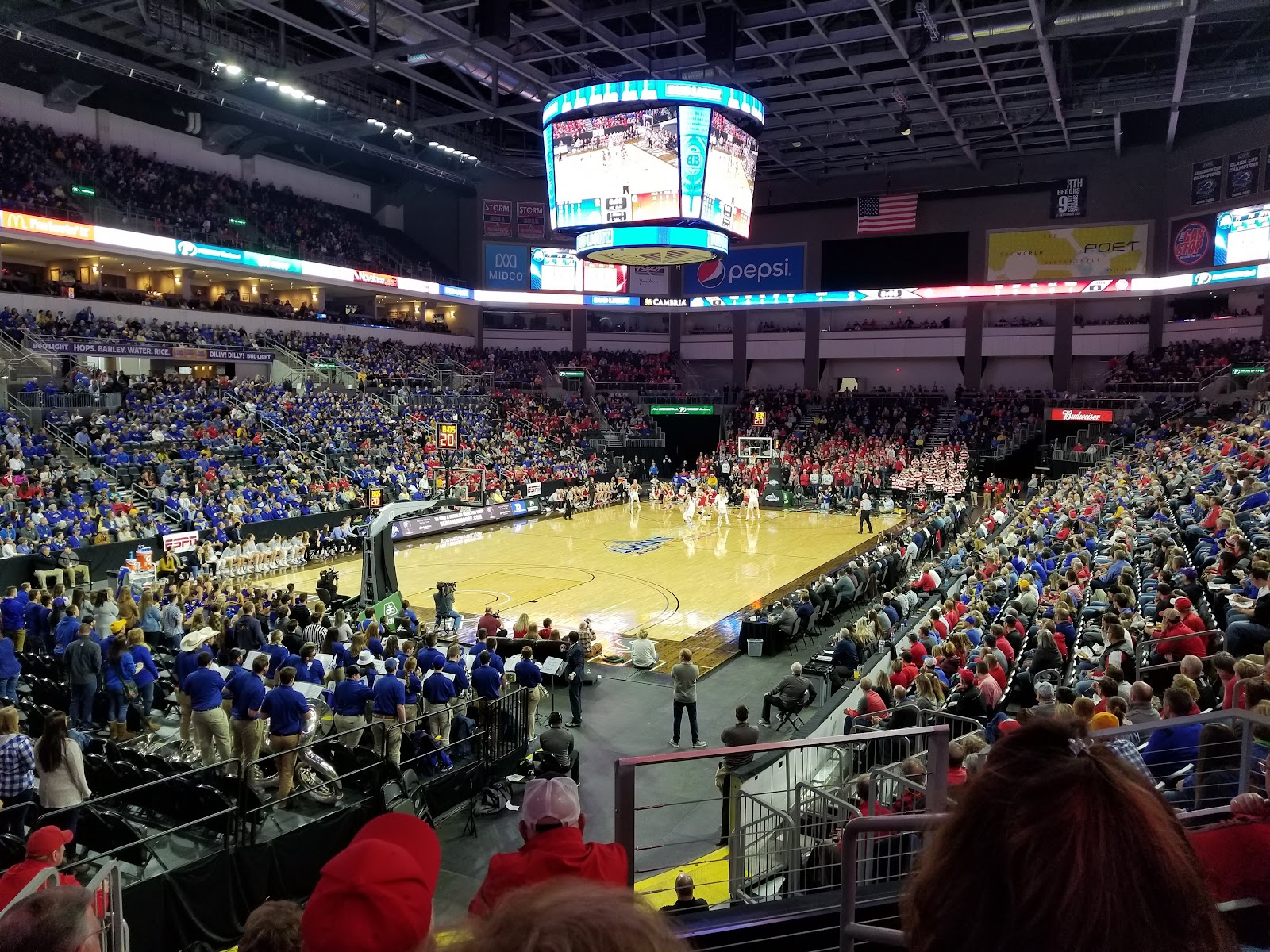
The Sioux Falls Convention Center, Sioux Falls: Field Notes, Problem and Solution
A convention centre in a city built on pink quartzite, with the river falling over it a short distance away.