Annapolis hands a photographer two gifts and one correction, and the correction is the one that improves a set fastest. The correction first: the water is not the subject. Chesapeake Bay is the largest estuary in the United States and it is shallow — the average depth is only a few metres — and brackish, carrying a great deal of suspended sediment, so the water reads green-brown rather than blue. Shallow, broad water also chops up quickly in any breeze, and a reliable sea breeze builds through the middle of most days. Nobody should be promised turquoise and nobody should be promised a mirror.
What the harbour does give, in quantity, is masts. Annapolis is a sailing town and the harbour carries a forest of them, and on a flat waterfront masts are the single most valuable element available: strong repeated verticals, and the only thing that breaks a horizontal skyline. A frame with masts in it is unmistakably this place; a frame of open brown water could be anywhere. So the working rule on the water here is to compose upward and across rather than outward — rigging, masts, hulls, dock structure, dock lines and the brick rising behind the harbour are all better subjects than the surface of the Bay.
Two practical harbour notes follow. The tidal range here is small, which is a genuine convenience: unlike a harbour with a metre and a half of movement, the relationship between docks and hulls stays roughly constant through a day, so a position scouted at noon still works at eight. And still water is a morning phenomenon. Before the sea breeze builds, the harbour is a true mirror and a forest of masts doubled about the waterline with brick behind it is the strongest photograph the town produces — available for about two hours after first light, and empty of other people in a way that eleven o'clock is not.
If a couple is staying in the centre and will be dressed early, twenty minutes before breakfast is worth more than an hour at noon, and nobody thinks of it.
The first gift is the street plan. Annapolis was laid out in the sixteen-nineties on a baroque radial scheme — two circles with streets radiating outward — and the State House sits on the higher of them. The consequence is that streets across the historic core have a terminated vista onto its dome, framed between eighteenth-century brick terraces. That is a complete composition handed over by a town planner three hundred years ago, available from a public street with no permission required from anybody.
Work long: at twenty-four millimetres the dome at the end of a street is a small distant bump and the photograph is of some brick houses, while at a hundred and thirty-five it fills the gap between the buildings and dominates. Compression is the whole technique. Find two or three of these positions on a scout and note which way each faces, because an eastward street gives a front-lit dome in the evening with the sun behind the camera, and a westward one gives a silhouette against a bright sky. Both work; they are different pictures. The second gift is the brick.
This town has one of the highest concentrations of surviving colonial buildings in the country, mostly laid in Flemish bond, and brick is the friendliest material a photographer can be given: warm, matte, finely textured, holding its colour in shade rather than going blue the way limestone does, and taking low raking light extremely well. Light it from the side rather than the front, because frontal light flattens the bond pattern while raking light makes every joint and irregularity register — and eighteenth-century brickwork is full of irregularity. On an overcast day brick still reads warm when everything else has gone grey.
The narrow streets are also the midday solution, which matters because the alternative is worse than people expect. A dock is a hard reflective surface with no shade, and a near-overhead summer sun on it gives flat top light with heat radiating back up: between about eleven and two there is nowhere pleasant to stand on the water's edge. Four minutes uphill, a canyon of eighteenth-century buildings with the sun overhead puts a band of open shade along one side, and that band is good directional portrait light at the worst hour of the day.
One local question deserves a straight answer, because couples routinely assume otherwise: the Naval Academy is adjacent to the historic district and it is an active military installation. Access is controlled, visitors require photo identification through a visitor centre, and what may be photographed, by whom and for what purpose is governed by the Academy's own rules rather than by any venue's goodwill. Chapel weddings are generally restricted to those with a defined connection to the Academy, and commercial photography on the grounds is a separate permission again. If it matters to a couple, pursue it directly with the Academy months ahead and plan as though the answer is no.
The same principle applies to the State House itself, which is a working seat of government and the oldest state capitol still in continuous legislative use: access there is granted by permit and governed by the legislature's schedule and by security, and what is realistic may be exterior and public-space photography rather than a ceremony in a historic chamber. Three numbers set the schedule at every venue here.
At about thirty-nine degrees north, the midsummer noon sun reaches near seventy-four and a half degrees, the midwinter noon sun near twenty-seven and a half, and civil twilight runs about twenty-nine minutes in midsummer with a genuinely usable balance point of twelve to fifteen. That is one frame made properly, or two if both positions are decided in advance and you walk rather than discuss.
Dusk in this town is unusually rich for a specific reason: at the harbour you get three tiers of light rather than two — the sky still holding a gradient, the town's lit brick above, and the boats' own riding and cabin lights at water level. A foreground of practical lights between the camera and everything else is exactly what a night frame wants and almost never has. Light the couple, because at any exposure holding all three tiers a face is dark, and get low, because the moving surface scatters those lights into shimmering columns that run the full depth of the frame from near water level.
Season by season, late September into early November is the strongest window: the summer humidity drops out so the Bay and the far shore resolve, temperatures are comfortable in formal clothing on an exposed dock, sunset lands around six so the balance point falls at a civil hour, and the street trees in the historic core turn through the second half of October. One caution attaches to it — autumn is the season of major sailing events, which fills the harbour with masts and the streets with visitors simultaneously.
Photographically that is the best version of this town; logistically it means crowds, closures and accommodation pressure, so check the calendar and plan the dock work for early morning if an event coincides. Late April and May are the other good window, mild and lengthening, with spring running slightly later than inland because a large body of shallow water is slow to warm.
July dewpoints around seventy-two fill shadows by roughly two stops against a dry climate, which keeps detail in eye sockets and makes midday open shade workable, at the cost of a pale washed sky, haze softening the broad Bay views, and a lens that fogs within seconds coming out of an air-conditioned interior into July air. Thunderstorms move through quickly and the half hour afterwards is the best light of the year — washed air so the Bay opens up, wet brick and wet decking several tones darker and far more saturated than dry, cobbles reflecting the sky, and a low sun under a broken ceiling.
Two coastal hazards need naming: remnants of tropical systems reach this part of the mid-Atlantic in September and October with sustained wind and rain rather than a passing shower, and the low-lying dock area is known for tidal flooding, while nor'easters do the same from the other direction in the colder months. Both are reasons to establish any venue's indoor capacity as a number rather than an assurance.
Winter is short and it suits this town better than couples expect: the clearest air of the year, a low sun raking brick and masts from the south through the whole middle of the day, far fewer people, and — because boats largely stay in the water here — masts still in the harbour. Snow on eighteenth-century brick with rigging behind it is as good as Annapolis gets.
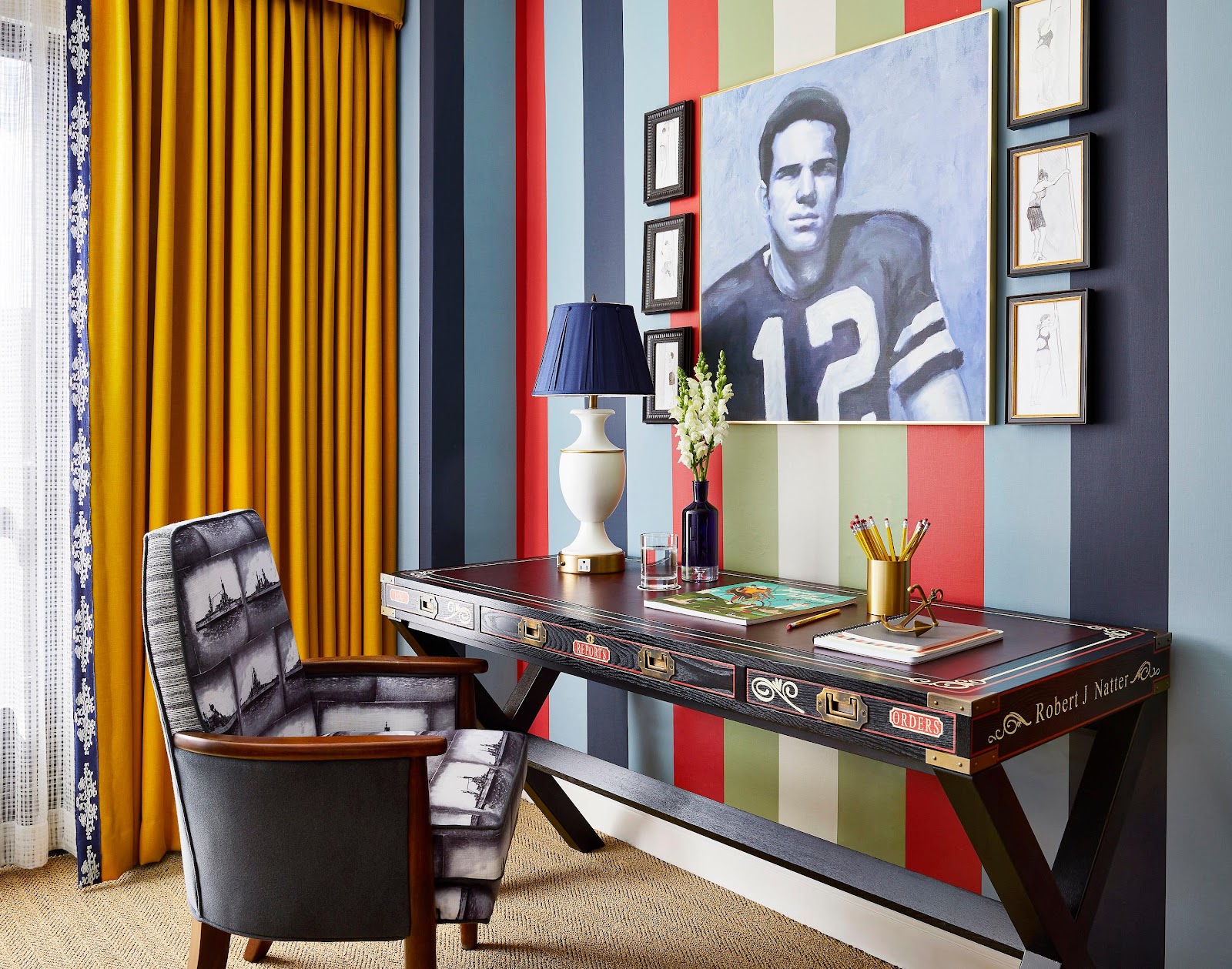
The Graduate Annapolis, Annapolis: Suits and Does Not Suit
A themed hotel in downtown Annapolis — walkable to everything, and on the water to nothing.
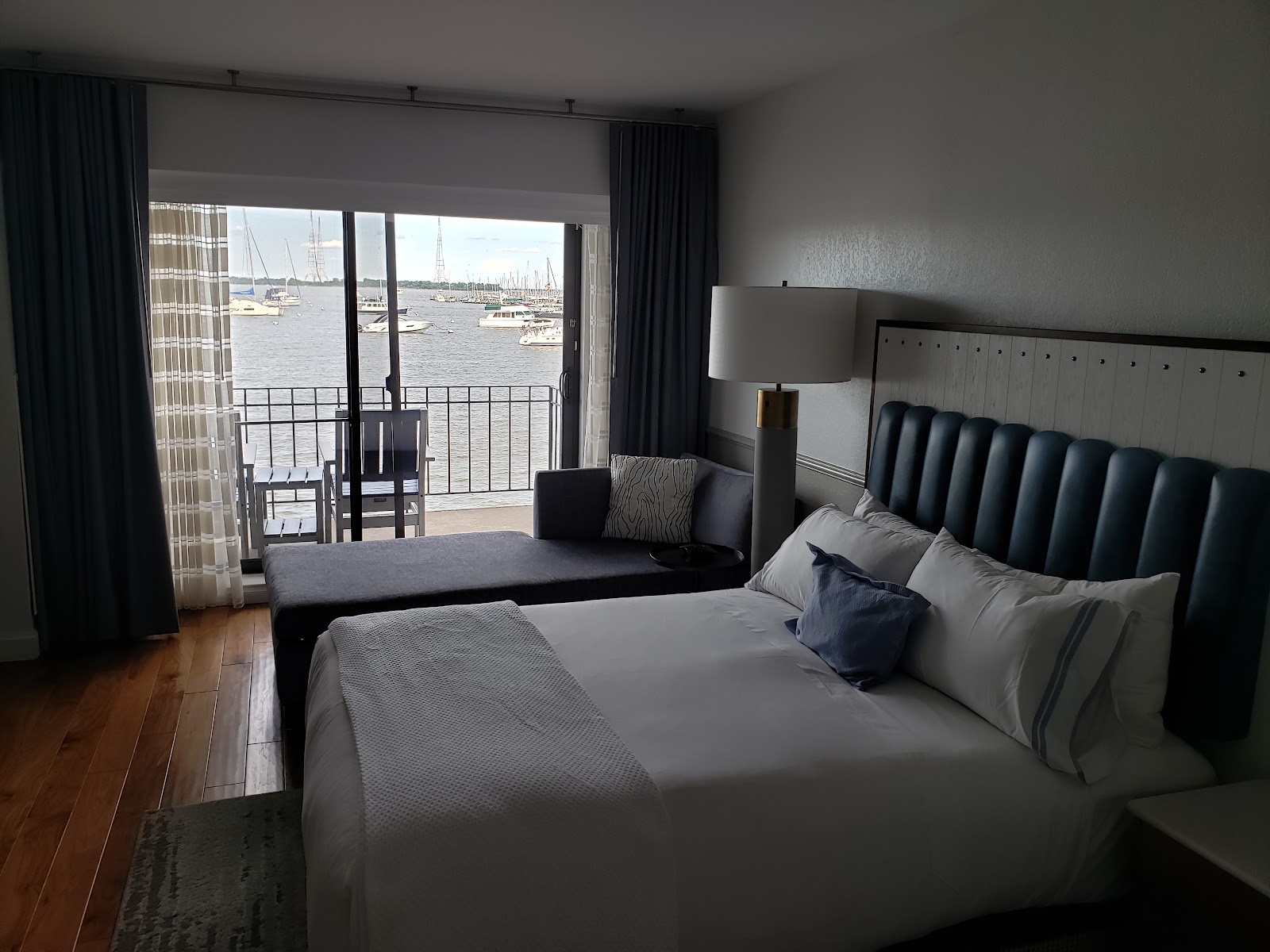
The Annapolis Waterfront Hotel, Annapolis: The Light Through the Day
A hotel on the water at the City Dock — where the masts do more work than the water does.
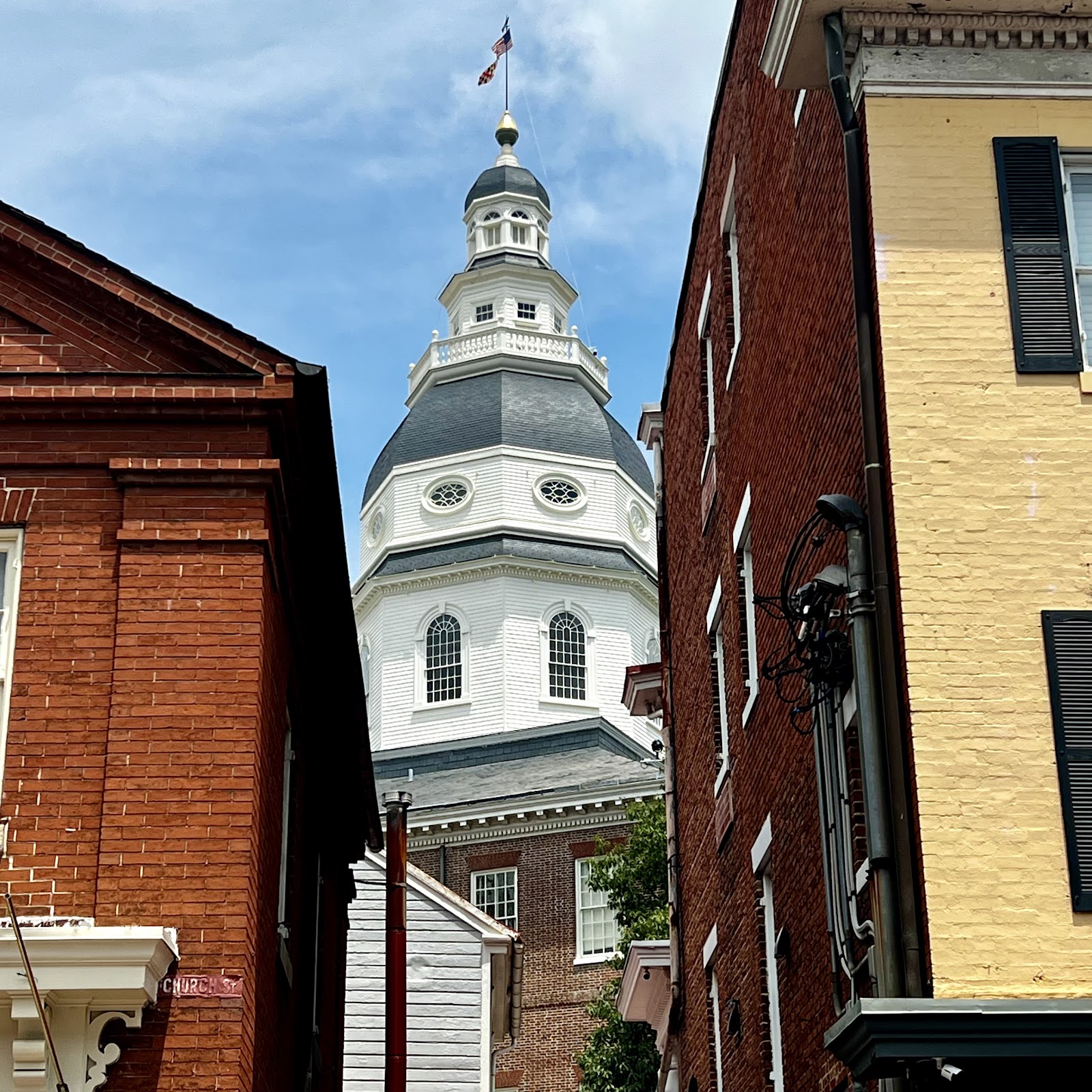
The Maryland State House, Annapolis: A Walk Through the Building
The oldest state capitol still in legislative use — a working seat of government, which sets the terms.