 Overhills Mansion: Who This Venue Suits, and Who It Doesn’t
The Annapolis Waterfront Hotel, Annapolis: The Light Through the Day
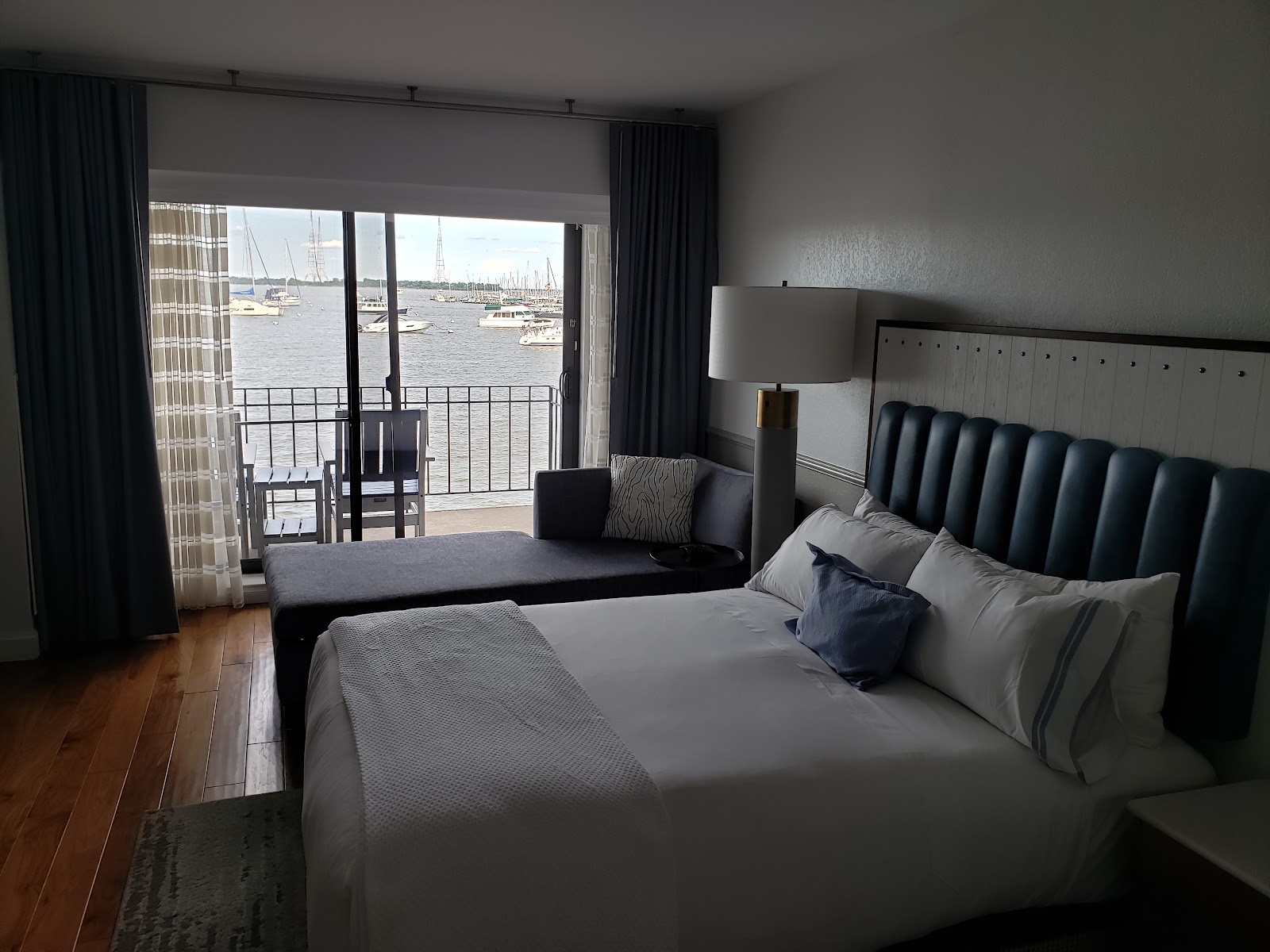
The water is green-brown and choppy. The masts are the picture.
Two facts about this venue need stating before the hours, because together they decide what a photographer actually points a camera at.
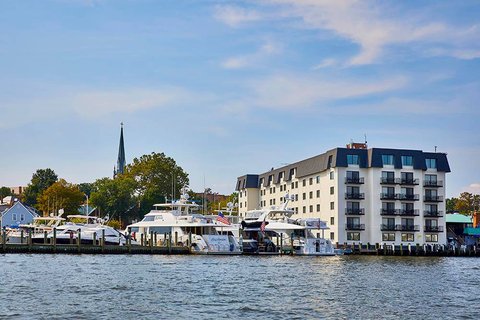
The Annapolis Waterfront Hotel sits on the water at the City Dock, at the bottom of the historic town, where the Severn River meets Chesapeake Bay. The water is immediately outside and the harbour is full of boats.
The first fact is that the water itself is not the subject. Chesapeake Bay is the largest estuary in the country and it is shallow — the average depth is only a few metres — and brackish, with a great deal of suspended sediment. The result is a green-brown water rather than a blue one, and shallow broad water chops up quickly in any breeze, so it is rarely still. Nobody should be promised turquoise, and nobody should be promised a mirror.
The second fact is that the masts are. Annapolis is a sailing town and the harbour carries a forest of masts, and on a flat waterfront masts are the single most valuable photographic element available: they are strong repeated verticals, and they are the only thing that breaks a horizontal skyline. A frame with masts in it is unmistakably this place; a frame of open brown water could be anywhere.
So the working rule at this venue is to compose upward and across rather than outward. Rigging, masts, hulls, the dock’s own structure and the eighteenth-century brick rising behind the harbour are all better subjects than the surface of the Bay.
With that established, the light here runs a legible course through the day, and it is governed by three things: the orientation of the building and the harbour, a small tidal range, and a reliable afternoon breeze.
The small tidal range is worth naming because it is a genuine convenience. Unlike New York Harbour, where a metre and a half of tide changes the relationship between docks and hulls through the day, Annapolis has a modest range — which means a position scouted at noon still works at eight, and a hull that sits well in frame in the morning sits the same way in the evening.
The afternoon breeze is the less convenient one. Broad shallow water heats and a sea breeze builds through the middle of the day, which ruffles the surface and sets the boats moving. That matters for reflections, for a veil on an open dock, and for a microphone.
Three numbers for the schedule. At about thirty-nine degrees north, the midsummer noon sun reaches near seventy-four and a half degrees, the midwinter noon sun near twenty-seven and a half, and civil twilight runs about twenty-nine minutes in midsummer with a usable balance point of twelve to fifteen.
Hour by hour, it goes as follows.
The Annapolis Waterfront Hotel at a glance
| Where | A hotel on the water at Annapolis City Dock, Maryland |
| The correction | The Bay is green-brown and choppy; the masts are the subject, not the water |
| The convenience | A small tidal range, so a scouted position holds all day |
| The constraint | A sea breeze builds through the middle of the day and ruffles everything |
| Ask first | Which way your rooms face, dock access, and the indoor fallback capacity |
Morning and the middle of the day
The early morning is the venue at its best and almost nobody uses it.
Before the sea breeze builds, the harbour is still. Still water in a working harbour is a genuine mirror, and a forest of masts reflected in it is the strongest photograph this location produces — a doubled field of verticals, symmetrical about the waterline, with the town’s brick behind. That frame exists for perhaps two hours after first light and then it is gone until the breeze drops in the evening, if it does.
It is also empty. A harbour dock at seven is quiet in a way it is not at eleven, which means no strangers in frame and no competition for the good positions.
So if a couple is staying on site and will be dressed early, a twenty-minute session before breakfast is worth more than an hour at noon. Say so, because nobody thinks of it.
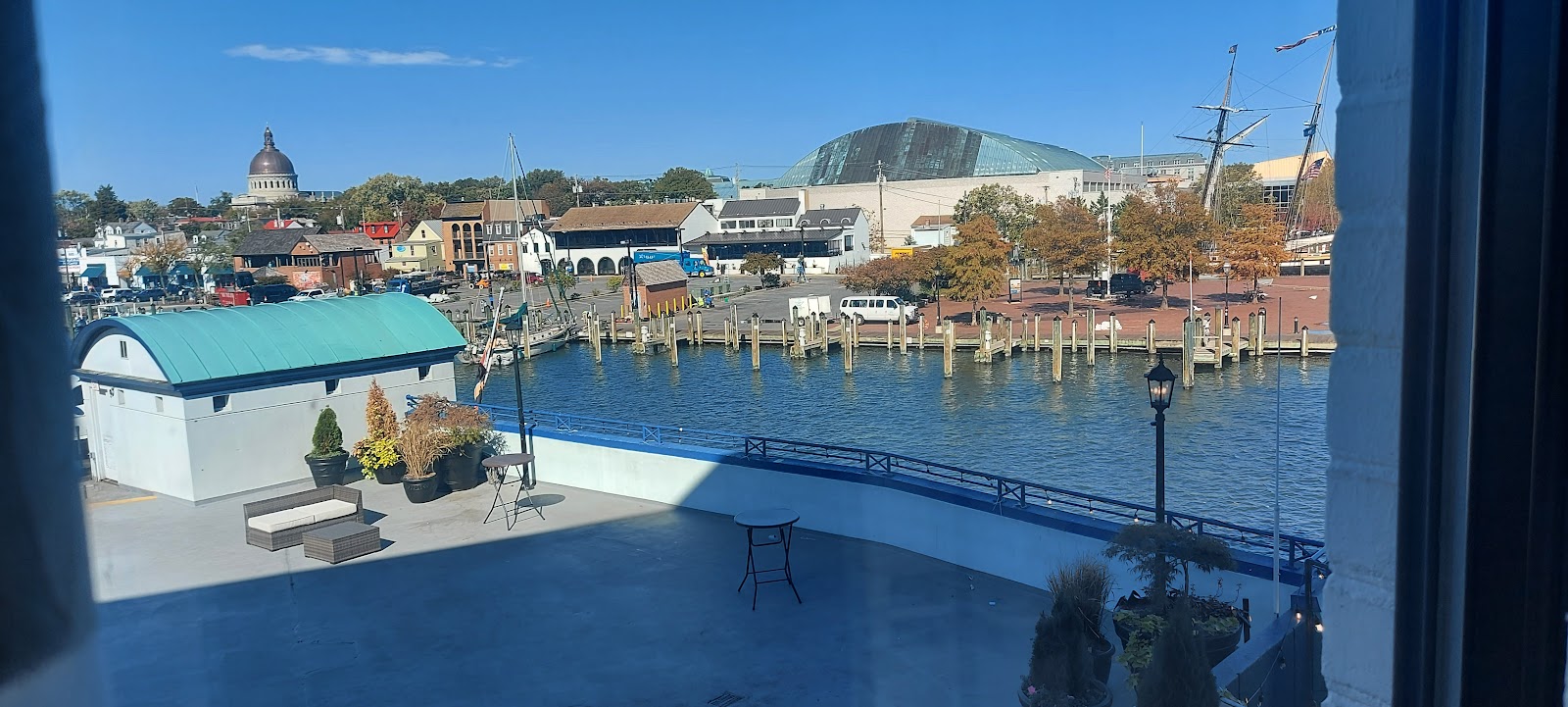
Through the morning the light in the rooms depends entirely on aspect, and at a waterfront hotel that is the question to ask before anything else. A room facing the water has a very large unobstructed area of sky and a substantial bounce off the harbour surface, which together give soft, even, directional light with fill arriving from below — that low bounce is the thing a landlocked hotel cannot offer, and it fills eye sockets and softens a jaw for free. A room facing the town has a much tighter view of brick and roof, which is dimmer and warmer but often more interesting as a background.
Ask which rooms you have, in writing. It is the single most consequential fact about the booking at any venue where the windows are the light.
On a clear morning a water-facing room may take direct low sun straight through the glass, depending on the exact orientation, which lays a hard bright rectangle across the floor several stops above everything else. Use it for one deliberate frame and close whatever coverings exist for the working light — a sheer over a large window facing a harbour is one of the best portrait sources in any building.
Two colour corrections apply throughout the daylight hours. Light off a green-brown estuary is not neutral: it carries a faint green-yellow cast, weaker than a painted wall’s but present, and it lands on anybody photographed near a water-facing window. And modern glazing is coated to reject heat, which shifts transmitted daylight cooler. Those two partly cancel and partly compound depending on the hour, so set a white balance for the position you are shooting from and re-check it when you move.
The middle of the day is the hardest hour outdoors and the reason is the dock. A dock is a hard reflective surface with no shade, and a near-overhead summer sun on it gives flat top light with radiated heat coming back up. Between about eleven and two in summer there is nowhere pleasant to stand on the water’s edge.
The answer is two streets uphill. Annapolis has a compact historic core of narrow streets and eighteenth-century brick, and narrow streets give real shade — a canyon of buildings with the sun overhead puts a band of open shade along one side, and that band is good directional portrait light at the worst hour of the day. It is a four-minute walk and it is the midday solution.
The brick itself is worth the walk. This town has one of the highest concentrations of surviving colonial buildings in the country, mostly Flemish-bond brick, which is warm, matte and finely textured — it holds its colour in shade rather than going blue, and it takes low raking light extremely well. On an overcast day it still reads warm when everything else has gone grey.
In winter the middle of the day inverts and becomes the best part of it. A midwinter noon sun near twenty-seven and a half degrees rakes the masts, the hulls and the brick from the south all afternoon, which is golden-hour light occupying the whole middle of the day. On a clear January afternoon the harbour looks better at one o’clock than it does at any hour in July.
Late afternoon and the balance point
From about ninety minutes before sunset the harbour becomes the venue’s entire argument, and the sequence is predictable.
Low light across a harbour does two things at once. It rakes the masts, which are thin vertical objects and therefore either catch the light along their full length or go dark — and a field of lit masts against a darkening sky is a photograph made of pure line. And it side-lights the hulls, which are large curved pale-and-dark forms, so they acquire modelling and stop reading as flat shapes.
Work across the light rather than into it. A frame looking along the line of the low sun gives you flare and silhouette; a frame at right angles to it gives you lit masts, modelled hulls and a sky with gradation in it.
The dock’s own structure is the foreground to use. Bollards, cleats, dock lines, timber edges and the geometry of a working quay all sit at ground level, and a low camera includes them as a foreground that an open water frame otherwise lacks. Dock lines in particular are good: a rope running diagonally out of the frame corner is a compositional gift.
Then the brick behind the harbour. In the last half hour, the eighteenth-century buildings at the head of the dock take warm light directly, and a frame with lit brick, masts in front of it and water below is the most complete composition this venue offers. Establish which buildings catch that light on a scout, because it will be a specific group and only for about twenty minutes.
Then the balance point, twelve to fifteen usable minutes after sunset. In a harbour that window is unusually good, because you have three tiers of light in it: the sky still holding a gradient, the town’s lights and the lit brick, and the boats’ own riding and cabin lights at water level. Three tiers is one more than most waterfront venues offer, and it is what makes an Annapolis dusk distinctive.
Light the couple for it. At any exposure that holds all three tiers, ambient will not expose a face. One small warmed source at low power, close, feathered so no pool shows on the dock. Set it up before the window opens, not during it.
Get low. The water at that hour is usually still moving, which means it scatters rather than mirrors and the lights become shimmering columns rather than clean reflections — and from near the surface those columns run the full depth of the frame. If the breeze has dropped and the harbour has flattened, you get true reflections instead, which is the better version and cannot be arranged.
Two practical matters about working on the dock in the evening. It is a public waterfront at the foot of a busy town, so expect other people — the City Dock is a place people go, and unless your booking closes an area there will be strangers in frame. Work tighter than instinct suggests.
And it is exposed. There is open water to one side and nothing to windward, so a breeze arrives unimpeded, and a veil on an open dock in fifteen knots is a two-person job. Sandbag every stand. Ask also what the indoor fallback for the ceremony is and get its capacity as a number, because a waterfront ceremony in this region is exposed to wind, to summer thunderstorms and to the remnants of tropical systems in early autumn.
One frame worth walking for if there is time: the hotel and the harbour seen from the far side of the dock or from further along the waterfront, at the balance point, so the venue itself is in the picture. Couples rarely think to ask for it and they value it afterwards.
After dark, the town, and the year
Once the sky has gone, the harbour becomes a field of small lights at water level and the town becomes warm windows above it, which is a good combination and needs a tripod.
The technique is the standard two-exposure one: the scene on ambient at a second or two at base sensitivity, the couple on your own light. If you are shooting from inside through glass, kill every light in the room behind you and press the lens to the pane, and the window effectively disappears.
Boats at night are the local bonus. Riding lights, cabin lights and dock lighting sit at water level and move slightly, which puts a foreground of practical lights between the camera and everything else — exactly what a night frame wants and almost never has. A skyline or a townscape with lit boats in front of it is considerably better than the same view over empty water.
The interiors after dark in a hotel of this kind are lit by a designed scheme, generally warm, low and from above, so ceiling downlights put shadow in eye sockets and a bounced light is usually needed even in a room that looks well lit to the eye. Check the ceiling colour and height on arrival: pale and normal means two lights into opposite corners will lift a reception space by a stop and a half invisibly, and dark means a modifier for the evening.
Now the year, and at a harbour venue the largest variable is air clarity rather than temperature.
July dewpoints here sit around seventy-two, which fills shadows by roughly two stops against a dry climate — helpful for faces — and also produces genuine haze across the broad Bay views. A wide frame down the water in August is soft and pale; the same frame in January is sharp. Since the far views are not the main subject here, that matters less than at a skyline venue, but it does soften a wide frame and wash the sky.
Humidity also fogs a lens within seconds coming out of an air-conditioned room onto a July dock, which on a day that moves between the two repeatedly is a recurring event. Keep the body warm.
Late September into early November is the strongest window. The humidity drops out, temperatures are comfortable in formal clothing on an exposed dock, sunset lands around six so the balance point falls at a civil hour, the brick is at its best in low light, and the street trees in the historic core turn through the second half of October.
One local caution for autumn: this is the season of major sailing events, which fills the harbour with masts and the streets with visitors simultaneously. That is excellent photographically — a harbour at its fullest is the best version of this venue — and difficult logistically, with crowds, closures and accommodation pressure. Check what is on before committing to a date, and if a regatta coincides, plan the dock work early in the morning.
Late April into May is the other good window, with mild air and lengthening evenings. Spring on the Bay runs a little later than inland, because a large body of shallow water is slow to warm.
Summer is long and workable with the middle of the day given to the shaded streets rather than the dock. Sunset after eight in late June puts the balance point near half past eight, comfortably inside a reception. Thunderstorms move through quickly and the half hour afterwards is the best light of the year: washed air so the Bay opens up, wet brick and wet decking several tones darker and far more saturated than dry, reflections on the dock, and a low sun under a broken ceiling. If a cell goes through at six, do not pack.
Two weather hazards specific to this coast. Remnants of tropical systems reach the mid-Atlantic in September and October and bring sustained wind and rain rather than a passing shower, and at a low-lying dock that includes tidal flooding — the City Dock area is known for it. And nor’easters do the same in the colder months from the other direction. Both are reasons to have the indoor capacity as a number rather than an assurance.
Winter is short and it suits the harbour better than couples expect. Sunset before half past four puts the balance point before five, during cocktails, which needs a named slot on the timeline. In exchange: the clearest air of the year, a low sun raking masts and brick through the whole middle of the day, far fewer people on the dock, and — because the boats largely stay in the water here — masts still in the harbour. Snow on eighteenth-century brick with masts behind it is as good as this town gets.
More frames from The Annapolis Waterfront Hotel
The Annapolis Waterfront Hotel wedding photography: common questions
Is the water the main subject?
No, and this is the correction that improves a set here more than any technique. Chesapeake Bay is the largest estuary in the country and it is shallow and brackish with a lot of suspended sediment, so the water is green-brown rather than blue and it chops up quickly in any breeze. The masts are the subject — on a flat waterfront they are strong repeated verticals and the only thing that breaks a horizontal skyline, and a frame with masts in it is unmistakably this place.
What is the best time of day?
Early morning, and almost nobody uses it. Before the sea breeze builds, the harbour is still, and still water in a working harbour is a genuine mirror — a forest of masts doubled about the waterline with the town’s brick behind is the strongest photograph this location produces. It exists for about two hours after first light and then it is gone until the breeze drops. It is also empty of other people, which eleven o’clock is not.
What do you do in the middle of a summer day?
Walk two streets uphill. A dock is a hard reflective surface with no shade, and a near-overhead sun on it gives flat top light with heat coming back up. Annapolis has a compact core of narrow eighteenth-century streets, and a narrow street with the sun overhead puts a band of open shade along one side — good directional light at the worst hour. It is a four-minute walk, and the brick there is warm, matte and finely textured, holding its colour in shade rather than going blue.
Why is dusk especially good here?
Three tiers of light instead of two. The sky still holds a gradient, the town’s lights and the lit brick sit above the harbour, and the boats’ own riding and cabin lights sit at water level — a foreground of practical lights between the camera and everything else, which is exactly what a night frame wants and almost never has. Light the couple, because at any exposure holding all three tiers a face is dark, and get low so the scattered light columns run the frame’s depth.
Does the tide matter?
Less than at most harbours, and that is a real convenience. Annapolis has a modest tidal range, so unlike a harbour with a metre and a half of movement, the relationship between docks and hulls stays roughly constant through the day — a position scouted at noon still works at eight. The thing that does change is the breeze, which builds through the middle of the day and ruffles the surface, sets the boats moving and makes a veil on an open dock a two-person job.
When is the best time of year?
Late September into early November: humidity gone, comfortable temperatures on an exposed dock, sunset around six putting the dusk window at a civil hour, and the street trees turning late in October. One caution — this is also the season of major sailing events, which fills the harbour with masts and the streets with visitors at once. Photographically that is the best version of this venue; logistically it means crowds and closures, so check what is on and plan the dock work early if a regatta coincides.
More Annapolis, MD venue guides
We are writing a photographer’s guide to every venue we would happily shoot in Annapolis, MD. Here are three more, plus the full index:
- The Graduate Annapolis, Annapolis: Suits and Does Not Suit
- The Maryland State House, Annapolis: A Walk Through the Building
Planning a wedding at The Annapolis Waterfront Hotel?
Masts, brick and three tiers at dusk. Tell us your date.