 Dry Tortugas National Park: A Walk Through an Island Fort
The Casa Monica Hotel, St. Augustine: One Frame, and How It Is Made
One frame, built on towers and a very short dusk.
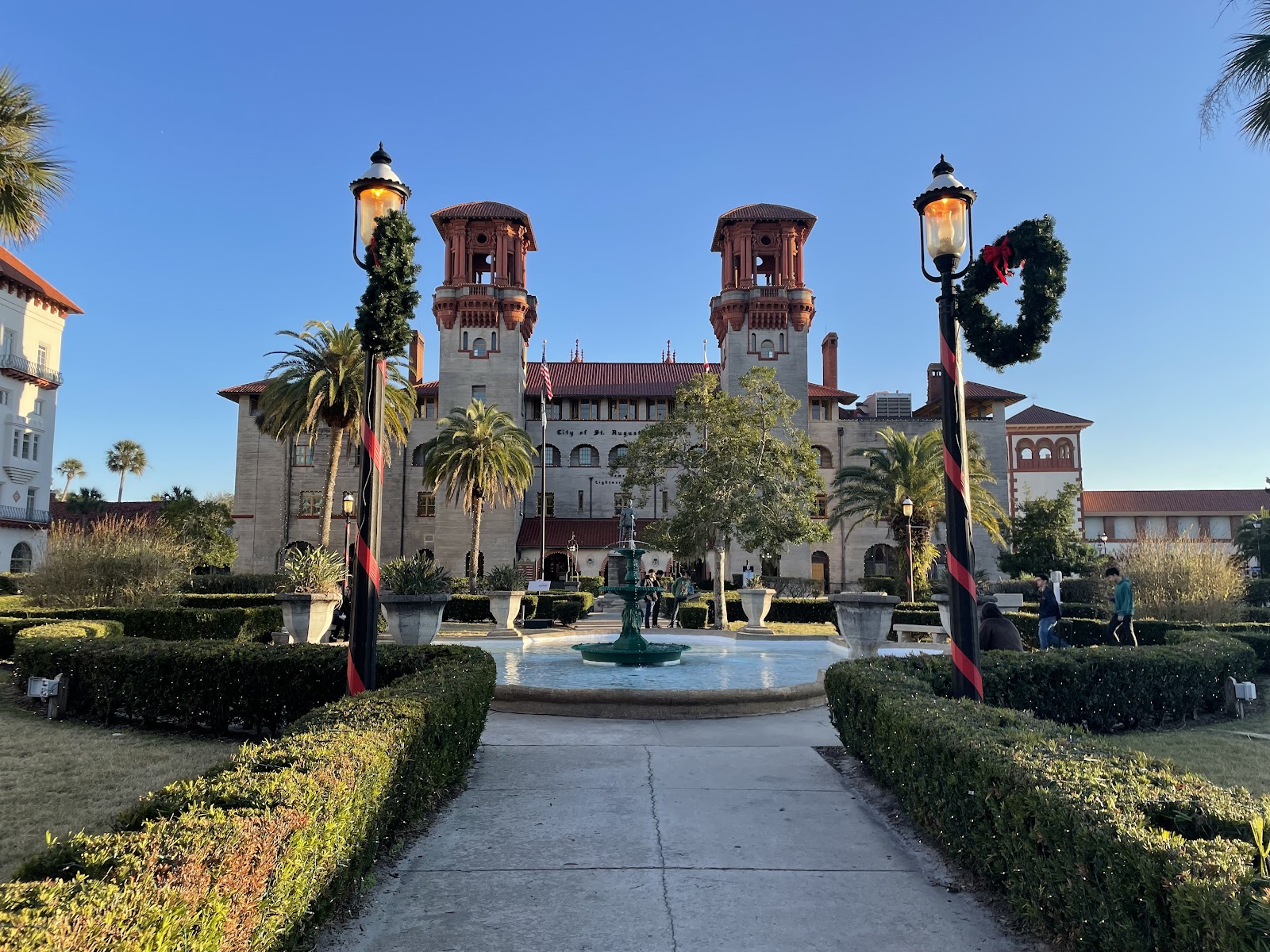
This guide is about a single photograph, and it depends on two things the building has and its neighbours do not: towers, and a working street frontage.
St. Augustine has three surviving Spanish Renaissance Revival hotels from the 1880s, built when Henry Flagler was developing the town as a winter resort. One is now a college, one is a museum, and this one is still a hotel — which means it is lit at night, it has guests coming and going, and it sits on a street rather than behind a campus wall.
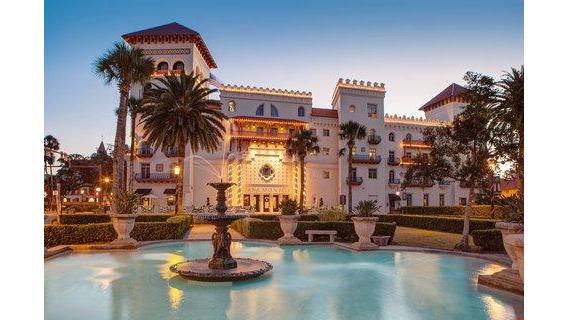
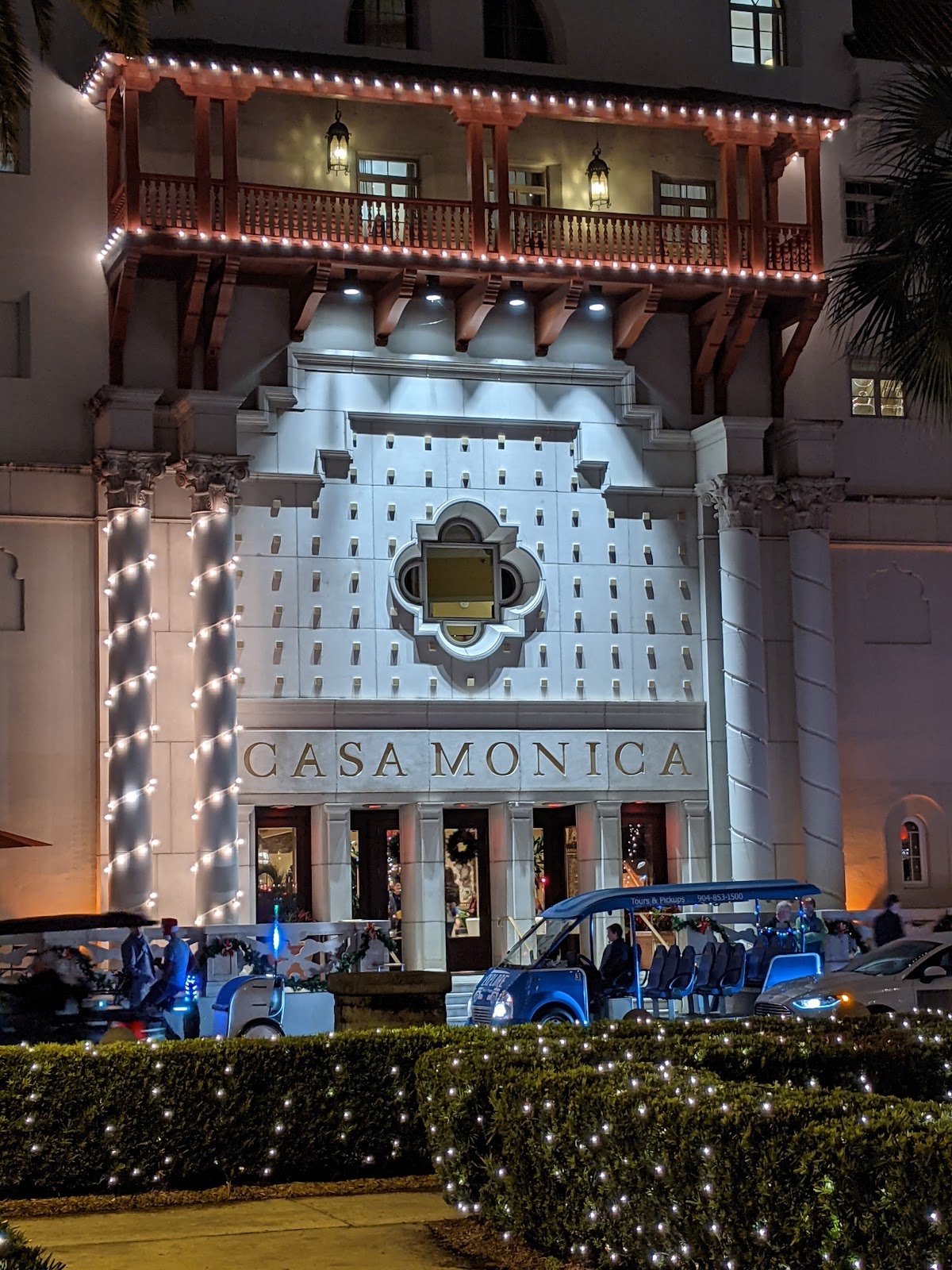
The frame is the building from the street at the blue hour: the towers dark against a deep sky, the windows and arcades lit warm from within, and the couple on the pavement or the steps below.
It is difficult for one specific reason that has nothing to do with the architecture: the window is very short. St. Augustine sits at about twenty-nine and three-quarter degrees north, which gives a civil twilight of roughly twenty-two minutes — among the shortest in this library — and the balance point where the sky and the building lights are equal lasts perhaps eight or ten minutes of that.
So the frame is a ten-minute proposition, and it needs to be composed and positioned before it starts rather than during it.
The second thing to understand is the construction, because it decides how the building takes light. These hotels were built of poured concrete with local coquina as the aggregate — coquina being a limestone of compressed shell fragments, quarried nearby — which was among the earliest large-scale use of the material in America.
That gives a pale, faintly warm, subtly textured surface that is neither stone nor stucco. It takes artificial light well and reads warm against a cold sky, which is exactly what the frame needs.
And the towers are the composition. Spanish Renaissance Revival uses towers and turrets as its vertical accents, and a building with several of them has a roofline that reads as a silhouette — which is what makes it legible against a sky rather than merely visible.
Days here run from about ten hours fifteen to fourteen hours, a narrow range by northern standards, so the schedule is less seasonal than almost anywhere else in this library.
We have not photographed a wedding here. Which spaces are bookable, whether the street frontage can be used and the permitted hours are questions for the hotel.
The Casa Monica Hotel at a glance
| Where | An 1888 Spanish Renaissance Revival hotel in St. Augustine, still a hotel |
| The frame | The towers dark against a deep sky with the interior lit warm, from the street |
| The difficulty | Twenty-two minutes of civil twilight, and eight to ten usable |
| The material | Poured concrete with coquina aggregate — pale, warm, subtly textured |
| Ask first | Whether the street frontage can be used; bookable spaces; hours |
Building the frame
Five decisions, and the first is about time rather than technique.
**Know when the balance point is, and be there early.** Civil twilight here runs about twenty-two minutes, and within it there is a window of perhaps eight or ten minutes when the sky’s brightness and the building’s artificial lighting are close enough that both render properly in one exposure.
Before it, the sky overpowers the windows and the building reads as a daylit facade with some lamps on. After it, the sky goes black and the frame loses its depth entirely — the building becomes a lit object floating in nothing.
At this latitude that window arrives roughly fifteen to twenty minutes after sunset, and sunset itself barely moves through the year: about half past five in December and half past eight in June. So the timing is predictable and it is unforgiving.
Be in position with the frame composed and the exposure roughed in before the sky starts to change. Ten minutes is enough to make three or four variations of one good frame and nowhere near enough to find the position.
**Choose the camera position for the towers.** The building’s roofline is its signature, and the position that works is the one where the towers separate against the sky rather than overlapping each other or a neighbouring building.
That usually means across the street and slightly off the building’s axis — square on, the towers may align and merge; from an angle they stagger and the roofline reads as a series of distinct verticals. Walking the pavement once in daylight to find it is worth ten minutes.
Keep the camera square in the vertical. A tall facade photographed with the camera tilted up converges the walls so the building leans back and the towers splay, which is immediately wrong on a symmetrical revival building. Raise the camera, or correct afterwards and accept the crop.
**Anchor the exposure on the windows.** The lit interior is the element that cannot be recovered — a blown window is a white rectangle with no detail, and the whole point of the frame is the warm glow against the cold sky.
Hold the brightest windows about two thirds of a stop below clipping. That will put the sky at a rich deep blue and the concrete walls in between at a mid tone, which is the relationship the frame wants.
**Light the couple.** At that exposure they will be a stop or two under, because street level is darker than the lit windows above. One source through a modifier, front and slightly off axis, at about a stop under the window exposure — not matching it, because a couple brighter than a lit building reads as pasted in.
Gel it warm. Street and architectural lighting here is tungsten or warm LED, and an ungelled daylight flash puts blue-white faces against a golden building. A half gel with a correspondingly warm white balance keeps them in the same world.
**Drag the shutter deliberately.** A thirtieth to a fifteenth on a wide lens holds the sky and the windows while the flash freezes the couple — and at a fifteenth any passing traffic becomes light streaks, which reads as a living street rather than an empty one. It is worth several attempts to get a streak that runs where you want it.
One practical warning. This is a working street with vehicles, and a wedding party standing in it needs someone whose job is watching traffic rather than watching the photograph.
What else the building gives
The blue-hour frame is the one this guide is about; the rest of the day has to come from the building’s interiors and courtyards.
The courtyards are the best of it. Spanish Renaissance Revival is arranged around them, and a walled courtyard is an open-topped interior: lit by the sky and by its own walls, changing completely as the sun crosses.
In pale coquina concrete the bounce is efficient and faintly warm — the material returns a good proportion of the light with a slight cream cast, which flatters skin. A subject three or four metres out from a sunlit courtyard wall is lit by a source the size of the wall, with a wrap no portable modifier reproduces.
Distance from the wall is the control and further is usually better. A metre away the wall subtends a narrow angle and the light is harsh; four metres out it wraps.
The arcades are the second resource and they are the most reliable light in the building. An arcade is a very large soft source with a hard mask, and depth back from the open edge is the entire control: at the edge flat, a metre back directional at about three to one, two or three metres back dramatic with the courtyard four stops brighter beyond.
Florida’s humidity softens that by perhaps a stop against a dry climate, which makes the deep positions more forgiving than the same arcade in Arizona.
The paving throws warm uplight into the arcade, which fills under the chin and opens the eye sockets for free.
Indoors, the building is a working hotel and the usual approach applies with one advantage. Poured concrete walls are thick, which means window reveals are deep — and a window at the bottom of a deep reveal is collimated by the thickness, arriving as a defined directional beam rather than spreading across the room.
That is a snoot built into the architecture and it is the best portrait light in the building. Place the subject in the reveal or immediately beside it, and respect the falloff: one step back drops a stop, three steps and they are unlit.
The public rooms are lit as hotel public rooms are — warm, low, decorative fixtures at ornamental heights — which means the ambient is characterful and inadequate. Bounce off pale surfaces where they exist, go direct through a modifier where they do not, gel warm to match, and drag the shutter to a thirtieth or sixtieth so the fixtures register.
Ballrooms are the exception and the trap. Recessed downlights on a dimmer give strong top light with shadowed eye sockets, so never key from them: bounce a warm-gelled source for a directional key and add a rim, because a frontally lit subject against a pale wall loses their edges.
And the exterior in daylight wants raking light. Cast concrete with coquina aggregate has a subtle shell texture that catches at a shallow angle and vanishes under frontal light, and the deep-set openings and mouldings read only when the light comes across them — so daylight exteriors belong at the ends of the day and midday flattens the whole building to a pale mass.
- Be composed and positioned before the sky starts to change — ten usable minutes
- Find the angle where the towers stagger rather than overlap
- Anchor on the lit windows two thirds below clipping; the glow is the subject
- A fifteenth turns traffic into streaks and the street into a living one
- Deep concrete reveals are snoots: one step back is one stop
St. Augustine, and the Florida year
The town is the building’s context and it is unusually rich, being the oldest continuously occupied European settlement in the continental United States, founded in 1565.
That gives two distinct historic layers a few streets apart. The older is Spanish colonial and its material is coquina — the same shell limestone used as aggregate in the hotel’s concrete, but here quarried in blocks. A coquina wall at close range is a visible mass of compressed shell, a texture found almost nowhere else, and it needs raking light: frontal midday renders it flat and a low angle brings the whole surface alive.
The newer layer is the 1880s Flagler development, of which this building is one of three survivors. Both layers photograph well and both want low light, which means the town’s exteriors are a first-hour or last-hour proposition throughout.
The narrow streets are worth knowing as a practical matter. A colonial street plan is tight, which means tall buildings shade the pavements for much of the day — and that shade is genuinely useful. A subject in a narrow shaded street with a sunlit wall at the end of it is separated by tone with no equipment at all.
It also means the sun leaves street level early, which shortens an already short dusk. Establishing where the light actually falls at the hour of the ceremony is worth doing on foot.
The live oaks are the Gulf South signature and St. Augustine has them throughout. Evergreen, broad, dense and low-crowned, holding their leaves year-round, they cast genuine solid shade with no dapple in January as in July — which makes a live oak the reliable midday position at any time of year.
That is unusual in this library, where most canopies vanish for half the year. The trade is that the canopy is dark, several stops below open ground, so a subject under one with sunlit ground beyond is a four-stop frame needing a fill or a deliberate silhouette.
Spanish moss hangs from the limbs in grey-green translucent streamers and glows when backlit against a low sun. And sabal palm, the state tree, gives almost no useful shade — the crown is high and the fronds sparse — but it is a strong graphic vertical against open sky.
The Florida year runs opposite to most of this library and the reversal is emphatic.
December through April is the season: mild, dry, sunny and comfortable, with a December noon sun of about thirty-seven degrees that models rather than flattens. Because the live oaks are evergreen, a January frame looks much like an October one — which makes a winter date here a positive choice rather than a compromise.
This is exactly why Flagler built here and the reason is unchanged. It also means the hotel is at its busiest in winter, which is worth knowing when booking.
June through September is the constraint. Subtropical summer brings afternoon temperatures in the nineties with dewpoints in the mid-to-high seventies, which for a party in formal clothing outdoors is a welfare matter rather than a comfort one.
The humidity has a real photographic effect and it is mostly favourable. Water vapour scatters light and fills shadows, so a sunlit street in July carries perhaps two and a half stops less contrast than the same sun angle in Arizona — soft shadow edges, eye sockets holding detail, and midday genuinely workable. The costs are a pale washed sky and hazed long lenses.
The cloud is the compensation. Florida summer afternoons generate convection from sea-breeze convergence almost daily, and the half hour after a cell passes is the best light of the year: washed air, wet concrete and coquina deeply saturated, a low sun under a broken ceiling — and wet paving reflecting a lit facade, which is the blue-hour frame improved.
Two hazards go with it. Florida receives more lightning than anywhere else in the United States, which for an outdoor ceremony in summer means a covered alternative that genuinely exists. And hurricane season runs June through November, which for a coastal town is a real planning consideration rather than a theoretical one.
For a venue whose signature frame is an artificially lit facade at dusk, most of that is manageable — the frame needs a dry ten minutes rather than a fine day, and a summer evening after a storm has passed is better for it than a clear one.
More frames from The Casa Monica Hotel
The Casa Monica Hotel wedding photography: common questions
Why is the frame so time-critical?
Civil twilight here is about twenty-two minutes and the balance point where sky and building lights match lasts perhaps eight or ten. Compose before it starts.
Where do I stand?
Across the street and slightly off axis, so the towers stagger against the sky rather than overlapping. Walk the pavement in daylight to find it.
What do I expose for?
The lit windows, two thirds of a stop below clipping. A blown window is a white rectangle and the warm glow is the whole point of the frame.
What shutter speed?
A thirtieth to a fifteenth on a wide lens. At a fifteenth passing traffic becomes streaks, which reads as a living street rather than an empty one.
What is the best interior light?
A deep concrete window reveal. Thick cast walls collimate the beam into a defined directional key with a steep falloff.
When is the season?
December through April — mild, dry, and with evergreen live oaks so January looks much like October. It is also when the hotel is busiest.
More Florida venue guides
We are writing a photographer’s guide to every venue we would happily shoot in Florida. Here are three more, plus the full index:
- The Hyatt Regency Grand Cypress, Orlando: The Light Through the Day
- The Lightner Museum, St. Augustine: The Problem, and Four Ways Out of It
- The Ponce de Leon Hotel, St. Augustine: A Walk Through the Building
Planning a wedding at The Casa Monica Hotel?
Towers, a lit facade and ten minutes. Tell us your date.