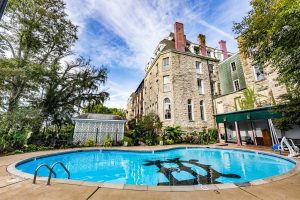
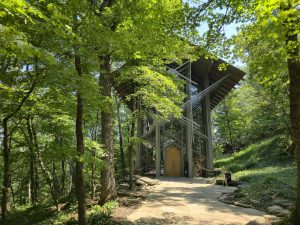
 The Ozark Mountain Lodge, Eureka Springs: The Problem, and Four Ways Out
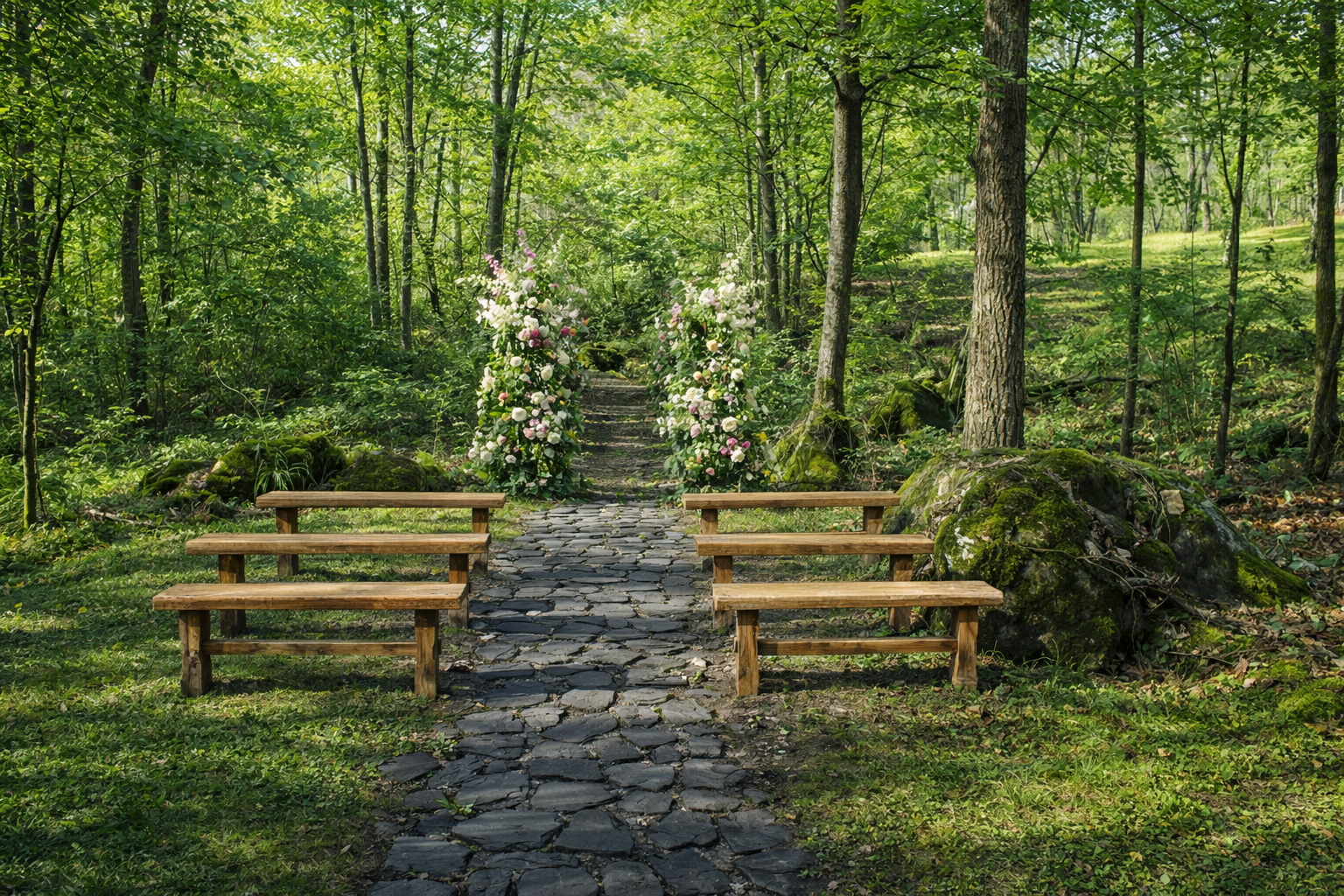
The Woodland Venue, Fayetteville: The Problem and Four Ways Out of It
Closed canopy light is soft, which is not the same as good.
A woodland venue is usually sold on the strength of its shade, and the shade is real. But closed canopy light has three problems and they are worth naming rather than discovering.
The first is level. Under a full oak-hickory canopy in summer the light is two to four stops below open ground, which is manageable but limits the aperture and shutter combinations available and makes a moving subject harder to hold.
The second is colour. Light that reaches the forest floor has been transmitted through and reflected off leaves several times, and leaves transmit and reflect strongly in the green part of the spectrum. The result is a genuine green cast on skin, and it is the single most common fault in woodland wedding photography. It cannot be fixed with a global white balance correction, because the correction that neutralises the faces turns the foliage grey and the whole frame dead.
The third is direction, and it is the one that does the most damage. Light arriving through a closed canopy comes from the whole hemisphere above, filtered — which means it is soft and directionless. Soft is good; directionless is not. A face lit from everywhere at once has no modelling: the nose casts no shadow, the cheekbone does not read, and the result is flat even though nothing about the exposure is wrong.
There is a fourth condition that is worse than all three, and it is the one to actively avoid: partial canopy in direct sun. Where gaps in the leaves let hard sunlight through, the floor is covered in dappled patches with a range of four or five stops between patch and shade — and a face half in one is unrecoverable. Dapple is the enemy at a woodland venue, and the whole of the approach below is partly about avoiding it.
Those problems have four distinct solutions. Each produces a different photograph, and choosing among them deliberately rather than by default is the job.
Fayetteville sits in the Arkansas Ozarks at about thirty-six degrees north. The June noon sun reaches around seventy-seven degrees, the December noon sun about thirty, days run from about nine hours fifty to fourteen hours twenty, and civil twilight is around twenty-eight minutes.
We have not photographed a wedding at this venue. Which spaces and grounds are included, what covered alternatives exist and what the permitted hours are, are questions for their team.
The Woodland Venue at a glance
| Where | A woodland venue near Fayetteville, in the Arkansas Ozarks |
| Three problems | Two to four stops down, a green cast on skin, and no direction at all |
| The worst condition | Partial canopy in direct sun — dapple with a four or five stop range |
| Four ways out | The canopy edge; a source of your own; backlight; the season |
| Ask first | Included grounds, covered alternatives, permitted hours |
The first two ways out
The first way out is the canopy edge, and it solves all three problems at once without any equipment — which is why it is the first and the most important.
The edge is the boundary where closed canopy meets open ground. A subject standing a metre or two inside it, facing out toward the light, is lit predominantly by the open sky in front of them rather than by light filtered through leaves. That fixes the level, because open sky is much brighter than filtered canopy. It fixes the colour, because the light has not passed through foliage. And it fixes the direction, because the light now arrives from one side rather than from everywhere.
Behind them, the closed canopy is still two to four stops down, which means the background is dark. Soft directional light in front and three or four stops of fall-off behind is precisely what a studio portrait is, and the edge supplies it for nothing.
The distance matters and it is worth being deliberate. At the very edge, the light is bright and nearly frontal and the background is not yet dark. Two metres in, the ratio is good and the background is properly dark. Four metres in, the subject is back in filtered light and the whole advantage is lost. Two metres is the number.
Eastern redcedar edges are better than oak edges and worth finding specifically. Redcedar is a juniper rather than a true cedar, and it is dense and very dark — so at three stops down it reads as near-black rather than as green, which gives a genuinely dark background rather than a dim green one.
The second way out is to bring a source, and in a wood it needs less output than instinct suggests. Because the ambient under canopy is two to four stops below open ground, a modest light at close range is already a stop or two above it — which means the frame can be shaped rather than merely filled.
One source at about forty-five degrees and slightly above eye level, close enough to fall off before it reaches the trees behind, restores the direction that the canopy removed. That is a very simple setup with a disproportionate effect: the same subject in the same place, with and without it, is the difference between a flat photograph and a modelled one.
The gel is the part that fixes the colour problem, and it is the most useful thing in this section. A warm-gelled source on the face overrides the transmitted green on skin while leaving the foliage the colour it is — which means the faces read correctly and the wood still reads as a wood. No global correction can do both.
Practically: a warming gel on the source, white balance set for the ambient rather than for the flash, and output at about a stop over the ambient on the subject. That is the standard woodland recipe and it works every time.
The second two, and the rest of the site
The third way out is backlight, and it turns the canopy from a problem into the subject.
When the sun is low and behind the canopy, oak and hickory leaves become translucent panels: they transmit light rather than blocking it, and a canopy seen against a low sun glows. That is the best thing a wooded property produces and it is available for roughly the last ninety minutes of a clear day.
The method is to expose for the leaves and let the trunks go dark, then lift the subjects with a close warm-gelled source at about a stop over the ambient on them. Metering on faces gives blown-out leaves and removes the entire effect.
Two things make the frame work. The subjects need to be positioned so that the sun is behind the canopy rather than behind a gap, because a gap gives a flare and a hard point source rather than a glowing field. And the camera needs to be low enough that the canopy fills the space above and behind them rather than showing open sky above the treeline.
The related frame is the light shaft. On a still morning with mist — common in Ozark hollows on clear calm nights because cold air sinks and the humidity is high — low sun through canopy produces visible beams. A subject standing in or beside one is a strong photograph and it depends entirely on conditions that cannot be planned.
The fourth way out is the season, and at a woodland venue it is the most powerful of the four because it removes the problem entirely rather than working around it.
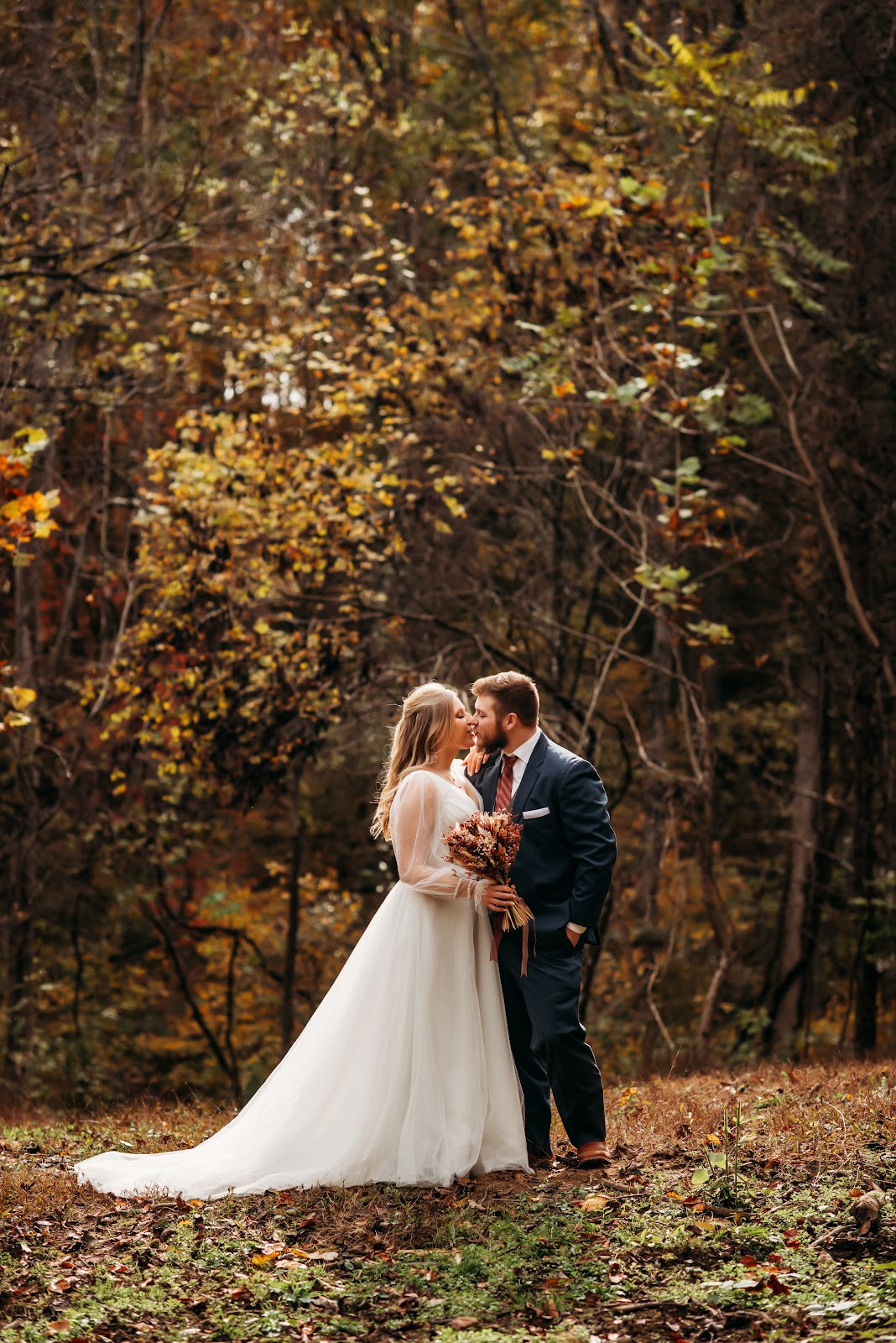
From late October the canopy comes down. With the leaves off, light reaches the forest floor everywhere, the green cast disappears completely, the level rises by two or three stops, and the light acquires direction because it is arriving through bare branches rather than through leaves. A bare oak-hickory wood in low sun is one of the best portrait environments in this guide, and it is the same wood that was unusable in July.
What replaces the green is also better background material: grey trunks, brown leaf litter, pale limestone ledges where the Ozark bedrock shows, and near-black redcedar. That is a landscape of neutrals, which treats skin and white fabric far better than green does.
The window is long. Arkansas woods are bare from about mid-November to late March, which is four months rather than a fortnight, and the December noon sun at around thirty degrees never rises high enough to flatten anything — so there is no bad hour in an Arkansas winter day in a bare wood.
The rest of the site follows from Ozark geology and topography. The ground is uneven, because this is a dissected limestone plateau, and a gradient is an asset: a camera below the subjects on any rise puts them against open sky with no horizon behind them, which is the cleanest background available in any conditions.
Limestone shows at the surface as ledges and low bluffs. Pale grey and weathered, it is a low-saturation background and a high-frequency texture that is spectacular under raking light and dull under flat light — which makes it a first-and-last-hour surface. A low ledge is also a strong horizontal at seated height.
Where there is water, it is worth finding: karst country produces clear springs and creeks with a blue-green carbonate tint quite unlike a muddy lowland stream, and moving water in shade is one of the most forgiving subjects there is.
Two practical notes. Chiggers and ticks are a genuine consideration in Arkansas woodland and tall grass from about May into September, and a woodland venue is exactly where they live. And this state sits in the secondary severe-weather corridor of the southeastern United States, with peaks in April–May and a smaller one in November — and a wood is a poor place to be in high wind, which makes a named indoor alternative a requirement rather than a courtesy.
- Two metres inside the canopy edge, facing out — not four, not at the edge
- Warm-gelled source at a stop over ambient fixes the green on skin only
- Backlight the canopy, expose for the leaves, light the faces
- Bare-canopy season runs four months and removes the problem entirely
- Redcedar edges read near-black where oak edges read dim green
The Ozark woodland year
Four real seasons, and at a woodland venue the canopy’s state matters more than the weather does — which makes this the most seasonal venue type in the state.
Winter is the best season here and it is worth being emphatic about, because it is the reverse of what most people assume. With the canopy down, the whole property becomes usable at any hour: light reaches the ground everywhere, the green cast is gone, and the December noon sun at around thirty degrees models rather than flattens all day.
Bare woods also reveal the structure of the place — the shape of the hillside, the limestone ledges, the trunks as vertical elements — all of which are hidden under summer leaf. And at nine hours fifty the day is meaningfully longer than a northern winter one.
Snow occurs but rarely lasts. The characteristic Arkansas winter event is freezing rain, which glazes every twig in clear ice: a bare wood in an ice storm with low sun through it is one of the most remarkable conditions in this guide, and entirely unplannable.
Spring is the region’s finest season and the two weeks before the canopy closes are the best fortnight of the year on a wooded property. Leaf-out runs from late March into early April, and before it completes the flowering understory is lit directly rather than filtered.
Redbud is the one to plan for. It flowers magenta on bare wood before its own leaves emerge and before the canopy closes above it, which means full sun on a saturated colour in a wood that is still open. Dogwood follows, flowering white beneath a canopy that is only half closed — the other classic Ozark spring frame. Serviceberry and wild plum add to it.
Then in a fortnight it closes and the problems at the top of this page arrive.
The cost of spring is the severe-weather peak in April and May, which is serious in Arkansas rather than nominal.
Summer is the season this page is about. Full closed canopy, two to four stops down, green, directionless, with dapple wherever the sun finds a gap. It is workable with the canopy edge and a gelled source, and it is demanding.
Summer also brings dew points in the low to mid twenties Celsius, which puts haze in the air — at close range under canopy that costs nothing, which is one of the few advantages of working inside a wood. Chiggers and ticks are at their worst from May through September, and fireflies in the Ozark hollows in June are genuinely worth a frame if an evening runs late.
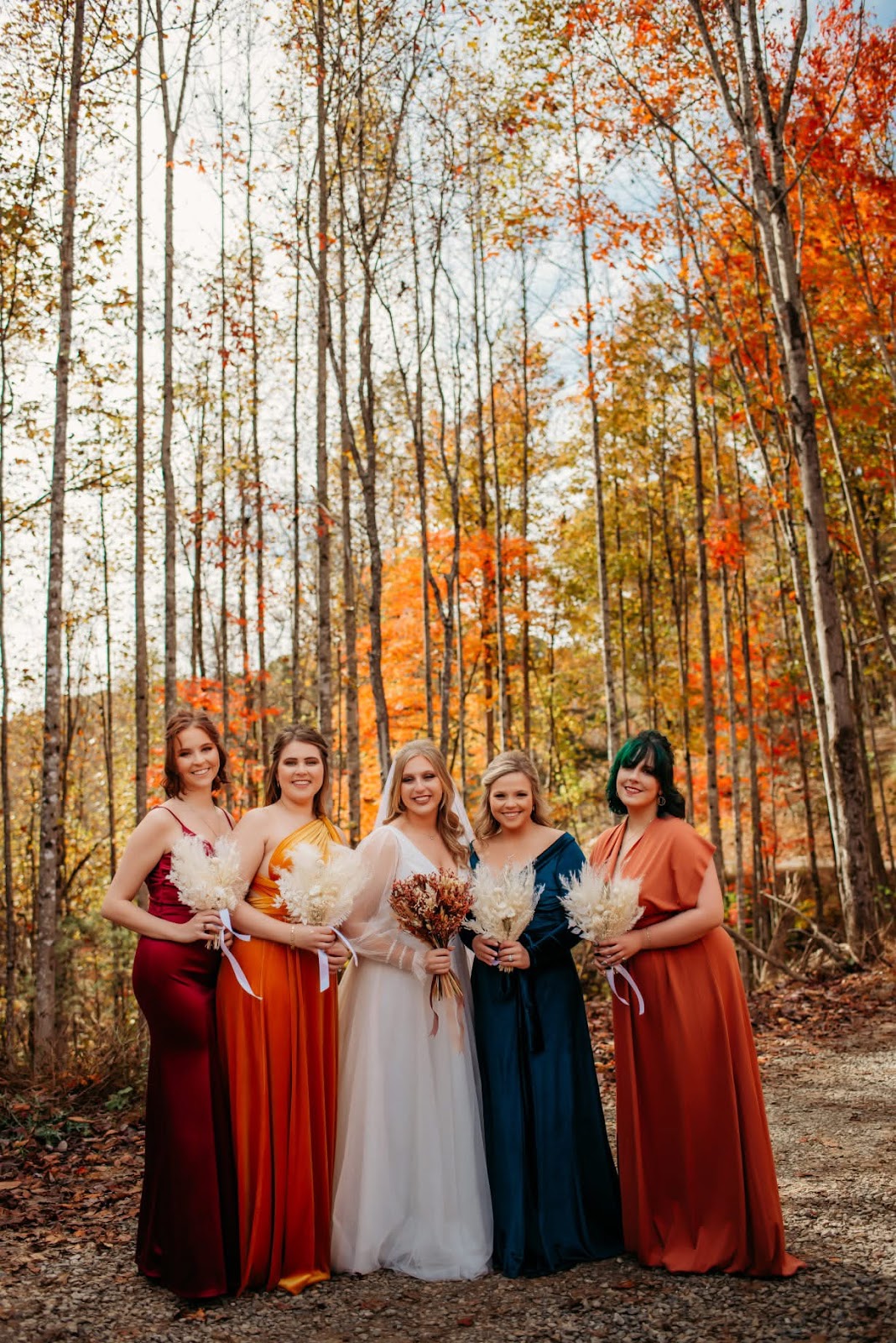
Autumn is the other strong season and it is much later than in the north. Oak-hickory forest turns from the last week of October into the first week of November — three to five weeks behind New England — and it holds for a genuine three weeks because oak colours and drops slowly.
On a wooded property that colour arrives overhead as well as around, which is the whole point: the backlight technique described above, applied to a canopy of hickory gold and oak russet rather than summer green, produces the strongest frame this venue offers all year. And as the leaves thin, the level rises and the direction returns, which means the last week of the colour is better lit than the first.
November brings a second, smaller severe-weather peak, and by the middle of the month the canopy is down and the four-month bare-wood window has begun.
More frames from The Woodland Venue
The Woodland Venue wedding photography: common questions
What is wrong with closed canopy light?
It is two to four stops down, it puts a green cast on skin, and it arrives from the whole hemisphere at once — so it is soft but completely directionless.
Why can't I just correct the green in white balance?
Because the correction that neutralises the faces turns the foliage grey and the whole frame dead. The fix is positional or a gelled source.
What is the single best position?
Two metres inside the canopy edge, facing out toward the open ground. Not at the edge, and not four metres in.
What is the standard woodland lighting recipe?
A warming gel on one source at forty-five degrees, white balance set for the ambient, output about a stop over the ambient on the subject.
What condition should I avoid?
Partial canopy in direct sun. Dapple gives a four or five stop range across a face and is unrecoverable.
When is a woodland venue at its best?
Late March to mid-April, before the canopy closes; the last week of October into early November for backlit gold overhead; and the whole bare-canopy season from mid-November to late March.
More Arkansas venue guides
We are writing a photographer’s guide to every venue we would happily shoot in Arkansas. Here are three more, plus the full index:
- The Alexander Mansion, Hot Springs: Field Notes on a Valley House
- The Garden at The Grand, Hot Springs: The One Decision That Governs Everything
- Garvan Woodland Gardens, Hot Springs: A Walk Through the Site
Planning a wedding at The Woodland Venue?
Four ways out of a closed canopy. Tell us your date and we will pick one.