 The Ozark Mountain Lodge, Eureka Springs: The Problem, and Four Ways Out
Thorncrown Chapel, Eureka Springs: What It Suits, and What It Does Not
A chapel with glass walls has no interior light of its own. Everything in it is the forest, coming in.
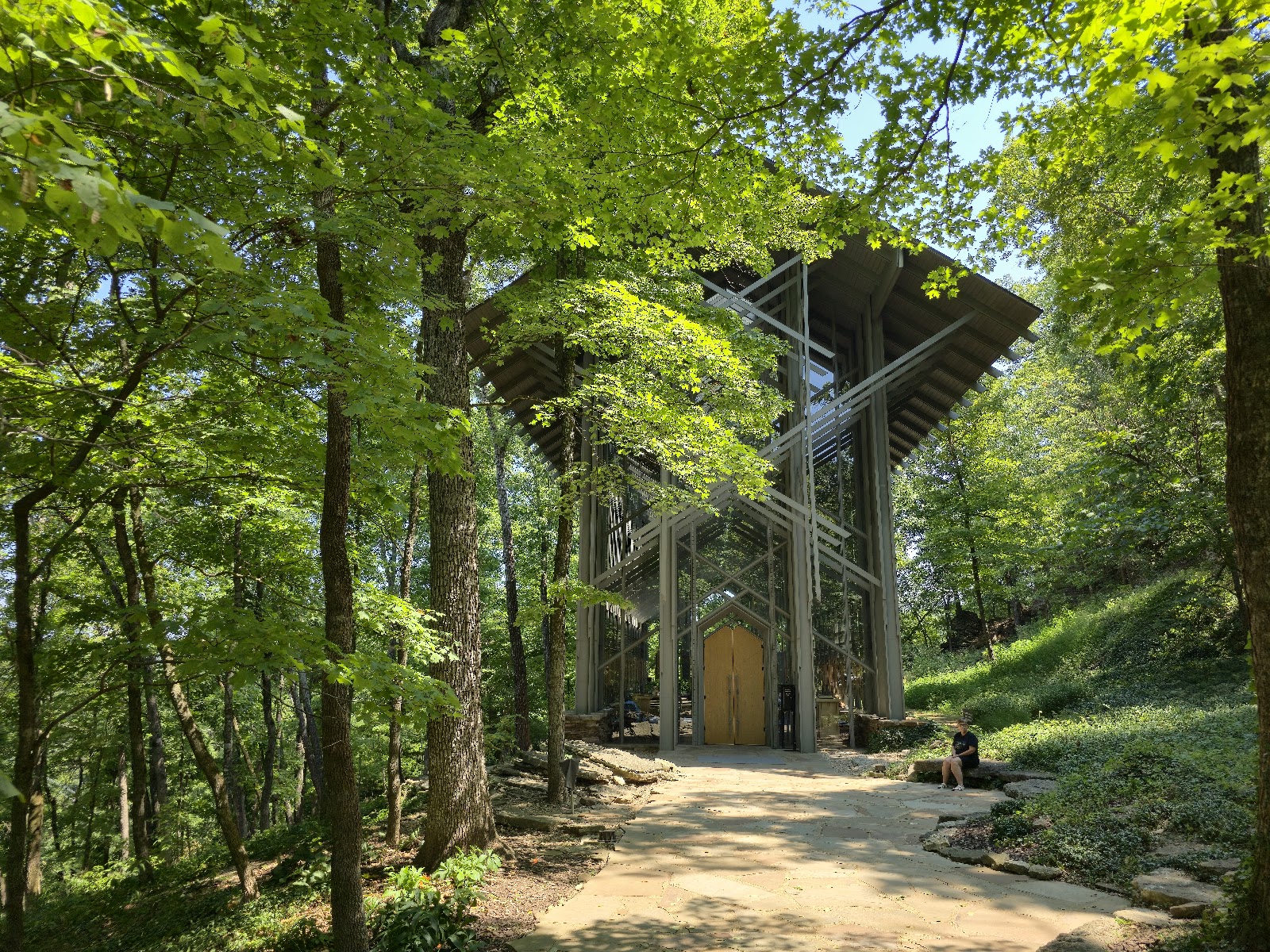
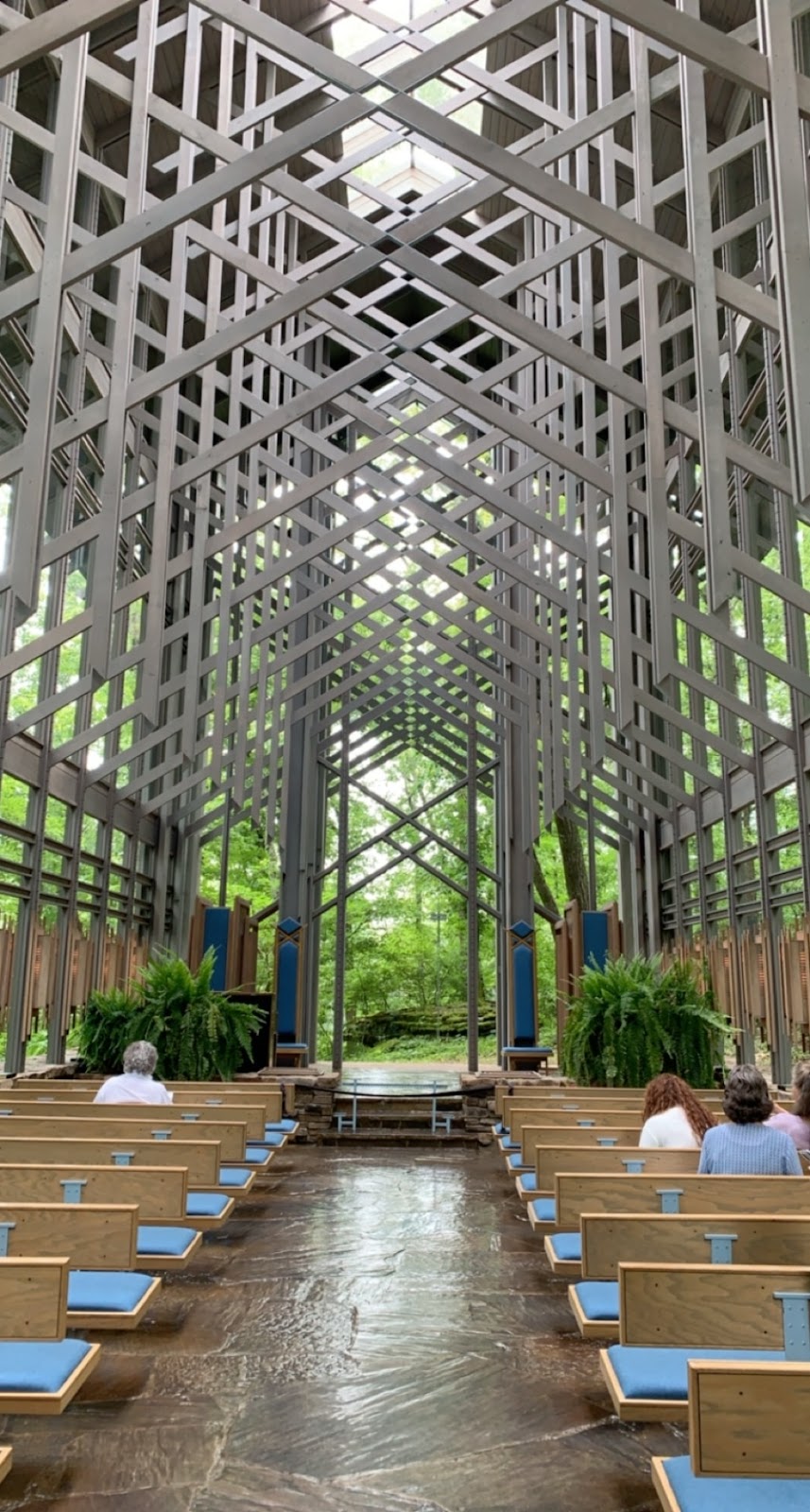
A chapel built almost entirely of glass in the middle of woodland is one of the most admired small buildings in America, and it is also one of the hardest interiors a wedding photographer will meet — for a reason that is structural rather than incidental.
It has no walls. That means it has no interior light of its own and no background of its own: everything inside it is the forest, arriving through glass on every side. The light is whatever the canopy is doing, from every direction at once, and the background behind anyone standing inside is trees rather than architecture.
That produces a set of conditions found nowhere else. Dappled light indoors, which is normally an outdoor problem. Backgrounds that cannot be changed by moving, because every direction is the same forest. Reflections in glass on all four sides. And a brightness range between the canopy gaps and the shaded interior that is genuinely wide.
It is worth every one of those difficulties, and a couple should know what the frames will look like before the day rather than after. We have not photographed a wedding at Thorncrown Chapel; glass buildings under a canopy behave according to what the canopy does. Ceremony length, permitted camera positions, whether photography is allowed during the service and what the equipment rules are are questions for their team — and at a building of this significance those answers govern the day.
The Thorncrown Chapel at a glance
| Where | Eureka Springs, Arkansas, in Ozark woodland |
| Suits | A frame that exists nowhere else; canopy light; genuine architecture |
| Resists | Dappling indoors, uncontrollable backgrounds, glass on every side |
| The best condition | Overcast, which turns the whole building into a soft box |
| Ask first | Permitted positions, photography during the service, equipment rules |
What it suits
Overcast is the first and most important thing it suits, and it inverts the usual assumption that a clear day is a good day. Under cloud the canopy above becomes a uniform filter rather than a stencil, which means the light arriving through the glass is soft, even and directionless in the best sense — and a building with glass on every side under a grey sky is effectively a very large soft box with people standing inside it.
That is the condition in which this interior photographs best, and it is worth saying plainly to a couple who might otherwise hope for sunshine. A bright overcast day here gives clean, even, flattering light on every face in the building with no dappling at all, and it needs nothing added.
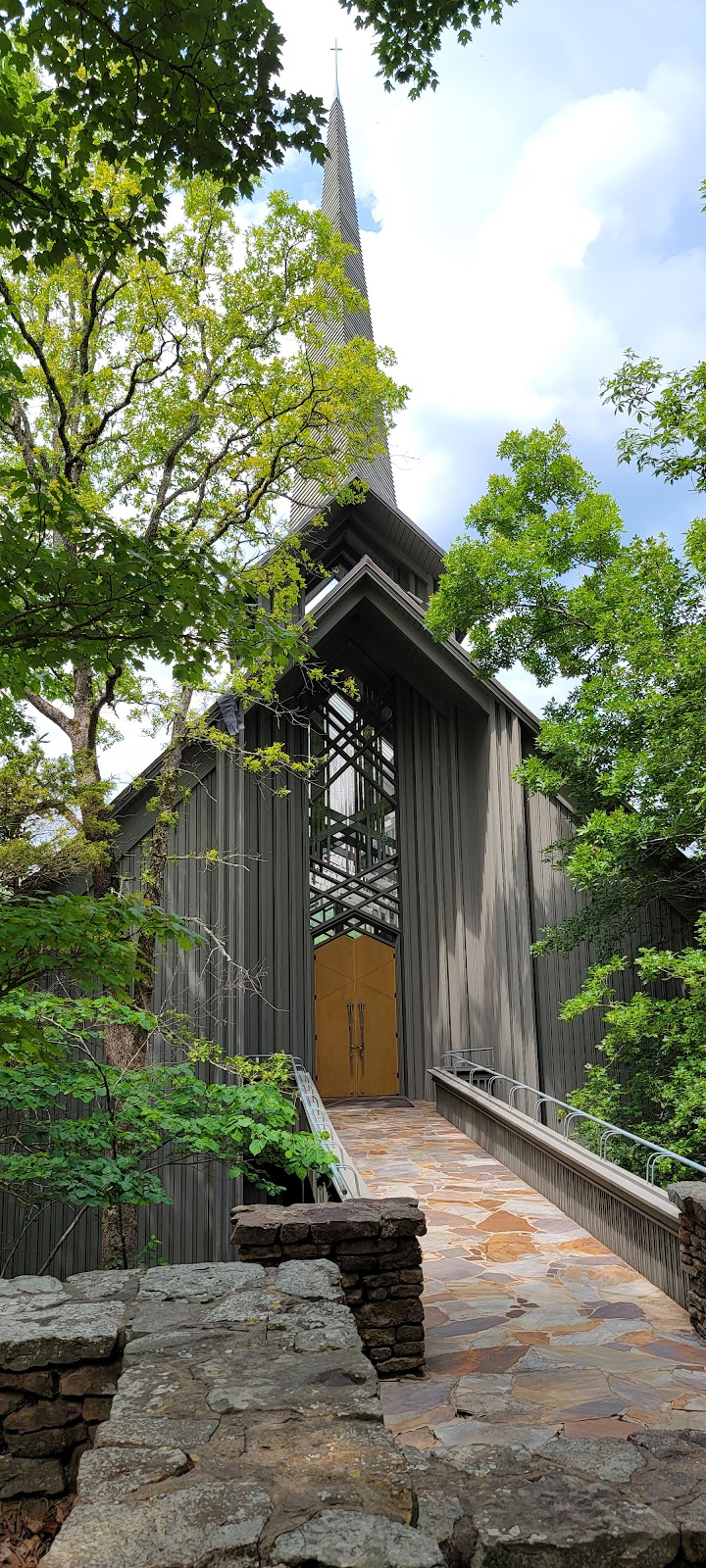
The architecture suits being a subject rather than a setting. The structure is the point of the building — a lattice of timber and steel against the forest — and it photographs as a graphic subject in its own right. Looking up, looking along the length, and looking through the structure to the trees are all frames that need no people in them and that place the day precisely.
It suits the couple-as-figures composition for the same reason. Two people standing in a glass building surrounded by forest, photographed from a distance, is a picture about a place rather than about faces — and it is the frame the building exists to give. The requirement is that the figures be readable, which means lit and placed where the eye lands.
It suits a low camera. Looking up through the structure to the canopy uses the one thing a glass building has that a conventional chapel does not: a ceiling that is also a view. That frame is available at any hour and in any weather.
And it suits the surrounding woodland, which is the other half of the venue. Ozark hardwood forest gives dense full shade in summer, and the rule outdoors is the familiar absolute one: full shade under a dense crown is excellent, while dappled light through a thin one puts bright patches and deep shadow on the same face at a ratio nothing holds.
The approach path is worth naming as an asset. A walk through woodland to a glass building is a sequence rather than a single frame, and the approach — with the structure appearing through trees — is frequently a better picture than the building photographed square on.
What it does not suit
Direct sun is the first refusal and it is the one that catches people out, because a sunny wedding day sounds like good news. Sun through a hardwood canopy and then through glass produces dappling inside the building — bright patches and deep shadow on the same face, centimetres apart, moving as the canopy moves in a breeze.
That is the same problem as dappled light outdoors and it has the same answer, except that here the answer is much harder to apply: normally you move, and in a chapel during a ceremony you cannot. A couple standing at the front of a glass chapel in dappled sun is in the single worst light a photographer meets, and nothing recovers it — the ratio is beyond any sensor and a fill light bright enough to close it would destroy the frame.
The practical answers are limited and honest. Check the site at the ceremony hour in advance, if possible on a sunny day, and see where the dapple actually falls — it is not uniform, and there are frequently positions at the front that are in full shade while others are not. Ask whether the ceremony position can be shifted a metre. And accept that a sunny ceremony at this building will be photographed with the dapple in it, and composed so the pattern reads as deliberate rather than as an accident.
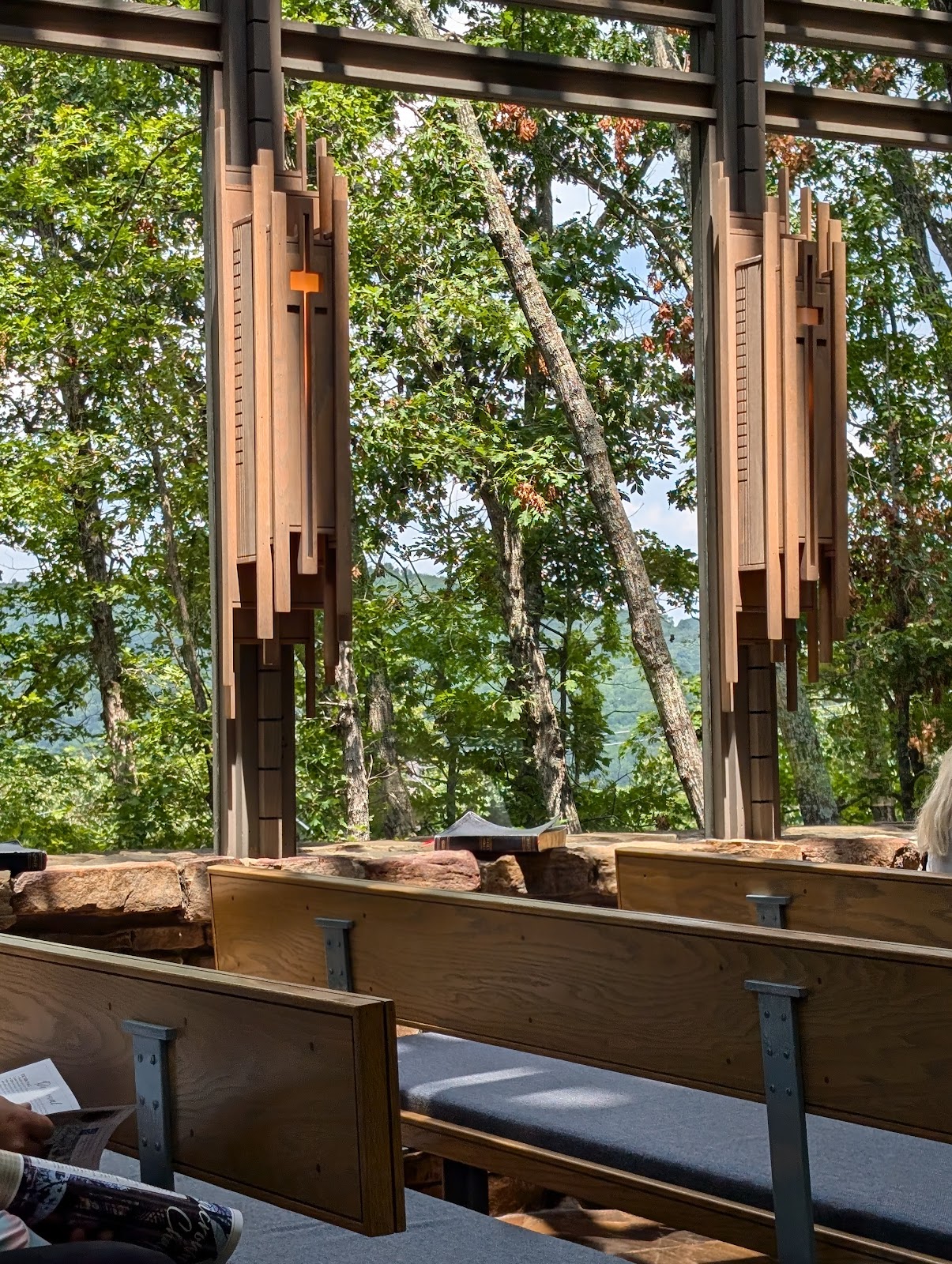
The background is the second refusal and it cannot be solved. In a conventional chapel a photographer moves to change what is behind a subject; here every direction is the same forest at the same distance, which means the background is a mid-toned, busy, detailed field of foliage in every frame.
That has one consequence worth acting on: a face has to be brighter than that field or the picture flattens, because mid-toned busy foliage competes with a face at the same scale. A long lens at a wide aperture reduces the forest to tone, which is the most reliable fix. And where light is permitted, a face half a stop to a stop above the background holds the eye regardless.
Glass on every side is the third and it means reflections everywhere. From any camera position, some panes will show the photographer, the congregation, the sky or a light — and a curved or angled pane shows them from a wide range of angles. The fifteen-second habit is essential here rather than merely advisable: stand where the camera will stand, look at the glass in the frame, and move whatever is showing.
Where reflections cannot be avoided they should be used: the forest reflected in glass alongside the forest seen through it is a genuinely interesting double image and specific to this building.
The fourth is scale and access. This is a small building with fixed seating, a narrow aisle and a floor that cannot accommodate free movement — which means one or two camera positions established in advance, a lens that covers both a wide and a tighter frame from there, and no repositioning mid-ceremony. Large groups belong outside.
And at a building of this architectural significance the rules about camera positions, photography during the service and equipment are likely to be specific and firm. They should be settled at booking, and they are not a photographer’s to interpret.
- Overcast is the best condition here, not the worst
- Check where the dapple falls at the ceremony hour before the day
- The forest is the background in every direction — use a long lens to dissolve it
- Check the glass from the camera position; reflections are on all four sides
- Establish one or two positions in advance; you cannot reposition mid-ceremony
The woodland, and the Arkansas year
The woodland around the building is the other half of the venue and it is where the portraits belong, because outside there is choice about background and light that inside there is not.
Full shade is the rule and dense Ozark hardwood supplies it reliably in summer. Ten minutes on arrival identifying which areas genuinely qualify — as opposed to looking pleasantly shaded — is the most valuable ten minutes of the day, because at this latitude, about thirty-six degrees north with a June midday sun around seventy-seven degrees above the horizon, the dappling contrast is severe rather than merely awkward.
Dense canopy throws green onto skin from whichever side it is thickest, localised so global white balance cannot remove it. A custom white balance set on a face in the position being used is the fix, and a metre further from the foliage roughly halves it.
Limestone is the local stone and it behaves as a reflector rather than a background: pale and warm, a sunlit limestone face is a source the size of the wall, and a couple three or four metres out from one, facing it, is well lit for nothing — with a custom white balance, because limestone bounce is markedly warmer than daylight.
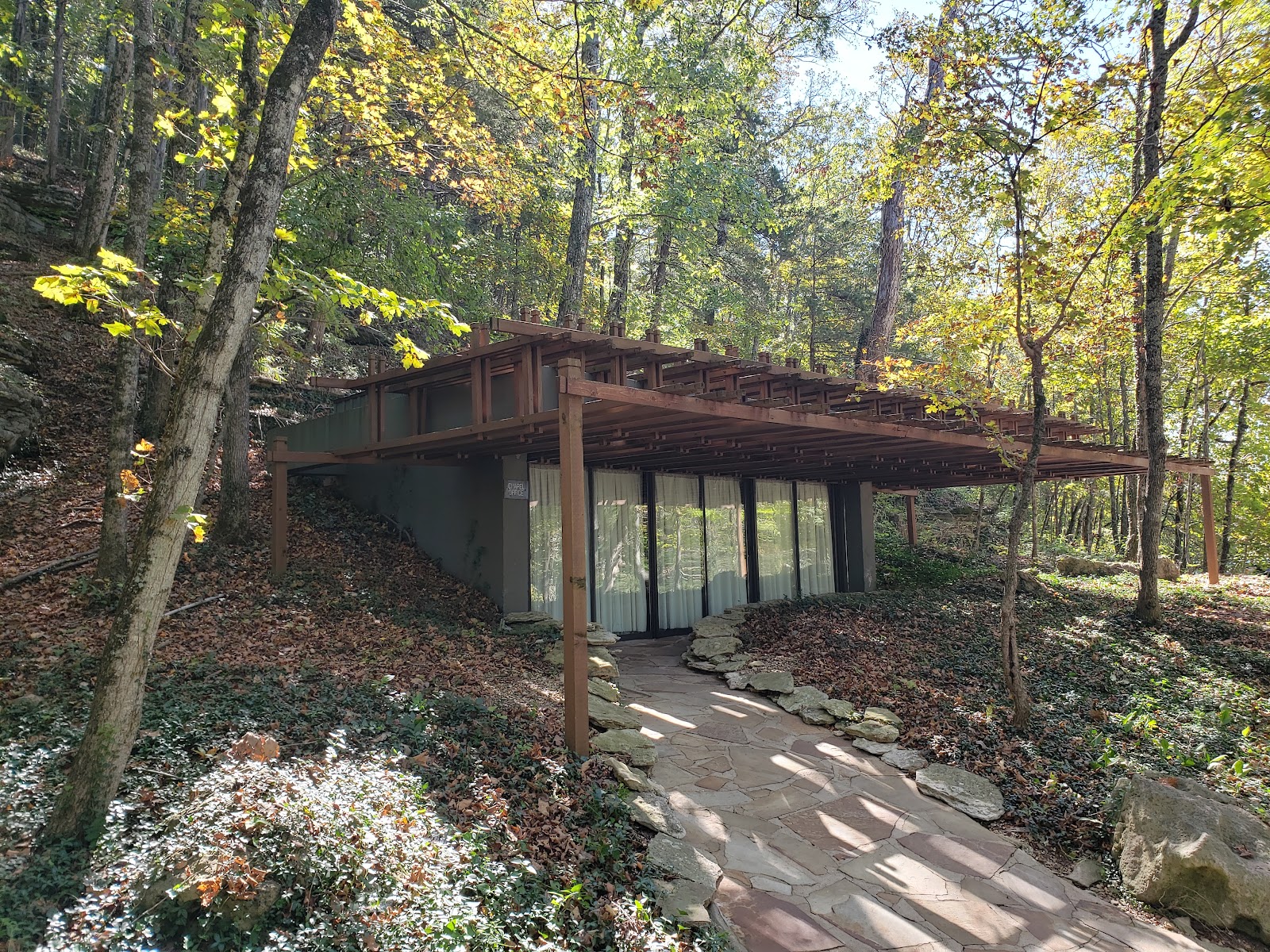
The terrain is the region’s other distinguishing feature and it is extreme. Eureka Springs is built on very steep ground, with streets at multiple levels and buildings whose entrances are storeys apart front and back — which means there are viewpoints above and below almost everything, and a subject can be photographed from a genuinely elevated or genuinely low position without any equipment. That is unusual and worth using.
The steepness also means deep hollows, and deep hollows with moisture in them produce morning fog readily. Fog is diffusion at landscape scale — it separates successive treelines into grey layers and gives a frame no clear morning does — and at a glass building it does something specific: it makes the forest behind the glass a soft pale field instead of a busy detailed one, which solves the background problem outright. A foggy morning here is the best condition the building gets after overcast.
Spring is the region’s best planting season and it is short: dogwood and redbud through late March and April, plus a canopy that has not yet closed, which means more light reaches the ground and the dappling is at its mildest. For this building that matters twice, because a thinner canopy means less dapple inside as well as out.
Summer is hot and genuinely humid, and the humidity rather than the heat is the photographic fact: moist air scatters light, softening shadows. Severe afternoon thunderstorms are a real possibility, which at a glass building in woodland is a matter for whoever is responsible for the party rather than a photographic question. The fogging problem is severe in this climate: a body carried from an air-conditioned vehicle into July air fogs on every surface at once, so a bag opened twenty minutes early is the whole fix.
Autumn is the other good window and the stronger one for the surroundings: Ozark colour usually peaks from late October into the first week of November, and a glass building with turning hardwood on every side is the most saturated version of it there is.
Winter strips the canopy, which changes the building completely: far more light reaches it, the dappling problem disappears, and the background becomes bare branch structure rather than a busy green field — which is graphic, open and arguably the most legible the architecture ever is. A December sun at about thirty degrees above the horizon also comes in at a low angle all day rather than from overhead.
More frames from The Thorncrown Chapel
The Thorncrown Chapel wedding photography: common questions
What makes this interior so difficult?
It has no walls, so it has no light of its own and no background of its own. Everything inside it is the forest arriving through glass on every side.
What is the best condition?
Overcast. The canopy becomes a uniform filter rather than a stencil, which makes the whole building a very large soft box with no dappling at all.
Why is direct sun a problem?
Sun through a hardwood canopy and then through glass dapples the interior — and in a chapel during a ceremony you cannot move to escape it.
Can the background be changed?
No. Every direction is the same forest at the same distance, so the fix is optical: a long lens at a wide aperture reduces it to tone.
What about reflections?
They are on all four sides. Check the glass from the camera position before committing — and where they cannot be avoided, use them, because forest reflected alongside forest seen through is specific to this building.
When is the building at its most legible?
Winter. The bare canopy removes the dappling, admits far more light, and turns the background into branch structure rather than a busy green field.
More Arkansas venue guides
We are writing a photographer’s guide to every venue we would happily shoot in Arkansas. Here are three more, plus the full index:
- All Souls Chapel, Fayetteville: The Problem and Four Ways Out of It
- The Barn at the Springs, Garfield: A Walk Through the Site
- The Barn at Twin Oaks, Rogers: The Venue’s Own Logic
Planning a wedding at The Thorncrown Chapel?
Extraordinary, and genuinely hard. Tell us your date and we will scout the hour.