 Dry Tortugas National Park: A Walk Through an Island Fort
South Pointe Park, Miami Beach: A Walk Through the Site
The one place on Florida’s Atlantic coast where you can face west over water.
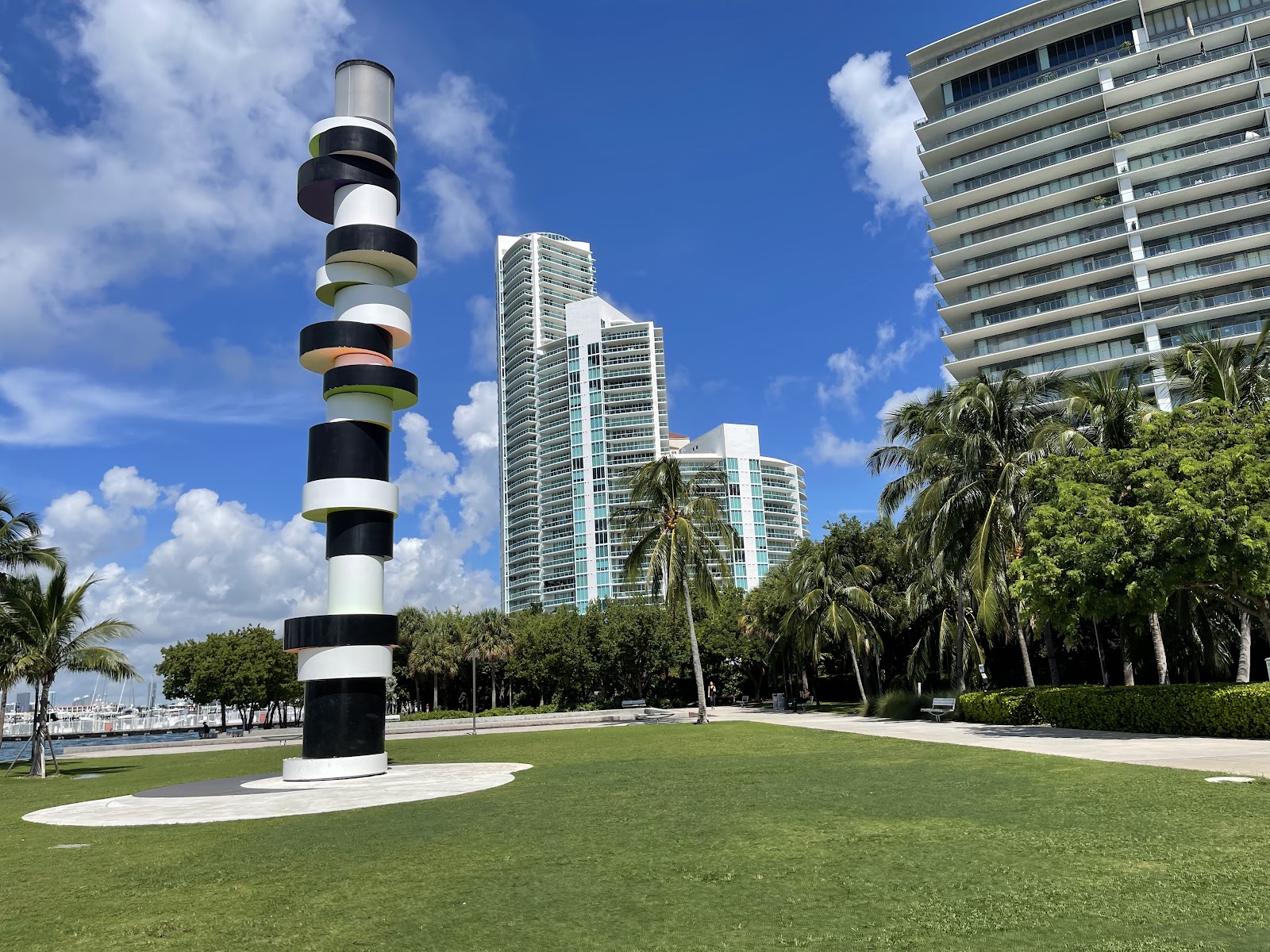
South Pointe Park occupies the southern tip of Miami Beach, and the reason it is worth a photographer’s attention is geographic rather than horticultural.
Every venue on Florida’s Atlantic coast faces east. The sun rises out of the water and sets behind the buildings, which means the sun-over-water frame belongs to dawn and the evening beach is lit by afterglow rather than by the sun. That is the rule for the whole coast and it is why so many beach-wedding expectations imported from the Gulf side do not survive contact with it.
The tip of a barrier island breaks that rule. At the southern end of Miami Beach the land narrows to a point with the open Atlantic to the east and the Government Cut shipping channel running west along its southern edge toward the bay and the mainland — which means from the point it is possible to stand on this coast and look west over water at a setting sun.
That single fact makes this a genuinely useful location rather than simply a pleasant one. It is the place on the Atlantic side of Florida where both ends of the day are available over water, and a walk out to the point moves through both of them.
The rest of the site is a designed waterfront park: lawns, a serpentine path, planting, hard landscaping, a long jetty, and a beach. It also has something no other park in this guide has — a working deep-water channel with cruise ships and cargo vessels passing at close range, which is a background that is both spectacular and entirely outside anyone’s control.
Miami Beach sits at about twenty-five and three-quarter degrees north, two degrees from the tropics. The June noon sun reaches roughly eighty-eight degrees — within two degrees of vertical, the highest in this guide — and even the December noon sun still reaches about forty-one.
We have not photographed a wedding at South Pointe Park. Whether ceremonies are permitted, what permit is required, which areas are available, what group sizes are allowed and what the hours are, are questions for the city — and at a public park those are rules rather than preferences.
South Pointe Park at a glance
| Where | The southern tip of Miami Beach, between the Atlantic and Government Cut |
| Why it matters | The one place on this coast where you can face west over water |
| The walk | Lawns, the serpentine path, the jetty, the point, the beach |
| The wildcard | A working shipping channel with vessels passing at close range |
| Ask first | Permits, permitted areas, group limits and hours — city rules |
The lawns and the path
Start at the landward end, because the lawns are the only part of the site with any shelter and they are where a ceremony would sit.
Open mown ground here behaves as open mown ground does everywhere, with one Florida amplification: at this latitude the summer noon sun is within two degrees of vertical, so between roughly ten and four in the warm months a face on the lawn has shadowed eyes and a lit forehead and there is no position that fixes it. The lawns are a morning and evening location, and treating them as an all-day one is the commonest mistake here.
What they do offer is level clean ground of generous size, which is what a group photograph needs. Everyone in the same light is the requirement — full open shade, full overcast, or full sun with the sun behind the camera — and level ground lets a large group be arranged in two or three ranks rather than a single line, with the ground behind them as clean as the ground they stand on.
The planting here is coastal and it divides the usual way. Sea grape holds large, round, leathery evergreen leaves in a dense mass and it blocks — which makes it the most useful plant on the site, giving soft reliable shade at any hour and a clean dark green field to stand a subject against. Palms do the opposite: a frond is a row of stiff parallel blades and its shadow at this sun angle is a set of hard stripes across a face. Use palms as vertical background elements and never as cover.
The serpentine path is the site’s designed gesture and it is a compositional resource rather than a route. A curve on the ground is a leading line, and a leading line only works from the right position — low enough that the curve reads as a curve rather than flattening into a stripe, and angled so that it arrives at the subjects rather than passing them.
Getting that wrong is easy and getting it right takes thirty seconds of moving the camera height. From standing height the path is a pale band; from a metre lower it sweeps.
The hard landscaping is the other designed element — stone and concrete edges, steps, walls, benches. Its virtue is neutrality: a plain stone or concrete surface is low in saturation, which makes it the most colour-neutral background on the site and therefore the kindest to a white dress and to skin. In a place full of blue water, blue sky and green planting, one plain grey field is worth locating.
The jetty, the point and the beach
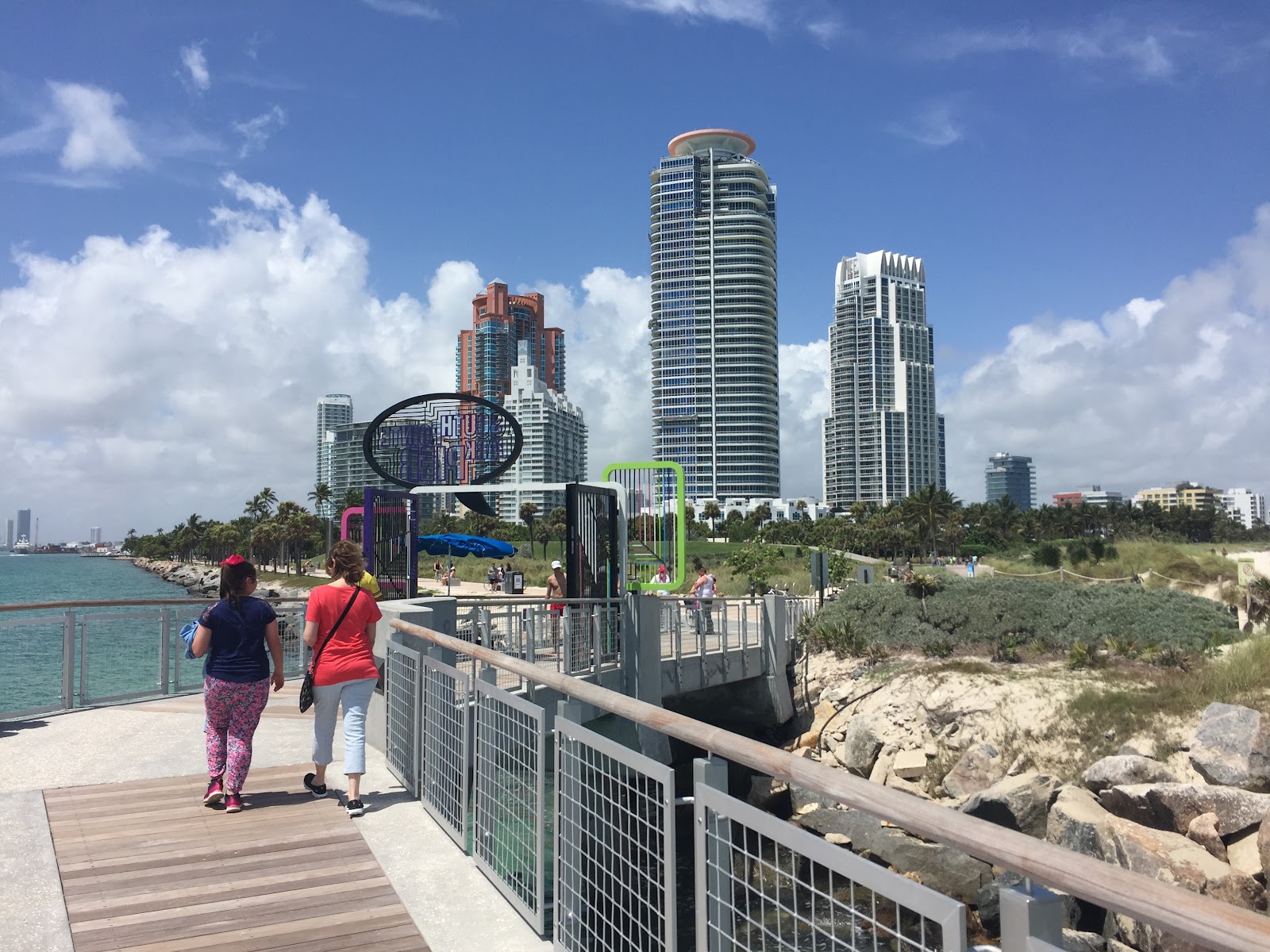
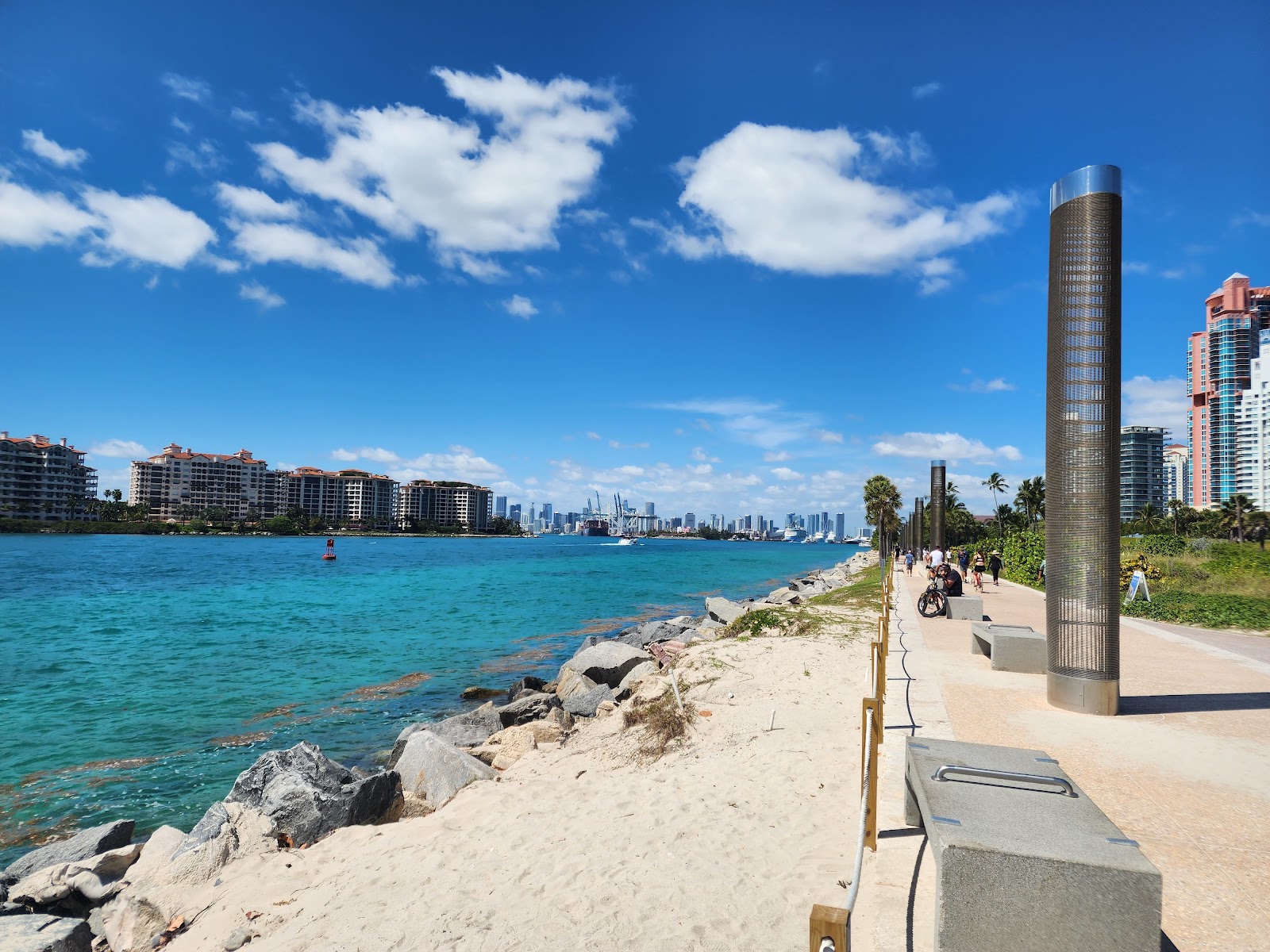
Walk out along the channel side and the character changes completely, because the water arrives on the south and the horizon opens west.
This is the part of the site that justifies the trip. Looking west along Government Cut in the last ninety minutes of the day gives a low sun over water on Florida’s Atlantic coast, which is otherwise not available — and it comes with a channel, a shoreline beyond it and, frequently, a large vessel in the frame.
The lighting problem there is the standard west-facing one: a subject in front of a setting sun is in front of the brightest thing in the frame, and the range can run to eight or ten stops. The three usable answers are the same as on any west-facing coast. Add a close warm-gelled source at a stop over the ambient on the faces and expose for the sky and the water. Expose for the sky alone and make a silhouette, which works unusually well here because a jetty gives a clean geometric base and a vessel gives a recognisable shape. Or turn around and use the low sun as a frontal key with the beach behind — the option that cannot fail and the one to take first when the window is short.
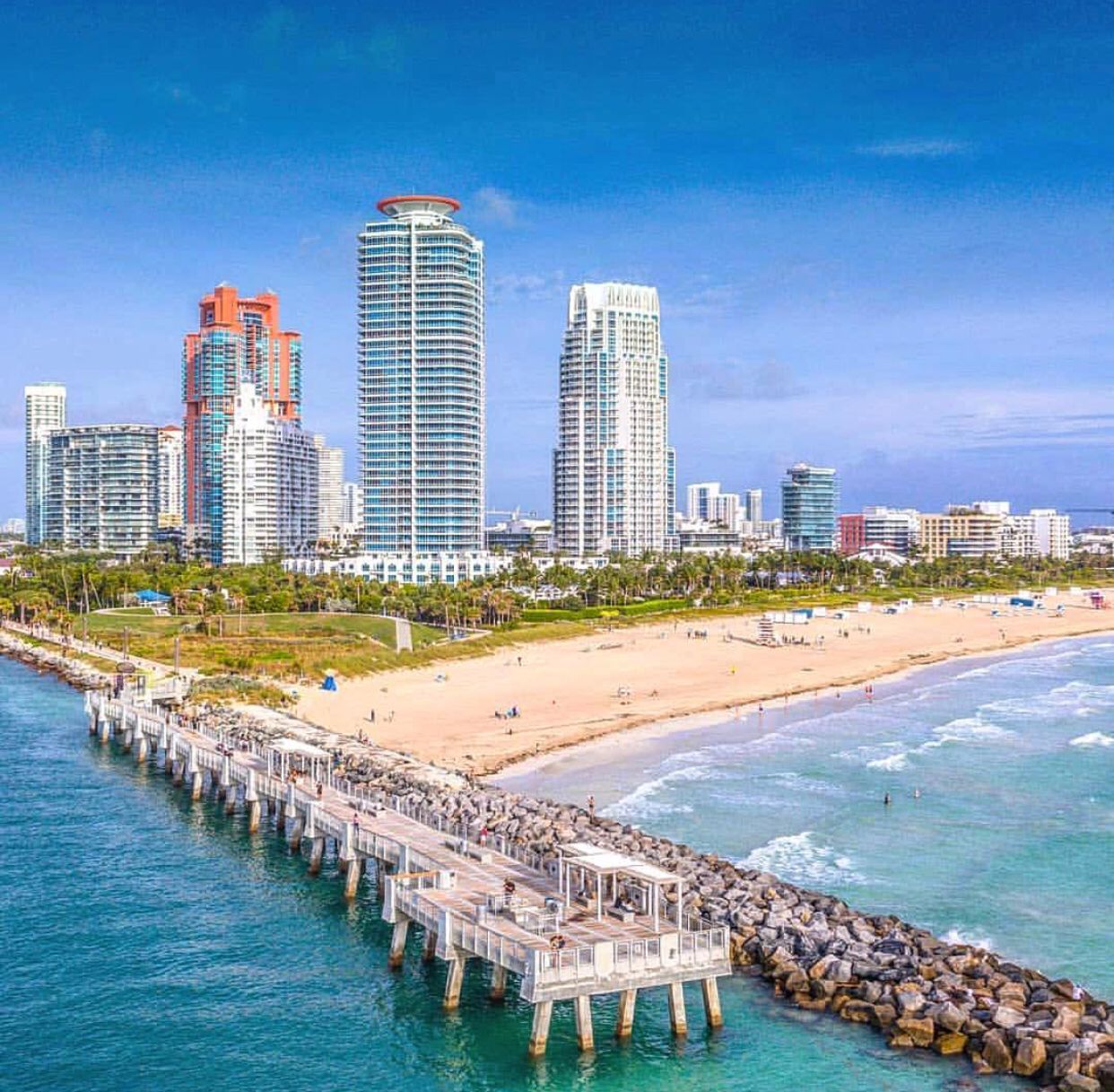
The jetty itself is the best structure on the site. It is a long straight line into water, which gives perspective, a place to put people that constrains and simplifies posing, and separation from everything on shore. The practical cautions are that it is narrow, hard-surfaced and exposed — which means a wedding party on it is single-file, the wind is unobstructed, and any light in use has to be handheld rather than standed.
The point is where the two waters meet and it is the one position from which both the Atlantic horizon and the channel are available by turning around. That makes it the most efficient place on the site: at the right hour a photographer standing there can take a frontally lit portrait, a backlit portrait, a silhouette and a wide landscape without moving.
The ships are the site’s wildcard. A large vessel passing at close range is a background of enormous graphic power and it is on nobody’s schedule — which means the working method is readiness rather than planning: know the frame you would take if one appeared, and have the couple somewhere that frame is possible. A cruise ship leaving in the evening light, with the couple small in front of it, is the most distinctive photograph this location produces.
It is also worth knowing that a large ship passing close in a channel displaces water, which can produce a noticeable surge along the shoreline a minute or two later. That is a practical caution for anyone standing at the water’s edge in wedding clothes rather than a photographic issue.
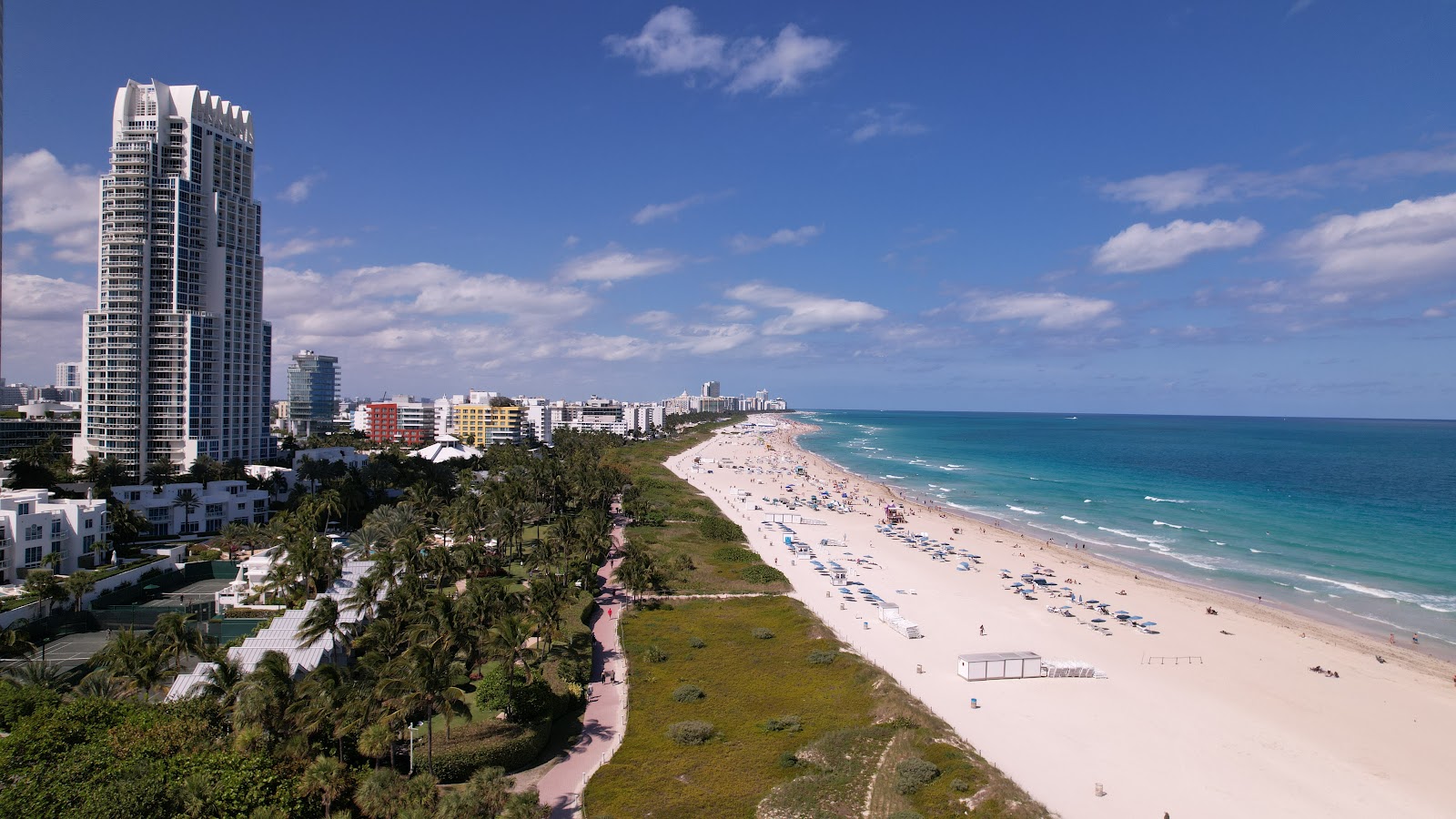
The beach on the Atlantic side completes the walk. It is broad, pale and groomed, and the sand is a very large low reflector — it fills under brows and chins, which is exactly where a near-vertical sun leaves people dark, and it is the reason a beach portrait here survives hours that would be unusable on grass. It also fools a meter: a frame full of bright sand and bright sky underexposes by a stop or more unless the compensation is deliberate and checked on skin.
The Atlantic side is east-facing, which means it belongs to the morning. A low sun coming straight out of the water into the subjects’ faces, on an empty beach, in the calmest air of the day, is the best portrait light the whole site offers — and it requires getting up for it.
And the site is public, in a busy part of a busy city. A frame that reads as private has to be composed to exclude what is beside it: a longer lens, a lower camera with sand or stone across the bottom, or a tighter crop. That is ordinary work, but it has to be planned rather than discovered.
- West along the channel is the only west-facing water on this coast
- Three answers to backlight: add light, silhouette, or turn around
- The jetty gives perspective and constrains posing; it is also narrow and windy
- Be ready for a ship rather than planning one
- The Atlantic beach belongs to the morning
The year at the tip of the island
Two seasons, and at the tip of a barrier island the difference is mostly about air and about what is on the sand.
The dry season, roughly November to April, is the strong half. Humidity drops, the haze clears, the daily storms stop, and the horizon over the Atlantic becomes a hard line rather than a soft band — which matters here because so many frames are looking out over water. The December noon sun still reaches about forty-one degrees, which models a face rather than flattening it, so the middle of the day is workable rather than merely survivable.
Days barely vary at this latitude: about ten and a half hours at the winter solstice, thirteen and three-quarters in June. The practical consequence is that the low light always arrives at a civilised hour, and in December the whole sequence at the point happens before six.
The wet season, roughly May to October, is hot and humid and the air is the problem. Dew points in the mid-twenties Celsius produce haze rather than fog — the Atlantic horizon softens, the far side of the channel loses definition, and every light blooms. Nothing recovers afterwards what the moisture removed.
It brings the afternoon convergence storm, formed where the sea breezes from the Atlantic and the Gulf collide over the peninsula and lift the air — the mechanism that makes this the most lightning-prone state in the country. At the tip of a barrier island, on a jetty or an open lawn, there is no cover of any kind, which makes an exposed summer ceremony a matter for a named alternative rather than for optimism.
The compensation is genuine. Towering convective cloud over the Atlantic, and the half hour after a cell passes offshore, give the most structured sky this site ever sees — and a park whose every wide frame is otherwise sky and water benefits from a sky with something in it more than almost any venue in this guide.
Hurricane season runs June to the end of November, peaking mid-August to mid-October, and at the tip of a barrier island that is a logistics and access question as much as a weather one.
Two local seasonal details belong here. Sargassum — free-floating brown seaweed carried in on the currents — reaches Atlantic-facing Florida beaches most heavily between roughly April and August, and in a heavy year it lines the high-water mark in brown windrows that framing does not hide. It varies enormously year to year and is worth a question close to the date rather than a worry months out.
And sea turtle nesting season runs on this coast from roughly March into October, which generally brings restrictions on lights and activity near the dune line after dark. For an evening session that is a real constraint, and it is a question for the city rather than something to find out on the night.
The planting gives no seasonal cue whatever — sea grape, palms and salt-tolerant shrubs look identical in January and July. Which leaves the clarity of the horizon as the only thing in a photograph here that says what month it is, and it says it very plainly.
More frames from South Pointe Park
South Pointe Park wedding photography: common questions
Why is this location unusual?
It is at the tip of a barrier island, so the Government Cut channel gives a west-facing water view on a coast that otherwise faces entirely east.
Where does sunrise and sunset each belong?
Sunrise on the Atlantic beach on the east side; sunset looking west along the channel. Both are over water, from one property.
How do I handle the backlight at sunset?
Add a close warm-gelled source and expose for the sky; or expose for the sky alone and silhouette; or turn around and use the low sun frontally.
What about the ships?
Be ready rather than plan. A large vessel passing at close range is the most distinctive background here, and it is on nobody’s schedule.
Where is the usable shade?
Under sea grape, whose dense leathery evergreen mass blocks well. Not under palms, whose fronds throw hard stripes.
Which season is best?
November to April. Clear dry air gives a hard Atlantic horizon and a defined channel, and the sargassum season has passed.
More Florida venue guides
We are writing a photographer’s guide to every venue we would happily shoot in Florida. Here are three more, plus the full index:
- The Vinoy, St. Petersburg: One Frame and How It Is Made
- Vizcaya Museum & Gardens, Miami: A Walk Through the Site
- The Casa Monica Hotel, St. Augustine: One Frame, and How It Is Made
Planning a wedding at South Pointe Park?
The only west-facing water on this coast. Tell us your date and we will walk out to it.