 Dry Tortugas National Park: A Walk Through an Island Fort
The Vinoy, St. Petersburg: One Frame and How It Is Made
The whole evening turns on about ten minutes when the sky and the floodlighting agree.
There is one frame at the Vinoy that is worth planning the evening around, and it is easier to describe by building it than by admiring it.
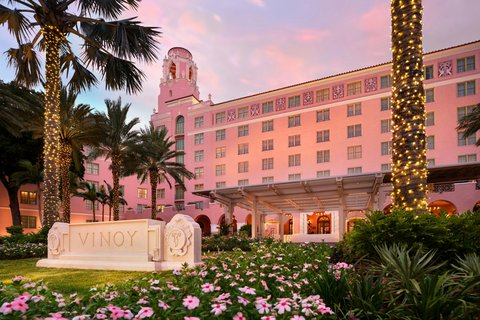
The frame is this: the couple in the foreground on the waterfront side, the ochre-pink façade rising behind them, the building’s own lighting on the stonework, and a deep blue sky behind that. It is a simple picture and it is made of three exposures that have to agree — the people, the building, and the sky — and they agree for about ten minutes a day.
Understanding why they agree only briefly is most of the skill. A building’s floodlighting is a fixed quantity: it comes on at dusk and it stays the same all night. The sky is not fixed. It falls by roughly a stop every few minutes through twilight and it does not stop until it is black.
Early in that fall the sky is far brighter than the façade lighting, so an exposure for the sky leaves the building dark and grey. Late in it the sky is far darker, so an exposure for the building gives a black rectangle behind it, which is the picture everybody has seen and nobody remembers. Between those two states is the crossing point where the lit stone and the sky sit within about a stop of each other, and both hold colour at once. That is the frame.
At twenty-seven and a half degrees north, the crossing point comes and goes quickly. The sun descends at a steep angle rather than sliding along the horizon, so civil twilight here runs a little over twenty minutes against thirty-five or more in a northern state. The window is genuinely about ten minutes, and it is not negotiable.
We have not photographed a wedding at the Vinoy. Which spaces are included, what the waterfront access allows, whether the exterior lighting is on a schedule and what the hours permit are questions for their team — and the lighting schedule is the one that decides whether this frame is possible at all.
The Vinoy at a glance
| Where | A 1920s waterfront hotel in downtown St. Petersburg, Florida |
| The frame | Couple, lit facade, deep blue sky — all within about a stop |
| The window | Roughly ten minutes, once, per evening |
| Why so short | At this latitude the sun sets steeply; civil twilight is about twenty minutes |
| Ask first | Whether and when the exterior lighting comes on |
Building the frame
Scout the position in daylight. In the dark there is no time to discover that a palm is in the way, that the best camera position is across a road, or that the façade is partly obscured from every point a tripod will fit.
The scouting question is narrow: from where does the building read as a single coherent shape with room beneath it for two people at a workable size? A hotel of this period is long, which means the whole façade at once puts the subjects at ant scale. The usable version is a section of the building — a corner, a tower, a central bay — treated as the whole thing.
Decide the focal length at the same time. Wide includes more building and leans it backward, which is expressive and slightly unflattering to the architecture; longer compresses, keeps the verticals nearer to true, and pushes the camera position back — which may or may not be possible depending on what is behind. Establishing that before dark converts the ten minutes into shooting time rather than searching time.
Expose from the sky down. The sky is the element that moves, so it sets the pace: meter it, choose the value that keeps it blue rather than grey — usually a stop or so under a neutral reading — and then check the lit stone against that. Early it will be too dark. Wait. When the stone comes up to within a stop of the sky, the frame is live.
The subjects are the third exposure and they need their own light, because neither the sky nor the floodlighting will do anything useful for faces at that distance. A single source close to the couple, a stop or a stop and a half above the ambient falling on them, does the whole job. Close, because fall-off is the only way to light two people without also lighting the twenty metres of paving around them.
Gel it warm. The sky at that point is a strong blue and the façade lighting is warm, so a daylight-balanced flash puts a cold pair of faces into a warm-and-blue picture and reads instantly as artificial. A warming gel on the source and a white balance set for the building brings the faces into the same world as the stone.
Give the couple something to do that holds still. Ten minutes is enough for three or four setups only if the people are not being rearranged between each one — so the sequence is: a still, close pose for the sharp frame; the same position from further back for the full-building version; one with movement for the frame that shows they are people; and one without the couple at all, because the building at that moment is worth a photograph on its own.
The rest of the day, and the rest of the building
One frame does not make a wedding, and the rest of the property has a shape worth knowing.
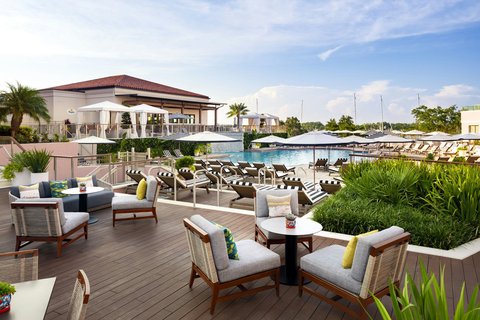
The waterfront faces roughly east across Tampa Bay, which decides a great deal. The sun rises over the water and sets behind the town, so the classic sun-over-water picture here belongs to the morning, and in the evening the bay is lit by the afterglow rather than by the sun. That afterglow is even and cool and it is exactly what makes the blue-hour frame described above work — the sky behind the building is not competing with a setting sun.
In the middle of the day the property behaves like every Florida venue of its type. St. Petersburg sits at about twenty-seven and a half degrees north, which puts the June noon sun near eighty-six degrees — effectively overhead — and makes open ground unusable for portraits between roughly ten and four in the summer months.
The compensations are architectural. A hotel of this period was built with covered walks, arcaded entrances, porte-cochères and deep loggias, all of which are directional soft sources with rapid fall-off, and all of which work the same way: the further back from the opening, the higher the ratio and the darker the background. Two or three metres in is where the free studio portrait lives.
The interiors are the other half of the day. High ceilings, deep-set windows and heavy finishes mean the ambient is well below what the eye reports, the windows are effectively the only light, and the drop from a face at a window to the wall behind it is often three stops or more. That fall-off is the asset. Meter on skin, let the room go.
A long corridor with a window at the end is the sleeper location in any hotel of this vintage, and it is reliably better than the room it leads to.
Ballrooms need the same treatment as every ballroom: warm low ambient, chandeliers reading as hot points, a room that absorbs. Gel warm, balance for the room, light the people and let the ceiling volume go dark rather than trying to fill it.
Downtown is the other resource and it is a different kind of place from the hotel. A waterfront park edge, a pier, a row of storefronts, a mural — these give the visual variety a single historic building cannot, and the contrast between the two is worth more than another angle on the façade. The practical limitation is mixed artificial light after dark, which needs either one dominant source chosen and balanced for, or enough flash to override the mixture entirely.
And the recurring Florida problem applies here as much as anywhere: in the wet season an air-conditioned lobby sits far below the outdoor dew point, so glass carried out onto the waterfront fogs at once and clears in ten to twenty minutes. On an evening built around a ten-minute window, that is the failure mode to guard against — the camera goes outside and stays outside well before the light arrives.
- Scout the camera position and the focal length in daylight
- Meter the sky, wait for the stone to come up to within a stop
- Light the couple close, warm-gelled, a stop above ambient
- Four setups in ten minutes, without rearranging the people
- Take the camera outside long before the window opens
The season, and when the window is best
The blue-hour frame is available all year, but it is not equally good all year, and the difference is the air.
In the dry season, roughly November to April, humidity drops and the atmosphere clears. That matters for this frame more than for any other kind of picture, because a long twilight exposure is looking through several hundred metres of air at a lit surface and a coloured sky. Clear air gives a saturated blue, crisp edges on the stonework and clean separation between the building and the sky. It is the best version of the frame and it is not close.
The dry season also brings an earlier sunset, which is a practical convenience at a wedding: the crossing point arrives around six in December rather than after half past eight in June, which means it lands during the reception rather than after most of the guests have settled in.
The wet season, roughly May to October, works against every part of it. Dew points in the mid-twenties Celsius produce haze — not fog, but a suspension that lowers contrast at distance and puts a visible bloom around every light on the building. The blue of the sky is paler, the stone is less defined, and the floodlights flare.
None of that makes the frame impossible. It makes it softer, and the honest response is to move closer so there is less air between the camera and the building, rather than to try to recover contrast afterwards.
The wet season also brings the afternoon storm, and it has a mechanism: sea breezes from the Gulf and the Atlantic push inland and collide over the peninsula, lifting air and building cells that arrive in the afternoon and early evening with some regularity. That is why Florida’s interior records more lightning than anywhere else in the country.
For an evening frame this cuts both ways. A cell sitting over the bay at dusk cancels the window entirely. A cell that has just passed produces the single best version of it — a broken sky still holding colour, wet paving returning the façade lighting, and an unusually long crossing point because cloud slows the sky’s fall.
Hurricane season runs from June to the end of November and peaks from mid-August into mid-October, which belongs in the planning conversation for any late-summer date on this coast.
The tidal range on Tampa Bay is small, generally well under a metre, which means the waterfront composes the same way all evening and a position scouted at four still works at eight. That is a convenience worth having when the schedule is this tight.
The vegetation offers no seasonal signal — palms and evergreen shrubs look the same in January as in July — so in this state the only thing in a photograph that says what time of year it is is the light itself. Which is a reasonable argument for making the frame that depends most on the light the one the whole evening is built around.
More frames from The Vinoy
The Vinoy wedding photography: common questions
What is the frame?
The couple in front of the lit facade with a deep blue sky behind — the three exposures agreeing for about ten minutes at dusk.
Why only ten minutes?
The floodlighting is constant and the sky falls about a stop every few minutes. They cross once. At this latitude the whole twilight is only about twenty minutes.
How do I expose it?
Meter the sky and keep it about a stop under neutral so it stays blue. Wait until the lit stone comes up to within a stop of it. Light the faces separately.
Why gel the flash?
The sky is deep blue and the building lighting is warm. An ungelled source puts cold faces into a warm frame and reads as artificial immediately.
Which way does the water face?
East, across Tampa Bay. Sun over water belongs to sunrise here; the evening sky is afterglow, which is exactly what this frame needs.
When is the frame at its best?
The dry season, November to April. Clear air gives a saturated sky and defined stonework, and the crossing point arrives early enough to fall inside the reception.
More Florida venue guides
We are writing a photographer’s guide to every venue we would happily shoot in Florida. Here are three more, plus the full index:
- Vizcaya Museum & Gardens, Miami: A Walk Through the Site
- The Casa Monica Hotel, St. Augustine: One Frame, and How It Is Made
- The Hyatt Regency Grand Cypress, Orlando: The Light Through the Day
Planning a wedding at The Vinoy?
Ten minutes decide the evening. Tell us your date and we will be standing there for them.