 The Tlaquepaque Arts Village, Sedona: Field Notes on Courtyards
The Sanctuary Resort, Paradise Valley: Field Notes
Built into a slope, in glass. Both facts matter.
These are notes on a specific kind of desert property: mid-century modern, terraced into a mountainside, and built substantially of glass.
Each of those three things sets a problem. The slope means the ground is never level and sightlines change with every step. The modernism means clean geometry that is unforgiving of a careless horizon and generous to a careful one. And the glass means interiors that are bright, reflective and directional in ways a masonry building is not.
The location adds a fourth. The north slope of Camelback Mountain faces away from the noon sun, which changes the whole light budget of the property: north-facing terraces get soft indirect light most of the day and direct sun only at the very ends, while the mountain itself rises behind rather than in front.
Paradise Valley sits at about thirty-three and a half degrees north at roughly thirteen hundred feet on the north slope. The June noon sun reaches around eighty degrees, the December noon sun about thirty-three, and civil twilight is about twenty-five minutes — short enough that the end of the day needs to be rehearsed rather than improvised.
The Sonoran Desert fact that governs everything outdoors applies here as everywhere in the low desert: there is no solid natural shade. Palo verde and mesquite have tiny leaves and open branching, which produces a fine moving dapple rather than cover. Every usable shade on this property is built or is the mountain’s own shadow.
What follows is four problems and what solves each. We have not photographed a wedding here; the specific terraces, the lawn positions and what is included are questions for the resort.
The Sanctuary Resort at a glance
| Where | A mid-century resort terraced into the north slope of Camelback Mountain |
| Problem one | A slope: no level ground, and sightlines change every few steps |
| Problem two | Glass: bright, reflective, directional interiors |
| Problem three | A north aspect: soft light most of the day, sun only at the ends |
| Problem four | No natural shade — and twenty-five minutes of twilight |
Problem one: the slope
A property terraced into a mountainside has no level ground, and that produces a specific and constant photographic difficulty: the camera’s horizon and the building’s lines disagree.
On flat ground a level camera renders vertical walls vertical and horizontal edges horizontal, and the frame reads as stable. On a slope, a level camera renders the ground as a diagonal and the building’s terraces as a set of stepped diagonals — and the eye, which reads verticals as the reference, decides the picture is tilted even though it is not.
The solution is not to tilt the camera to match the slope, because that puts the walls off vertical and produces a worse problem. It is to compose so that a strong vertical is present in the frame — a post, a doorframe, a corner, a standing figure — which gives the eye its reference and lets the diagonal ground read as slope rather than error.
The second consequence of terracing is more useful than problematic: the levels put the camera above or below the subject without any effort. From a terrace edge the ground drops, which means a photographer standing one level up shoots slightly down at a group on the level below and gets clean separation and a landscape background rather than a wall of legs.
That is the strongest formal advantage this kind of property has, and it is worth walking the levels before the day to find the three or four positions where the drop is right. A group of thirty on a lawn photographed from a terrace above it is a frame no flat venue can produce.
The reverse position — camera low on a terrace below, subjects on the edge above — puts the subjects against sky, which is the cleanest possible background and works at any hour. It needs care with the lens: a wide lens from below stretches the nearest legs, so a moderate telephoto from further back is the right instrument.
The third slope consequence is practical. Ninety minutes of formal photography on a property with steps and gradients is physically demanding in the way a flat venue is not, and in desert heat it compounds. A route planned to move downhill rather than repeatedly up is a genuine kindness and it costs nothing to plan.
Problems two and three: glass and a north aspect
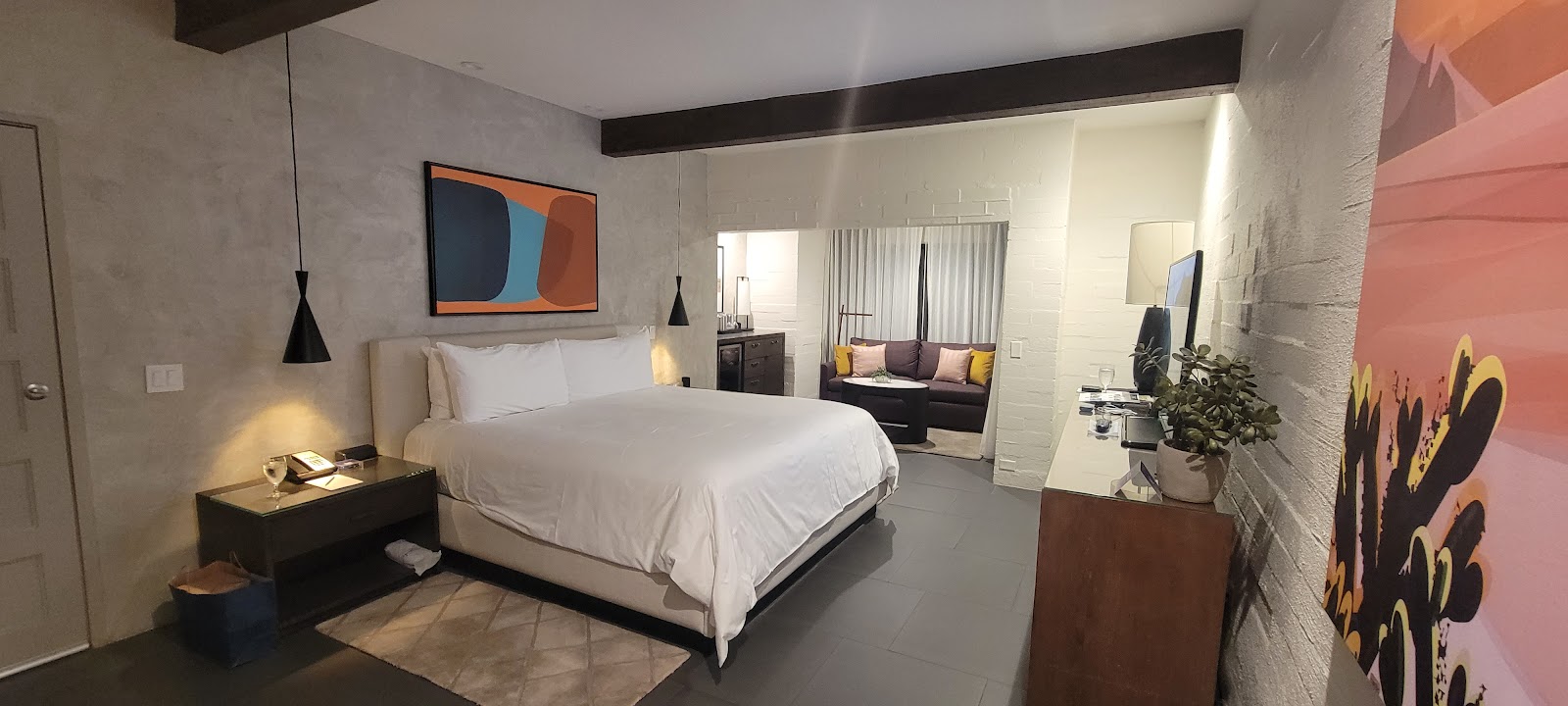
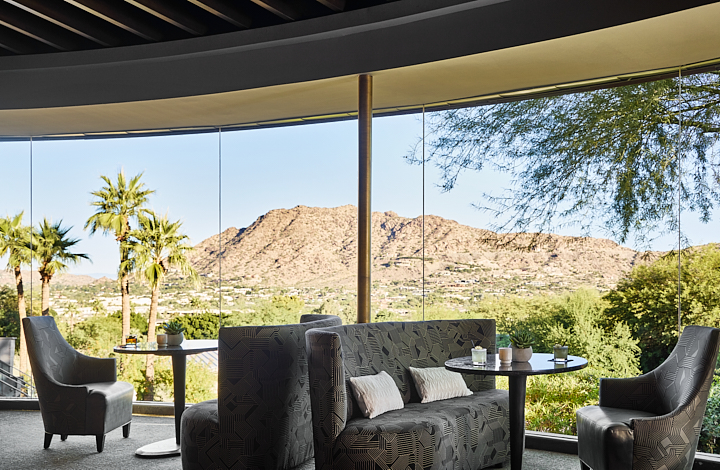
Mid-century modern desert architecture is largely glass on its view side, and glass sets two problems that masonry does not.
The first is reflection. A wall of glass photographed from outside shows whatever is behind the camera — the sky, the mountain, the photographer — rather than the room behind it, and at some angles that is more legible than the interior. The fix is angle: reflections are strongest near the specular angle and weakest when the camera is close to perpendicular to the glass, so a step sideways usually resolves what a polariser only partly can.
A circular polariser does help and it is worth carrying, but it works on reflections at intermediate angles and does almost nothing at forty-five degrees on a vertical surface. Angle first, filter second.
The second is that glass makes interiors directional in a way that reads as very good light. A room with one glass wall is lit by a single large source, which means a subject standing three metres in from it has clear modelling, a soft shadow edge and no top light — which is exactly what a portrait wants. That is the best unassisted light inside any modernist building and it needs nothing but a position.
The problem is the opposite wall. A single glass wall means the side away from it is very dark, so a group arranged along the glass is lit beautifully and a group arranged across the room has one end four stops down. Arrange parallel to the glass, not perpendicular to it.
And the exposure trap is the view. A camera metering an interior with a bright desert landscape through the glass will either expose the room correctly and blow the view to white, or hold the view and lose the room. Holding both means adding light inside to within about a stop and a half of the exterior, or accepting a blown window and composing so it is a shape rather than a hole.
The north aspect is the third problem and it is mostly a gift. A slope facing away from the noon sun is in the mountain’s own shade for the middle of the day, which means soft indirect light on the terraces from mid-morning to mid-afternoon rather than the brutal overhead sun the rest of the valley gets.
That is a real advantage in a climate where unmodified direct sun at eighty degrees of elevation is effectively unusable. A north-slope terrace at noon in June is one of the few places in the low desert where a portrait works without a modifier.
The cost is colour. Light on a north-facing surface in the desert comes almost entirely from the sky, and the desert sky at this latitude in this air is a deep saturated blue — which means north-slope shade is markedly cooler than shade in a humid climate, where the whiter sky gives a more neutral cast.
So warm-gel every source and set a warmer white balance than the meter suggests. An ungelled flash on a north terrace produces a face that reads yellow-green against a blue-shaded background, which is the single most common desert colour error.
The other cost is the ends of the day. A north slope loses the sun earlier in the evening than the valley floor, because the mountain is between the terrace and the setting sun for the last part of its arc — which means the golden light everyone wants may end fifteen or twenty minutes before civil sunset here. That is worth confirming on site rather than reading off an app.
- Put a strong vertical in every sloped frame to give the eye its reference
- Shoot from a terrace above a lawn group — the drop does the separation
- Arrange interiors parallel to the glass wall, never perpendicular to it
- Warm-gel everything: desert north-slope shade is markedly blue
- Confirm when the mountain takes the evening sun — it is earlier than the app says
Problem four: no shade, and a short dusk
The two remaining problems are the low desert’s rather than this building’s, and both are solved by preparation rather than technique.
There is no natural shade. This is worth repeating because photographers arriving from wooded regions plan around it without noticing. Palo verde, the significant tree of the low desert, has leaves a few millimetres long and photosynthesises through its green bark — an adaptation to drought that means it casts a filigree dapple rather than shadow. Mesquite is the same. Ironwood is slightly denser and still not cover.
So the shade on this property is the building, the mountain’s shadow and whatever is carried. A large collapsible diffuser held by one person is the difference between a usable midday portrait and none, and on a slope-built property with long sightlines it is often the only option in the middle of the day.
The mountain’s shadow is the useful free one, and on a north slope it arrives early in the afternoon and is enormous. The transition line — where the slope’s shadow meets sunlit ground below — moves visibly across the afternoon and it is a genuine compositional subject as well as a practical resource.
The dusk is short. Civil twilight at this latitude is about twenty-five minutes, which is among the shortest in these guides, and in the exceptionally clear desert air the fall-off is abrupt rather than gradual: usable light becomes unusable light in a span that feels like half what a temperate dusk gives.
The practical answer is rehearsal. Decide the two or three end-of-day frames before the light arrives, walk to the positions, and know which is first. Three planned setups fit into twenty-five minutes; two unplanned ones do not.
What the desert gives back in exchange is the colour. Low humidity and suspended dust scatter long wavelengths very efficiently, which makes a clear desert sunset more saturated than the same sun angle in a humid climate — and on a north slope the show is in the sky and on the opposing slopes rather than on the horizon, which is a different and arguably better frame.
Camelback itself is the subject at that hour. Red sandstone and conglomerate taking low light, and from the north slope the camera is on the mountain rather than looking at it — so the frame is the valley, the far mountains and the enormous sky rather than the rock. Compress it with a telephoto and expose for the sky.
The seasons reverse everything most of this guide assumes. The good season here is November to April: mild, dry, calm, with a December noon sun at thirty-three degrees that models all day. February to April adds the bloom — brittlebush yellow, Mexican gold poppy, ocotillo red, and palo verde in mass yellow through April, which is the strongest colour the low desert produces and which depends entirely on the previous winter’s rain.
May to September is the honest constraint. Phoenix afternoons above a hundred and ten degrees are a welfare matter for a party in formal clothes, and the north slope moderates that only slightly. The compensation is the monsoon from July: convective cloud building over the mountains, thunderstorms in the late afternoon, washed air afterwards and the best evening light of the year — and, unplannably, the haboob, a wall of dust advancing across the valley ahead of a collapsing cell.
October is underrated: the heat breaks, the air is at its clearest of the year, and the season has not started. There is no autumn colour in the low desert, so nothing in an October frame says October except the quality of the light — which is reason enough.
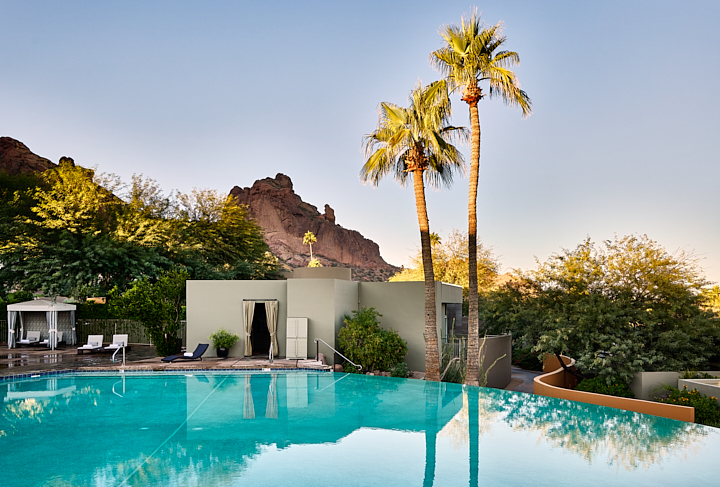
More frames from The Sanctuary Resort
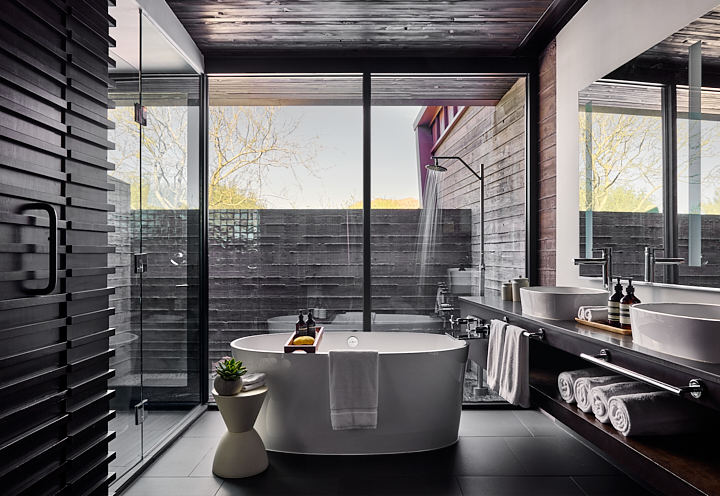
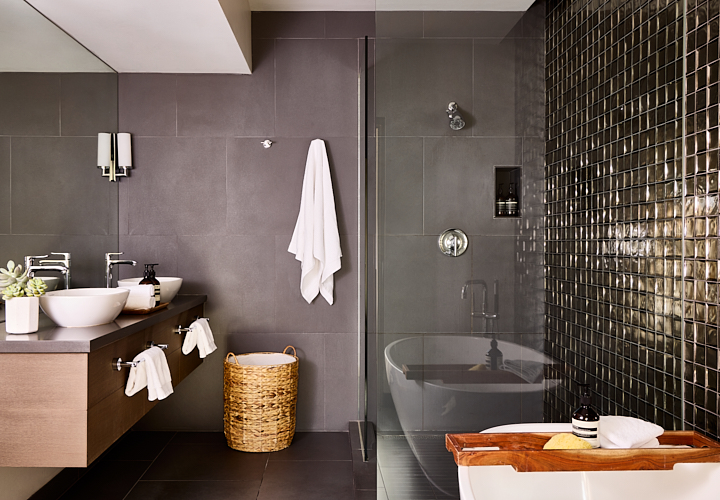
The Sanctuary Resort wedding photography: common questions
How do I handle the slope in frames?
Put a strong vertical in the composition — a post, a doorframe, a standing figure. That gives the eye its reference so the diagonal ground reads as slope rather than a tilted camera.
What is the slope's advantage?
Height without effort. Shooting from a terrace down onto a group on the level below gives separation and a landscape background that no flat venue can produce.
How do I photograph the glass?
Change angle before reaching for a filter — reflections are weakest near perpendicular. A polariser helps at intermediate angles and does little at forty-five degrees.
Why does a north slope help?
It is in the mountain’s own shade through the middle of the day, so terraces get soft indirect light when the rest of the valley has unusable overhead sun.
Why warm-gel everything?
North-facing desert shade is lit almost entirely by a deep blue sky, so it is much cooler than shade in a humid climate. An ungelled flash reads yellow-green against it.
How long is the dusk?
About twenty-five minutes of civil twilight, and the fall-off is abrupt in clear desert air. Rehearse two or three end-of-day frames rather than improvising them.
More Arizona venue guides
We are writing a photographer’s guide to every venue we would happily shoot in Arizona. Here are three more, plus the full index:
- The Silverleaf Club, Scottsdale: The One Decision That Governs Everything
- The StoneHouse Venue, Prescott: The Problem, and Four Ways Out of It
- The Vineyard at Florence: The Light Through the Day
Planning a wedding at The Sanctuary Resort?
A slope, a wall of glass and a short dusk. Tell us your date.