 The Tlaquepaque Arts Village, Sedona: Field Notes on Courtyards
The Red Rock Country Club, Sedona: The Problem, and Four Ways Out
Open ground in high desert has no shade worth the name. Four ways round that, and the rock supplies one.
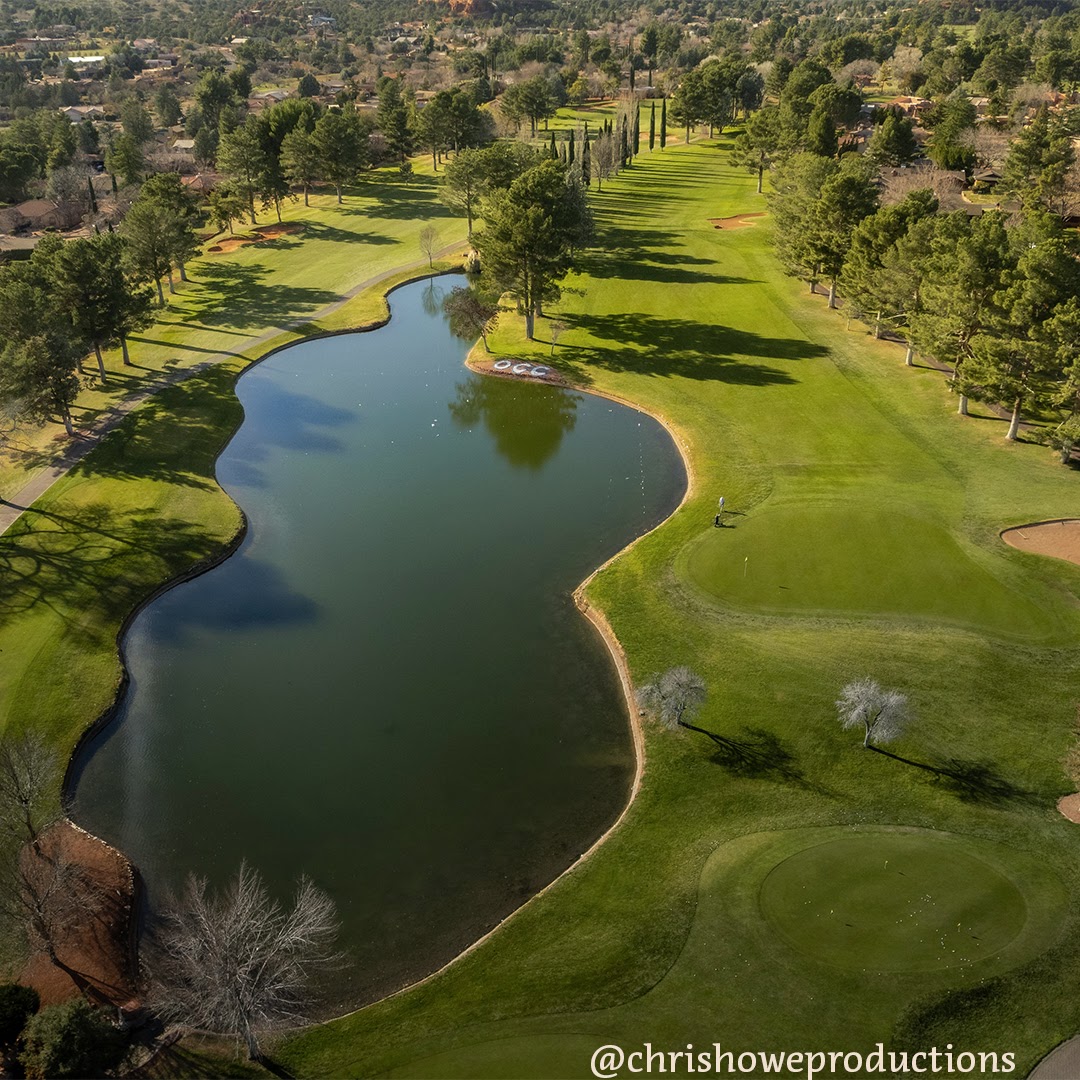
The central problem on open ground in Sedona is that there is no usable shade, and the sun is harder than it is at sea level.
The shade half is specific rather than general. The native trees here are juniper and pinyon pine — small, sparse and open-crowned — which means they filter light rather than blocking it. A juniper makes dappled shade, and dappled light puts bright patches and deep shadow on the same face at a ratio nothing holds. On a mown course with scattered juniper there is no equivalent of a dense hardwood canopy anywhere.
The sun half is altitude. At about four and a half thousand feet there is meaningfully less atmosphere overhead to scatter sunlight, so shadows are harder and deeper than the same sun angle gives at sea level, and with a June midday sun around seventy-eight degrees above the horizon it arrives close to straight down.
Put together, that makes the middle of a Sedona day genuinely unusable in the open, with no leafy escape. But there are four ways out, and one of them is the thing that makes this landscape famous.
We have not photographed a wedding at the Red Rock Country Club; high desert open ground behaves consistently. Which areas are available and when, what the covered alternative is, and whether the course may be used are questions for their team.
The Red Rock Country Club at a glance
| Where | Sedona, Arizona, at about 4,500 feet |
| The problem | No usable shade, and a hard high-altitude sun |
| Way one | Schedule it: the ends of the day and nothing in the middle |
| Way two | Use the rock as a light. Way three: the buildings |
| Way four | The monsoon clouds, which are the only diffusion here |
Ways one and two: the clock, and the rock
The first way out is scheduling and it is the honest one. An open high desert site is a morning-and-evening venue: the first hour after sunrise, the last hour before sunset, and the twenty-odd minutes after it. Everything between is either a shade exercise or a compromise, and no equipment changes that.
The last hour is where the value is, because that is when the whole landscape works. Low sun across mown ground gives it texture that midday flattens entirely; the mowing lines become graphic elements that either lead into a frame or cut across it depending on where the camera stands; and the rock formations are at their most saturated.
The first hour is the quieter equivalent and it has one specific advantage in this region: the air is at its stillest and clearest before the day’s heating, which means the long views hold detail. On a site whose backdrop is rock formations several miles away, that matters.
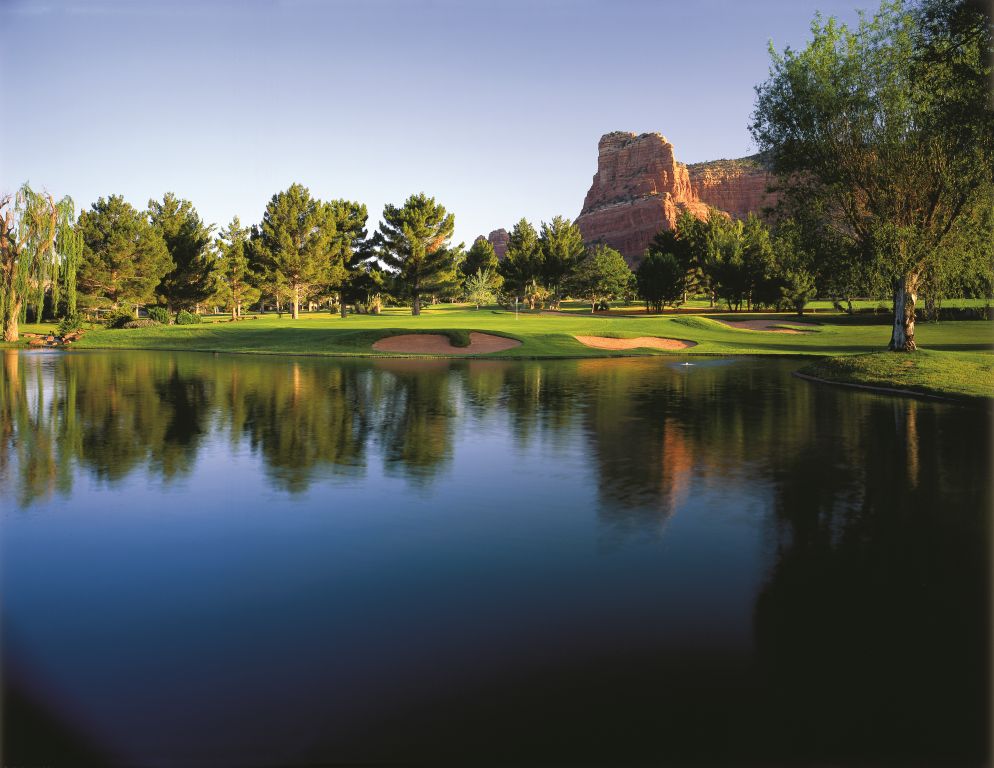
The second way out is to use the rock as a light source, and it is the thing that distinguishes this landscape from any other open site.
Iron-stained red sandstone is intensely warm and highly reflective, which means a sunlit rock face is an enormous orange light. On a course with formations around it, that gives a frame available nowhere else: a couple standing in shade or in flat light three or four metres out from a lit rock face, turned towards it, lit by a source the size of a cliff — soft because it is enormous, directional because it comes from one side.
It has a colour consequence that must be handled at the time rather than afterwards. Red rock bounce is far warmer than daylight, warmer than golden hour sun in its effect on skin, and there is no preset that renders it correctly. A custom white balance set on a face in the actual position is the fix; a daylight setting makes skin orange, and a global correction in editing neutralises the face and turns the rock a dull grey-brown.
Because the bounce arrives from one side only, a face can be warm on the rock side and cool on the other, lit by deep blue sky. No single white balance fixes that split, and the answers are to turn the couple so the rock light is more frontal, or to accept it as a warm-to-cool gradient — which in this landscape reads naturally.
The corollary is that any added source must be gelled strongly warm to sit anywhere near the rock bounce, with white balance set to that gel. An ungelled flash here is conspicuously wrong because it is so much cooler than everything else in the frame.
Ways three and four: the buildings, and the clouds
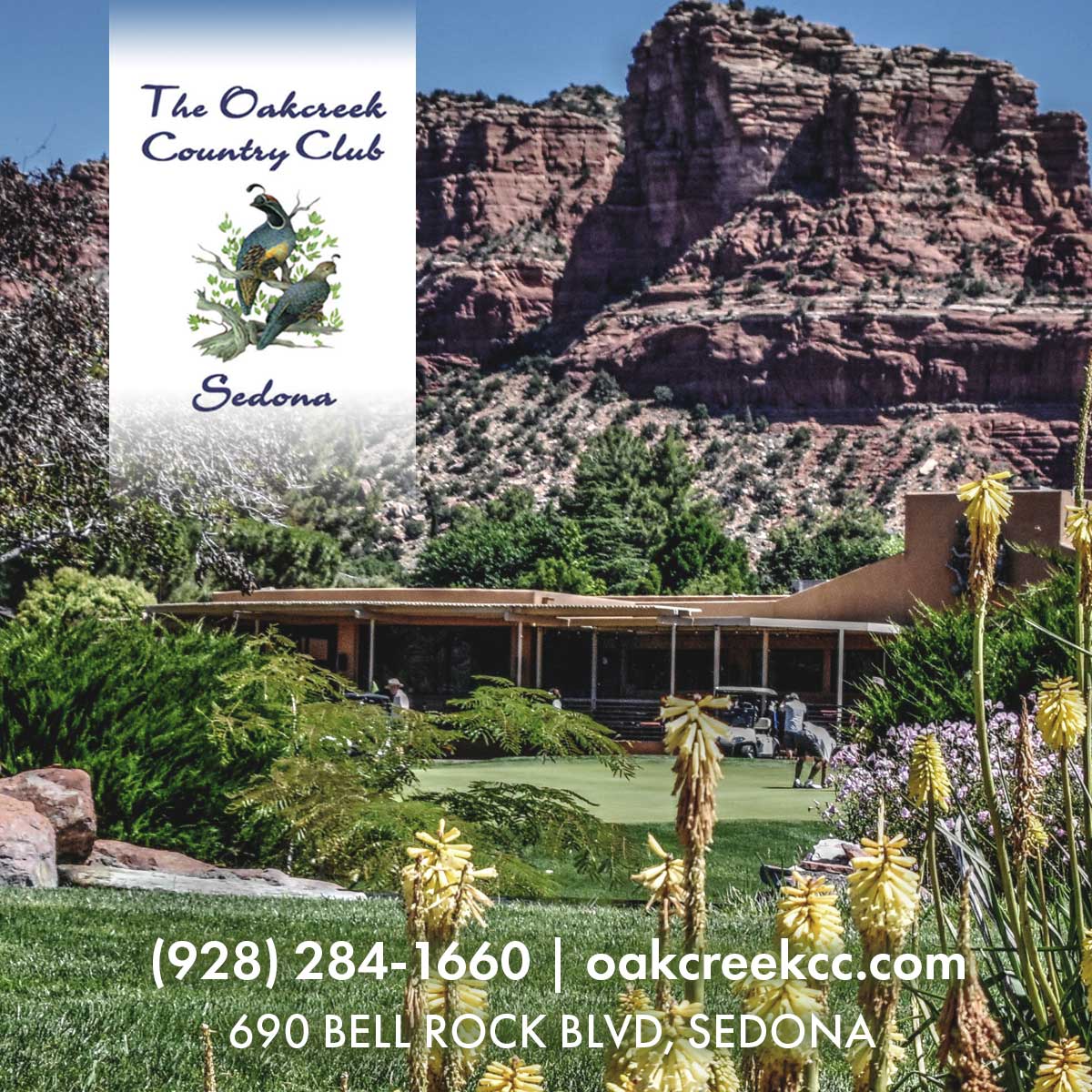
The third way out is the buildings, and on a club property there are usually several kinds of covered edge.
A covered terrace, a veranda, a colonnade or a porte-cochère all do three things at once: the roof blocks the overhead component of the sun, which is what shadows eye sockets; the depth restricts the light to a horizontal band, which is direction; and the floor bounces it back to fill under the chin. That is a balanced three-source setup occurring naturally, and it cannot dapple, because the roof is solid.
The working position is about a third of the way in from the open edge, and looking along a covered walk rather than out of it gives depth with the far end darkening by itself. In this landscape the floor is frequently warm-toned stone or flagging, which adds to the warm cast — the same custom white balance applies.
The north side of any substantial building is the other reliable shade: at this latitude it is shaded all day and it gives soft directional light with a solid wall doing the blocking rather than leaves.
Inside, a clubhouse in this region is typically light-coloured, glazed and evenly lit, which means the problem inverts to separation rather than darkness. A pale wall behind a face is as bright as the face and the picture flattens, which is fixed geometrically: five metres between subject and background rather than one, the darker end of the room, depth behind rather than a near wall, and a source brighter on the face than the room is on the wall.
Where a clubhouse has generous glazing, that is the best interior light — shaded side or overcast rather than direct sun, and about three metres back from the glass so a row of people is evenly lit rather than dropping two stops across it. And modern glazing in this climate is frequently coated for solar control, which throws a localised cast worth checking with one frame.
The fourth way out is the monsoon, and it is the only time this landscape supplies diffusion. From roughly July into September, afternoon moisture builds enormous cumulus towers over the high country — and under them the whole site becomes soft and even, the reds saturate rather than glare, and the middle of the day becomes usable for the only time in the year.
A monsoon afternoon is genuinely the best light Sedona produces, and it is worth working rather than waiting out. It also removes the timing problem entirely, because a diffused sky lights everything at once.
The hazard is real and it is the reason the alternative matters. These storms produce lightning, and open mown ground under a building storm is a genuinely dangerous place to be — more so on a course, where there is nothing higher than the people on it. A named covered alternative with a known capacity, agreed at booking, is a requirement, and the decision to use it belongs to whoever is responsible for the party rather than to whoever wants one more frame.
Outside the monsoon the sky is usually cloudless, which means waiting for diffusion is not a plan. The clock, the rock and the buildings are the plan.
- Treat it as a morning-and-evening venue; the middle of the day has no answer
- Three to four metres out from a sunlit rock face, turned towards it
- Custom white balance on a face — nothing else renders red rock bounce
- Covered terraces cannot dapple, because the roof is solid
- A monsoon afternoon is the best light of the year, and needs a named alternative
The Arizona year, and the practicalities
Winter is the quiet best of the year on open ground here, and for a reason specific to the landscape. The December midday sun at about thirty-one degrees above the horizon never gets high, which means it rakes both the mown ground and the rock all day rather than lighting them from overhead — so the texture and the colour are at their best through the whole short day rather than for an hour at each end.
That effectively removes the problem this piece is about: with a low sun, the midday shade crisis does not arise, and an open course becomes usable from morning to evening. It is the reverse of most people’s assumption about a desert venue.
Snow on red rock is occasional and it is the most striking frame the region offers, because white against saturated red is a contrast nothing else in American landscape provides. It rarely lasts a day, which makes it luck rather than planning.
The diurnal swing is the constraint and it is larger than people plan for: twenty degrees Celsius between afternoon and evening is normal at this altitude in dry air. A party comfortable at four o’clock is genuinely cold by seven, and on open ground with no shelter that is a welfare consideration rather than a preference — coats and heat, and short excursions.
Spring is windy, and in this landscape wind means dust: haze that flattens the long views, which on a site whose backdrop is distant formations is the specific thing it takes away, and grit that gets into everything. It also makes a lightstand a liability and a veil unpredictable, which given that nothing here breaks the wind is worth planning for — source in a hand or on a bracket.
April and May are otherwise excellent: mild, clear, with the air at its best before the summer heat.
Late May into June, before the monsoon, is the hardest period of the year: cloudless, hot, and with the sun at its highest, which makes the covered structures the entire plan and the open ground unusable in the middle of the day. A June wedding here is an evening wedding.
Autumn after the monsoon has passed — late September into October — is the other strong window: the air is at its clearest of the year, the temperatures are comfortable, and sunset falls at a civilised hour rather than late in the evening.
Three practicalities close it out. Ultraviolet is markedly higher at this altitude, so a party standing on open ground for an hour burns faster than expected, including under cloud — worth mentioning in advance rather than discovering. The dry air means less fogging than a humid climate, but the large evening temperature drop still condenses on a cooling body, so a bag opened early is the fix. And after dark there is an unusual opportunity, because Sedona has lighting restrictions to protect the night sky: the darkness here is genuine, which makes a frame of a couple under stars with rock silhouetted behind achievable rather than theoretical.
More frames from The Red Rock Country Club
The Red Rock Country Club wedding photography: common questions
Why is there no usable shade?
Juniper and pinyon are small and open-crowned, so they filter light rather than blocking it. There is no equivalent of a dense hardwood canopy on open ground here.
What is the honest answer to midday?
Scheduling. An open high desert site is a morning-and-evening venue, and no equipment changes the middle of the day.
How do you use the rock as a light?
Stand the couple three or four metres out from a sunlit face, turned towards it. It is a soft directional source the size of a cliff.
What white balance does that need?
A custom one set on a face in position. A daylight setting renders skin orange, and a global correction turns the rock a dull grey-brown.
Why can a covered terrace not dapple?
Because the roof is solid. It blocks the overhead component entirely and the floor bounces back to fill.
Is winter good on open ground here?
Quietly the best. A low December sun rakes both the mown ground and the rock all day, which removes the midday problem entirely.
More Arizona venue guides
We are writing a photographer’s guide to every venue we would happily shoot in Arizona. Here are three more, plus the full index:
- The Tlaquepaque Arts Village, Sedona: Field Notes on Courtyards
- The Boojum Tree, Phoenix: The Venue’s Own Logic
- The Cave at Lake Pleasant, Peoria: The One Decision That Governs Everything
Planning a wedding at The Red Rock Country Club?
Four ways round no shade. Tell us your date and we will use all four.