 The Tlaquepaque Arts Village, Sedona: Field Notes on Courtyards
L’Auberge de Sedona: A Walk Through the Property
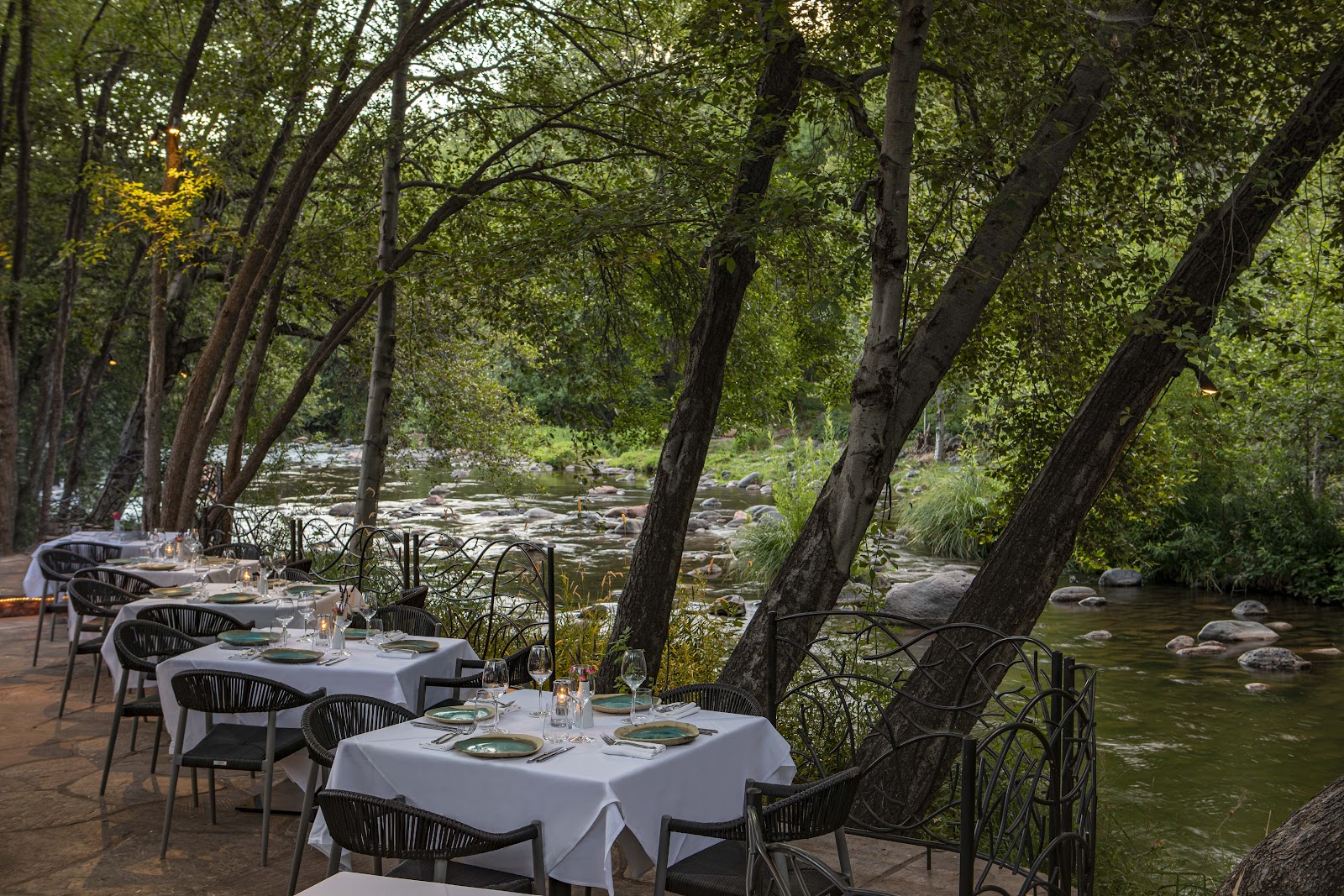
A green creek corridor under red rock cliffs. Two completely different environments, a few steps apart.
A resort built along a creek in a red rock canyon contains two environments that could hardly be less alike, separated by a few minutes’ walk.
The creek corridor is green, shaded and humid. Oak Creek supports sycamore and cottonwood — large deciduous trees with dense crowns — which means genuinely full shade, moving water, and a canopy that behaves like temperate woodland rather than desert.
The rock above is red, exposed and reflective. Iron-stained sandstone is intensely warm and highly reflective, which means a sunlit cliff is an enormous orange light source and shaded rock is a deep textured background.
Between them the buildings and terraces sit in a transition zone, taking light from both. Walked in the order a wedding day uses it, that produces a plan in which each zone does what it is good at: the creek for midday and for shade, the rock for the timed evening window, and the buildings for everything else.
This is that walk. We have not photographed a wedding at L’Auberge de Sedona; creek corridors and red rock canyons behave consistently. Which areas are included, what the creek access rules are, and what the covered alternative is are questions for their team.
L'Auberge de Sedona at a glance
| Where | Along a creek in a Sedona canyon, Arizona |
| The creek | Green, shaded, humid — genuinely full shade and moving water |
| The rock | Red, reflective, and the light source in the evening window |
| The buildings | A transition zone taking light from both |
| Ask first | Areas included, creek access rules, covered alternative |
The creek corridor
The creek is where a day here should start and where the middle of it should be spent, and the reason is that it solves the region’s central problem.
Sedona has very little usable shade. The native trees are juniper and pinyon pine — small, sparse and open-crowned — which means they filter light rather than blocking it, so they dapple rather than shade. Dappled light puts bright patches and deep shadow on the same face at a ratio nothing holds, and at this altitude with a high summer sun it is severe.
Sycamore and cottonwood are the exception. These are large deciduous trees with dense crowns, and a mature riparian canopy gives genuinely full shade over a substantial area — which in this landscape is rare and valuable. Ten minutes on arrival identifying which areas are fully shaded rather than merely leafy is the most useful ten minutes of the day, and the test is to look at a face rather than the ground: any bright spot means move a metre.
The canopy throws green onto skin from whichever side it is thickest, localised so global white balance cannot remove it — a custom white balance set on a face in the position being used is the fix, and a metre further from the foliage roughly halves it. That matters more here than usual, because the same day will involve red rock bounce a few minutes away, and the two casts are opposites.
The water does three things. It reflects, which doubles the canopy and any lit rock visible above — and camera height decides whether you get it, with low across the surface seeing a mirror and high looking down seeing a stony bed. Half a metre is the whole difference and low is the answer on a shallow creek.
It bounces light upward, filling exactly the shadows a high sun carves — so a shaded position beside water is materially better light than the same shade beside dry ground, which in this landscape is a real advantage.
And it moves, which makes shutter speed a deliberate choice: a long exposure turns the creek into a smooth field and strengthens reflections, a short one holds every drop. In bright daylight the long version needs a neutral density filter, and a polariser is worth carrying because water in sun throws specular highlights several stops above everything else, which clip and fool a meter. It comes off for the mirror frames, because it reduces reflections.
The frame the corridor gives that nothing else does is green canopy against red rock: sycamore leaves in the foreground with a lit cliff beyond, which is a colour pairing specific to this place and worth using deliberately rather than incidentally.
One practical caution: a desert creek is cold, its bed is uneven and its banks are loose, and flash flooding can arrive from rain falling miles away. Frames near water should be composed so nobody needs to stand in it, and a monsoon afternoon is not the time to be in a creek bed.
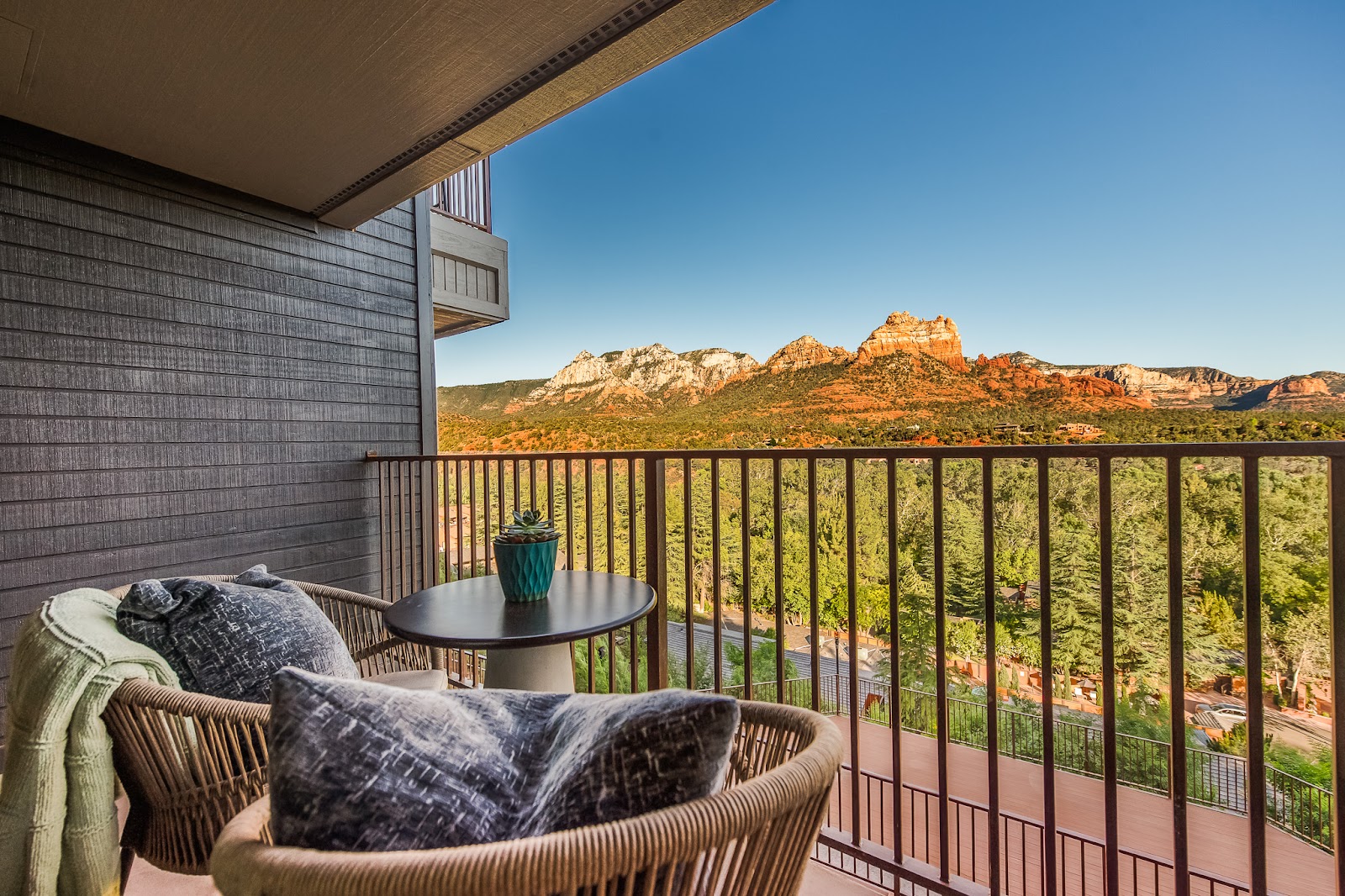
The buildings, the terraces, and the rock
The buildings sit in the transition zone and they take light from both worlds, which makes them more variable than they look.
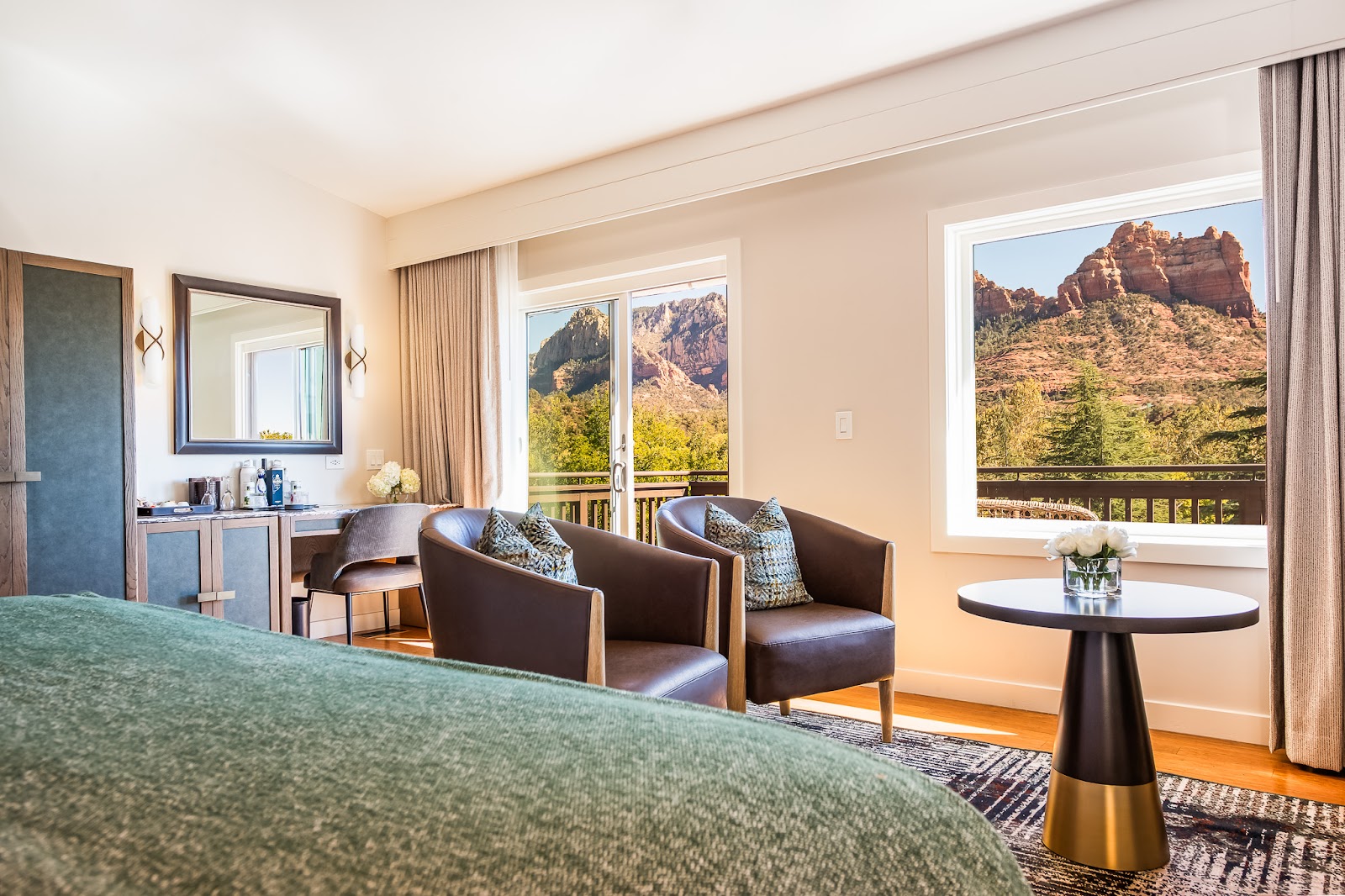
Cabins and rooms in a creekside resort are domestically scaled, which is an advantage: a window sized for a room is a soft source about right for two people at two or three metres, near walls return light into the shadow side, and a ceiling under three metres is a very large softbox when a flash is aimed at it. One test frame confirms the bounce, and a dark-stained ceiling absorbs.
Two to three metres back from the glass is the working distance, with every overhead and lamp fitting off so the room has one colour of light. And the orientation question here is unusual, because a window may be facing dense green canopy — which floods the room with green light — or lit red rock, which floods it with orange. Both need a custom white balance set on a face rather than a preset, and it is worth asking which way a room faces for that reason rather than for the view.
Terraces and covered structures are the reliable outdoor light and they work all day. A roof with an open face blocks the overhead component that ruins faces, restricts the light to a horizontal band, and bounces off the floor to fill under the chin. At a resort in this landscape the floor is frequently warm-toned stone or flagging, which adds to the warm cast — the same custom white balance applies.
The working position is about a third of the way in from the open edge, and looking along a terrace rather than out of it gives depth with the far end darkening by itself.
The rock is the fourth zone and it is the timed one. Because iron-stained sandstone is intensely reflective, a sunlit cliff is an enormous warm source — and the key window in a canyon is when the floor is in shade and a wall is still fully lit, because then the light arrives sideways off rock rather than down from the sky.
The frame is a couple three or four metres out from — or simply in the light of — a lit wall, with shaded rock behind them, and the camera positioned so the lit cliff is not in the frame, because it will be several stops brighter than a shaded face and will clip. A custom white balance on a face is essential: red rock bounce is far warmer than daylight, and a daylight setting renders skin orange while a global correction turns the rock grey.
The sun clears the canyon’s eastern rim late and drops behind the western one early, so the exact timing is local and specific — and the single most useful question to ask is when the sun leaves the floor and which wall is lit afterwards. The venue will know precisely for the date.
The crossing follows: sky still holding colour, rock going deep and blue-shadowed, the resort’s own lighting coming up. In dry desert air that twilight is shorter than in a humid climate, so it is a scheduled ten minutes rather than a wander.
And after dark there is an unusual opportunity, because Sedona has lighting restrictions to protect the night sky. The darkness here is genuine, which means a frame of a couple under stars with rock silhouetted behind is achievable rather than theoretical — a fast lens, a high ISO, an exposure short enough that the stars do not trail, and a very modest amount of light from close range.
- Start and spend midday in the creek corridor — it is the only real shade
- Test with the face, not the ground; any bright spot means move a metre
- Ask which way a room faces: green canopy and red rock flood it differently
- Terraces work all day; a third of the way in from the open edge
- Ask when the sun leaves the floor and which wall is lit after
The Arizona year
The monsoon is the region’s defining seasonal event and for a photographer it is a gift. From roughly July into September, afternoon moisture builds enormous cumulus towers over the high country, and those clouds are the only reliable diffusion this climate offers — soft directional light, saturated reds rather than glaring ones, and the most dramatic skies of the year.
At a creekside property the hazards are specific and serious rather than general. These storms produce lightning, and exposed rock is a dangerous place under one. And flash flooding in a creek bed can arrive from rain falling miles upstream with very little warning — which at a venue built along a creek is a matter for whoever is responsible for the party, not a photographic judgement. A named covered alternative is a requirement and it should be used rather than debated.
Outside the monsoon the sky is usually cloudless, so waiting for diffusion is not a plan. The creek canopy, the terraces and the evening rock window are the plan, and they are reliable.
Autumn is the creek corridor’s own season and it is short. Sycamore and cottonwood turn yellow and gold, usually from late October into November at this elevation — and yellow riparian canopy against red rock is the most saturated colour combination the region produces, more so than the summer green. The air is also at its clearest after the monsoon has passed.
Winter is the quiet best of the year for the rock. The December midday sun at about thirty-one degrees above the horizon never gets high, which means it rakes the sandstone all day rather than lighting it from overhead — so the red is at its most textured and saturated through the whole short day. And a low sun keeps the canyon walls lit for longer relative to the floor, which extends the key evening window.
The creek corridor in winter is bare, which changes it completely: far more light reaches the ground, the dappling problem disappears entirely, and the rock above becomes visible through the branches rather than screened by them. For a property whose subject is the relationship between creek and cliff, that is arguably the most legible it ever is.
Snow on red rock is occasional and it is the most striking frame the region offers, because white against saturated red is a contrast nothing else in American landscape provides. It rarely lasts a day, which makes it luck.
The diurnal swing is the constraint at altitude and it is larger than people plan for — twenty degrees Celsius between afternoon and evening is normal, and a canyon with a creek in it cools faster than open ground because it loses the sun earlier and holds cold air. A party comfortable at four is genuinely cold by seven, and coats and heat are the answer.
Spring is windy, which in this landscape means dust that flattens the long views and gets into everything. April and May are otherwise excellent: mild, clear, with the creek running well from snowmelt above and the canopy coming into new leaf, which is thin and translucent and the best green of the year.
And late May into June, before the monsoon, is the hardest period: cloudless, hot, with the sun at its highest — which makes the creek shade and the terraces the entire plan and the middle of the day unusable in the open.
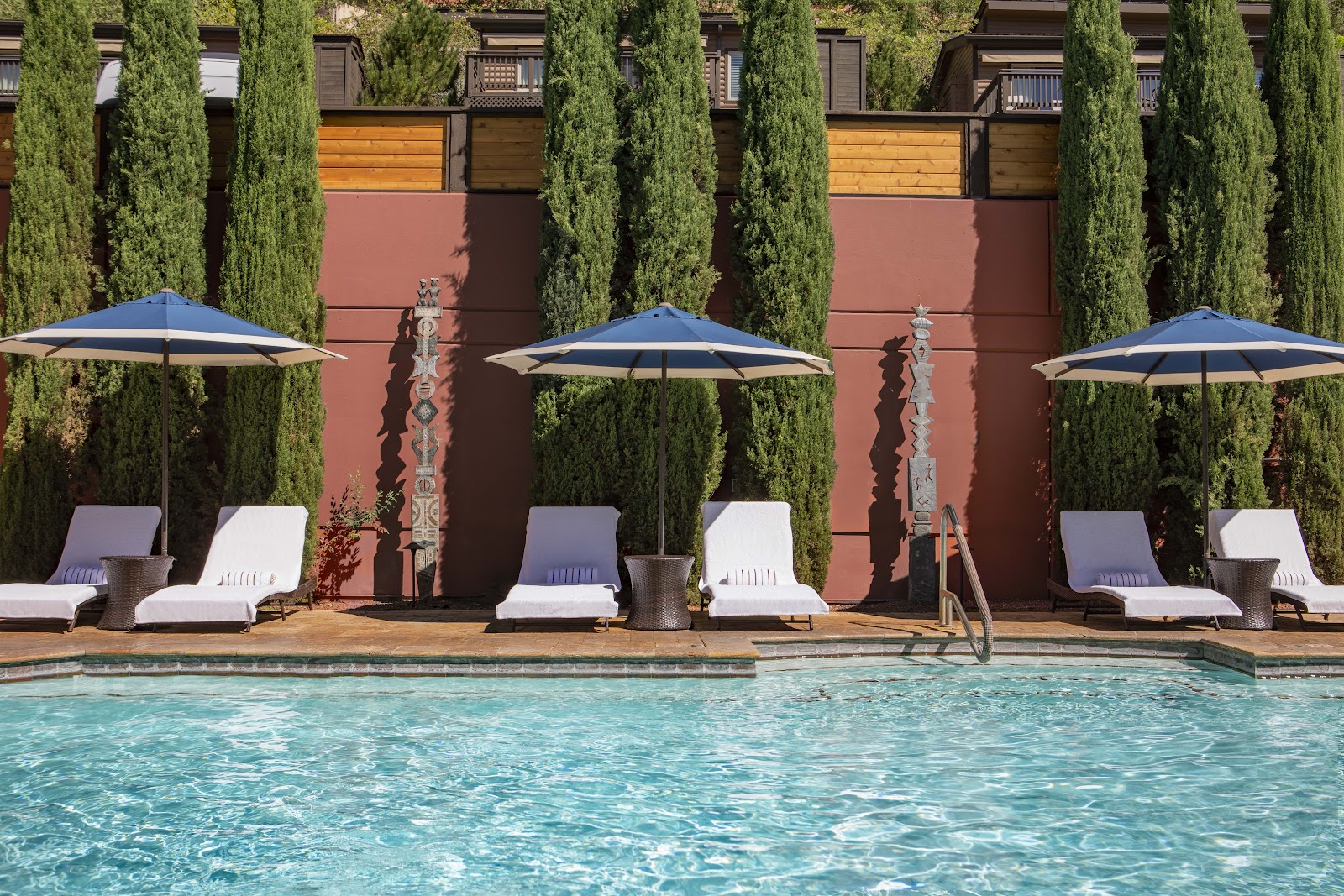
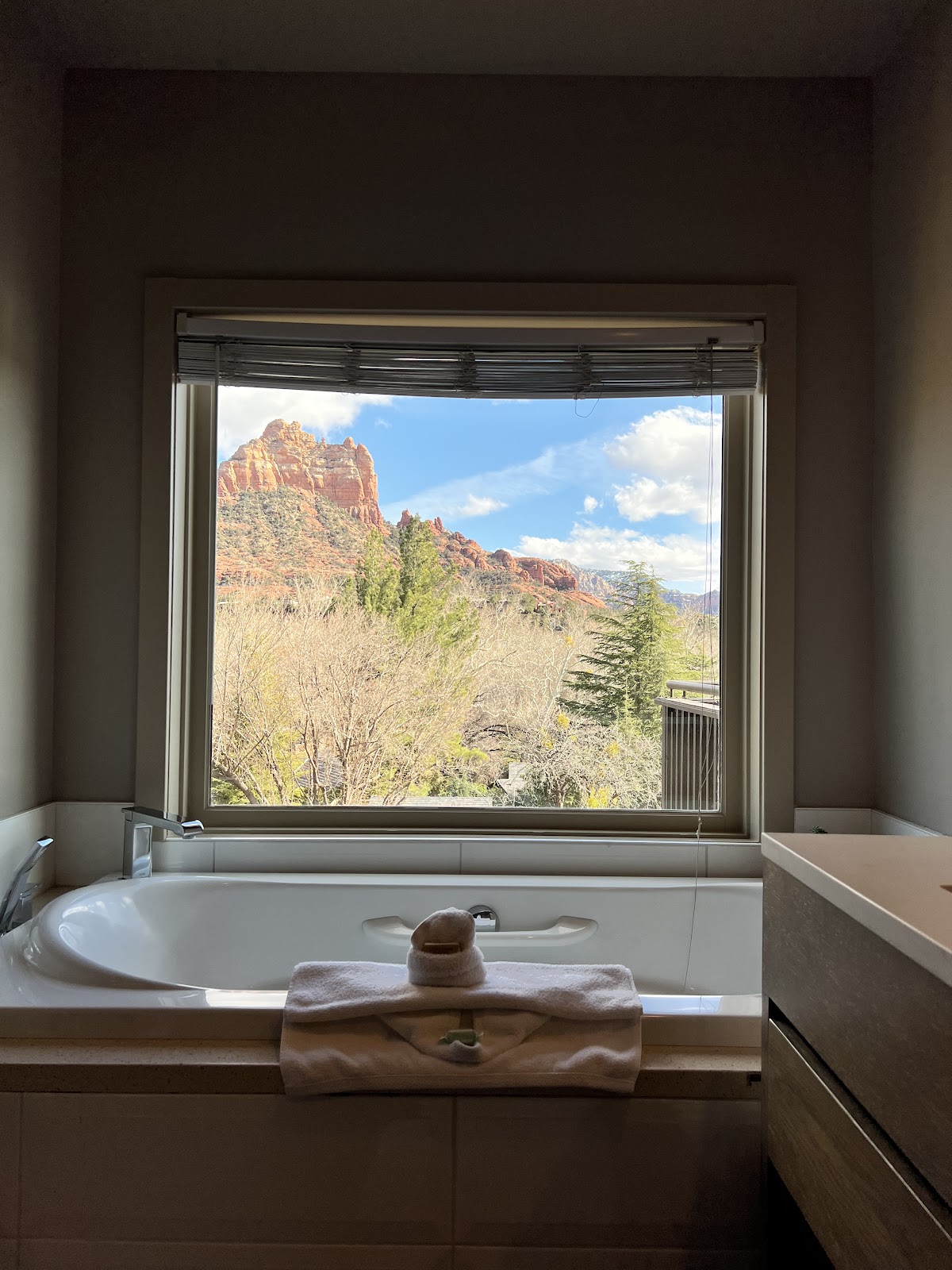
More frames from L'Auberge de Sedona
L'Auberge de Sedona wedding photography: common questions
Why is the creek corridor so important?
Because it is the only genuinely full shade in the region. Juniper and pinyon dapple rather than block; sycamore and cottonwood have dense crowns that actually shade.
How do you test for full shade?
Look at the face, not the ground. Any bright spot on it means the position is not full shade, and moving a metre will fix it.
Why ask which way a room faces?
Because a window onto green canopy floods the room with green and one onto lit red rock floods it with orange. Both need a custom white balance on a face.
When is the rock window?
When the floor is in shade and a wall is still fully lit. The exact hour is local, and the venue will know it precisely for the date.
What are the monsoon hazards?
Lightning on exposed rock, and flash flooding in the creek bed from rain falling miles upstream. Both are matters for whoever is responsible for the party.
When is the colour best?
Late October into November, when sycamore and cottonwood turn yellow against red rock — more saturated than the summer green.
More Arizona venue guides
We are writing a photographer’s guide to every venue we would happily shoot in Arizona. Here are three more, plus the full index:
- The Red Rock Country Club, Sedona: The Problem, and Four Ways Out
- The Tlaquepaque Arts Village, Sedona: Field Notes on Courtyards
- The Boojum Tree, Phoenix: The Venue’s Own Logic
Planning a wedding at L'Auberge de Sedona?
Two environments, one plan. Tell us your date and we will walk both.