 The Redd on Salmon Street: Building the Shot List
The Jupiter Hotel, Portland: Four Ways Out of the Courtyard Problem
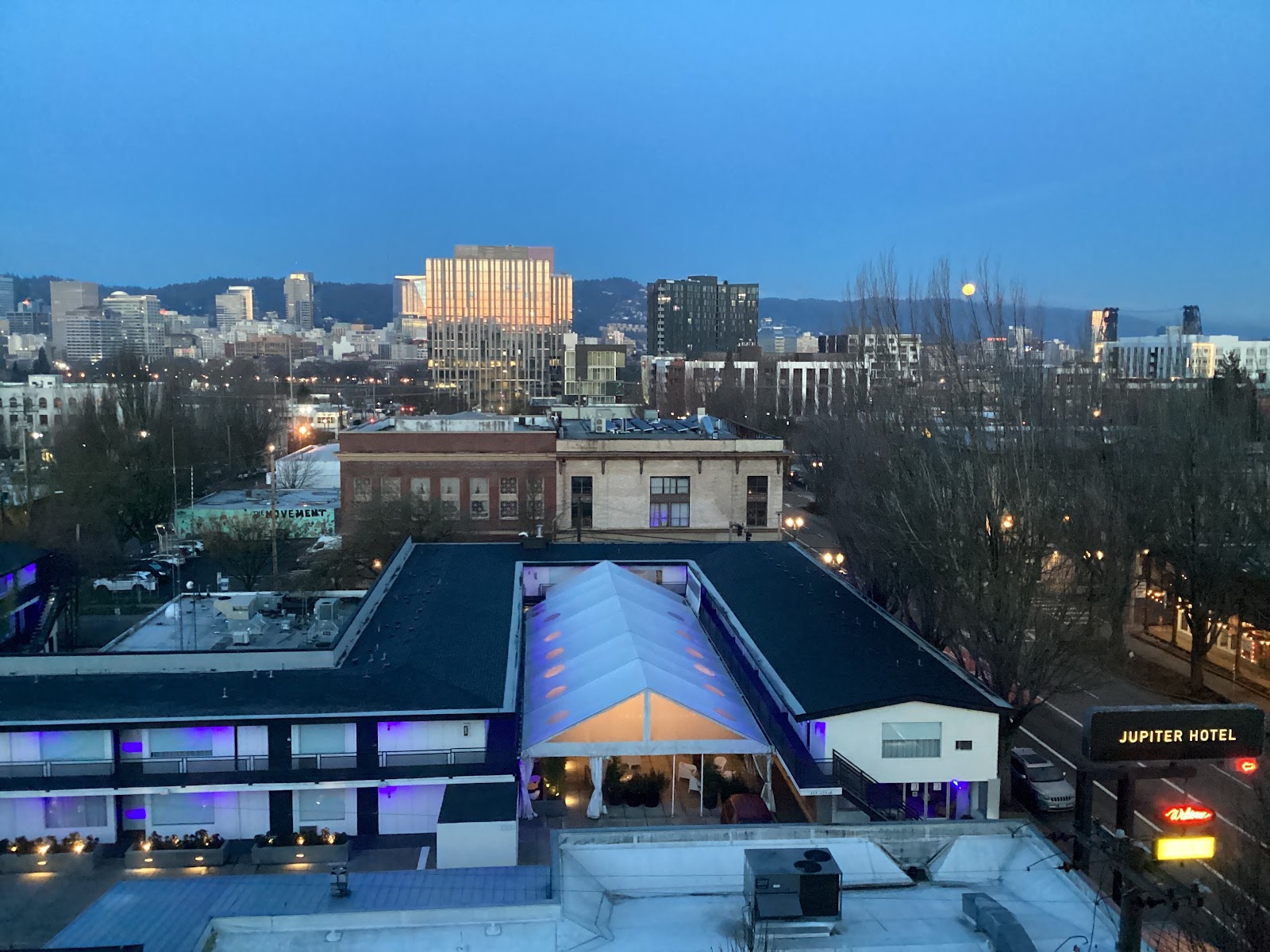
A hard-surfaced courtyard open to the sky is not the same thing as a walled garden.
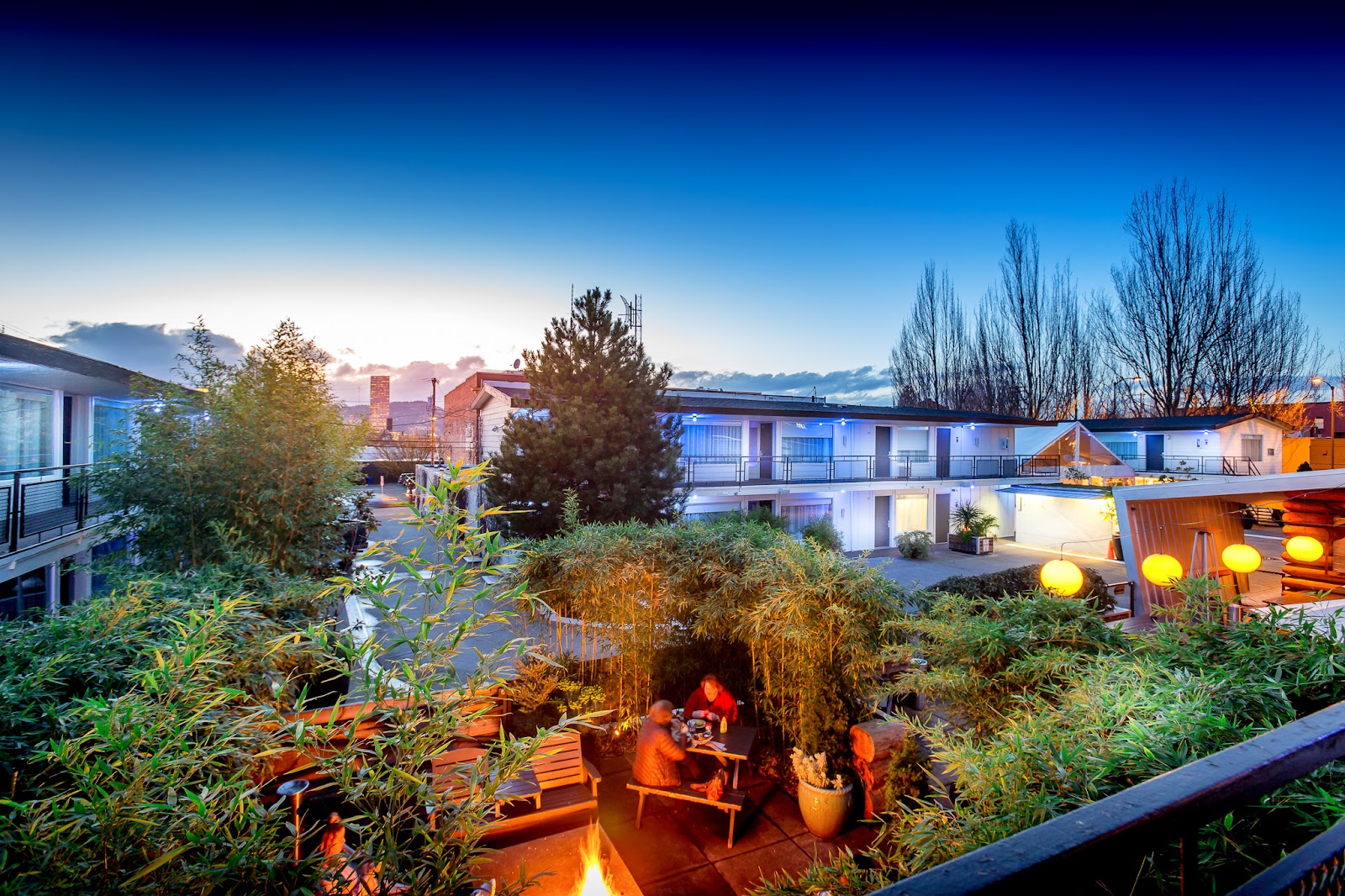
The Jupiter Hotel’s most captivating feature, by its own account, is its outdoor courtyard — the space the hotel is arranged around.
A courtyard is usually an asset and it is worth being precise about which kind this type of hotel has, because the two behave very differently. A walled garden courtyard is enclosed on all sides by tall building, densely planted, and shaded for most of the day: light bounces inward off the walls and arrives soft and directional. A motor-court style courtyard — the arrangement a converted motel or a low-rise hotel produces — is wider than it is tall, hard-surfaced, and open to a large area of sky. That gives an entirely different set of conditions: much more light, much less enclosure, a bright overhead sky as the dominant source, and paving as the main reflector.
This is written as that problem and four ways out of it. We have not photographed a wedding at the Jupiter; low-rise courtyard hotels behave consistently. Courtyard capacity and exclusivity, what the event space consists of, and what happens in rain are the questions for their team.
The Jupiter Hotel at a glance
| Where | Portland, Oregon |
| Character | A low-rise hotel arranged around an outdoor courtyard |
| The problem | Open sky overhead, hard surfaces, little enclosure |
| The consequence | Top-down light, no soft wall bounce, nowhere to hide at midday |
| Ask first | Courtyard capacity and exclusivity, event space, rain plan |
Why an open courtyard is harder than a walled one
The difference is the ratio of wall height to open width, and it decides everything. In a tall narrow courtyard the walls are the source, because most of the light a subject receives has bounced off them — which is why that kind of space is soft and directional. In a wide low courtyard the sky is the source, because the walls are too low and too far apart to intercept much of it.
Sky as the dominant source means light arrives from above. On an overcast day that is soft and pleasant but still overhead, which darkens eye sockets and marks the line under the nose. On a clear day it is hard and overhead, which is the worst portrait light there is.
Hard surfaces are the second difference. Paving, concrete and asphalt reflect a certain amount of light back up, which is actually useful fill — but they are neutral to cool rather than warm, and in Portland’s diffuse light that can push skin towards grey. Warm bounce from brick or timber, which softens most urban environments, is largely absent from a hard-surfaced court.
The third difference is that there is nowhere to hide. A walled courtyard is shaded for most of the day by its own walls; a low-rise court is in open light for most of it. The shade that exists is narrow, beside a building on one side, and it moves.
And the fourth is background. A motor-court arrangement means the background from any position is the opposite range of rooms, with doors, windows, numbers, signage, air conditioning units and possibly parked cars. That is either used deliberately as a graphic, repeating element or it is excluded — and excluding it in a wide open space requires a long lens.
None of this makes the venue difficult to shoot. It means the default assumption about courtyards is wrong here, and the plan needs to reflect the space that actually exists.
Four ways out
The first way out is the shade line beside the building, and it is the most reliable. A single-storey or two-storey range casts a band of shade along one side of the court for part of the day, and standing a metre inside that line facing out gives exactly the condition the courtyard otherwise lacks: light arriving horizontally from the open side rather than vertically from the sky. Which side, and at what hour, is a question with a definite answer and it is worth establishing in advance.
Any covered walkway, balcony overhang or canopy does the same job better. A roof overhead blocks the sky entirely and the open side becomes a large directional source — an architectural softbox. At a low-rise hotel that usually means the walkway in front of the rooms, which is not an obvious portrait position and is frequently the best one on the property.
The second way out is to fill from below. Because the light is overhead, a reflector held low bouncing back up into the face fixes the problem completely and costs nothing — and in a hard-surfaced court the paving itself is already doing some of that work, so the correction needed is small. A lifted chin achieves much of it without any equipment at all.
The third way out is to use the repetition deliberately. A range of identical doors, windows or balcony bays is strong graphic repetition, and a courtyard shot along its length with the bays receding and the couple placed into the depth is a real composition — better than trying to pretend the building is not there. The rule is the same as always: commit to it or exclude it with a long lens, but not half of each.
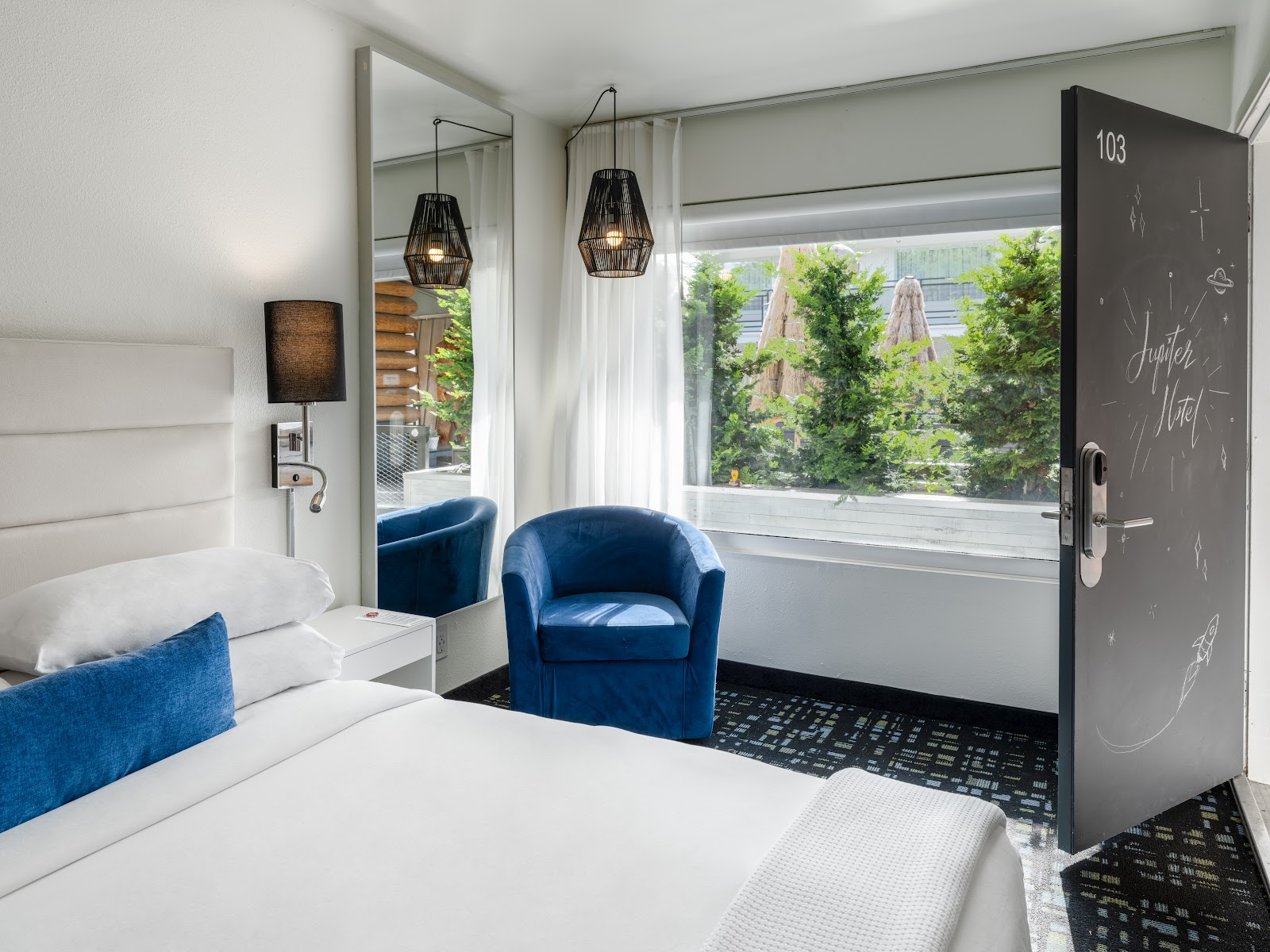
The fourth way out is the interior, and at a hotel of this kind it means finding where the daylight is. Guest rooms are the best portrait light in almost any hotel: domestic-sized windows with close walls that bounce and ceilings low enough that a flash aimed upward returns something. Ask for the largest window on the shaded side, switch off every overhead so the room has one colour of light, and move the lamps out of frame.
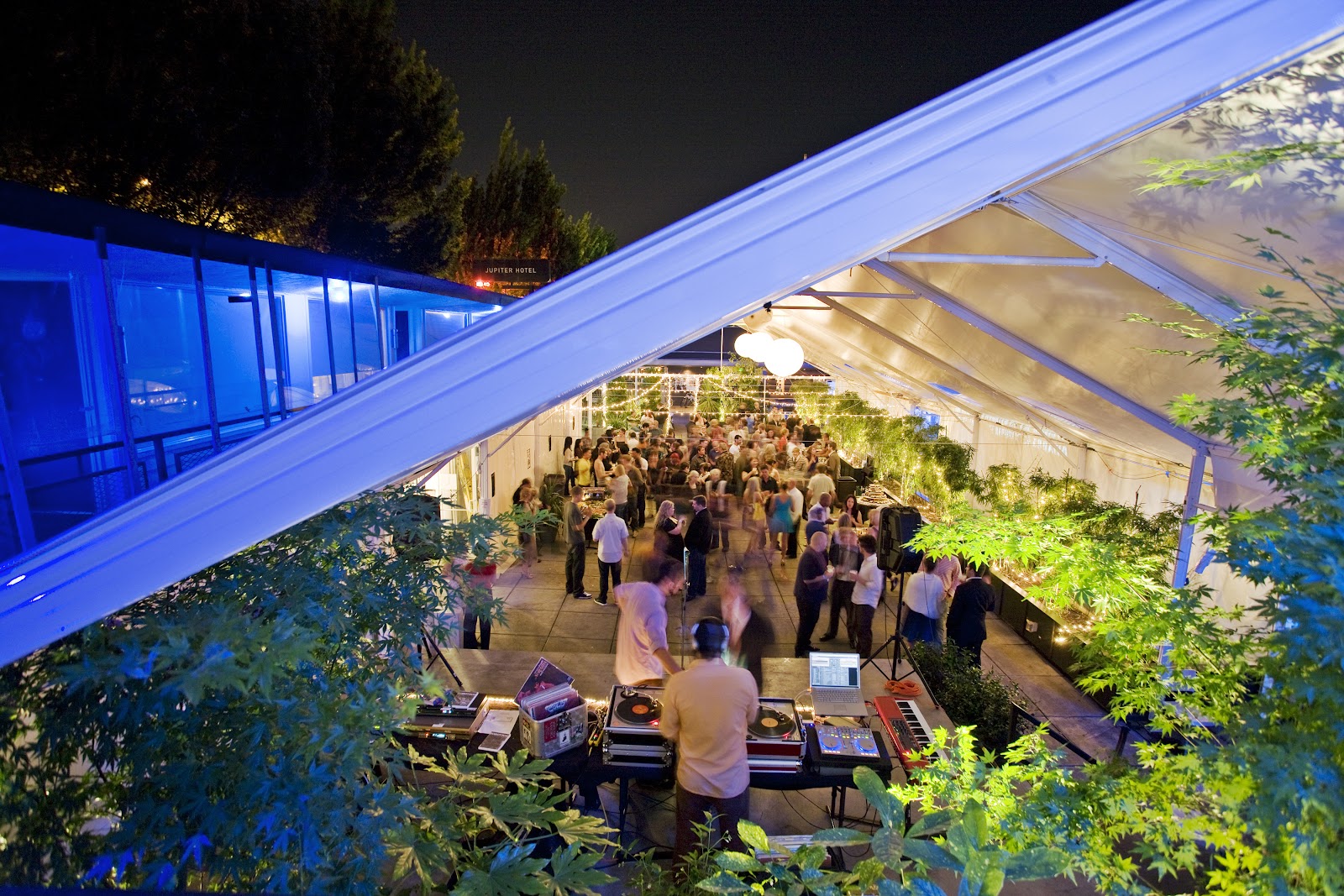
Event and communal spaces at a design-led hotel will likely be lit low and warm with decorative fittings, and possibly coloured. Expose for the room so it reads as the warm space it is, add one warm-gelled source at face height where legibility matters, set white balance to the gel and hold it, and test bounce once on arrival because a low ceiling here may actually work.
- Find the shade line beside the building and stand a metre inside it
- A covered walkway is the best light on the property, and the least obvious
- Fill from below with a reflector or a lifted chin; the correction is small
- Commit to the repeating bays or exclude them with a long lens
- Guest rooms are the best portrait light: biggest shaded window, overheads off
Portland weather, and the courtyard through the year
Portland’s default overcast changes this venue considerably and mostly for the better. Under heavy cloud the bright hard sky that makes an open courtyard difficult becomes an enormous diffuser instead, and the whole court fills with soft even light. The overhead direction remains, so the low reflector still earns its place, but the hard-light problem disappears entirely — and that is the majority of the year.
Add half a stop to a stop over the metered reading when a bright grey sky fills part of the frame, and check that skin holds tone rather than going grey. Hard paving and a diffuse sky together can produce a very neutral, slightly cool rendering, so a custom white balance set on a face is worth the ten seconds.
Shape has to be brought back subtractively in that condition, because there is no directional source to work with. Placing a couple near the dark mass of a doorway, under a walkway edge, or beside anything dark removes light from one side and restores a gradient across the face. In flat light, subtracting works and adding usually does not.
Summer here is long-day country: sunset falls late enough in June that the golden hour arrives after the reception has started. In a courtyard that is worth planning for deliberately, because low sun late in the evening will come in over the low roofline and rake across the court — the one time of day the space gets genuinely directional natural light, and it happens when everybody is indoors eating.
Winter is the reverse: days are short, the sun stays low and rakes all day when it appears, and the whole outdoor window may be a few hours. At a courtyard venue in December the outdoor block has to be early, and the interior will carry more of the gallery.
Rain is the question every open courtyard has to answer, and Portland rain answers it in a specific way. It tends to be persistent and light rather than violent, which means a courtyard ceremony in it is uncomfortable rather than impossible — but a persistent hour of light rain is a real problem for seated guests in a way that a twenty-minute cell is not. So the honest questions are what the indoor fallback is, how many it holds, and when the decision gets made.
The compensation is that a wet hard-surfaced courtyard is genuinely good material: paving holds reflections of lit windows and signage, wet surfaces go dark and saturated, and a couple under a covered walkway with rain falling beyond the edge is better than the dry version. The walkway that is the best light on the property is also the best rain position on it.
More frames from The Jupiter Hotel
The Jupiter Hotel wedding photography: common questions
How is this different from a walled courtyard?
The ratio of wall height to open width. A tall narrow courtyard is lit by its walls, so it is soft and directional; a wide low one is lit by the sky, so it is overhead and open.
What does hard paving do?
It reflects some light back up, which is useful fill, but it is neutral to cool rather than warm — so the warm bounce that softens most urban environments is largely absent.
Where is the good light in an open court?
In the shade line beside the building, or better, under any covered walkway. A roof overhead blocks the sky and the open side becomes a large directional source — an architectural softbox.
How do you fix the overhead direction?
A reflector held low, or simply a lifted chin. Because the paving is already doing some of that work, the correction needed is small.
What about the range of doors and windows behind?
Commit or exclude. A courtyard shot along its length with the bays receding and the couple in the depth is a real composition; half-in reads as a mistake and excluding it needs a long lens.
Does Portland overcast help here?
Considerably. The bright hard sky that makes an open courtyard difficult becomes an enormous diffuser, and the hard-light problem disappears. The overhead direction remains, so the low reflector still earns its place.
More Oregon venue guides
We are writing a photographer’s guide to every venue we would happily shoot in Oregon. Here are three more, plus the full index:
- The Oregon Museum of Science and Industry, Portland: What It Suits and What It Does Not
- The Oregon Zoo, Portland: Four Ways Out of the Fencing Problem
- The Society Hotel, Portland: Field Notes on a Historic Small Hotel
Planning a wedding at The Jupiter Hotel?
Find the walkway, then plan the rain. Tell us your date and we will do both.