 The Ozark Mountain Lodge, Eureka Springs: The Problem, and Four Ways Out
Pratt Place Inn, Fayetteville: How the Light Moves
A hillside under a closed canopy. Both facts change every hour.
Two things govern the light on this property and both are structural rather than seasonal: it is on a hillside, and much of it is under closed oak-hickory canopy.
The hillside means the sun’s effect changes with aspect. A slope facing one way receives direct light hours before a slope facing another, and a property with several aspects has several different light conditions happening simultaneously — which is the opposite of a flat site, where the whole property has the same light at the same time.
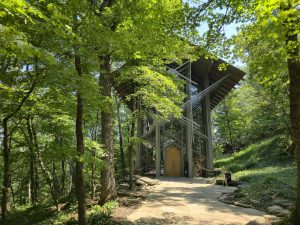
The canopy means that a large part of the acreage is in soft green shade for the whole growing season, and that the transition from open ground to closed canopy is abrupt rather than gradual. Walking twenty metres at this venue can change the light by three stops and the colour by a noticeable amount.
Together they produce something unusual: a property where the question is not what time it is but where on the property you are standing. An hour that is unusable on the open lawn may be excellent at the canopy edge fifty metres away, and the reverse holds in the evening.
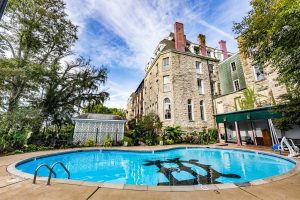
The building sits on top of that — a historic inn with the interior character of its period, which means deep-set windows, moderate ceilings, and rooms that are darker and more directional than a modern building of the same size.
Fayetteville sits in the Arkansas Ozarks at about thirty-six degrees north, in hilly ground on the plateau’s western edge. The June noon sun reaches around seventy-seven degrees, the December noon sun about thirty, days run from about nine hours fifty to fourteen hours twenty, and civil twilight is around twenty-eight minutes.
We have not photographed a wedding at this inn. Which rooms and grounds are included, whether the wooded acreage is accessible, what covered alternatives exist and what the permitted hours are, are questions for their team.
Pratt Place Inn at a glance
| Where | A historic inn on wooded hillside acreage in Fayetteville, Arkansas |
| Two governing facts | A hillside with several aspects, and large areas of closed oak-hickory canopy |
| The consequence | The question is where you are standing, not what time it is |
| The transition | Open ground to closed canopy is three stops and a colour shift in twenty metres |
| Ask first | Included rooms and grounds, woodland access, covered alternatives, hours |
Morning into midday
First light on a hillside arrives unevenly, and the useful consequence is that a photographer has a choice at an hour when a flat site offers none. The east-facing slopes are lit while the west-facing ones are still in the hill’s own shadow, which means direct warm low light and even open shade are both available within a short walk.
The frame that belongs to the first hour is the one that uses both: subjects in even shade on the shaded side, with a brightly lit slope or canopy behind them. That gives a lit background behind a softly lit subject — the separation of a studio setup, supplied by topography — and it is available twice a day at any hillside property.
Ozark mornings in the warmer half of the year frequently produce valley mist, because cold air sinks into the hollows overnight and the humidity is high. On a hillside that means the low ground is full of white while the higher ground is clear, and a frame looking down through trees into mist is the most atmospheric thing this kind of property produces. It happens most often on clear calm nights in late summer and autumn.
Mid-morning is the best open-ground portrait window of the day. With the sun between twenty and forty degrees, the lawns are lit directionally rather than from overhead, faces have modelling rather than shadowed sockets, and the grass has visible texture. A group on open ground with the sun behind the camera at this hour needs nothing added.
It is also when the canopy edges begin to work properly. A closed oak-hickory canopy beside open lawn creates a hard boundary, and a subject standing a metre or two inside that boundary facing out toward the lit ground gets soft directional light in front with three or four stops of dark behind. That is the best free portrait position on any wooded property and it is available from mid-morning until late afternoon.
The green cast is the thing to manage. Light that has been transmitted through and reflected off oak and hickory leaves is noticeably green, and skin standing deep under canopy reads sallow. The correction is positional: at the canopy edge, most of the light reaching a face arrives from open sky rather than through leaves, which cuts the cast to something a small adjustment handles.
Deep under canopy, a warm-gelled source at about a stop over ambient overrides the transmitted green on skin while leaving the foliage as it is. A global white balance correction turns the whole wood grey and is the wrong move.
Midday on open ground is the hardest light of the day, and at seventy-seven degrees of June elevation there is no position on a lawn that fixes a face. The answers are the canopy, the building’s shaded elevations, any covered porch or terrace, and indoors.
Eastern redcedar, where it grows on this property, is worth finding specifically. It is a juniper rather than a true cedar, dense and very dark, and it blocks almost all direct light — which makes its edge better than an oak edge, because the background behind the subject reads as near-black rather than as green.
Afternoon to dark, and inside
Early afternoon is the weakest window and the right time to be inside, and a historic building of this kind rewards it.
Expect deep-set windows, moderate ceiling heights and finishes that absorb rather than bounce. The light coming in is directional and falls off fast — often three or four stops between a face at a window and the wall two metres behind it — which does the separation for free.
The method is the standard one: subject at forty-five degrees to a window, at a distance that sets the ratio, metered on skin, with the room falling away behind. In a corner room with windows on two walls, one becomes key and the other fill, which is a complete lighting setup made of architecture.
A deep reveal around an older window acts as a snoot, narrowing the beam and steepening the fall-off, which makes the effect stronger than a modern window of the same size would give. Small movements change the ratio noticeably, which means precision pays.
Corridors and stair halls are reliably better than they look. A hallway with a window at one end is a directional source with several stops of fall-off along its length, and it is often the one interior space with real distance in it.
Where a room is pale and modern the problem inverts to separation: everything is bright, so a subject needs something dark behind them, or a source a stop over ambient so they have a shadow side at all.
Mid-afternoon the sun crosses onto the western aspects and the property begins to improve, and on a hillside the improvement is uneven — the west-facing slopes and the west elevations of the building light first while the east side goes into shade. The twice-daily gift returns, in mirror image: subjects in even shade on the east side with a brightly lit slope behind them.
The last ninety minutes are the property’s best and a hillside gets more of them than a valley does, because the western horizon from an elevated position is further away and lower. A low sun rakes across a slope rather than falling onto it, which puts relief into ground that reads flat at noon, and it backlights the canopy — which turns oak and hickory leaves into translucent panels and makes the canopy edge glow.
Backlit canopy is the frame that belongs to this window and it is the best thing a wooded property produces. Expose for the leaves and let the trunks go dark, then lift the subjects with a close source, warm-gelled to match the low sun, at about a stop over the ambient on them.
The gel is not optional. Low sun here is strongly warm and the shade under canopy is lit by a blue sky, so an ungelled flash puts cold faces into a gold wood.
Then dusk. Civil twilight here runs around twenty-eight minutes, which is shorter than New England’s and longer than Florida’s — a workable window that has to be planned rather than drifted into. On a hillside with an open western aspect the whole of it is usable; under canopy, almost none of it is, because the trees take it early.
That difference is worth knowing: the last usable light on this kind of property is on the open high ground, and being in the wrong place at that moment loses the whole window.
Two practical notes. Chiggers and ticks are a genuine consideration in Arkansas in tall grass and at woodland edges from about May into September, and a wooded property is where they live. And this state sits in the secondary severe-weather corridor of the southeastern United States, with peaks in April–May and a smaller one in November — so a named indoor alternative for anything outdoors in those months is a requirement.
- The twice-daily gift: a lit slope behind a subject in even shade
- Canopy edge, facing out, is the best free portrait position
- Green cast is fixed by position or a warm source, never by white balance
- Backlit canopy in the last ninety minutes is the property’s best frame
- Be on open high ground for twilight, not under trees
The Ozark year
Four real seasons with long generous shoulders, and on a wooded hillside the canopy’s state changes the property more than the weather does.
Winter opens it up completely. With the oak and hickory bare, light reaches the ground everywhere, the hillside’s shape is visible rather than hidden, and the limestone that underlies this plateau is exposed as ledges and outcrops. The canopy-edge technique stops working because there is no canopy, and in exchange the whole property becomes usable at any hour.
The December noon sun at around thirty degrees means the whole short day models rather than flattens — there is no bad hour in an Arkansas winter day — and at nine hours fifty the day is meaningfully longer than a northern winter one.
Bare woods also remove the green problem entirely: brown leaf litter, grey trunks, pale limestone and near-black redcedar produce a landscape of neutrals that is considerably better background material than summer offers.
Snow occurs but rarely lasts. The characteristic Arkansas winter event is freezing rain, which glazes every twig in clear ice: spectacular for a day, hazardous for longer, unplannable. An ice-glazed hillside wood with low sun through it is one of the most remarkable conditions in this guide.
Spring is the region’s best season and it is early. Leaf-out runs from late March into early April, and the two weeks before the canopy closes are the best of the year on a wooded property — because the flowering understory is lit directly rather than filtered.
Redbud is the one to plan for: it flowers magenta on bare wood before its own leaves emerge and before the canopy closes above it, which means full sun on a saturated colour in a landscape that is still brown. Dogwood follows, flowering white beneath a canopy that is only half open, which gives the other classic Ozark spring frame. Serviceberry and wild plum add to it.
The cost is the severe-weather peak in April and May, which needs a named indoor alternative rather than optimism.
Summer closes the canopy and the property becomes two places: bright open lawn and deep green shade, with nothing in between. That is the condition this page’s first section describes, and it is workable but demanding.
Dew points in the low to mid twenties Celsius put haze into the air, which on a hillside with views across wooded valleys takes the definition out of every wide frame. The honest summer strategy is to work close — canopy edges, the building, the interiors — and to save the wide frames for the ends of the day.
Chiggers and ticks are at their worst from May through September, and fireflies in the Ozark hollows in June are worth a frame if an evening session runs late.
Autumn is the other strong season and it is much later than in the north. Oak-hickory forest turns from the last week of October into the first week of November — three to five weeks behind New England — and it holds for a genuine three weeks, because oak colours and drops slowly.
On a wooded hillside that colour arrives overhead as well as around, which is the point. Backlit hickory gold and oak russet in the last ninety minutes, with the canopy as a translucent ceiling and the subjects beneath it, is the single strongest frame this property produces all year. The palette — gold, russet, deep red, sweetgum purple, sassafras orange — is richer and more varied than the pure reds of the north.
November brings a second, smaller severe-weather peak, and by late in the month the canopy is down, the hillside is open, and the low sun models everything all day.
More frames from Pratt Place Inn
Pratt Place Inn wedding photography: common questions
What governs the light here?
A hillside with several aspects, and large areas of closed oak-hickory canopy. The question is where you are standing, not what time it is.
What is the twice-daily gift?
A brightly lit slope or canopy behind a subject standing in even shade on the opposite aspect — studio separation supplied by topography.
Where is the best free portrait position?
A metre or two inside the canopy edge, facing out toward the lit ground: soft directional light in front, three or four stops of dark behind.
How do I fix the green cast under canopy?
Stand at the edge so most of the light comes from open sky, or add a warm-gelled source a stop over ambient. A global white balance fix turns the wood grey.
Where should I be at twilight?
On open high ground. Under canopy the trees take the last light early, and the twenty-eight-minute window is lost.
When is the best time of year?
Late March to mid-April, when redbud and dogwood flower before the canopy closes; and the last week of October into early November for backlit gold and russet overhead.
More Arkansas venue guides
We are writing a photographer’s guide to every venue we would happily shoot in Arkansas. Here are three more, plus the full index:
- The River Market, Little Rock: A Walk Through the Site
- The Stone Chapel at Mattix Farms, Lowell: One Frame and How It Is Made
- The Venue at Cedar Creek, Maumelle: Field Notes, Problem and Solution
Planning a wedding at Pratt Place Inn?
A hillside and a canopy. Tell us your date and we will plan where to stand.