 The Iowa Events Center: Four Ways Out of the Blank-Hall Problem
The University of Iowa Memorial Union: The One Decision That Governs Everything
River on one side, campus on the other. Pick one.
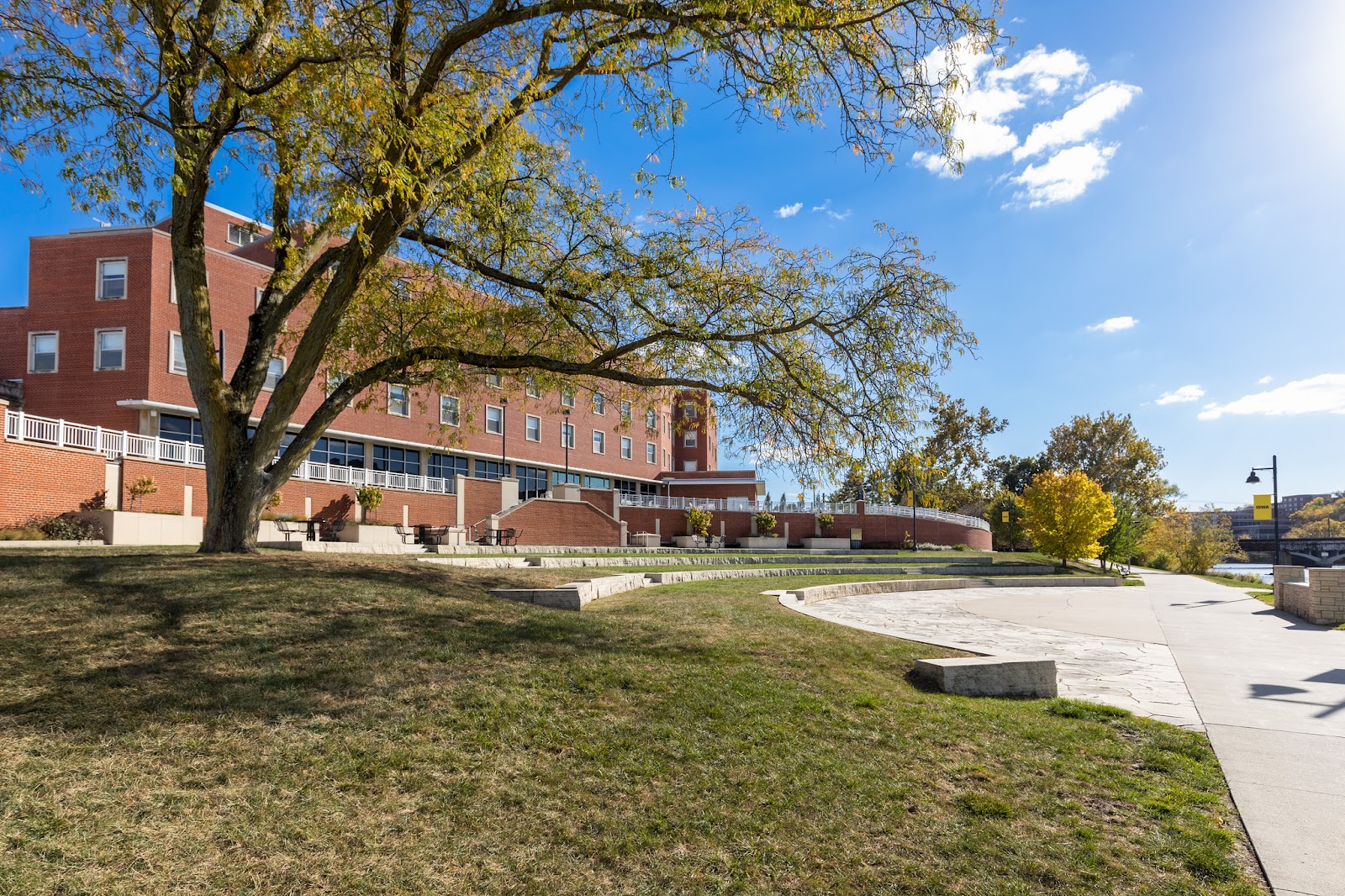
A university union on a riverbank offers one decision and it is a simple one: river or campus.
The building has water on one side and an institutional campus on the other, and those are two entirely different pictures. The river gives reflection, a horizon, mature bankside trees and a sense of landscape. The campus gives substantial masonry architecture, mature planting between buildings, and a sense of place that is specifically collegiate.
They are also lit differently, because they face opposite ways — so the direction commits the hour, and a photographer who intends to use both needs to know which belongs at which end of the day.
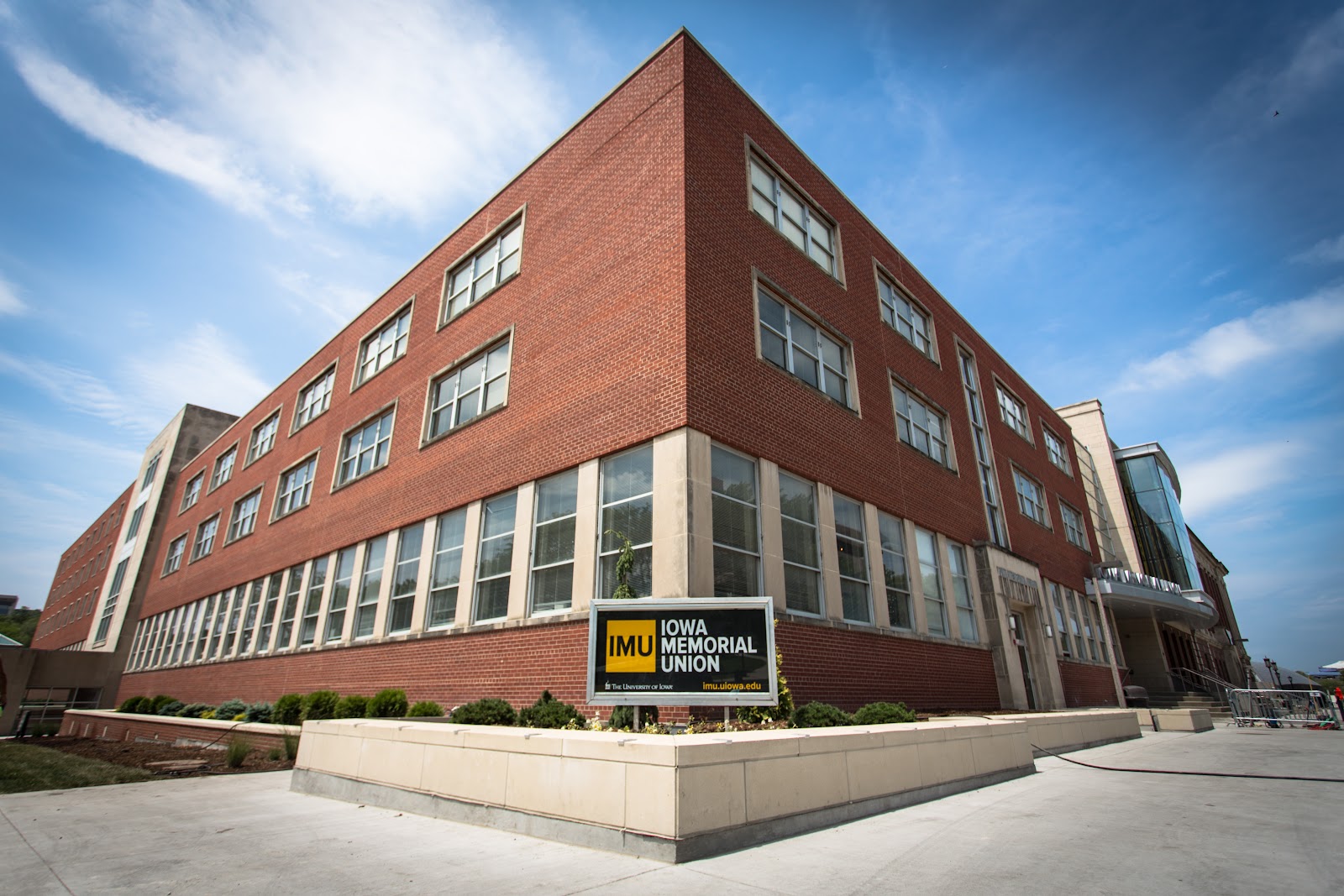
The second thing to understand is the building type, because a memorial union is a specific and under-appreciated one. These were built across American universities in the interwar decades, funded by subscription and dedicated to the dead of the First World War, and they were designed as the social centre of a campus — with a ballroom, lounges, dining rooms, meeting rooms and often a theatre under one roof.
That produces a building with an unusual combination: institutional scale and domestic-feeling rooms. A union ballroom is a real ballroom, and the lounges around it were designed to be sat in rather than passed through — which means panelling, fireplaces, generous windows and the kind of comfortable proportions a purpose-built conference centre never has.
The third is that it is a working building on a working campus. There will be students, events, term-time traffic and public access, and the bookable spaces are a defined subset of a much larger building.
Iowa City sits at about forty-one and two-thirds degrees north at roughly seven hundred feet. The June noon sun reaches around seventy-two degrees, the December noon sun about twenty-five, days run from about nine hours ten to fifteen hours fifteen, and civil twilight is roughly thirty-one minutes — generous.
We have not photographed a wedding here. Which rooms are bookable, what each faces and the permitted hours are questions for their team.
The University of Iowa Memorial Union at a glance
| Where | A university union on the Iowa River in Iowa City |
| The decision | River or campus. They face opposite ways and are lit at opposite times |
| The building type | An interwar memorial union — institutional scale, domestic-feeling rooms |
| The asset | A real ballroom, and lounges designed to be sat in |
| Ask first | Which rooms are bookable and what each one faces |
Facing the river
The river is the quieter and more flattering direction, and it has a specific technical advantage.
Open water reflects the sky, which makes it a very large low-angle source. A subject standing at the bank is lit from below as well as above, and that bottom light fills under the chin and lifts eye sockets — the exact opposite of what a high sun does and precisely what a face wants.
The effect strengthens sharply at low sun angles, because water’s reflectivity rises at grazing incidence. So the fill is strongest in the last hour, which is also when the light is best — a convenient alignment and the reason bankside positions flatter people.
Whether the surface is still is a matter of wind rather than hour in eastern Iowa, unlike the desert where afternoons are reliably breezy. A mirror is luck. Broken water works too: a low camera turns a rippled surface into a bright path of speculars running toward the lens, and dropping the camera to knee height lengthens that path substantially.
The Iowa River is a modest river rather than a great one, which changes what it offers. The far bank is close, which means it reads as a detailed background rather than as a distant horizon — bankside trees, another building, a bridge. That is better for a portrait background than a wide empty river would be, and worse for a landscape frame.
The bankside trees are worth knowing. Eastern cottonwood is the signature bottomland tree — enormous, broad-crowned, leaves that rustle audibly, turning clear yellow in October — with silver maple, hackberry and box elder filling in. All of those cast solid shade with no dapple, unlike the filigree canopies of arid regions, so a bankside tree is a workable position at any hour.
Silver maple is the one to notice for a specific reason: its leaves are pale and silvery on the underside, and in wind a silver maple flickers between green and near-white. That is a distinctive movement and it reads in a photograph as shimmer rather than as blur.
The bridges are the built element on the river and they want a moderate telephoto. Compression stacks the structure and gives it mass; a wide lens renders a bridge as a thin line across the frame and wastes it.
One genuine caution about the Iowa River in this city. It flooded severely in 2008 and again since, and the university has invested substantially in flood protection — which means parts of the bank are engineered rather than landscaped. Levees, floodwalls and revetment are functional rather than photogenic, and the difference between a planted riverside and a concrete embankment is considerable. Both may exist within a few hundred metres, so it is worth walking before the day.
Spring is the risk period. Snowmelt and spring rain raise the river from March into June most years, which can put the low bank underwater or the path closed — and that removes the frames this direction depends on. Worth asking about rather than discovering.
Facing the campus, and inside
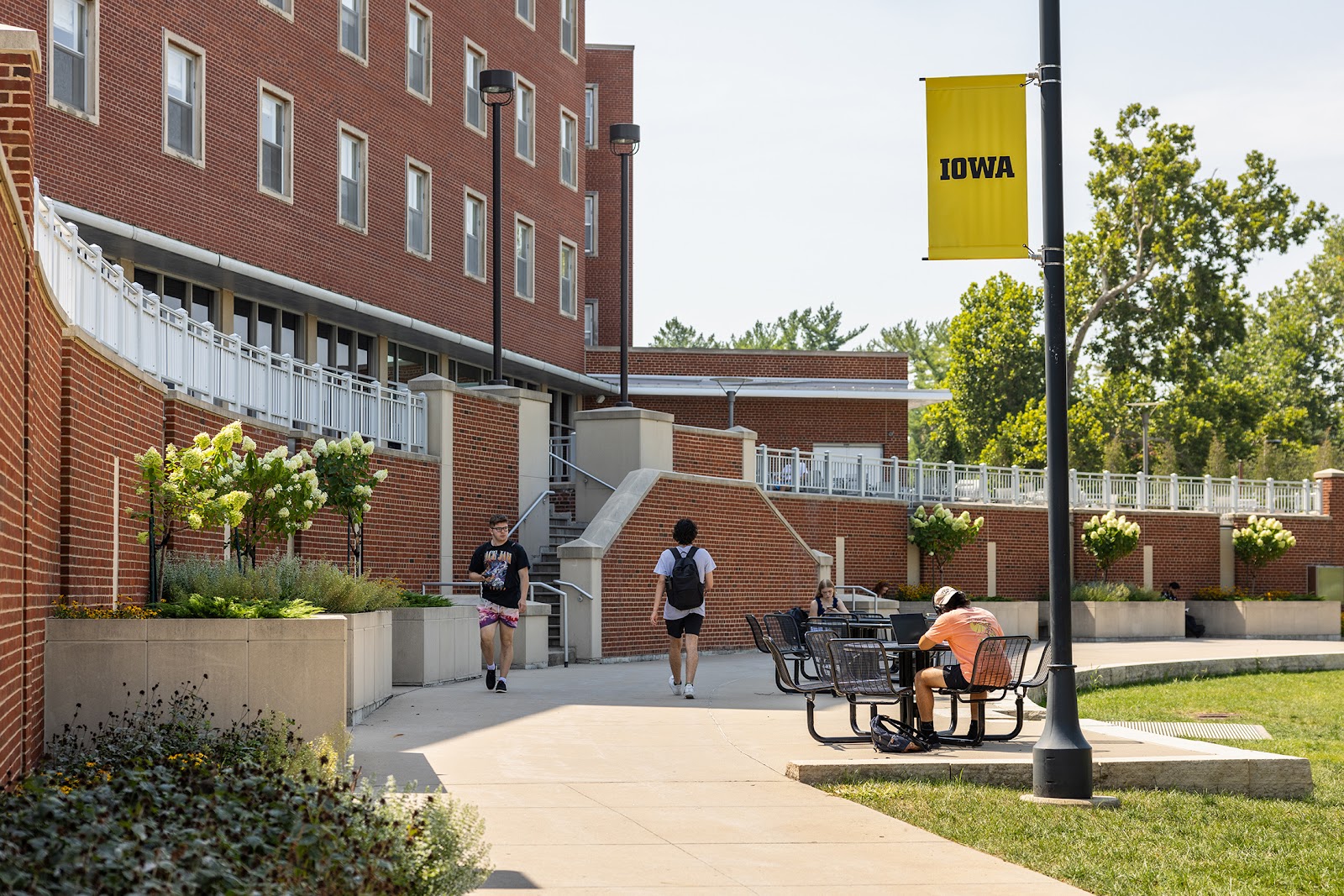
The campus direction gives architecture, and a university of this age has a coherent set of it.
Interwar and nineteenth-century collegiate buildings here are brick and limestone at consistent scale, and both materials need raking light. A masonry elevation under a frontal midday sun is an even field with no modelling; at a low angle every joint, reveal and tool mark appears.
Limestone is the local material and it is worth naming: eastern Iowa sits on Devonian limestone, the public buildings were built from it, and it goes a genuine honey colour in low evening light — which pairs well with a warm-gelled key and badly with an ungelled one.
Iowa City has one landmark worth the walk: the Old Capitol, the first state capitol of Iowa, with a gold dome at the head of the campus axis. A gold dome is a specific exposure problem — a small very bright specular object against sky — and the answer is to expose for it and let the sky go where it goes, because a blown dome has no detail and there is no recovering it.
Mature campus planting is the other asset. A university founded in the nineteenth century has trees planted in the nineteenth century, which means full-crowned specimens grown with room rather than crowded — and a full-crowned mature tree casts broad even shade and reads as a shape from distance.
The canopy edge is the most reliable free light anywhere: a metre or two inside a tree line, a subject gets soft directional light from the open ground in front and three or four stops of darkness behind. Separation without equipment, at any hour.
Inside, the union’s rooms are the building’s real proposition and they divide into two kinds.
The ballroom is the large one and it is a genuine interwar ballroom rather than a function room: high ceiling, a proper floor, decorative plasterwork, and — in buildings of this date — often tall windows along one or both long walls, because they were built before air conditioning and needed light and ventilation.
Those windows are the best thing about it. A tall window is much taller than it is wide, which gives strong horizontal direction with gentle vertical falloff — and a subject two metres in, turned three-quarters toward the glass, is modelled cleanly with no top-light problem. Arrange groups parallel to that wall, never across the room.
Where the windows are draped or the event is after dark, the approach is the standard one for a large period room. Bounce a warm-gelled source off a pale wall or ceiling for a directional key — plasterwork returns light well, unlike stained panelling — drag the shutter to a thirtieth or sixtieth so the room’s own fixtures register, and use two or three sources because the distances are real.
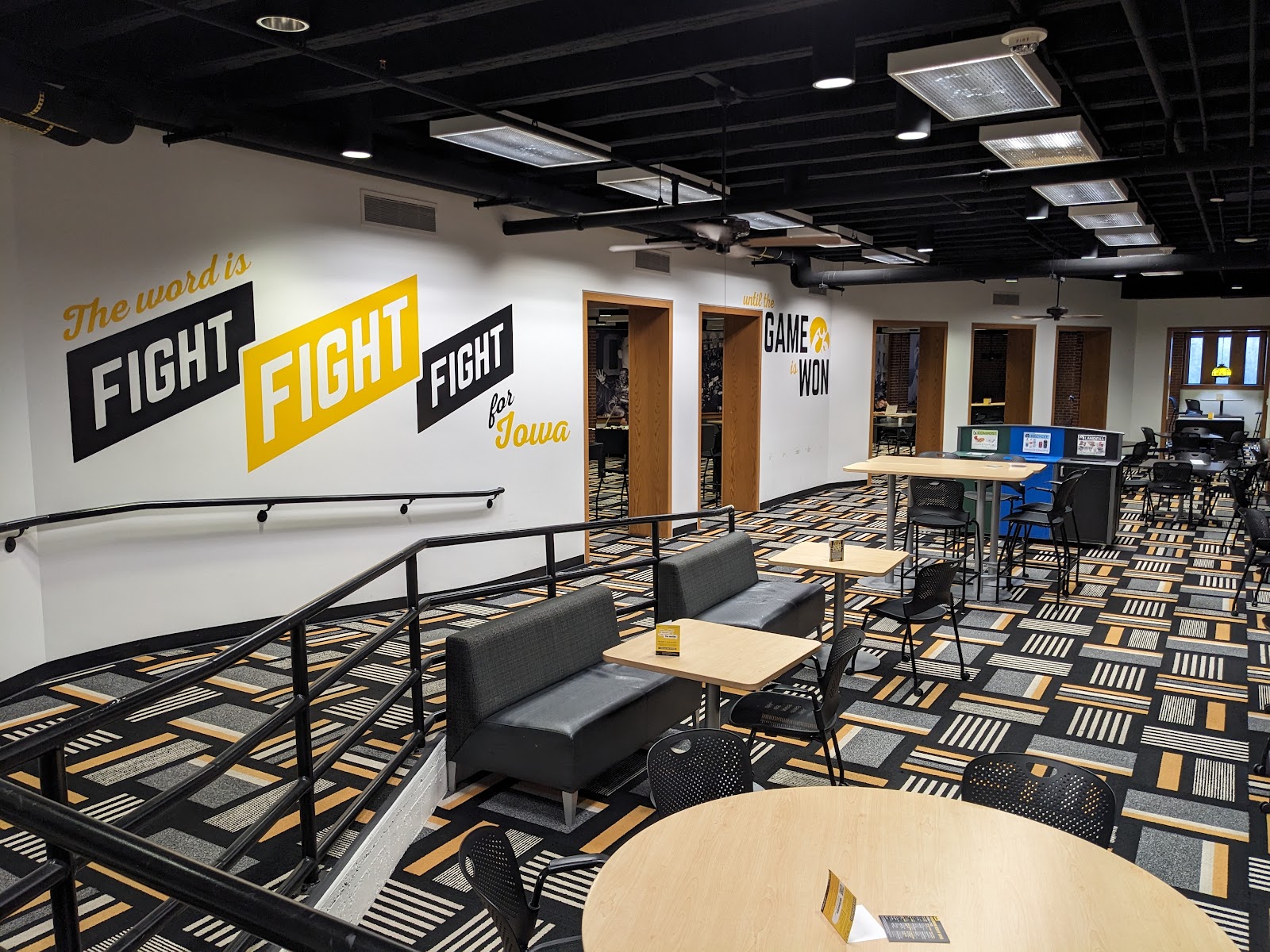
The lounges are the other kind and they are the under-used asset. A memorial union’s lounges were designed to be sat in: panelled, fireplaced, furnished, with generous windows and comfortable proportions. That gives domestic-scale rooms with good window light inside an institutional building — which is an unusual combination and the best portrait environment in the building.
A fireplace is worth one frame. An unlit one is simply a strong architectural element; a lit one is a small warm practical source that gives a face a low warm key, and it needs the room’s ambient dropped so it reads. Gel to match it, because firelight is very warm indeed.
And the panelling is the constraint: stained oak returns perhaps ten percent, so bounce off a pale ceiling where there is one and go direct through a modifier where there is not, leaving the room dark rather than trying to fill it.
- Drop the camera to knee height to lengthen the specular path on the river
- Scout the bank — planted riverside and concrete floodwall may be metres apart
- Brick and limestone need raking light; frontal midday flattens both
- Expose for a gold dome and let the sky go; a blown dome has no detail
- The lounges beat the ballroom for portraits — domestic scale, good windows
A working campus, and the Iowa year
Two practical matters shape a wedding in a union building and both are about it being institutional.
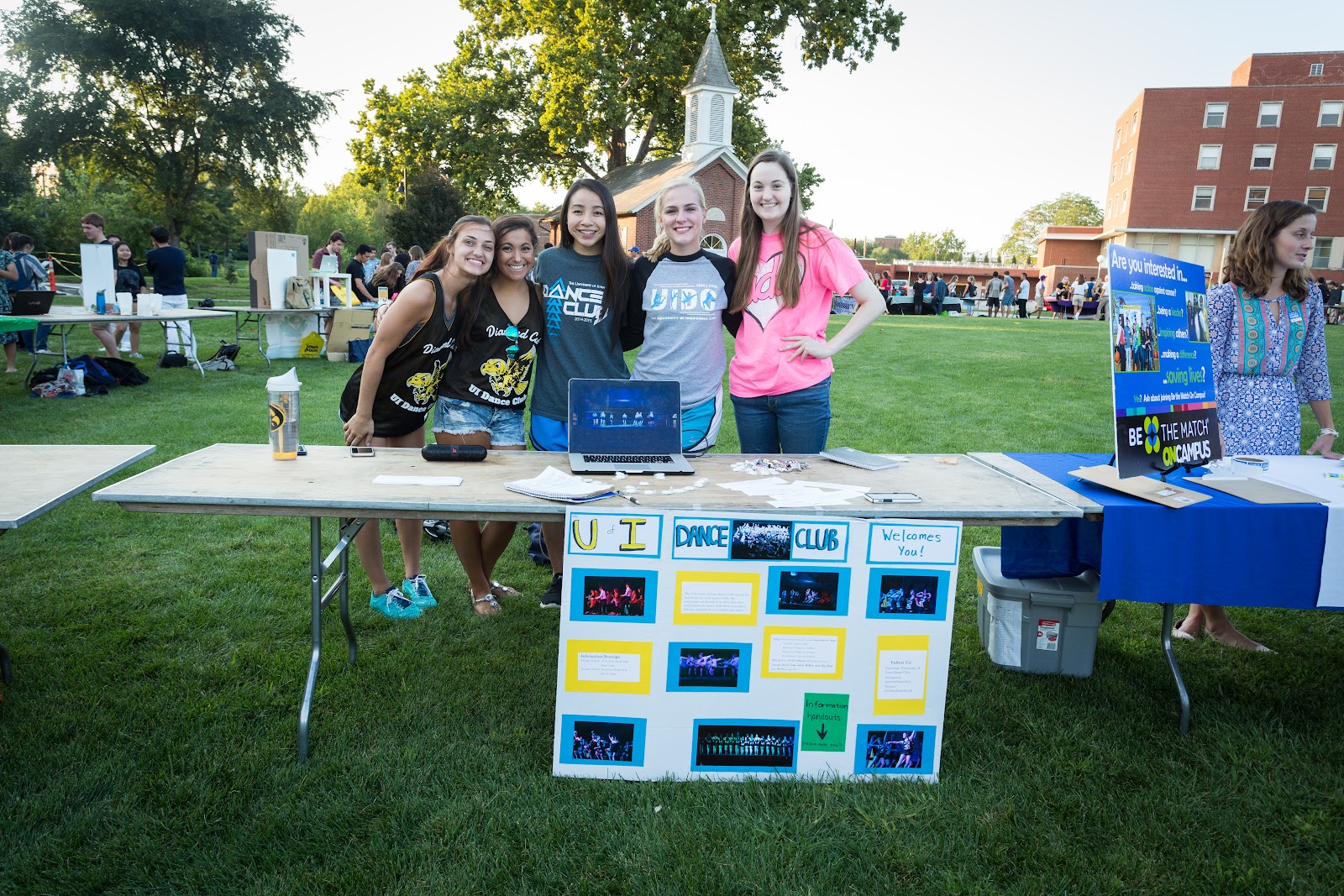
It is a working student building. Term time means students in the public spaces, events in adjacent rooms, and a level of traffic that has nothing to do with the wedding. The weeks between semesters are markedly quieter, and knowing which a date falls in is genuinely useful for planning exterior and circulation frames.
It also means the bookable spaces are a subset. A union is large and most of it is not available, so establishing exactly which rooms are included — and what happens if a university event has priority — matters more here than at a commercial venue.
University venues often have specific constraints worth asking about early: alcohol policy on campus, approved caterers, restrictions on candles and open flame, and a firm finish time. Those are institutional rather than negotiable.
Flash is generally unproblematic in a union building, unlike an art museum, because there is no light-sensitive collection. Tripods and stands may be restricted for egress reasons, which is worth confirming because it changes the plan from stands to hand-held.
The Iowa year then governs the outdoor half, and the seasons here are emphatic.
Mid to late October is the best fortnight. Eastern Iowa is dissected till plain with real relief along its rivers, and the hardwoods turn properly — sugar maple to scarlet and orange, hickory and oak to bronze and russet, cottonwood along the bank to clear yellow. Where the campus has century-old specimens those turn as individual events rather than as a mass, which means a single tree can fill a background.
The timing moves with the year: a warm dry autumn delays and dulls it, a cool wet one brings it forward and intensifies it. Plan a fortnight either side of the third week rather than a specific weekend.
It is also, on a university campus, the busiest and most atmospheric time of year — which cuts both ways for a photographer but does mean the place looks like itself.
Spring is short, unreliable and carries the flood risk described above. Its one specific asset is the two weeks before the canopy closes in early May, when light reaches the woodland floor along the river and the spring ephemerals appear — Virginia bluebells and trillium in quantity. That window is brief and genuinely spectacular.
Summer is humid, green and long-lit: fifteen hours fifteen of daylight at the solstice, which gives the most schedule room of any season. Water vapour scatters light and fills shadows, so a sunlit lawn in July carries perhaps a stop and a half less contrast than the same sun angle in a dry climate — softer shadow edges, more detail in eye sockets, and a paler sky.
Summer is also the quietest time on a campus, with students gone, which for exterior frames is an advantage worth having.
Winter is cold, snowy and short on light — about nine hours in December, with long stretches of flat grey overcast. That light is soft and kind to faces and gives masonry nothing, because brick and limestone without shadow lose their texture.
But snow suits collegiate architecture unusually well. White ground reduces a frame to tone and line, which makes substantial masonry read more clearly than it does against summer green — and a gold dome above snow is about as good as that particular frame gets.
Bare hardwoods against a grey sky read as fine black branch structure, which is a graphic frame no leafed tree can make and which is available for four months.
Civil twilight here runs about thirty-one minutes, generous enough to be a working session. The frame worth scheduling is the building lit from within with the river in front of it, fifteen to twenty minutes after sunset — windows glowing, water doubling them, and the campus dark behind. In December that lands around five, before the reception; in June near nine-thirty, after dinner.
More frames from The University of Iowa Memorial Union
The University of Iowa Memorial Union wedding photography: common questions
What is the one decision?
River or campus. They face opposite ways and are lit at opposite times, so the direction commits the hour.
What is a memorial union?
An interwar building type funded by subscription and dedicated to the First World War dead, designed as a campus social centre — ballroom, lounges, dining rooms.
Which interior is best for portraits?
The lounges, not the ballroom. They were designed to be sat in — domestic scale, panelling, fireplaces and generous windows inside an institutional building.
Is the riverbank reliable?
Not in spring. Snowmelt and rain raise the Iowa River from March into June most years, and parts of the bank are engineered floodwall rather than planted park.
How do I expose a gold dome?
For the dome. It is a small very bright specular object and a blown dome has no detail to recover, so let the sky fall where it falls.
Does term time matter?
Yes. Term means students throughout the public spaces; the weeks between semesters are much quieter, and summer is quietest of all.
More Iowa venue guides
We are writing a photographer’s guide to every venue we would happily shoot in Iowa. Here are three more, plus the full index:
- The Quad Cities Waterfront Convention Center: The One Decision That Governs Everything
- The Cedar Valley Sportsplex, Waterloo: One Frame, and How It Is Made
- The Electric Park Ballroom, Waterloo: The Light Through a Day
Planning a wedding at The University of Iowa Memorial Union?
A river, a campus, and rooms built to be sat in. Tell us your date.