 The Tlaquepaque Arts Village, Sedona: Field Notes on Courtyards
The Hacienda del Sol, Tucson: A Walk Through the Building
Adobe, arcades and courtyards, in the order a day uses them.
A Spanish Colonial Revival guest ranch is a building type with a coherent internal logic, and understanding it makes the whole property legible in about ten minutes.
The logic is thermal. Adobe — sun-dried earth block, often two feet thick — has enormous heat capacity and very little insulation value, which means it does not stop heat so much as delay it. A thick adobe wall absorbs the day’s sun slowly, lags the peak by many hours, and releases it into the night when the desert has cooled.
In a climate with a twenty-five or thirty degree daily swing, that lag is the whole point: the interior stays close to the average rather than following the extremes. It is a building that works by being slow.
Everything else follows from it. Walls are thick, which makes window reveals deep. Windows are small, because glass defeats the wall. Rooms are therefore dim and the building turns outward rather than inward — to courtyards, arcades and covered terraces, which are the real rooms of a hacienda.
For a photographer that produces a specific and unusually good set of conditions: very deep window light, covered outdoor spaces that behave as enormous soft sources, and walled courtyards that carry daylight all day while changing character completely with the sun’s angle.
Tucson sits at about thirty-two degrees north at roughly twenty-four hundred feet, in the foothills below the Santa Catalina Mountains. The June noon sun reaches around eighty-one degrees, the December noon sun about thirty-five, days run from about ten hours twenty to fourteen hours ten, and civil twilight is roughly twenty-four minutes — the shortest figure in these guides.
What follows is a walk through the building in the order a wedding day uses it. We have not photographed a wedding here; which rooms and courtyards are included, and the permitted hours, are questions for their team.
The Hacienda del Sol at a glance
| Where | A Spanish Colonial Revival guest ranch in the Catalina foothills, Tucson |
| The logic | Adobe works by thermal lag — thick walls, small windows, outward-facing rooms |
| What that gives | Deep window reveals, arcades as soft sources, courtyards as outdoor rooms |
| The view | The Santa Catalina Mountains, a sky island rising to over nine thousand feet |
| Ask first | Included rooms and courtyards, permitted hours |
The rooms, and the window reveals
Start inside, because the interiors are the part that most surprises people.
An adobe room is dim. Two feet of earth wall makes a window expensive to build and a heat liability to enlarge, so the openings are small relative to the floor area and the ambient level indoors is low even on a blazing Tucson afternoon.
But the light that does come in is exceptional, and the reason is the reveal. A window in a two-foot wall is at the bottom of a two-foot shaft, which means it acts as a snoot: the light is collimated by the thickness, arriving as a defined beam with a hard edge rather than spreading across the room.
That is the single best portrait light in the building and it needs almost nothing. Place the subject in the reveal itself, or immediately beside the opening where the beam is widest, and there is a strong directional key, a rapid fall-off and a dark surround — the light a studio spends money to reproduce.
The reveals are also warm, and that is the adobe. Earth plaster in the Southwest vernacular is tan, ochre or a soft white over earth, and it bounces the incoming light back with a warm tint — so the light in a reveal is warmer than the daylight outside it, which flatters skin and separates the subject from any cooler shade beyond.
The fall-off is the thing to respect. A collimated light source with a small aperture has an extreme inverse-square gradient: a step back from the reveal drops the exposure a stop, two steps drops it two, and four steps back the subject is effectively unlit. That means the positions are precise rather than approximate, and moving someone a foot is a real adjustment.
Ceilings are the second interior element. A traditional hacienda ceiling is vigas — round peeled log beams spanning the room — with latillas, smaller sticks or boards laid across them, and often a dark finish. That reads beautifully and it absorbs light rather than bouncing it, which means a flash aimed at the ceiling returns very little.
So bounce off a wall instead. Pale earth-plaster walls are efficient reflectors and they are warm, which means a single source aimed at a side wall gives a large soft warm key that suits the room’s colour palette. That is the standard technique in an adobe building and it works everywhere in it.
Colour in these rooms is the recurring issue. Warm plaster, dark timber, tungsten fixtures and a small patch of blue-cast daylight through a reveal produce three different colour temperatures within a few feet. Set white balance on the face in its actual position, gel the flash warm to match the ambient, and let the daylight patch read cool as an accent — which is what the eye does anyway.
The arcades and the courtyards
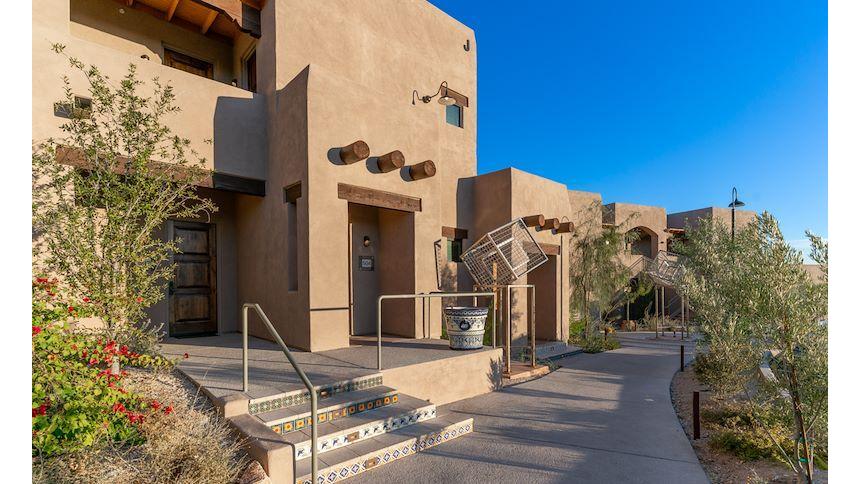
Step out and the building’s real rooms begin. In a hacienda the covered arcade — the portal — is where life happens, and it is the most useful photographic space on the property.
Optically an arcade is a very large soft source with a hard mask. Light enters from one open side only, bounces off the paving and the ceiling, wraps around a subject, and falls off with depth back from the edge. The columns break it into bays.
Depth is the entire control and it is a complete one. At the open edge the light is bright and nearly frontal with a low ratio. A metre back it acquires direction and opens to about three to one. Two or three metres back against the wall the ratio is dramatic and the sunlit courtyard beyond has fallen four or five stops.
That last figure is at the top of its range in Tucson rather than the middle, because desert air gives shadows almost no atmospheric fill — so an arcade here produces a stronger ratio than the same arcade in a humid climate, and the deep position is correspondingly more powerful.
The columns reward precision. A camera moved a few inches decides whether a column bisects a face, frames it, or disappears entirely. One couple per bay, or a pair centred in a single opening with the arcade receding behind them, converts repetition into composition. A group strung along the arcade at random does not.
The paving matters to the colour. Saltillo tile, brick or warm stone under a sunlit courtyard throws a strong warm bounce up into the arcade, which fills under the chin and opens the eye sockets — an unassisted uplight that the region’s pale ground makes stronger than it would be elsewhere.
The courtyards are the second outdoor element and they change completely through the day. A walled courtyard is an open-topped interior: at noon it is a bright box with overhead light and very little shape. Early and late it is a single enormous directional bounce, with one wall lit and the opposite in shade.
In earth-toned walls that bounce is warm, which makes the early and late courtyard here the best light on the property — a subject standing three metres from a sunlit adobe wall is being lit by a source the size of the wall, in a colour that suits skin.
And the courtyard plantings are worth knowing. A hacienda courtyard is usually the one irrigated place on a desert property, which means it carries things the surrounding landscape cannot: citrus, oleander, bougainvillea, date palms, sometimes a fig or an olive.
Bougainvillea is the one to look for. Its colour is in bracts rather than petals — papery magenta, orange or white — and it holds for months rather than weeks, which makes it reliable in a way a flowering season is not. Against a tan adobe wall in warm bounce light it is the strongest colour on the property.
Citrus in a courtyard flowers white and fragrant in February and March and carries fruit through the winter, which means a January courtyard frame can have oranges in it. That is a Sonoran detail worth using rather than passing.
- Put the subject in the window reveal — two feet of adobe collimates the light
- Bounce off a warm plaster wall, never off a dark viga ceiling
- Depth back from the arcade edge is the whole control, and the ratio is extreme here
- Let warm paving bounce up under the chin — it is free uplight
- Bougainvillea holds colour for months; use it against tan adobe
Outside, and the mountain behind
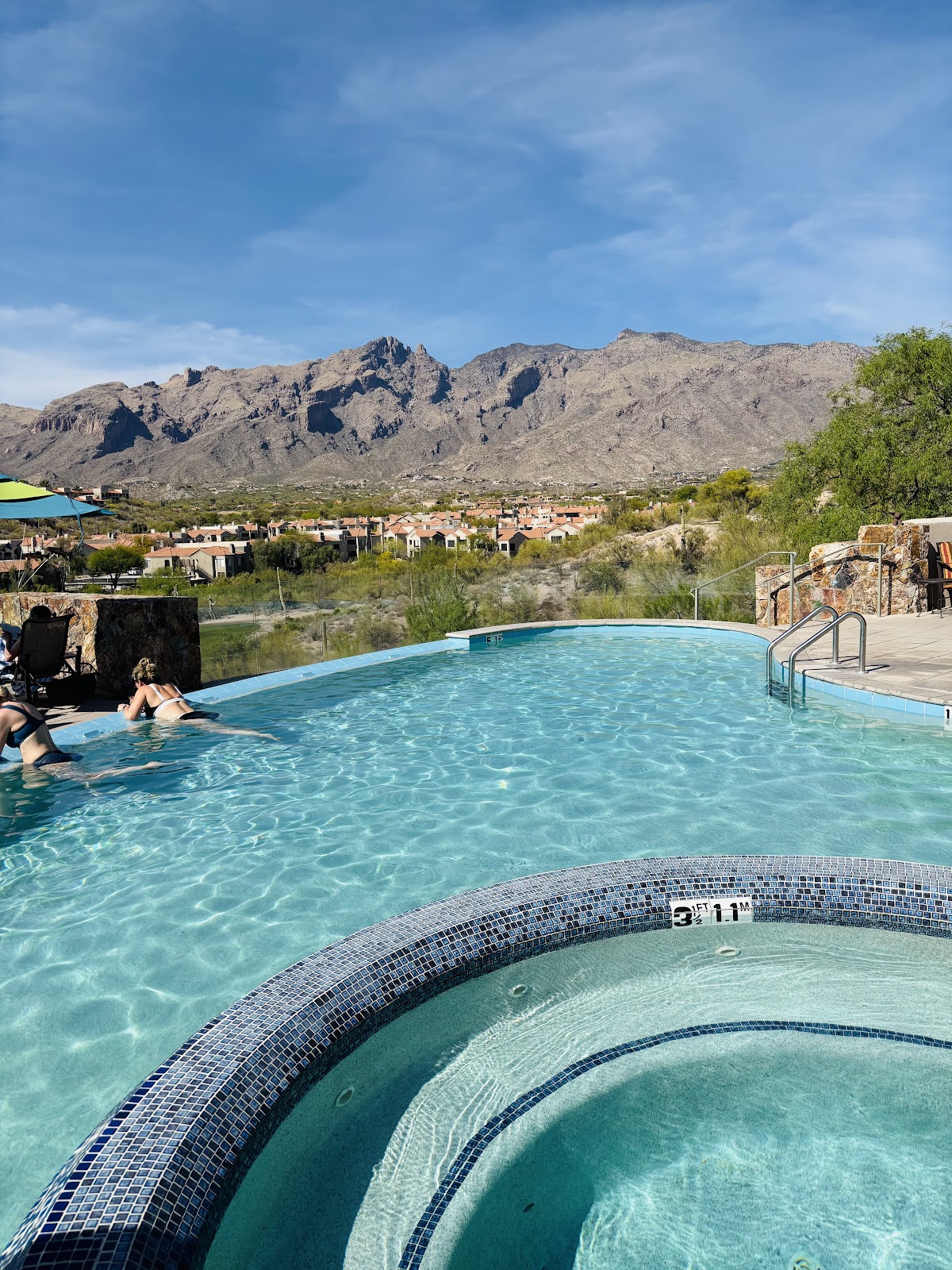
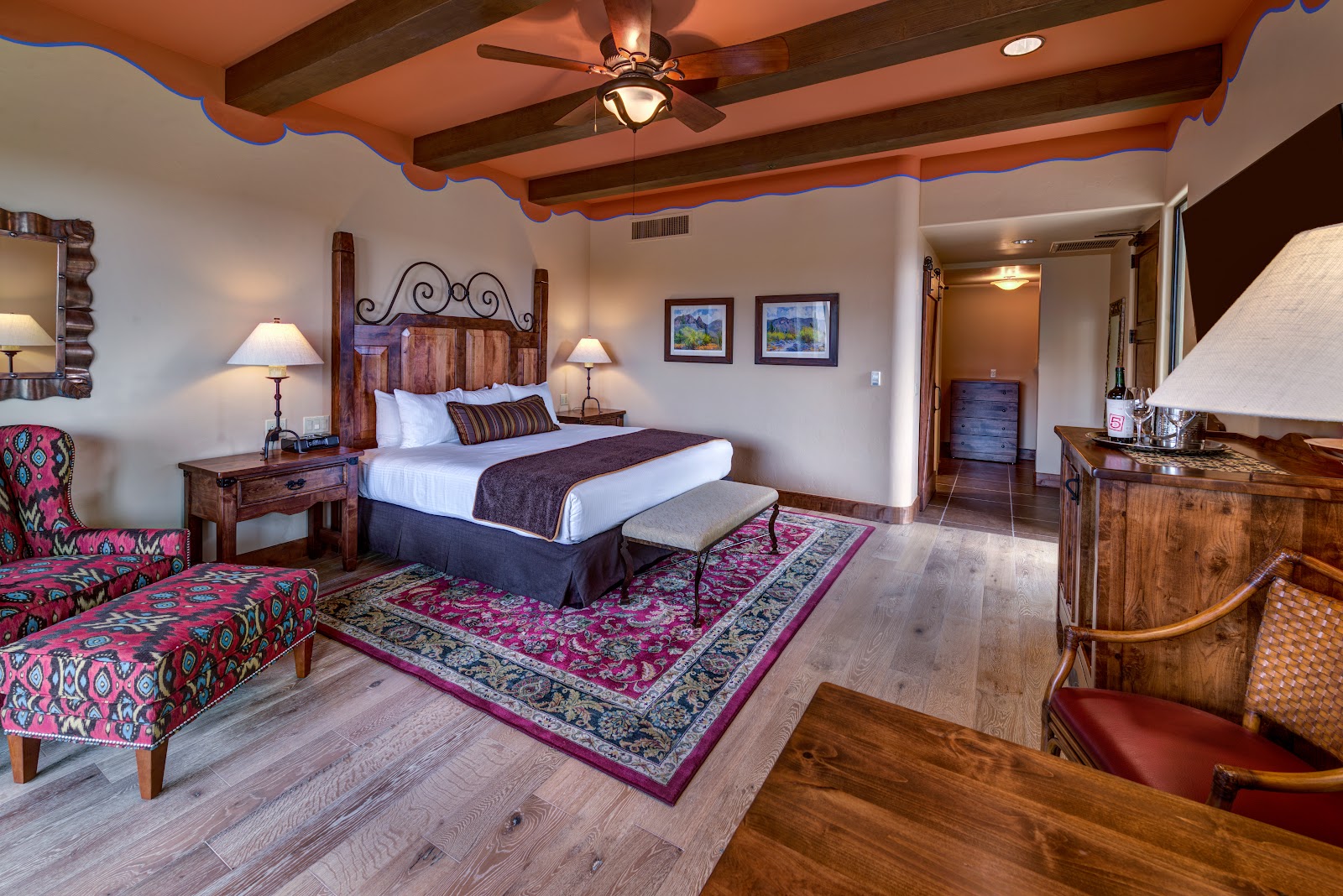
Beyond the walls the property becomes Sonoran Desert, and the Santa Catalina Mountains rise directly behind it.
The Catalinas are worth understanding as a subject because they are unusual. They rise from about twenty-four hundred feet at the city to over nine thousand at the summit, and in that twenty-seven-mile climb the vegetation passes through saguaro desert, grassland, oak woodland, ponderosa pine and finally spruce and fir — a biome sequence equivalent to driving from Mexico to Canada.
That is the sky island phenomenon, and it has a direct photographic consequence: the range behind a Tucson venue is not a uniform desert mountain but a banded one, dark-forested at the top and pale-rocked below, with a visible treeline. In clear air that banding reads at distance and gives the background structure a plain ridge would not.
It also means snow. The Catalina summits hold snow in winter, so a January frame in Tucson can have a party in shirtsleeves in the foreground and a white mountain behind — which is one of the more striking juxtapositions available anywhere in these guides and is entirely reliable in most winters.
The rock is Catalina gneiss, and it behaves well in low sun: pale, banded and steep, it takes the last light frontally and goes a warm pink-gold at a moment when the foothills below are already in shadow. That lag is the frame to wait for — the venue in cool shade with the mountain still lit above it.
A moderate telephoto is required. A wide lens renders the Catalinas at their true angular size, which reduces nine thousand feet of mountain to a modest ridge. Compress from distance, expose for the rock, and lift the subjects with a warm-gelled source at about a stop over the ambient on them.
The desert immediately around the property is the usual Sonoran set and the usual rules apply. No solid natural shade — palo verde and mesquite have millimetre-scale leaves on open branches and cast a hard dapple rather than cover. Saguaro is a sculpture to be placed rather than included, and backlit against clean sky at low sun it needs nothing else. Cholla glows when backlit and its barbed spines detach on contact, so photograph it and do not pose beside it.
The seasons here are the low desert’s, moderated slightly by twenty-four hundred feet. November to April is the good half: mild, dry, with a December noon sun at about thirty-five degrees that models all day. Tucson is a few degrees cooler than Phoenix year-round and its summer, while still severe, is marginally more survivable.
The monsoon is stronger here than in Phoenix and it matters more. Tucson receives about half its annual rainfall between July and September, which is enough to green the desert visibly — the creosote flushes, the grasses come up between the cacti, and the landscape changes from tan to a genuine green for a few weeks in August.
That is a real and under-appreciated photographic window. A green Sonoran Desert under structured monsoon cloud, with the Catalinas dark and wet behind, is a completely different picture from the tan and blue one the region is known for.
The cost is the storms themselves, which arrive fast and hard and make a covered alternative necessary rather than prudent. And the dusk is short — about twenty-four minutes of civil twilight, the briefest in these guides — so the last frames have to be known in advance and walked to rather than discussed.
More frames from The Hacienda del Sol
The Hacienda del Sol wedding photography: common questions
Why is an adobe building dim inside?
Because adobe works by thermal lag rather than insulation, so windows are kept small. What light does enter is collimated by two feet of wall, which makes the reveals superb.
Where is the best portrait light indoors?
In the window reveal itself. Two feet of adobe acts as a snoot, giving a directional key with rapid fall-off and a dark surround — and a warm bounce off the plaster.
How do I light an adobe room with flash?
Bounce off a pale plaster side wall, not off the ceiling. Traditional viga-and-latilla ceilings are dark and return almost nothing.
How do I use the arcade?
By depth. At the edge the light is flat; two or three metres back the ratio is dramatic and the sunlit courtyard beyond has fallen four or five stops.
What makes the Catalinas an unusual background?
They are a sky island — twenty-seven miles from saguaro desert to spruce-fir forest — so the range reads as banded, with a visible treeline and winter snow on the summits.
Is the monsoon worth planning around?
In Tucson, yes. About half the annual rain falls July to September, which greens the desert visibly for a few weeks in August — a completely different picture from the usual tan.
More Arizona venue guides
We are writing a photographer’s guide to every venue we would happily shoot in Arizona. Here are three more, plus the full index:
- The Loews Ventana Canyon, Tucson: Field Notes
- The McCormick Ranch, Scottsdale: Field Notes
- The Oasis at Wild Horse Ranch, Tucson: One Frame, and How It Is Made
Planning a wedding at The Hacienda del Sol?
Adobe, arcades and a sky island behind. Tell us your date.