 The Tlaquepaque Arts Village, Sedona: Field Notes on Courtyards
Desert Botanical Garden, Phoenix: What It Suits, and What It Does Not
A collection, not a landscape. That distinction runs through everything.
The first thing to understand about a botanical garden is that it is a collection rather than a landscape, and the distinction governs every frame.
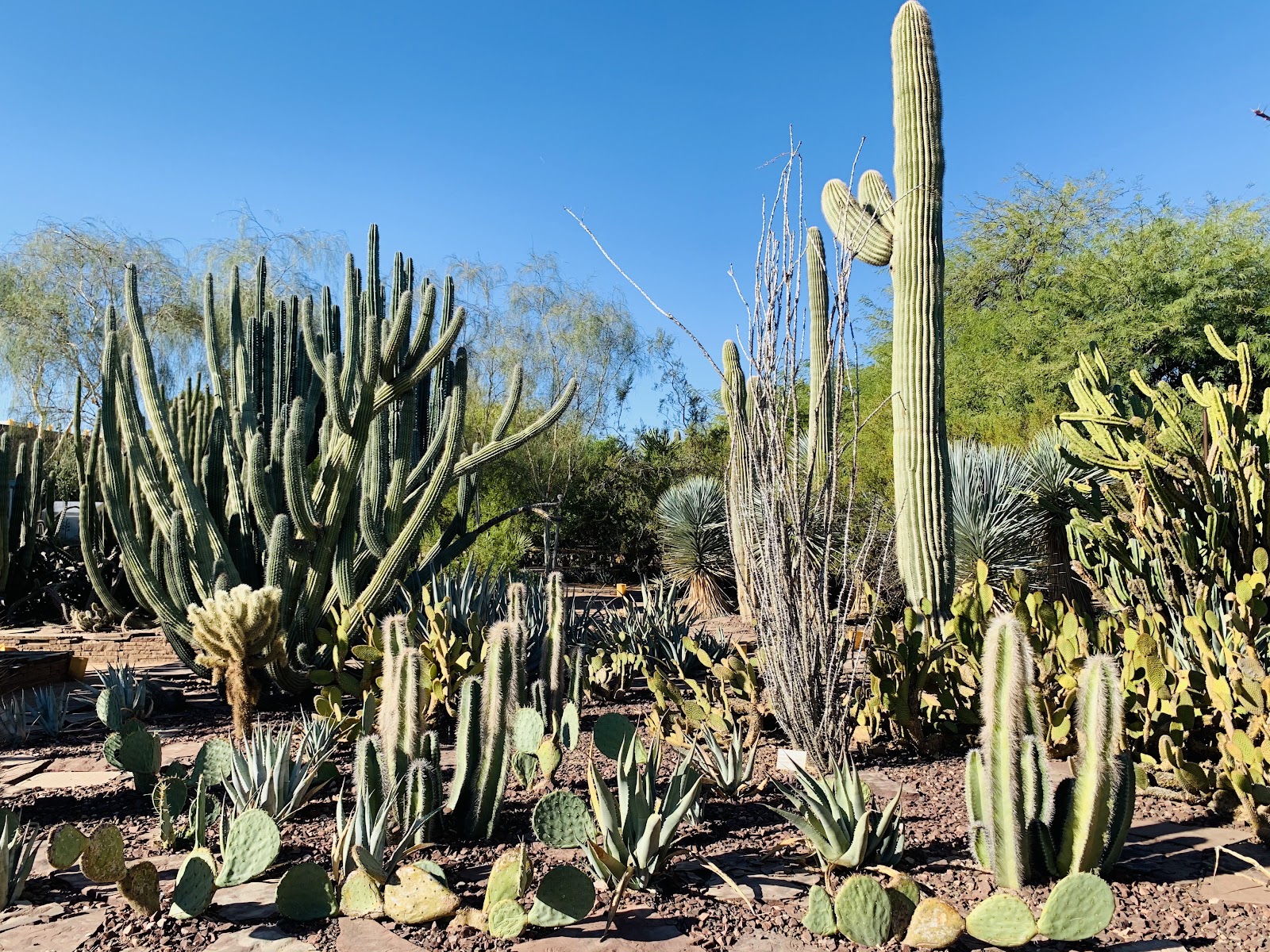
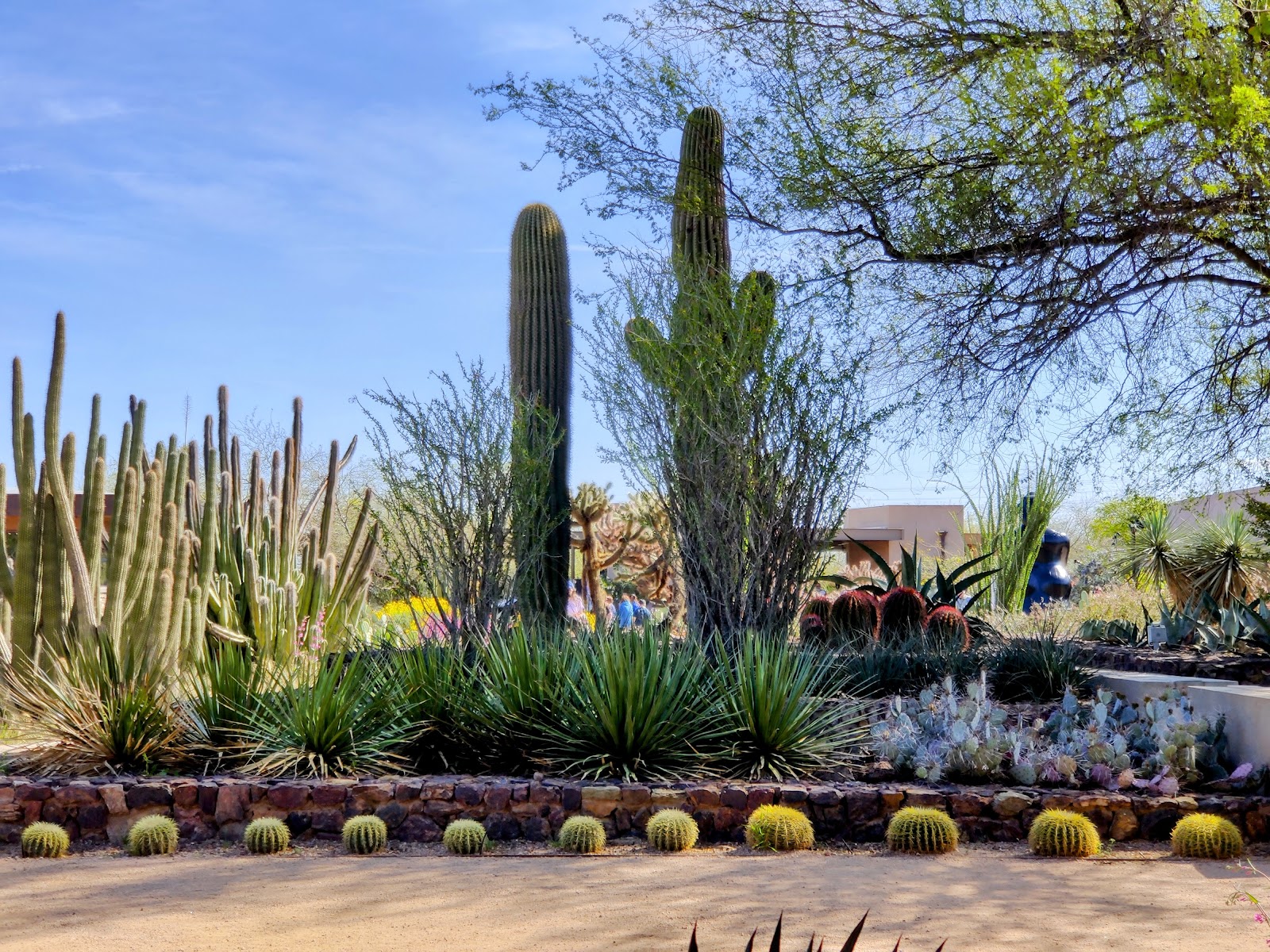
A desert landscape in Arizona is Sonoran: saguaro, palo verde, ocotillo, cholla, brittlebush, creosote, in the densities and associations that rainfall and drainage produce. A desert botanical collection is global: agaves from central Mexico, aloes from southern Africa, boojum and cardón from Baja California, euphorbias, barrel cacti, yuccas and dozens of columnar species from across the world’s arid regions, planted in beds at densities no wild ground would produce.
That is the garden’s whole purpose and it is also the thing to be honest about. A frame taken here is a frame in a superb collection of desert plants, not a frame in the Sonoran Desert — and the two look genuinely different.
What it does give is an intensity and a variety of form that the wild desert cannot. Wild desert is sparse by definition, because water limits density. A planted collection is irrigated and curated, which means the beds are full, the specimens are mature and chosen, and the shapes are extraordinary.
For a photographer that is a real gift, because desert plants are among the most sculptural living things there are — columnar, spined, geometric, symmetrical — and a collection puts a great many of them within a few steps of each other.
The setting adds the geology. Papago Park’s buttes are red Precambrian sandstone and conglomerate, weathered into rounded masses with distinctive cavities, and they take a low frontal sun and glow strongly.
Phoenix sits at about thirty-three and a half degrees north at roughly eleven hundred feet. The June noon sun reaches around eighty degrees, the December noon sun about thirty-three, days run from about ten hours fifteen to fourteen hours twenty, and civil twilight is roughly twenty-five minutes.
We have not photographed a wedding here. Which spaces are bookable, whether the collection paths are accessible to a wedding party, and the permitted hours are questions for the garden — and the last one matters unusually much, because a public garden has visiting hours.
Desert Botanical Garden at a glance
| Where | A major desert plant collection in Papago Park, Phoenix |
| Suits | Sculptural detail, form, symmetry, and colour in spring — plus red butte geology |
| Does not suit | Large counts, exclusivity, casual movement off paths, or a sense of wild desert |
| The honest note | The collection is global, not Sonoran. The plants are from everywhere arid |
| Ask first | Permitted hours — a public garden has visitors, and that governs everything |
What it suits
It suits close work, and that is its clearest strength. A mature agave is a rosette of thick spined leaves arranged in a near-perfect spiral, and the spiral is a genuine mathematical one — the leaves emerge at a consistent divergence angle that packs them with minimal overlap, which is why an agave photographed from directly above reads as a designed object rather than a plant.
That makes it one of the best detail subjects in any garden anywhere. It needs a flat frontal angle, a small aperture to hold the whole rosette, and soft light rather than direct sun, because the spines cast hard shadows across the leaves that break up the pattern.
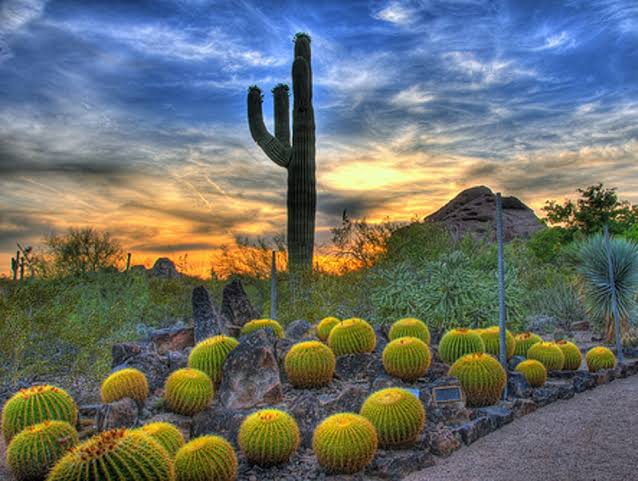
Barrel cacti do something similar with ribs and spines. A barrel cactus is a cylinder of vertical ribs carrying radiating spine clusters, and backlit at low sun the spines catch and glow while the body goes dark — which turns a squat green plant into a luminous halo. That is one of the most reliably beautiful frames in a desert garden and it needs only a low sun behind the subject.
Aloes are the surprise for anyone expecting only cacti. They are African rather than American, they are succulent rather than spined, and many of them flower in winter in tall spikes of orange, red or yellow — which means a January garden here has substantial flower colour when the surrounding Sonoran Desert has none at all.
That is a genuinely useful fact for a winter date, and it is entirely a consequence of the collection being global. Southern-hemisphere species flower on a southern-hemisphere schedule, which in Phoenix lands in the cool season.
It suits form and symmetry more generally. Columnar cacti — cardón, organ pipe, totem pole, and the Sonoran saguaro — give strong verticals with recognisable silhouettes, and a path lined with them is a colonnade. Ocotillo gives a fan of whip-like stems that reads as line drawing. Yucca gives a dense radiating burst. None of that occurs together in the wild.
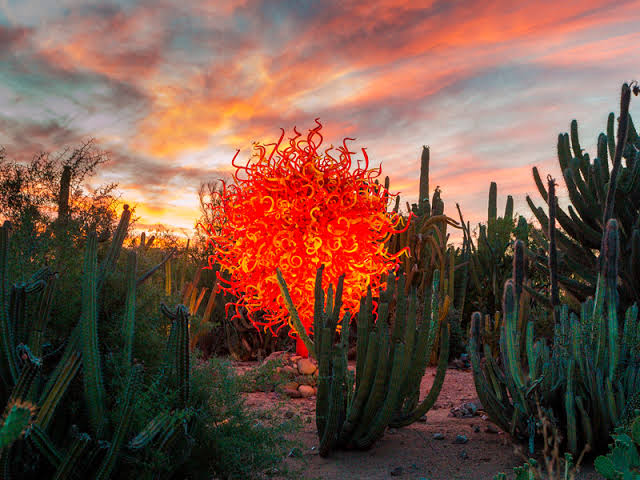
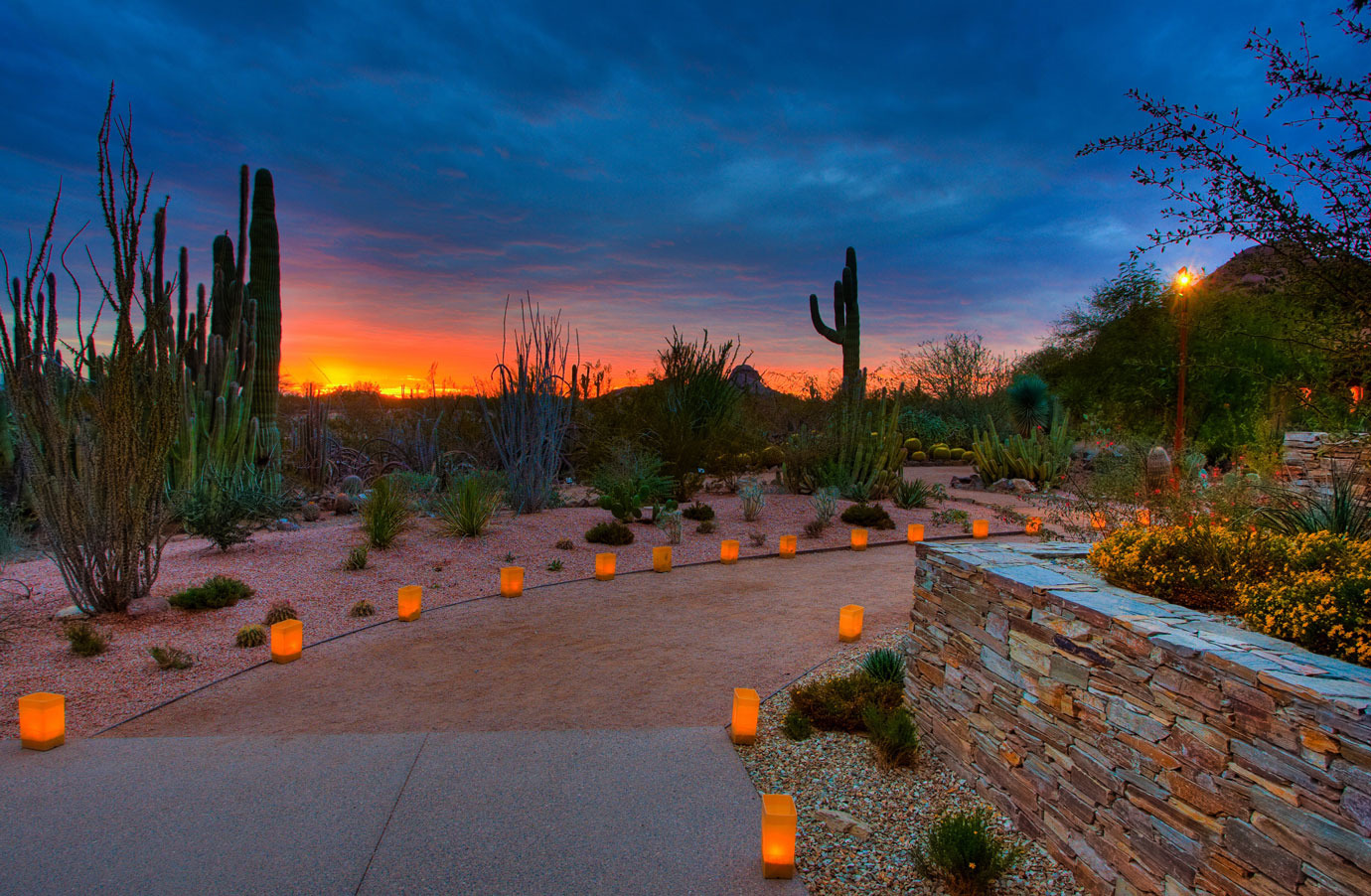
It suits the golden hour exceptionally well, because spined plants and low sun are made for each other. Every spine is a tiny translucent filament, and a low sun behind a spined plant lights thousands of them at once — which produces a rim and a glow that no other plant type generates. The last forty minutes in a cactus collection is the best it will ever look.
It suits the butte geology. Papago Park’s formations are red sedimentary rock weathered into rounded masses with characteristic hollows and cavities, and in the exceptionally clear dry desert air they hold colour and detail in low sun in a way a hazier climate would not allow. A frame with a red butte behind a columnar cactus is specific to this one park.
And it suits a small, mobile, walking wedding party. A garden is a route rather than a room, and a group of twenty that is happy to walk it will get far more variety in an hour than the same group would in any building.
What it does not suit
It does not suit a large guest count, and the constraint is physical rather than administrative. A collection is organised around paths, and paths are narrow because the beds are the point — which means a group of a hundred cannot be moved through the collection or assembled within it.
Gardens of this kind do have event lawns and terraces, and those hold numbers perfectly well. But the event space and the collection are different places, and a large wedding will largely be in the former looking at the latter.
It does not suit exclusivity. A public botanical garden has visitors, and unless the booking is genuinely outside opening hours there will be people in the background — in sun hats, with cameras, walking the same paths. That is entirely normal and it needs expecting rather than resenting.
The permitted-hours question is therefore the most important one to ask. An evening booking after closing is a different product from a daytime one, and the difference is total: empty paths, the golden hour, and the garden to yourselves.
It does not suit casual movement, and this is the practical point most easily underestimated. A desert collection is full of plants that injure people.
Cholla is the serious one. Its spines are barbed and they detach on contact, which means brushing against one leaves a segment attached to fabric or skin, and removing it is genuinely difficult and painful. Agave leaves end in a hard terminal spine that is sharp enough to puncture. Barrel cactus spines are stout and hooked. Ocotillo stems carry thorns along their whole length.
None of that is a reason to avoid the place and all of it is a reason to stay on the paths, to keep a train and a veil under control, and to never position anyone for a photograph inside a bed. The rule for a photographer is simple: the plants are subjects, not backdrops to stand among.
It does not suit a party that wants to feel it is in the wild desert. The garden is beautiful and it is manifestly designed — labelled, irrigated, curated, pathed. That is not a criticism of a botanical garden, which is doing exactly what it exists to do, but a couple whose mental image is empty Sonoran desert with a lone saguaro should know that this is a different thing.
And it does not suit a summer afternoon, which nothing in the low desert does. Phoenix afternoons regularly exceed a hundred and ten degrees, and a garden with almost no overhead cover is among the more exposed places to be in that. The reason there is no cover is the collection itself: desert plants are adapted to full sun and most of them are short, so a desert garden is by design an open one.
That last point is worth making explicit because it surprises people who associate the word garden with shade. A woodland garden is a shaded place; a desert garden is the opposite, and the midday problem here is as acute as on open ground.
- Book outside opening hours if you can — it changes the product entirely
- Backlight every spined plant at low sun; the spines do the work
- Aloes flower in winter, so a January frame has colour the desert lacks
- Stay on the paths: cholla spines are barbed and detach on contact
- A desert garden has no shade by design — the plants want full sun
Technique, and the year
Five things govern the day here and the first is the absence of cover.
A desert collection is an open garden, and the low desert’s own trees offer nothing: palo verde and mesquite carry leaves measured in millimetres on open filigree branch structures, which cast a fine hard moving dapple rather than shade. At eighty degrees of sun elevation, in air that gives shadows almost no atmospheric fill, a face beneath one is covered in small hard patches and nothing recovers it.
So the answers at midday are built cover — a ramada, a pavilion, a covered walk — or a carried diffuser held overhead, which converts the sun into a large soft source directly above and is the only portable solution on open ground. There is no third option, and a garden with neither has an unusable middle of the day in the warm half of the year.
The second is the colour split. At this latitude in very dry air the sky is a deep saturated blue, which means open shade is lit by a blue source and reads distinctly cool while direct sun reads warm. An ungelled flash puts a yellow-green face into a frame that is warm above and cold below — the most common desert error. Warm-gel everything by about a quarter to a half.
The third is depth of field, and in a collection it matters more than usual. A garden frame is typically a subject in front of an intricate background, and desert plants are intricate in a way that punishes a shallow aperture — spines, ribs and rosettes that go slightly soft read as visual noise rather than as bokeh.
So a smaller aperture than a portrait photographer’s instinct is usually right here: either enough depth to render the plants cleanly, or considerably less depth so they dissolve entirely. The awkward middle, where they are recognisable but unresolved, is the one to avoid.
The fourth is scale. Desert plants vary from a few centimetres to over ten metres within a few paces, and a frame that mixes them without a reference gives the viewer no sense of size. A person in the frame resolves that instantly, which is one of the genuine advantages of photographing a garden with a wedding party in it rather than without.
The fifth is the sun’s position relative to the spines, which is the whole craft of a cactus collection. Front-lit, a spined plant is a pale green mass with hard shadows across it and it looks like nothing. Side-lit, the ribs and spines pick out and it has form. Back-lit, the spines glow and it is luminous.
That means the route through the garden should follow the light rather than the map. Walk the collection in the direction that keeps the sun in front of the camera in the last hour, and every plant along the way is at its best.
The year is the low desert’s, with the garden’s own overlay. November to April is the season: mild, dry, calm, with a December noon sun of about thirty-three degrees that never gets high enough to produce the midday problem — so the whole short day has directional light and the collection has form from morning to dusk.
The garden’s winter advantage is the aloes, which flower in tall orange and red spikes through the cool months on a southern-hemisphere schedule. That gives a January or February garden substantial flower colour that the surrounding wild desert simply does not have.
March to May is the peak. The Sonoran natives flower in spring — brittlebush yellow, Mexican gold poppy, lupine, ocotillo red — and the collection’s global species overlap with them, so the beds carry colour from several continents at once. Palo verde flowers a mass of bright yellow through April into May.
In May the saguaros and many other columnar cacti flower white at the crown of the column, several metres up, which needs a long lens and is a small specific subject rather than a landscape one. Barrel cacti flower in a ring of yellow or pink at the top of the barrel, which is at knee height and photographs beautifully from directly above.
May to September is the constraint, and a summer booking here belongs entirely in the last ninety minutes of the day. The monsoon from July is the compensation: convective cloud building over the mountains through the afternoon turns an empty blue sky into a structured one, and the half hour after a cell passes gives washed air, wet plants and saturated colour.
Wet cactus is a specific and underused subject. Water beads on a waxy cuticle rather than soaking in, which means a rained-on cactus carries droplets along every rib and at the base of every spine — and backlit, each droplet is a point of light. It is the best the collection ever looks and it lasts about twenty minutes.
More frames from Desert Botanical Garden
Desert Botanical Garden wedding photography: common questions
Is the collection all Sonoran plants?
No, and that is the point. It is global — agaves from Mexico, aloes from southern Africa, Baja columnar species — planted at densities no wild ground produces.
What is the single best technique here?
Backlighting. Every spine is a translucent filament, so a low sun behind a spined plant lights thousands at once and produces a glow nothing else generates.
Why is there no shade in a desert garden?
By design. Desert plants are adapted to full sun and most are short, so the collection is open. The midday problem is as acute as on bare ground.
What should we be careful of?
Cholla above all — its spines are barbed and detach on contact. Agave leaves end in a puncturing spine. Stay on the paths and keep trains under control.
Does a botanical garden have winter colour?
Yes, unusually. Aloes are southern-hemisphere species and flower in tall orange and red spikes through the cool months, when the wild desert has nothing.
What aperture should I use?
Either enough depth to render the plants cleanly or little enough that they dissolve. Slightly-soft spines read as noise rather than as bokeh.
More Arizona venue guides
We are writing a photographer’s guide to every venue we would happily shoot in Arizona. Here are three more, plus the full index:
- El Chorro, Paradise Valley: The Venue’s Own Logic
- The Farm at South Mountain, Phoenix: The Light Through the Day
- The Garden at The Orchard, Queen Creek: The Light Through the Day
Planning a wedding at Desert Botanical Garden?
A collection of extraordinary shapes. Tell us your date.