 Tulsa Country Club: Field Notes on a 1908 Club
The Tulsa Convention Center: The Problem, and Four Ways Out
A room designed to suit anything looks like nothing. Four ways out, and the city supplies the fifth.
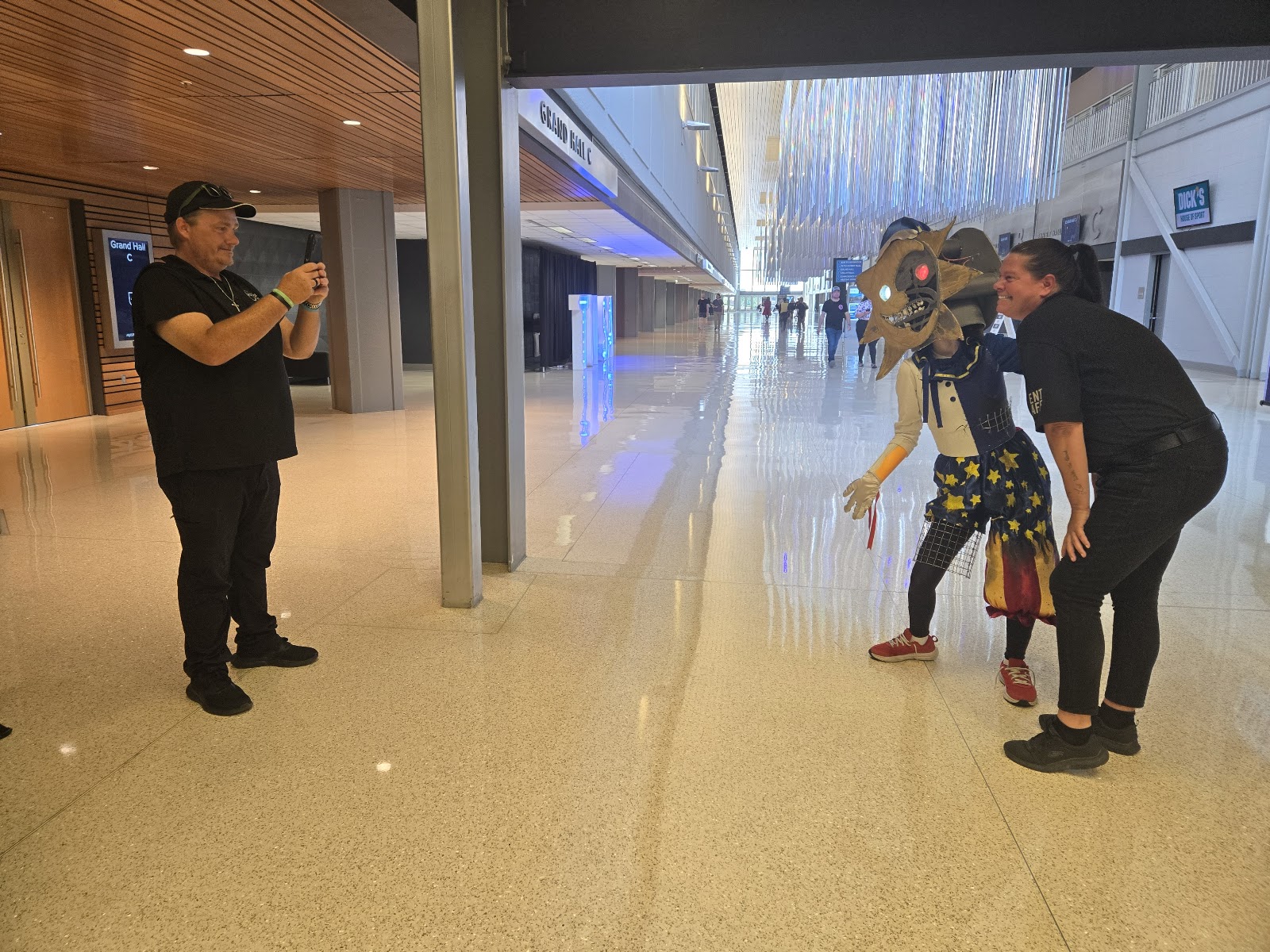
A convention centre is the most honest venue type about what it is: a neutral container that can hold a trade show on Tuesday and a wedding on Saturday. Neutrality is the product rather than a shortcoming.
For a photographer that produces one clear problem. The rooms are pale, evenly lit from above, hard-surfaced and featureless, which means the wall behind a face is as bright as the face, the picture flattens, and nothing in the frame says where it was taken.
None of that is recoverable afterwards, because the information was never recorded. But there are four ways out, all reliable, and none of them requires the building to be something it is not.
There is also a fifth thing, which is outside: downtown Tulsa holds one of the largest concentrations of Art Deco architecture in the country, which is a genuinely distinctive exterior asset and the answer to the neutrality problem in a single walk.
We have not photographed a wedding at the Tulsa Convention Center; convention facilities behave consistently. Which spaces are included, whether the lighting is adjustable and what may be attached are questions for their team.
The Tulsa Convention Center at a glance
| Where | Downtown Tulsa, Oklahoma |
| The problem | Pale, evenly lit, featureless rooms with nothing to stand against |
| Way one | Build separation geometrically: distance, the dark end, depth behind |
| Way two | Out-light the room. Way three: find the real features |
| Way four | Go outside — and here that means Art Deco |
Ways one and two: geometry, and light
The first way out costs nothing but attention. A subject a metre from a pale wall has no separation; the same subject five metres from it, with the camera at the same distance from them, has a measurably darker background — because light falls off with distance, and that difference is the whole effect.
Three variants all work. Distance, as above. The darker end of the room, because every evenly lit space is in fact unevenly lit and one end is always half a stop to a stop down — two minutes of walking finds it. And depth behind, which means composing so the background is a corridor, an open doorway or a further space rather than a near wall, because depth darkens by itself.
The second way out is photometric: make the subject brighter than the room. The eye goes to the brightest thing in a frame, so a face half a stop to a stop above its background holds attention regardless of how featureless that background is — and it is the most controllable of the four, because it does not depend on the room’s geometry.
In practice that is one source off the camera axis at face height, in a modifier large enough to be soft at working distance, gelled to match the dominant fitting colour with white balance set to the gel.
That gel matters more in a convention facility than in most buildings, because the lighting is a mixture of whatever has been installed and replaced over decades — fluorescent, LED of varying quality, warmer decorative fittings in the pre-function areas, and any coloured uplighting brought in for the event. Three temperatures on one face cannot be reconciled afterwards, so pick the one that should be correct, set white balance to it, and switch off or overpower whatever else reaches skin.
Coloured uplighting is usually the worst of it and frequently the easiest thing to have turned off for the ten minutes the portraits need, which is a reasonable request rather than a compromise.
The underlying problem is direction. Dense downlighting shadows eye sockets and cuts a hard line under every chin, and no exposure correction fixes it — one source placed to the side at face height improves every face in the building at once, which makes it the most economical intervention available.
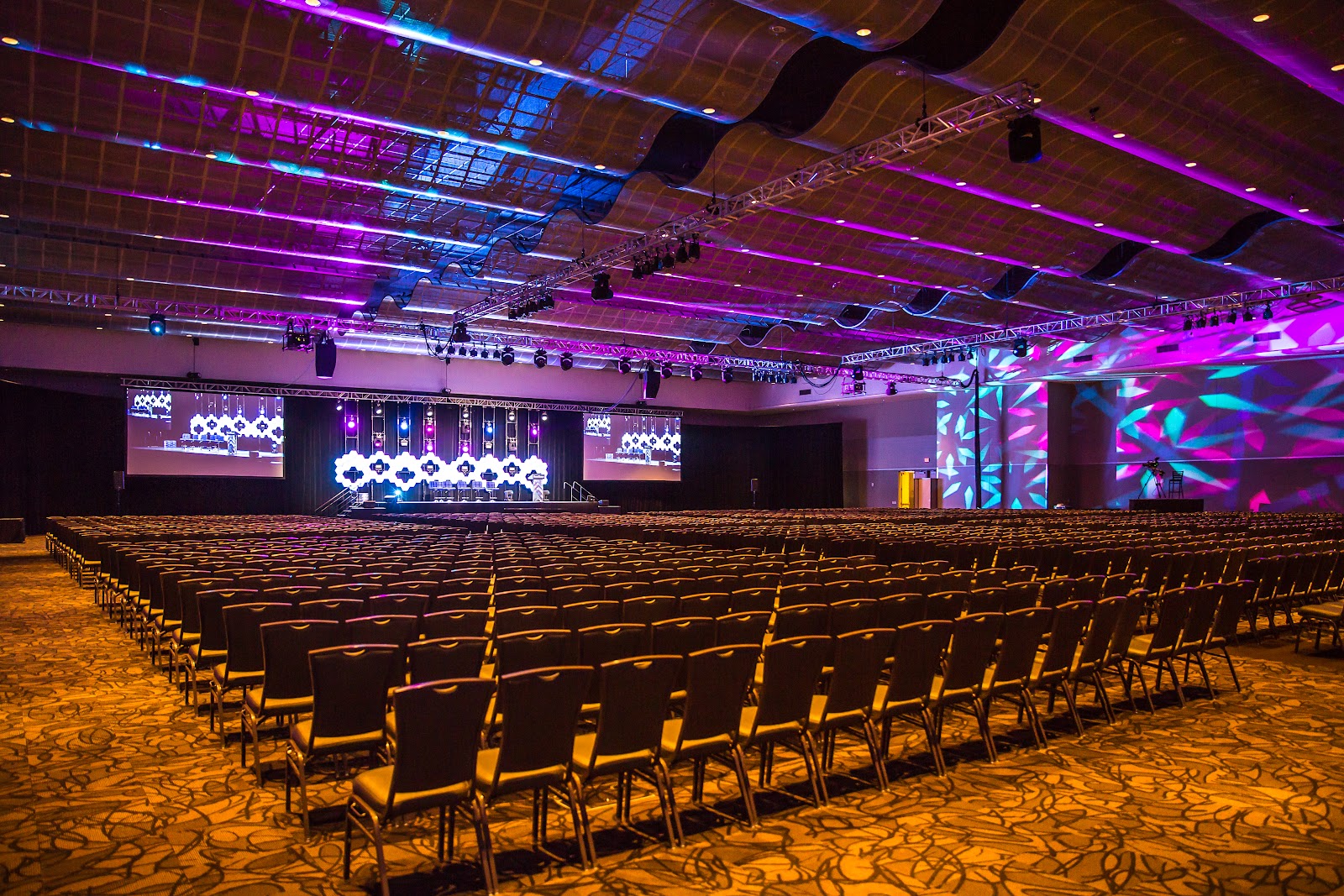
And bounce should be answered per space rather than assumed. Exhibition halls and ballrooms have ceilings well over four metres, which return very little and colour what they do return; pre-function areas, corridors and meeting rooms are frequently lower, where a bounced source is a very large soft one. One test frame each is thirty seconds well spent.
Ways three and four: the real features, and the Deco
The third way out is to find the building’s actual features, and every convention facility has them even when the main rooms do not.
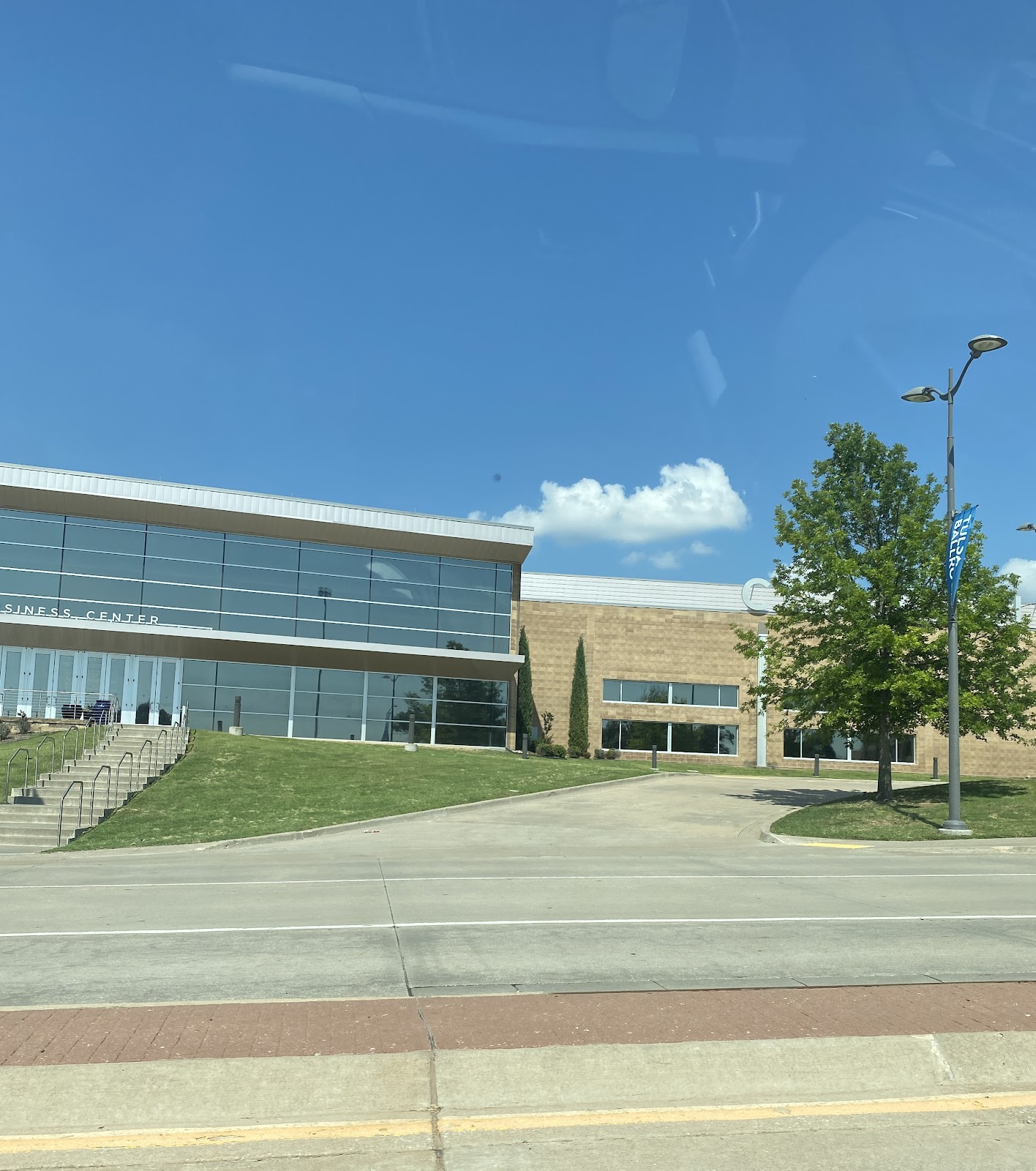
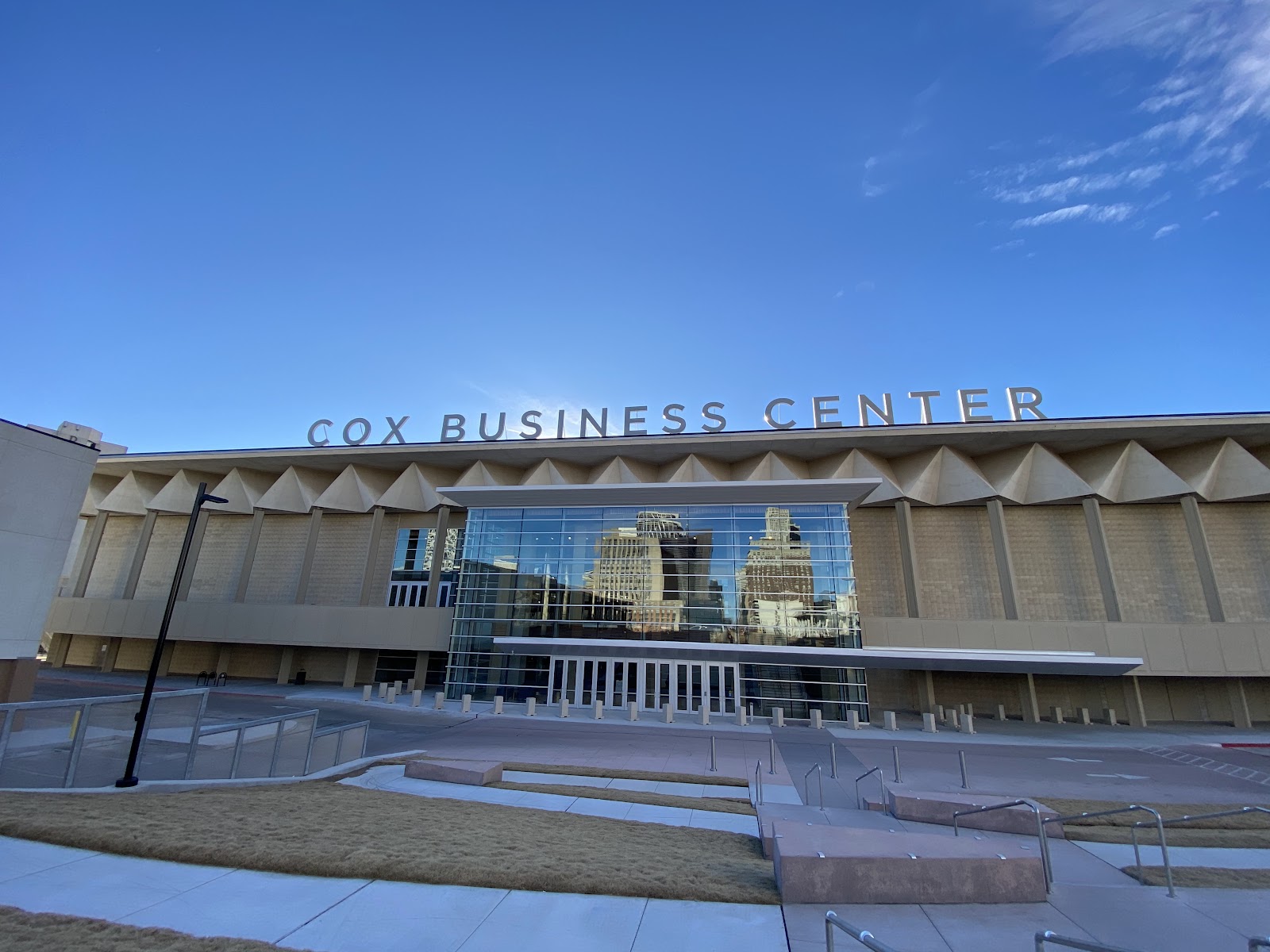
A glazed entrance or atrium is the first and it is the only large daylight source in the building. It behaves like a very long window — shaded side or overcast rather than direct sun, and about three metres back from the glass so a row of people is evenly lit rather than dropping two stops across it. That three-metre figure is what makes a glazed lobby capable of lighting a thirty-person formal with no equipment, and it is where the large groups belong.
Commercial glazing is frequently coated for solar control, which throws a localised green or blue cast worth checking with one frame. And at Tulsa’s latitude, about thirty-six degrees north, a north-facing glazed wall is shaded all year and is the most reliable, while a south-facing one carries direct low sun through much of a winter afternoon.
A stair is the second and it is the best architectural asset in most convention centres: elevation, so a photographer above a group sees faces rather than the backs of heads; a natural line for a descent; and a vertical composition with rows of people. It needs light from one side, because overhead light on a stair shadows every eye socket at once.
A long corridor is the third, giving depth and repetition and the cheapest separation available anywhere. And back-of-house is the fourth — loading bays, service corridors, plant and rigging — which is frequently the most characterful part of a neutral building and is often available for ten minutes with someone escorting if asked.
Ten minutes on arrival locates all four, and between them they carry a meaningful part of a gallery.
The fourth way out is to go outside, and in Tulsa that is a stronger answer than in most cities. Downtown here holds one of the largest concentrations of Art Deco architecture in the country, built on oil wealth in the nineteen-twenties and thirties — and Deco is an unusually photogenic idiom for a specific reason.
It is made of moulded, stepped and patterned surfaces: terracotta, polychrome tile, cast stone and geometric relief. All of that reads only under raking light, because light running along a moulded surface lifts every step and chevron while the same light facing it flattens the whole facade into a field of one colour. So the Deco frames are low-sun frames, and a short walk to find which elevation the sun is skimming is worth more than any accessory.
Deco is also strongly graphic and repetitive, which suits tight framing rather than wide establishing shots: a couple against a single bay of patterned terracotta reads better than the same couple in front of a whole building. And in a mid-sized city the streets are wide enough to stand back in, so the whole building is available too — rare enough to be worth using.
That combination is the direct answer to the neutrality problem. Nothing in a function room says where the day happened; a bay of Tulsa terracotta does.
- Five metres off the wall, or the darker end, or depth behind
- One gelled source, a stop above the room; ask for the uplighting off
- Ten minutes finds the atrium, the stair, the corridor and the back-of-house
- Large formals in the glazed lobby, three metres back from the glass
- Go outside for the Deco — low sun, tight framing, one bay rather than a facade
Outside, and Oklahoma's year
The Arkansas River is the other exterior element and a riverside position gives water that reflects and doubles anything lit — with camera height deciding whether it reads as a mirror or as its own sediment colour, and low being nearly always the answer.
The timed frame is the crossing: twenty-five to forty minutes after sunset, when the sky still holds colour at about the brightness of the city’s lighting, so one exposure holds couple, buildings and sky. Since the interior does not change through the day, taking ten minutes for it costs nothing indoors.
The seasons here are emphatic and one needs naming plainly. Spring in Oklahoma brings severe convective storms, and this region sits in the part of the country with the highest frequency of them — which means a spring date carries a genuine risk of severe weather rather than mere rain. That is a planning matter for whoever is responsible for the party, and at an entirely indoor venue it costs a decision rather than a picture.
The compensation is that a storm approaching across open country is visible for a long time before it arrives, which is both a useful warning and the most dramatic sky the region produces.
Summer is hot and humid, and the humidity rather than the heat is the photographic fact: moist air scatters light, which softens shadows and slightly flattens distance — good for faces, less good for a long view down the river.
The fogging problem is the equipment issue in this climate and a convention centre makes it worse, because the halls are cooled hard for full occupancy: a body carried straight out into July air fogs on every surface at once and does not clear quickly. Opening a bag twenty minutes before going out is the whole fix, and at a venue whose one unmovable frame is a timed crossing, a fogged lens means missing it.
Autumn is the best light of the year: humidity drops, the air clears, and low sun arrives at a civilised hour, usually late October into November. That is also when the Deco frames are at their best, because the raking angle lasts longer through the day.
Winter is mild by northern standards, with cold snaps rather than sustained freeze. The December midday sun at about thirty-one degrees above the horizon rakes terracotta, tile and relief ornament all day rather than lighting them from overhead — which makes winter quietly the best season for the city’s architecture, and the one time the middle of the day works outdoors.
Snow is occasional and when it comes it does two useful things: outdoors it is the best natural fill available, lifting exactly the shadows a low sun carves while fooling a meter by about two stops; and indoors it turns the ground into a reflector, so a glazed lobby gives softer, brighter and more even light than at any other time of year.
The winter constraint is the short day, which compresses the outdoor block into a couple of hours and means the Deco route should be decided in advance rather than explored.
More frames from The Tulsa Convention Center
The Tulsa Convention Center wedding photography: common questions
What is the central problem?
Neutrality. Pale, evenly lit, featureless rooms give a subject nothing to stand against, and nothing in the frame says where it was taken.
What is the cheapest fix?
Geometry. Five metres off the wall, the darker end of the room, or a background that is depth — a corridor or doorway — rather than a near surface.
Which real features are worth finding?
A glazed entrance or atrium, a stair, a long corridor and the back-of-house. Ten minutes on arrival locates all four.
Where do the large formals belong?
The glazed lobby, three metres back from the glass. That figure is what makes a thirty-person group possible with no equipment.
What does Tulsa give outside?
One of the country’s largest concentrations of Art Deco — moulded terracotta and relief that reads only under raking light, and best in tight frames.
Is there a seasonal warning?
Spring. This region has the highest frequency of severe convective storms in the country, which is a planning matter rather than a photographic one.
More Oklahoma venue guides
We are writing a photographer’s guide to every venue we would happily shoot in Oklahoma. Here are three more, plus the full index:
- The Ambassador Hotel, Tulsa: A Walk-Through of a 1929 Boutique Building
- Cain’s Ballroom: Field Notes on a 1924 Dance Hall
- The Gilcrease Museum: Building the Shot List Across Gardens and Galleries
Planning a wedding at The Tulsa Convention Center?
Four ways out, and a Deco walk. Tell us your date and we will use all five.