 The House of Blues, Cleveland: What It Suits and What It Does Not
The Cleveland Museum of Art: What It Suits and What It Does Not
The facade and the atrium are the reasons to book it. The galleries are a separate question.
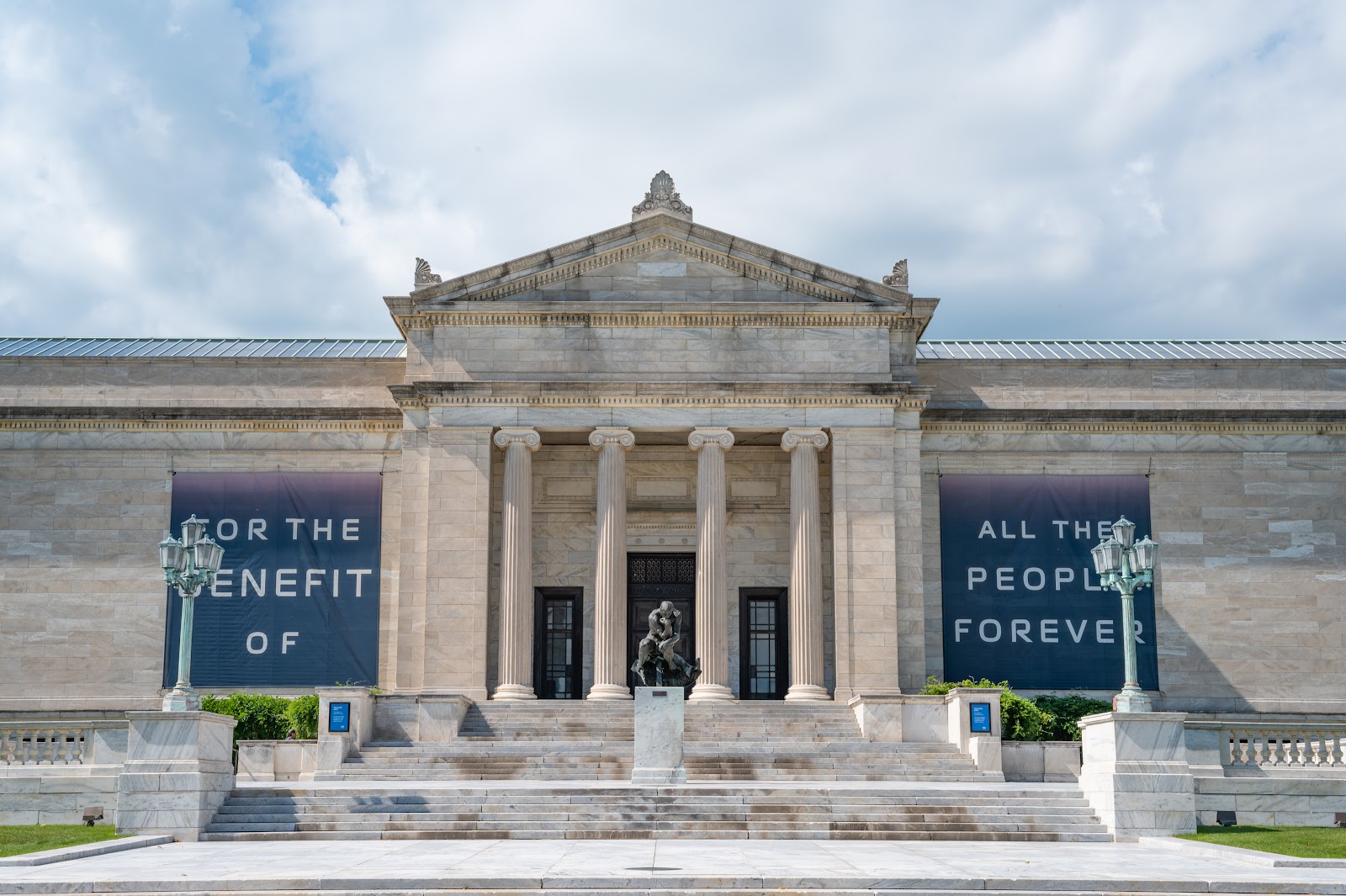
The Cleveland Museum of Art’s facade, with its clean lines and historic elements, makes an incredible setting for first-look and exit photographs — which is, unusually, an accurate assessment from the venue’s own material.
It is accurate because a neoclassical museum’s exterior and its public architecture are genuinely the best parts of it photographically, and its galleries are genuinely the hardest. That inversion is worth being explicit about rather than discovering: the rooms holding the collection are lit for conservation and display, which is close to the worst possible portrait condition, while the entrance hall, the atrium and the steps hold nothing light-sensitive and are therefore generously lit, monumental and symmetrical.
So this is written as suits and does not suit, because the match between a museum and a brief is where most disappointment in this category comes from. We have not photographed a wedding at the Cleveland Museum of Art; neoclassical museums with glazed atria behave consistently. Whether photography is permitted in galleries, whether stands and flash are allowed, and which spaces a booking includes are the questions for their team — three separate questions that venues frequently answer differently.
The Cleveland Museum of Art at a glance
| Where | University Circle, Cleveland, Ohio |
| Character | A neoclassical art museum with a glazed atrium and formal grounds |
| Suits | Architecture, monumental frames, weatherproofing, large counts |
| Does not suit | Bright airy gallery portraits, or a small intimate day |
| Ask first | Gallery photography, stands, flash — three separate questions |
The three light conditions in one building
The exterior is the first condition and it is the best of the three. Pale stone shows its texture only when light runs along it, which means a facade that looks flat and chalky at noon separates into planes and shadowed detail in raking light — so the exterior is a last-ninety-minutes proposition and close to inert before that. Which elevation receives that light depends on orientation, so one walk around the building is worth more than any accessory.
Monumental steps, where the building has them, are the most useful single feature: steps make rows automatically, so a group of thirty arranges itself with everybody visible, which no gallery floor or lawn will do. Almost every group photograph at a museum of this type belongs on its steps.
Pale stone also bounces neutral-to-cool light, which renders skin slightly grey in flat weather, and it pushes a meter towards underexposure because the whole frame is bright. Add a stop or more, exactly as for snow, and carry a warm reflector or gel specifically for a stone building.
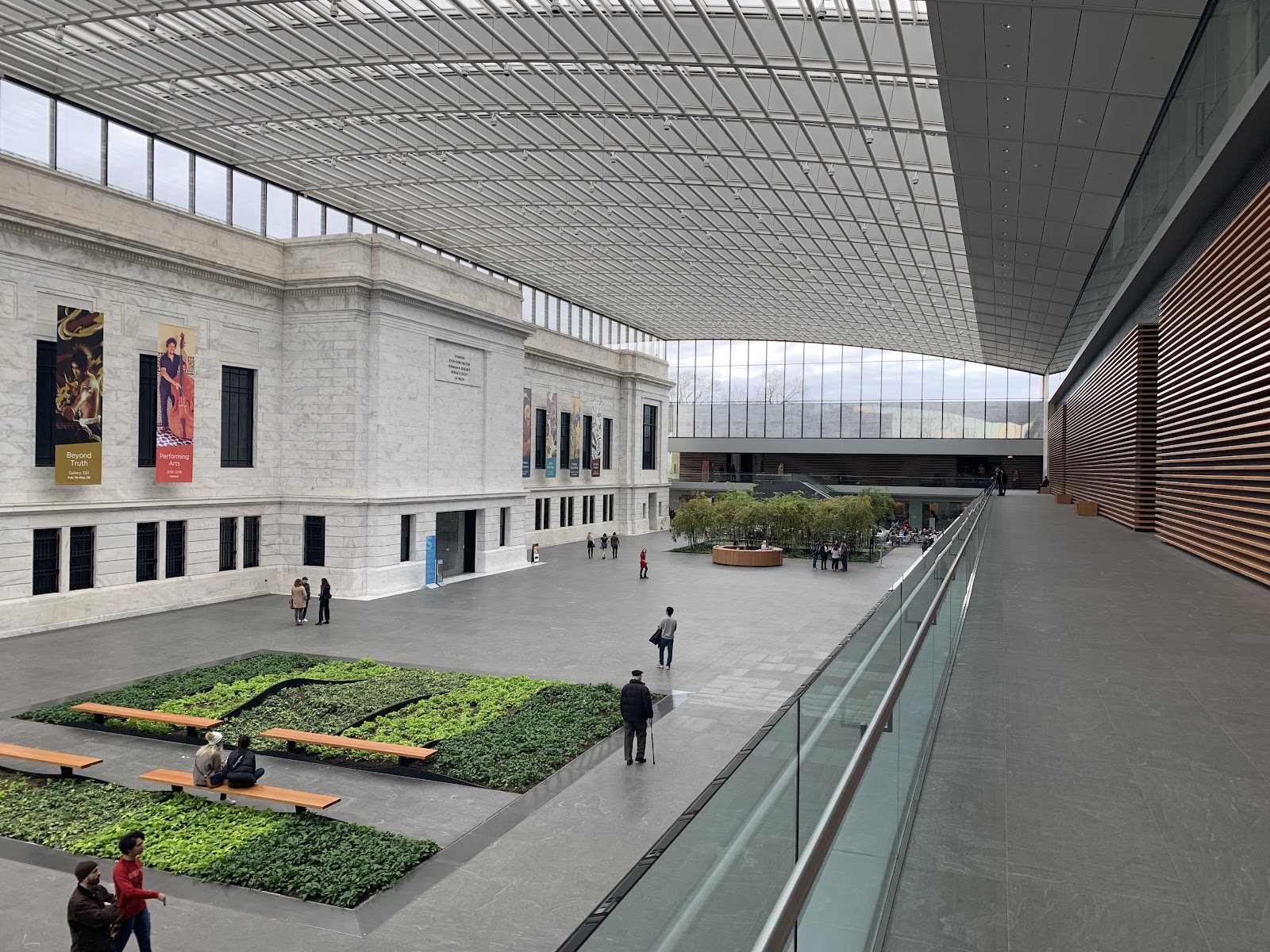
A glazed atrium is the second condition and it is the best interior in the building. It holds nothing light-sensitive, so it is generously daylit; it is tall, which carries no visual clutter; and it is pale-surfaced, which raises ambient throughout. The light arrives largely from above, so eye sockets darken — fixed with a reflector held low, a lifted chin, or a small face-height source.
Under overcast a glazed atrium is at its best, because cloud diffuses the light before the glass does and it arrives from the whole sky with no hard edge. Under direct sun, the roof structure prints a lattice of hard shadow across the floor and anybody in it, which is a genuine exposure difference across the subject and cannot be corrected — so on a sunny day work where the structure is densest, or use the pattern on a floor rather than on a face.
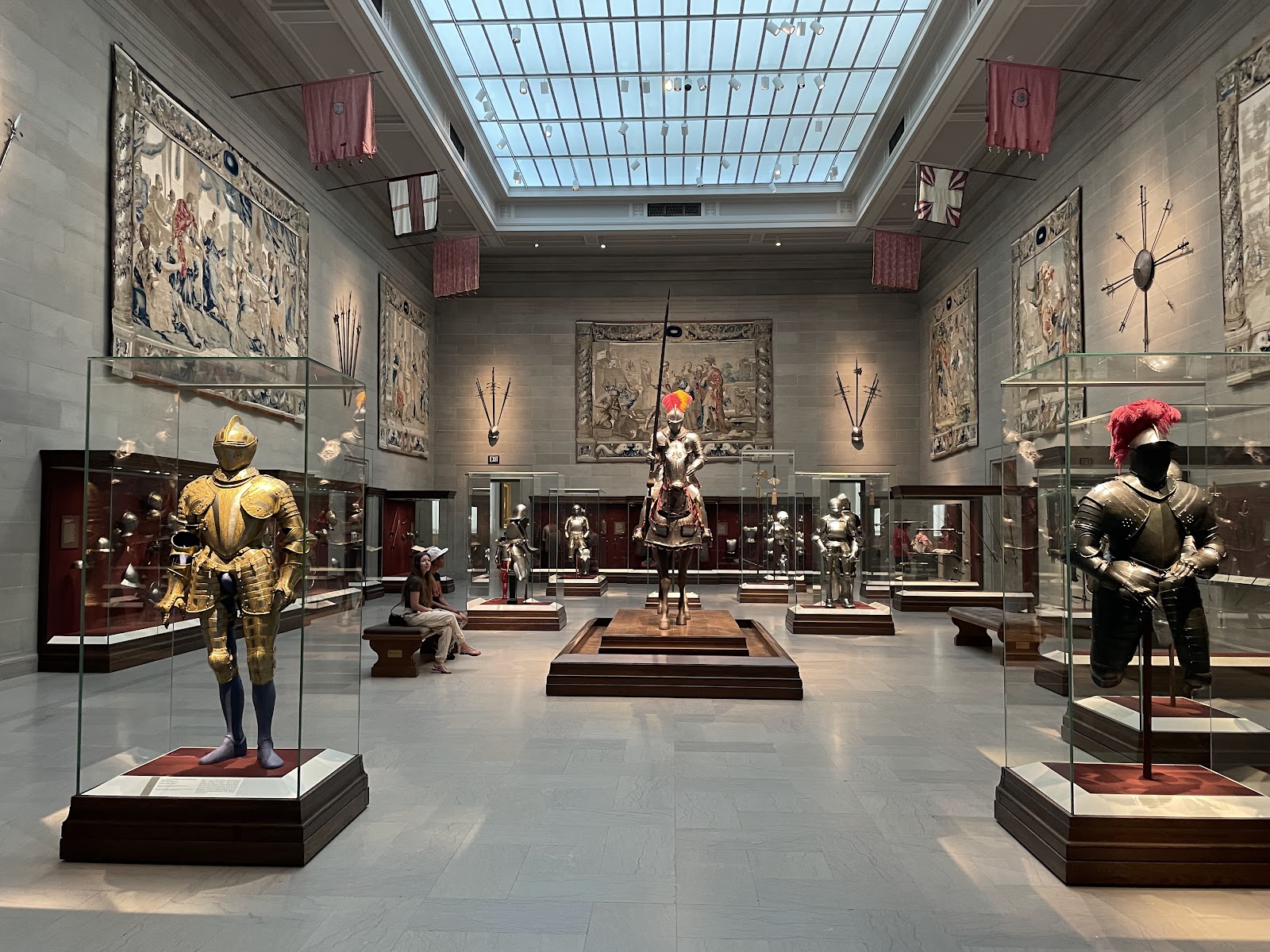
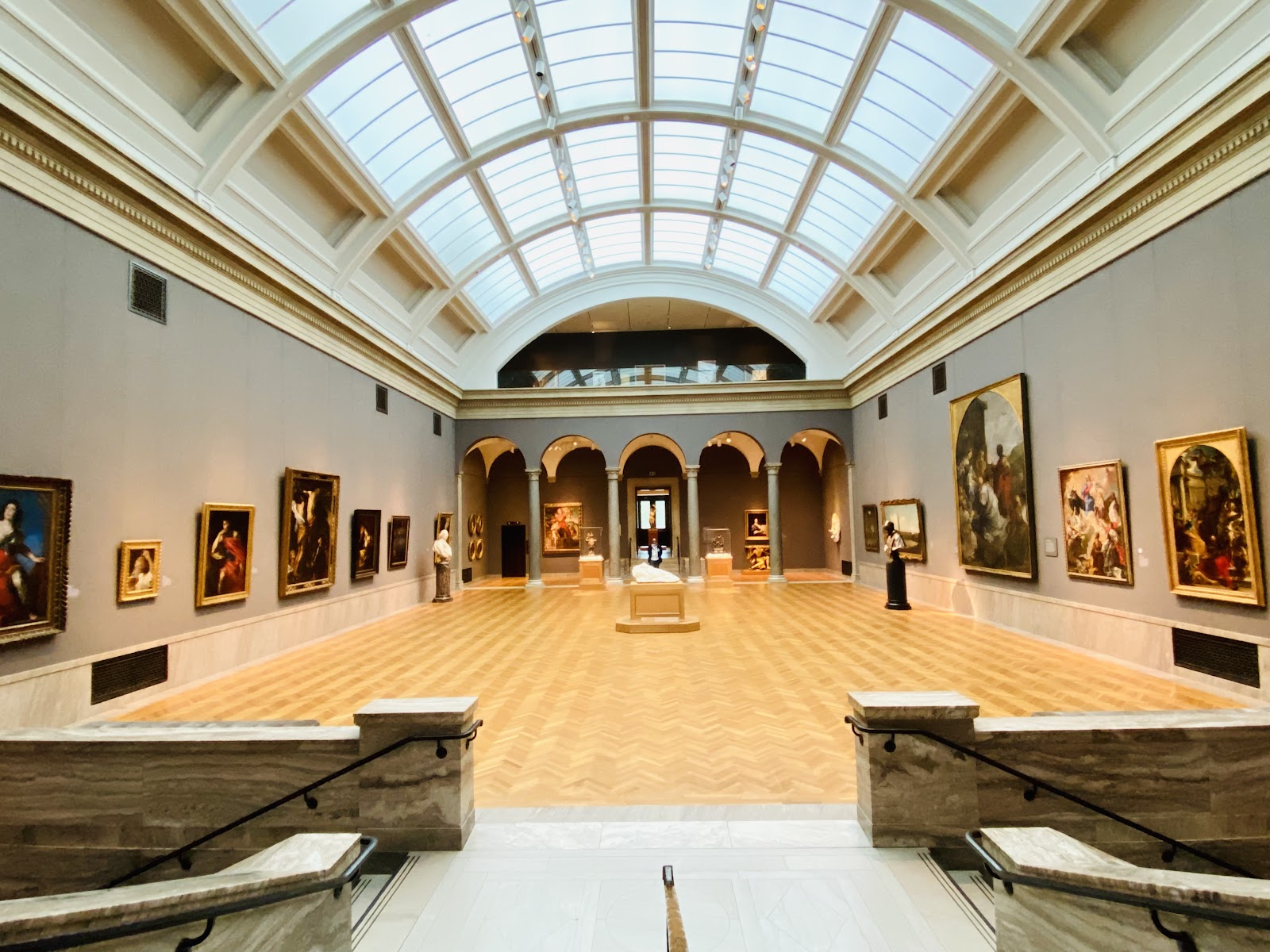
The galleries are the third condition and they resist for three reasons at once. Conservation caps the light two or three stops below comfortable. Display fittings aim down from the ceiling at works, which darkens eyes and draws a hard line from the nose. And museum fittings are frequently narrow-spectrum, chosen for low ultraviolet output rather than colour rendering, which renders skin sallow or plum even at technically correct white balance — and no adjustment recovers a wavelength that was never emitted.
Where any light is permitted, keep it small: a gridded source on the couple alone, spilling onto nothing, about a stop under a correct reading for the room. A dim gallery with a small pool reads as atmospheric; flooded, it reads as a lit room with pictures in it.
Who it suits
The architecture is the product and where a couple wants monumental frames there is nothing comparable in the city.
These briefs are well served here:
- Couples who want architecture — steps, columns, symmetry, scale
- Larger guest counts, which monumental public spaces absorb easily
- Anyone who wants Cleveland’s weather to be irrelevant to the day
- Couples happy for the formal frames to be outdoors and in the atrium
- Photographers comfortable working within firm institutional rules
Who should look elsewhere
The reverse list is not a criticism. A museum’s first duty is to its collection, and every constraint here follows from that.
Several reasonable briefs run against the grain:
- Couples who want gallery portraits to carry the album, which the light forbids
- Anyone whose references are warm timber, brick or intimate interiors
- Small intimate weddings, which read as sparse in monumental space
- Briefs needing extensive on-site natural-light preparation coverage
- Anyone who wants to work without permissions settled well in advance
The grounds, and Cleveland's year
Formal grounds are the counterweight and they photograph best either along an axis, which reinforces the design, or from a low camera, which drops the horizon and lets the building’s elevation occupy the upper frame rather than sitting in the middle of it.
Mature trees around a museum of this age are the summer resource: continuous deep shade is soft, cool and directional, and it is the only condition in which formal clothes and a long outdoor block are comfortable on a humid Ohio afternoon. Dapple is the hazard — hot spots several stops above the surrounding shadow, shifting with any breeze — so full shade, open light, or wait for the sun to drop.
Green bounce from dense planting throws green onto nearby skin and is localised, so a custom white balance set on a face in position is the answer, with pale stone paving used as a neutral bounce.
Cleveland’s weather is the thing that most distinguishes this city from others in the series, and it needs saying plainly: this is one of the cloudiest major cities in the country, with persistent overcast through much of the late autumn, winter and spring.
For a stone building and a glazed atrium that is largely good news. Overcast is an enormous diffuser — soft, even, shadowless light with open shadows and no hard edge anywhere, which is the best portrait light there is. It removes the atrium’s shadow lattice entirely and it makes the exterior workable at hours when direct sun would be unusable. The adjustments are small: add half a stop to a stop for the bright grey sky, and bring shape back subtractively by placing people near something dark, because a uniformly grey sky has no direction and adding a flash usually makes things worse.
The cost is that raking light on pale stone — the condition that makes a neoclassical facade separate into planes — needs sun, and in Cleveland from November to April that is not reliable. On a grey day the facade is a flat pale plane, which is perfectly usable and is not the photograph the building is capable of. Saying so to a couple in advance is better than explaining it afterwards.
Winter brings lake-effect snow, which is localised, sudden and heavy, and which is both a logistics question for guests and the best natural fill there is — lifting exactly the shadows a low sun carves while fooling a meter by about two stops. Against pale stone, snow and limestone together will clip if the exposure is not watched, which at this building is a real caution rather than a theoretical one.
Winter days are also short, with sunset in the middle of the afternoon in December, which compresses the whole outdoor window into a couple of hours and makes an early protected block essential. And humidity in summer plus cold in winter fog a lens in opposite directions, so let equipment come towards the temperature of where it is going before it gets there.
More frames from The Cleveland Museum of Art
The Cleveland Museum of Art wedding photography: common questions
What is the best part of the building?
The exterior and the glazed atrium. Both hold nothing light-sensitive, so both are generously lit, monumental and symmetrical — unlike the galleries.
When does the facade work?
In the last ninety minutes, when raking light separates pale stone into planes. At noon it is a flat chalky plane, and on a grey Cleveland day it stays one.
What does pale stone need?
A stop or more of added exposure, because the whole frame is bright — and a warm reflector or gel, because it bounces neutral-to-cool and can grey skin.
What does direct sun do in the atrium?
The roof structure prints a lattice of hard shadow across the floor and anybody in it, which cannot be corrected. Work where the structure is densest, or use the pattern on a floor.
Why do the galleries resist?
Three reasons at once: conservation caps the level, fittings aim down from the ceiling, and narrow-spectrum sources render skin badly even at correct white balance.
Does Cleveland's cloud help?
Mostly. It removes the atrium’s shadow lattice and makes the exterior workable at any hour — but raking light on pale stone needs sun, and from November to April that is not reliable.
More Cleveland, OH venue guides
We are writing a photographer’s guide to every venue we would happily shoot in Cleveland, OH. Here are three more, plus the full index:
- The Cleveland Zoo: Four Ways Out of the Fencing Problem
- The FirstEnergy Powerhouse, Cleveland: Field Notes on a Converted Power Station
- The Forest City Brewery, Cleveland: Field Notes on a Brewery Venue
All Cleveland, OH Wedding Venues →
Planning a wedding at The Cleveland Museum of Art?
Permissions first, then the facade and the atrium. Tell us your date.