 Hotel Saint Louis: A Walk-Through of an 1893 Union Trust Building
The St. Louis Aquarium: One Frame, and How It Is Made
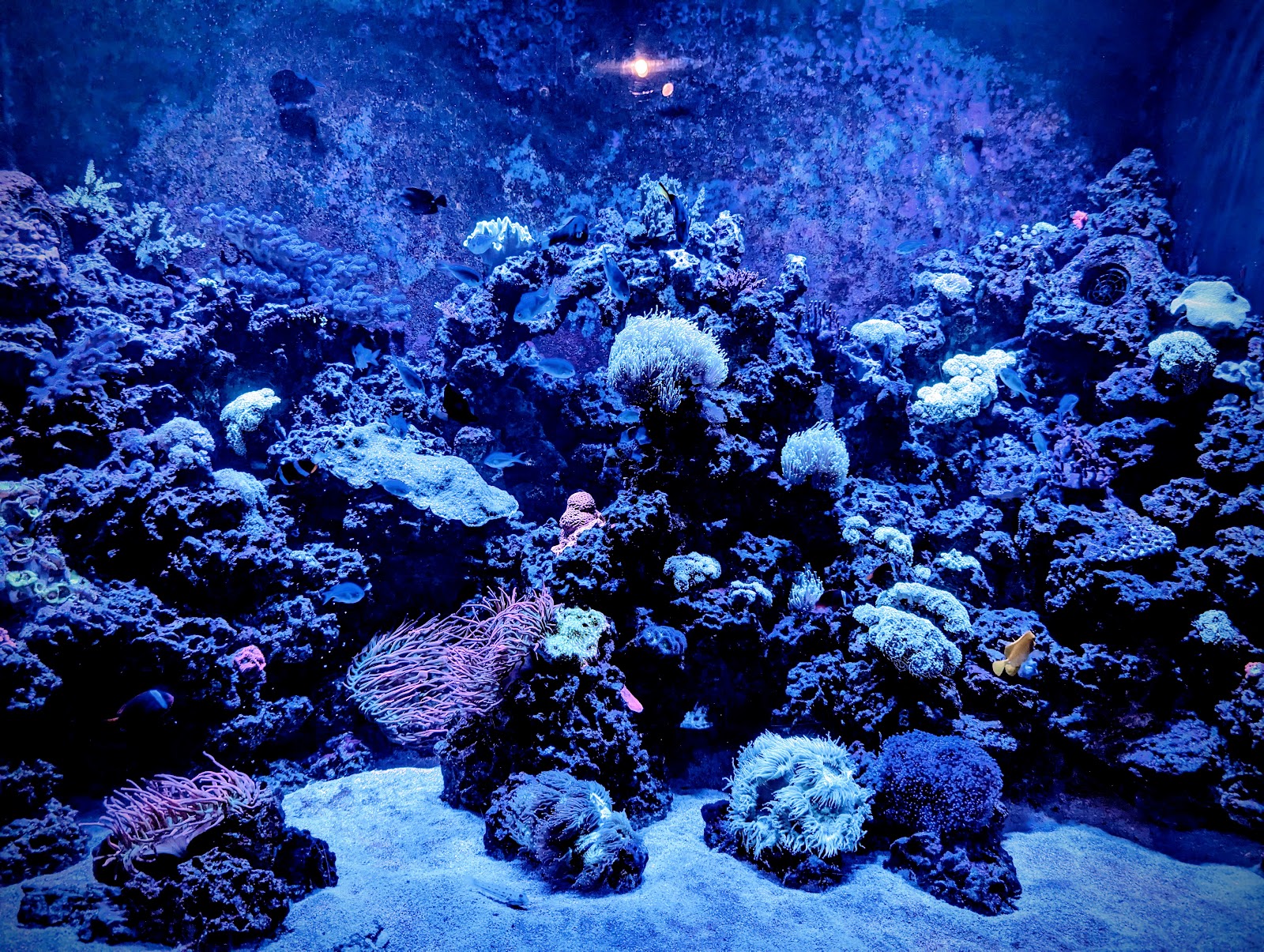
A lit tank in a dark room is the most dramatic background in any venue type. It is also blue-green and behind glass.
An aquarium gives one frame that no other venue type can, and it is worth building deliberately because the accidental version fails in two specific ways.
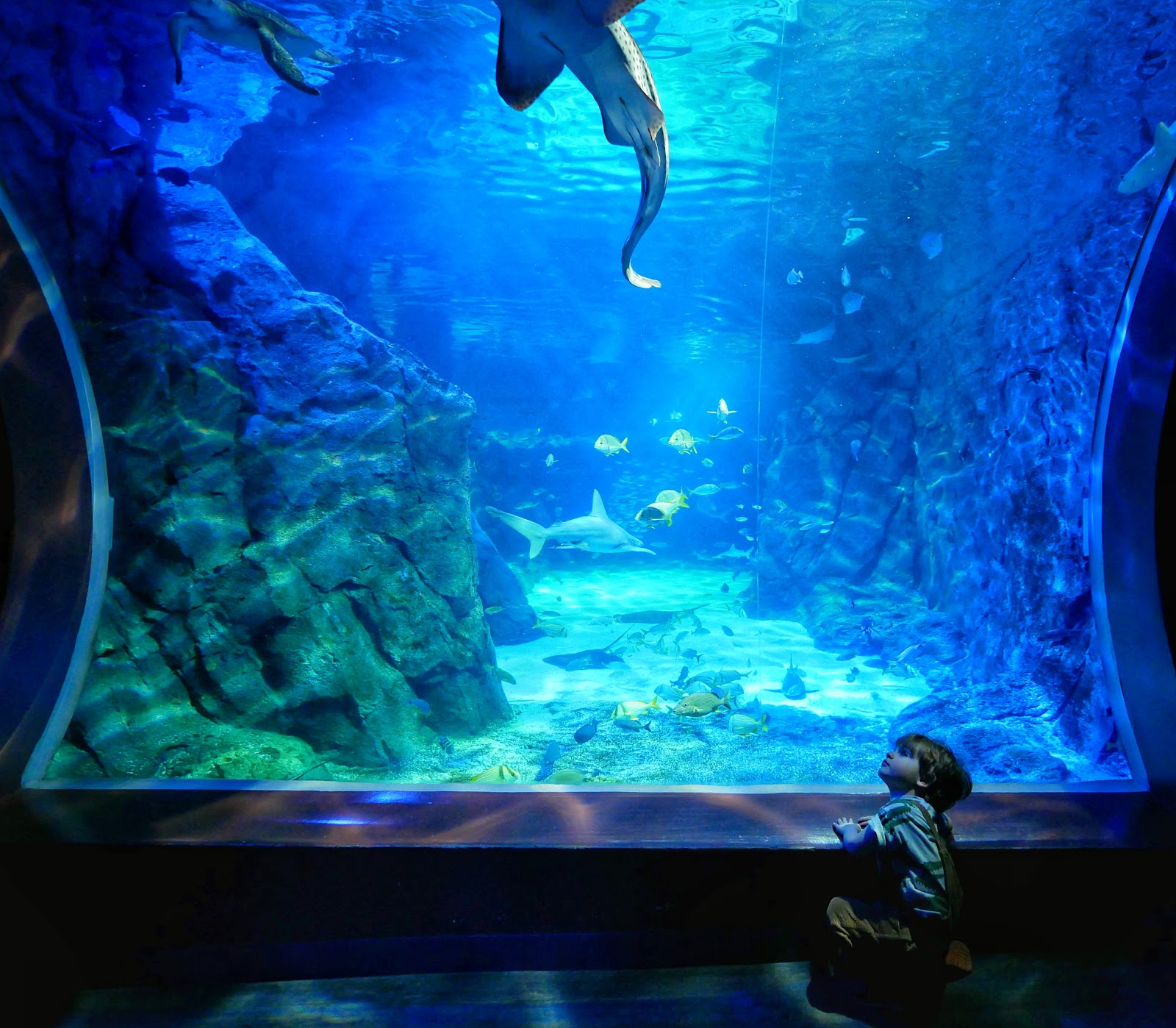
The frame is a couple standing in front of a lit tank in an otherwise dark room. The tank is a large, even, glowing panel — which makes it both a background and a light source — and the darkness around it means the couple is separated completely, with no equipment needed for that at all.
The two failures are colour and reflection. Tank lighting is strongly blue-green, because that is what makes water read as water and what suits the animals in it, and a face lit by it is a colour nothing corrects to skin. And the glass in front of the tank is a mirror pointed wherever the camera is, which means any light added to fix the faces appears in the frame as a bright rectangle.
Six decisions make the frame work. And one condition runs above all of them, which is the venue’s own: an aquarium houses living animals, and its policy on flash is a welfare matter rather than a house preference. That policy should be established first, and it may well be that no flash is permitted near the tanks at all.
We have not photographed a wedding at the St. Louis Aquarium; lit tanks in dark rooms behave according to physics. The flash policy, permitted areas, group limits and whether a ceremony is possible in the galleries are questions for their team.
The St. Louis Aquarium at a glance
| Where | St. Louis, Missouri |
| The frame | A couple against a lit tank in a dark room |
| Failure one | Blue-green tank light, which corrects to nothing on skin |
| Failure two | Glass that shows any added source as a bright rectangle |
| Ask first | Flash policy near the animals, permitted areas, group limits |
Decisions one to three: the policy, the position, the colour
The first decision is not the photographer’s. An aquarium’s flash policy exists because repeated flash near animals is a welfare question, and it has to be established before anything else in the plan — because the answer determines whether the frame is made with added light or without it.
If flash is not permitted near the tanks, the frame is still available and in some ways simpler: the tank is bright enough to light a subject standing close to it, and the whole picture is then one colour, which is a coherent look rather than a broken one. A fast lens and a high ISO are the configuration.
If modest flash is permitted away from the glass, the frame becomes controllable in the way described below. Either way the policy is the starting point and not a negotiation.
The second decision is the position, and it is governed by the glass rather than by the composition. Standing a subject directly in front of a tank means they are between the camera and a mirror — which will show the camera, the photographer and anything lit behind them.
The answer is to work at an angle rather than square on. A tank photographed obliquely reflects what is to one side rather than what is behind the camera, which removes the photographer from the frame and usually removes any added source with them. That single change solves most of the reflection problem and it costs nothing but standing somewhere else.
The second part of the position is distance from the glass. A subject close to a tank is lit brightly by it but also casts a shadow on it and appears in its reflection; a subject a metre or two out is lit less strongly but cleanly, and the tank behind them reads as a field rather than as a surface. A metre to two metres is the working range, and one test frame at three distances settles it.
The third decision is the colour and it is the frame’s central problem. Tank lighting is strongly blue-green, and skin lit by it has almost no information in the red channel — which means it is not a colour cast to be corrected but missing data, and no amount of editing produces natural skin from it.
There are two honest resolutions. Let the whole frame be blue-green, treating it as a deliberate monochromatic look, which works and which suits the subject matter — the couple reads as being underwater, which is the point of the room.
Or light the faces with a source of your own, gelled to something near daylight or warmer, with white balance set to that gel — which puts correct skin in front of a blue-green field, a contrast that is striking rather than incongruous because the two are separated cleanly by distance.
What fails is the middle: a global white balance correction that tries to neutralise the tank, which turns the water grey and the faces pink and loses both.
Decisions four to six: the source, the exposure, the rest of the room
The fourth decision is where the source goes, assuming one is permitted, and the constraint is the glass.
The rule is the same as for any mirror: stand where the camera will stand, look at the glass in the frame, and place the light where none of it shows the source. In practice that means forward of the glass plane and outside the frame edge on the side away from the reflection — and because tank glass is large and frequently curved, the angle at which it shows a source is wide, so this needs checking rather than assuming.
The source should also be modest. A tank is not bright by daylight standards, which means a face only needs a little light to read — and a source bright enough to be obvious destroys the whole effect, because the point of the frame is that the tank is the brightest thing in the room.
Half a stop above the light the tank is putting on the face is plenty. And no bounce: a dark gallery returns nothing, so the source goes direct into a modifier, close, in a hand or on a bracket — which is the right configuration anyway, because stands in a gallery of animals are unlikely to be welcome.
The fifth decision is the exposure and it should be set on the tank rather than on the face. A lit tank clips easily, and a clipped tank is a white hole in the middle of the picture with no water in it — whereas the faces can always be lifted, either by the source or afterwards.
So: expose so the tank holds its detail and its colour, let the room go black, and bring the faces up. Working in manual is the mechanism, because a frame that is mostly darkness with one bright panel in it will be metered differently every time by an automatic system.
The sixth decision concerns the rest of the room, because an aquarium is not only its tanks.
The circulation between galleries is very dark by design, which gives the steepest fall-off any venue type offers — a subject lit by any small source in a black corridor is separated absolutely. And the thresholds between a dark gallery and a lit one are natural gradients worth finding, where a subject two or three metres into the darkness facing a lit space is lit softly with nothing behind them.
Where there are tunnel or overhead tanks, the light comes from above and the water moves — which produces rippling caustic patterns across faces and floors that are genuinely unusual and entirely uncontrollable. They are a subject rather than a light: a frame that includes them should be composed around the pattern rather than trying to expose through it, and a faster shutter holds the ripple where a slow one smooths it away.
And the rules extend beyond flash. Expect restrictions on where people may stand, on numbers in a gallery, on touching anything, and on stands — all of which protect animals and equipment that cannot be replaced. The working assumption is small groups, nothing set down, a source in a hand, and the large formals in whatever function space the venue has rather than in the galleries.
- Establish the flash policy first; it is a welfare matter, not a preference
- Work at an angle to the glass, never square on
- One metre to two out from the tank; closer casts a shadow on it
- Either commit to blue-green or gel your own source — never correct globally
- Expose for the tank and let the room go black; work in manual
Outside, and the Missouri year
Outside, St. Louis gives two things that are worth building frames around and one that is unique.
Red brick is the city’s material and it is everywhere. Brick is a warm mid-toned reflector rather than a dark absorber, which means a sunlit brick elevation is a genuine soft source — a couple three or four metres out from one, facing it, is well lit for nothing, with a custom white balance set on a face because brick bounce is markedly warmer than daylight. And brick reads as brick only under raking light, so the elevations the sun is skimming are the ones worth using.
The rivers are the second. The city sits near the confluence of the Mississippi and the Missouri, and a riverside position gives water that reflects and doubles anything lit — with camera height deciding between a mirror and the water’s own sediment colour, and low nearly always the answer.
The unique thing is the stainless steel monument on the riverfront, and it is worth understanding rather than simply photographing. A polished stainless surface of that scale is a gigantic specular mirror with a curve in it, which means it reflects the sky, the ground, the weather and anyone standing near it — and what it reflects changes completely with the camera’s position and the time of day.
In overcast it is a soft grey; in low sun it is brilliant on one face and dark on the other; and at the crossing it holds both the last of the sky and the first of the city’s lights. It is also a source: the sunlit face of a large polished curve throws a great deal of light, which means a subject standing in the right relation to it is lit by it.
What that requires is walking round it rather than photographing it from one place, because a curved mirror gives a different picture every few steps.
The seasons here are four emphatic ones. Summer is hot and genuinely humid, and the humidity rather than the heat is the photographic fact: moist air scatters light, which softens shadows and slightly flattens distance. Severe thunderstorms are a real possibility from spring through summer, which at an entirely indoor venue costs a decision rather than a picture.
The fogging problem is severe and an aquarium makes it particular: the galleries are climate-controlled and humid for the animals, which means a body carried out into July air fogs immediately and a body carried in from a cold street fogs too. A bag opened twenty minutes before each transition is the fix.
Autumn is the best light of the year: humidity drops, the air clears, the cover along the rivers turns, and low sun arrives at a civilised hour, usually mid-to-late October. Winter is cold with a December midday sun at about twenty-eight degrees above the horizon, which rakes brick all day rather than lighting it from overhead — and snow, when it comes, turns the ground into a reflector that makes the stainless curve brighter and softer than at any other time.
More frames from The St. Louis Aquarium
The St. Louis Aquarium wedding photography: common questions
What is the frame?
A couple in front of a lit tank in an otherwise dark room — the tank is both background and light source, and the darkness separates them completely.
What must be established first?
The flash policy. An aquarium houses living animals, so it is a welfare matter rather than a house preference, and the answer shapes the whole approach.
Why work at an angle to the glass?
Because a tank photographed square on reflects what is behind the camera — including the photographer and any added light. Obliquely, it reflects what is to one side.
What about the blue-green colour?
Either commit to it as a monochromatic look, or gel your own source and put correct skin in front of a blue-green field. A global correction loses both.
What should the exposure be set on?
The tank. A clipped tank is a white hole with no water in it, whereas the faces can always be lifted.
What is the city's exterior asset?
Red brick as a warm reflector, the rivers, and the stainless monument — a gigantic curved specular mirror that gives a different picture every few steps.
More Missouri venue guides
We are writing a photographer’s guide to every venue we would happily shoot in Missouri. Here are three more, plus the full index:
- The Angad Arts Hotel: Who This Colour-Themed Venue Suits
- The Cathedral Basilica of Saint Louis: Photographing 41 Million Tesserae
- The Chase Park Plaza: A Walk-Through of a 1920s Grand Hotel
Planning a wedding at The St. Louis Aquarium?
One frame, and the policy comes first. Tell us your date and we will ask.