 The Portland Regency: A Season-by-Season Guide
The Youngtown Inn, Lincolnville: The Problem and Four Ways Out of It
No landmark, no view, no drama. Which is a solvable problem.
This is an honest venue with an honest problem: there is nothing obvious to point a camera at.
The proposition is a nineteenth-century farmhouse inn in the country inland of the Maine midcoast — near the Camden Hills, a short distance from the coast, in the mixed farmland and woodland that covers this part of the state. It is a good building and a pleasant setting, and it has no landmark, no water view, no cliff, no harbour and no mountain.
That is worth stating plainly because it changes what a photographer has to do. At a lighthouse or a clifftop the place supplies the photograph and the job is to handle it well. Here the place supplies nothing in particular, and every frame has to be made out of light, material, people and composition.
Many of the best wedding photographs are made at venues exactly like this, and the reason is that a set built entirely from those four things holds together better than a set built around a landmark. But it requires a method rather than an eye, and it requires knowing in advance where the frames are going to come from.
There are four sources and they are worth taking in order, because the first two are on the property and the other two are decisions rather than places.
Lincolnville sits at about forty-four and a quarter degrees north, inland of Penobscot Bay. The June noon sun reaches around sixty-nine degrees, the December noon sun about twenty-two, days run from about eight hours forty-five to fifteen hours thirty-five, and civil twilight is around thirty-six minutes — the most generous dusk in this guide.
We have not photographed a wedding at this inn. Which rooms and grounds are included, what access there is to the surrounding land, and what the permitted hours are, are questions for their team.
The Youngtown Inn at a glance
| Where | A nineteenth-century farmhouse inn inland of the Maine midcoast at Lincolnville |
| The problem | No landmark, no view, no drama — every frame has to be made |
| Four ways out | The old windows; the spruce and birch; the season; the twilight |
| The advantage | Nothing about the weather can spoil what the place offers |
| Ask first | Included rooms and grounds, land access, permitted hours |
The first two ways out
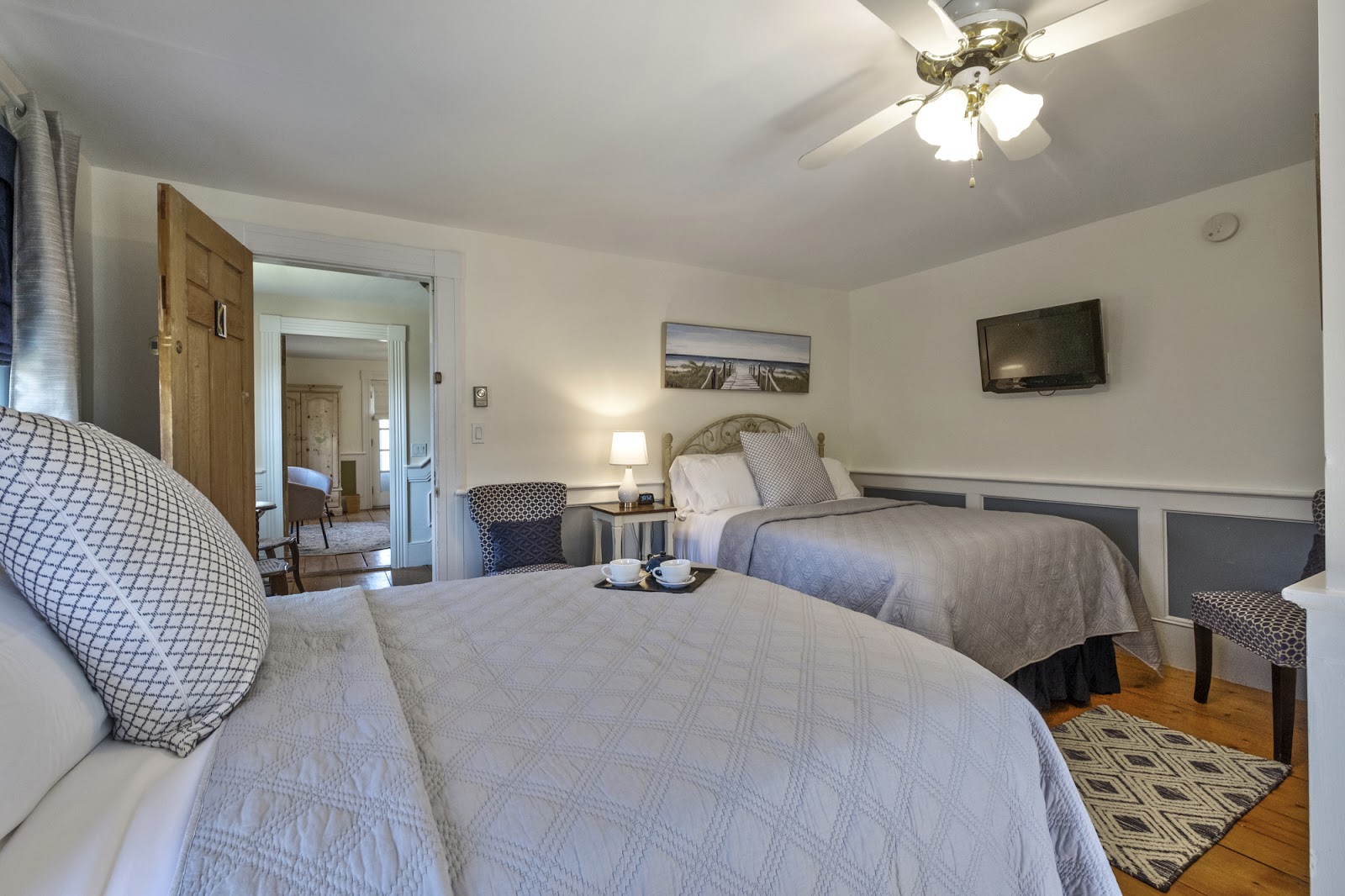
The first way out is the windows, and in a nineteenth-century New England farmhouse they are the best thing on the property.
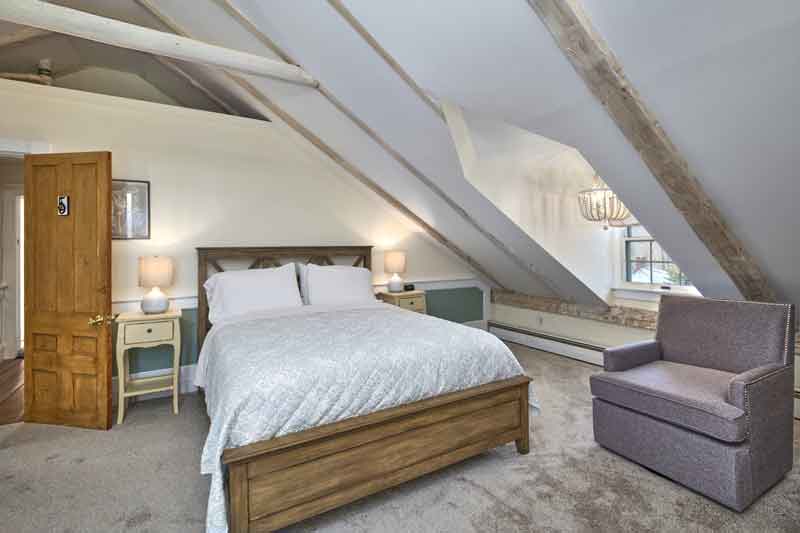
A house of that period has small, deep-set, multi-paned windows in thick walls, with dark or mid-toned interior finishes. The light coming in is narrow, strongly directional and falls off extremely fast — often four stops or more between a face at a window and the wall two metres behind it, because the finishes absorb and give no fill back.
That is the best raw material for portraiture there is, and considerably better than the even ambient of a modern room. The method is a single-window setup: subject at forty-five degrees to the window, at a distance that sets the ratio, metered on skin, with the room falling away behind.
The deep reveal is what makes it stronger than a modern window of the same size. A thick wall around a small opening acts as a snoot: it narrows the beam, restricts the angles from which light arrives, and steepens the fall-off. A subject can move six inches and change the ratio noticeably, which means precision pays here in a way it does not in a bright room.
Multi-paned glazing does something useful as well. The muntins break the incoming light into a grid, which on a nearby wall or floor reads as a soft pattern — free background texture — and on a face reads as nothing at all.
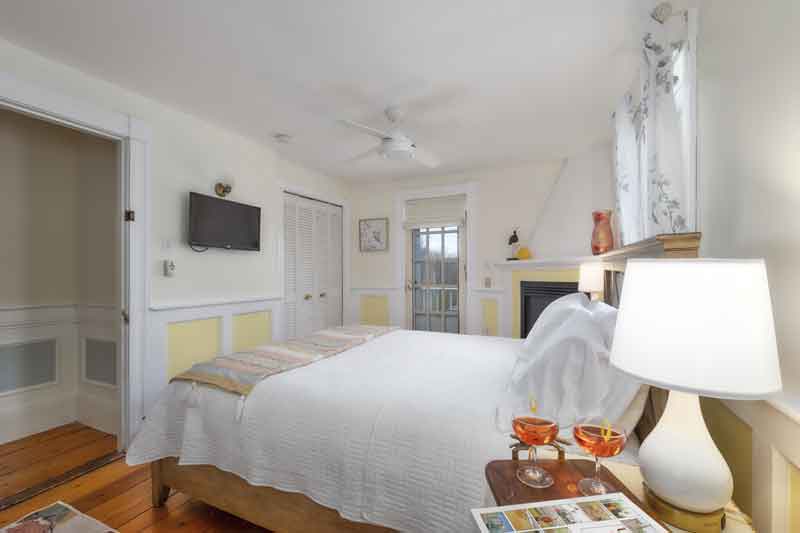
A farmhouse’s other interior asset is its doorways. A subject standing a metre inside an open door is lit by the whole sky in front and backed by the dark interior: a giant softbox and a four or five stop black backdrop, positioned by the architecture, available in any weather. A house with several exterior doors facing different directions has several of those positions, one of which will be right at any hour.
The scale is the constraint. A period farmhouse room cannot hold a large group, a camera cannot back up far in it, and a very wide lens used to compensate distorts faces at the frame edges and makes the room look like a corridor. Small numbers inside, larger numbers outside, and doorways between rooms used as frames so that depth compensates for width.
The second way out is the trees, and inland Maine’s are unusually good for this purpose.
Red spruce, white spruce and balsam fir hold dense evergreen canopies that block almost all light, which makes their margin the darkest natural background in the northeast. A subject a metre inside a spruce edge has soft directional light in front and three or four stops of near-blackness behind — a studio portrait with a black backdrop, supplied by the wood, at any hour of any day.
White paper birch is the counterpoint and the best light-toned background available. Its bark is white, papery and highly reflective, which makes a stand of mature birch a field of luminous pale verticals — and against dark spruce, the highest-contrast natural combination in New England.
Those two species together give a venue with no view the two things a portrait background can be: very dark, or very light and structured. Locating the spruce margins and the birch stands on arrival takes ten minutes and it is the most valuable preparation available here.
The second two, and the rest of it
The third way out is the season, and at a venue with no landmark it does more than at any other kind, because the landscape is the only thing that changes.
In summer the surroundings are green — grass, canopy, distance — and green is the least useful background colour there is, because skin sits close to it in luminance and complementary to it in hue. A summer date here relies almost entirely on the windows, the doorways and the spruce.
In autumn the problem solves itself. The Maine midcoast interior turns in the last week of September and the first half of October, ahead of the coast because the sea delays the shoreline — and the palette is red maple scarlet, sugar maple orange, birch clear yellow and oak russet, all of it against near-black spruce.
Birch is the one to time here. Its leaves go a clean uniform yellow and, because the bark is white, a birch in autumn is a white trunk under a gold canopy — which against dark spruce is the most distinctive frame inland Maine produces.
In winter the landscape is transformed rather than diminished. Bare hardwood and snow with near-black spruce in it is a high-contrast graphic setting, and snow is the best natural fill available: it lifts shadows to within a stop and fools a meter by about two, so open up deliberately. A white clapboard farmhouse against snow, with dark spruce behind it, in a December sun that never rises above twenty-two degrees, is the cleanest composition this property offers all year.
The fourth way out is the twilight, and at forty-four degrees north it is the most generous in this guide: around thirty-six minutes of civil twilight. That is a genuine working session rather than a scramble, and at a venue with no view it is worth planning as its own block.
What twilight gives a plain setting is colour in the sky and lights in the building — and the crossing point is the frame: the sky and any lit windows come within about a stop of each other for roughly ten minutes, and a nineteenth-century farmhouse with warm-lit windows against a deep blue sky is a simple, complete photograph that needs no landmark at all.
Scout the camera position in daylight, because ten minutes is not enough time to search.
The rest of the property follows the New England pattern. Open ground is excellent when the sun is low and unusable at midday — at sixty-nine degrees of June elevation there is no position on a lawn that fixes a face — so the middle of the day belongs to the windows, the doorways and the spruce margins.
Granite is the local stone and it appears as walls, steps and outcrop: coarse-grained, pink-grey, crystalline, low in saturation, and a high-frequency texture that is spectacular under raking light and dull under flat light. New England stone walls are nineteenth-century field boundaries left when the farms were abandoned and the woods grew back, and a low granite wall is a strong horizontal at seated height.
White clapboard, which is what this coast is built of, is a substantial neutral reflector: the light beside a sunlit white wall is brighter, softer and more evenly distributed than near a dark building, which makes it the most flattering free light available. It also fools a meter by about a stop, and it has almost no silhouette against a pale overcast sky.
Two practical notes. Blackflies are severe in inland Maine from mid-May into June and mosquitoes from June into September — and unlike the coast, there is no reliable breeze here to keep them off. And ticks are a genuine consideration from spring through autumn.
- A small deep-set window is a complete portrait setup — and six inches changes it
- Spruce for a dark background, birch for a light structured one
- Autumn and winter solve the summer green problem outright
- Thirty-six minutes of twilight — plan it as its own session
- Small numbers inside, larger numbers outside
The inland midcoast year
Four sharply separated seasons, and a venue whose photographs depend on them more than most.
Winter is the best exterior season here and it is worth being emphatic about, because it is the reverse of what most people assume. The December noon sun at around twenty-two degrees never rises high enough to flatten anything, which means the whole short day rakes rather than floods — so granite, clapboard and stone walls all have texture from morning to dusk rather than for twenty minutes.
Bare hardwood opens the woods completely, which removes the green cast entirely and makes the spruce the one solid dark mass rather than one green thing among many. White birch against black spruce over snow is the cleanest, highest-contrast composition available in the northeast.
The interiors gain too. Snow outside a small deep window is a very large bright neutral reflector, which raises the light level coming into a dark farmhouse room substantially and softens it — so a period interior is better lit on a bright February day than in leafy July. It is also much cooler in colour, which makes the white balance reading essential rather than optional.
The costs are cold, an eight-hour-forty-five-minute day, and glass that fogs coming indoors.
Spring is very late in inland Maine and it is the weak window. April and early May are bare, brown and raw, the ground is saturated with meltwater, and leaf-out runs into late May. The two weeks before the canopy closes are good — the understory is lit directly rather than filtered — but northern Maine’s flowering understory is thin compared with further south.
Blackflies from mid-May into June are a real constraint at a wooded inland site, and this is the season where the coast’s breeze is most missed.
Summer is the season for weddings and the weakest for backgrounds. Days are the longest in this guide — over fifteen and a half hours at the solstice with thirty-six minutes of civil twilight — which gives an unhurried schedule and a genuine blue period as a separate session.
The costs are the green, the middle of the day, and insects. The compensations are the windows, the doorways, the spruce margins, and lupines, which flower along Maine’s roadsides in mid to late June and are a genuinely regional foreground.
Autumn is the strongest season and inland is ahead of the coast. The last week of September and the first half of October bring the colour here, two to three weeks before the immediate shoreline, and the inland palette is richer: sugar maple orange and red, red maple scarlet, birch clear yellow, oak russet, and near-black spruce behind all of it.
Against white clapboard, that combination is the strongest exterior frame the property produces, and at a venue with no landmark it is genuinely the reason to choose an October date.
November strips it to structure — white birch trunks, black spruce, bare hardwood, brown fields, grey granite and a very low sun all day. It photographs austerely and extremely well, and it is the beginning of the property’s best season rather than the end of it.
More frames from The Youngtown Inn
The Youngtown Inn wedding photography: common questions
What is the problem here?
There is no landmark, no view and no drama. Every frame has to be made from light, material, people and composition rather than found.
What is the best thing on the property?
The windows. Small deep-set period windows in absorbing rooms give four stops or more of fall-off — the best raw material for portraiture there is.
What are the two background options?
Spruce, which blocks almost all light and reads near-black; and white paper birch, which is luminous and structured. Between them they cover both needs.
Why does the season matter so much here?
Because the landscape is the only thing that changes. Summer green is the weakest background there is; autumn and winter solve the problem outright.
What should I do with the thirty-six minutes of twilight?
Plan it as its own session. A farmhouse with warm-lit windows against a deep blue sky is a complete photograph that needs no landmark.
When is the venue at its best?
The first half of October, when inland colour arrives ahead of the coast — and any clear snow-covered winter day, when the low sun rakes everything all afternoon.
More Maine venue guides
We are writing a photographer’s guide to every venue we would happily shoot in Maine. Here are three more, plus the full index:
- The Children’s Museum of Maine, Portland: One Frame, and How It Is Made
- The Portland Company, Portland: The Problem, and Four Ways Out of It
- The Cathedral of the Immaculate Conception: A Photographer Answers Your Questions
Planning a wedding at The Youngtown Inn?
Nothing obvious to point a camera at, and four ways round that. Tell us your date.