 The Please Touch Museum, Philadelphia: What It Suits and What It Does Not
The Ritz-Carlton Philadelphia: The One Decision That Governs Everything
A hotel inside a domed banking hall has one room that matters more than all the others.
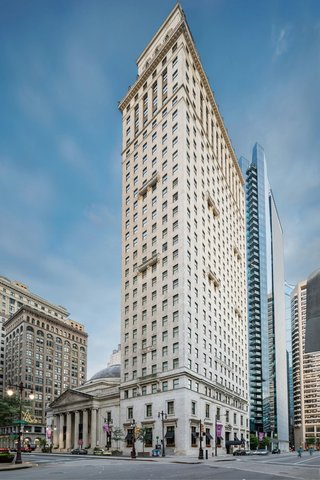
The lobby of the Ritz-Carlton Philadelphia is, by its own description, a space of real opulence — which is accurate, because it occupies a former bank building with a domed banking hall at its centre.
One decision governs the photographic day here and it is about that room. A domed banking hall is the single most impressive interior a hotel can contain, and it is also a working lobby: guests check in, staff move through, and the space is in continuous use. So the question is not how to photograph it — that part is straightforward — but whether and when a photographer can work in it properly, with what equipment, and with how much time.
That answer determines everything else, because the hall is worth more than any other frame in the building and it is the only one that has to be scheduled. Made in advance, it settles the day; left to the afternoon, it produces a rushed version of the one frame that mattered.
We have not photographed a wedding at the Ritz-Carlton Philadelphia; converted banking halls behave consistently. Lobby access, permitted equipment and available time are the questions to settle first, and they belong in writing.
The Ritz-Carlton Philadelphia at a glance
| Where | Central Philadelphia, Pennsylvania |
| Character | A luxury hotel in a former bank, with a domed banking hall at its centre |
| The decision | Whether you can work in the hall properly, with what, and for how long |
| Why | It is worth more than any other frame, and it is a working lobby |
| Ask first | Hall access, permitted equipment, time — in writing |
What the hall gives, and what it needs
A domed banking hall combines the four things that make an interior photograph well and it is rare to find all four together. It is tall, so a couple reads as small inside something large. It is symmetrical and axial, so the composition is half made before the camera is raised. It is lit from above, through a dome or lantern, so the light is soft and even everywhere. And it is finished in stone, which raises ambient across the whole volume rather than absorbing it.
The dome is also worth pointing a camera straight up at, once. Coffers, ribs or a glazed oculus converging overhead make an abstract composition that almost nobody takes, and with a couple small at the bottom of the frame it is one of the most distinctive pictures the building can give. It costs a minute.
Three things it needs. First, a fix for the overhead light, because illumination arriving from a dome darkens eye sockets and marks the line under the nose on everybody in the frame. A reflector held low, a lifted chin, or one small source at face height solves it — and in a hall this size a reflector is often easier to place than a light.
Second, an exposure adjustment: pale stone and a bright dome fill the frame and push a meter towards underexposure, so add a stop or more exactly as for snow, and check the stone still holds texture rather than clipping to blank cream.
Third, a colour correction. Stone bounces neutral-to-cool light, which in flat conditions renders skin slightly grey — so a warm-gelled source or a warm reflector is worth carrying specifically for a building like this, and a custom white balance set on a face in position is the minimum.
Polished stone adds a fourth consideration: it is partly specular, returning a bright reflection of any source rather than a soft scatter, so a light aimed near a polished plane produces a hot spot rather than a gentle lift. Angle sources away from polished surfaces, or place the reflection deliberately where it is wanted.
Symmetry rewards precision and punishes near-misses. A frame centred on a rotunda collapses if the camera is off centre or a degree out of level, because the eye detects a two-degree error in a symmetrical composition instantly. Level, and either centre exactly or clearly do not.
The couple belongs in the depth or the centre of such a frame rather than close to the camera. Placed well into the volume they become the focal point of the architecture and read as two people in a room built for something else entirely, which is the emotional content of a bank conversion.
What follows: the working-lobby problem and the rest of the hotel
A working lobby imposes constraints that a function room does not, and they are practical rather than technical. Other guests will be present, and a large group assembled in a check-in area is an obstruction rather than a photograph. Stands and modifiers may be restricted for the same reason. And the time available may be a window rather than an afternoon.
The response is preparation rather than speed. Knowing in advance which three frames the hall is for — the axial view, the straight-up dome frame, and one portrait position with the overhead fix ready — means twenty minutes is enough. Arriving to look for them means twenty minutes is not.
It is also worth asking whether the hall is quietest at a particular hour. Early morning in a hotel lobby is a different place from six in the evening, and if the schedule can put the hall frames at the quiet hour rather than the convenient one, the pictures improve without any equipment changing.
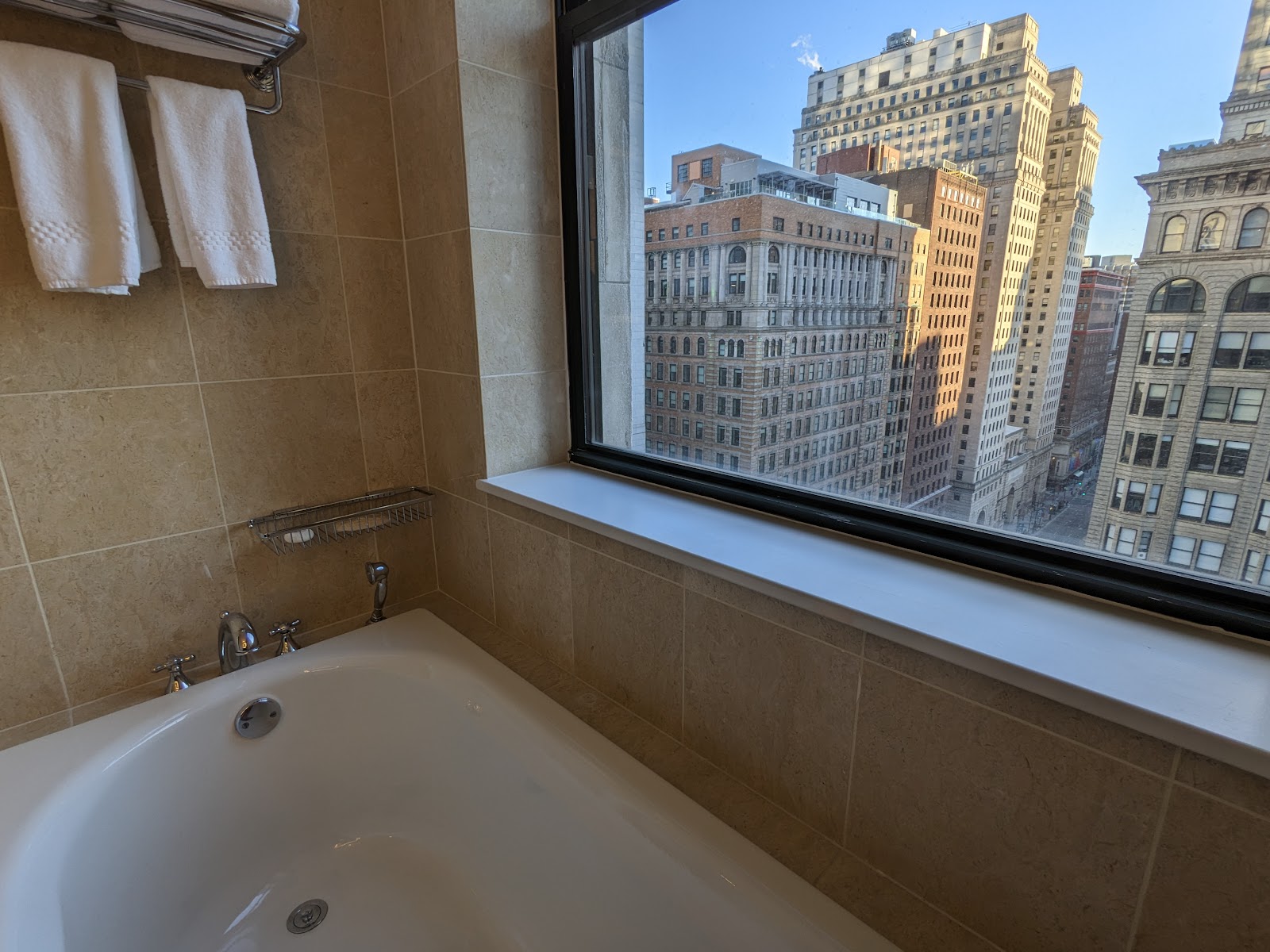
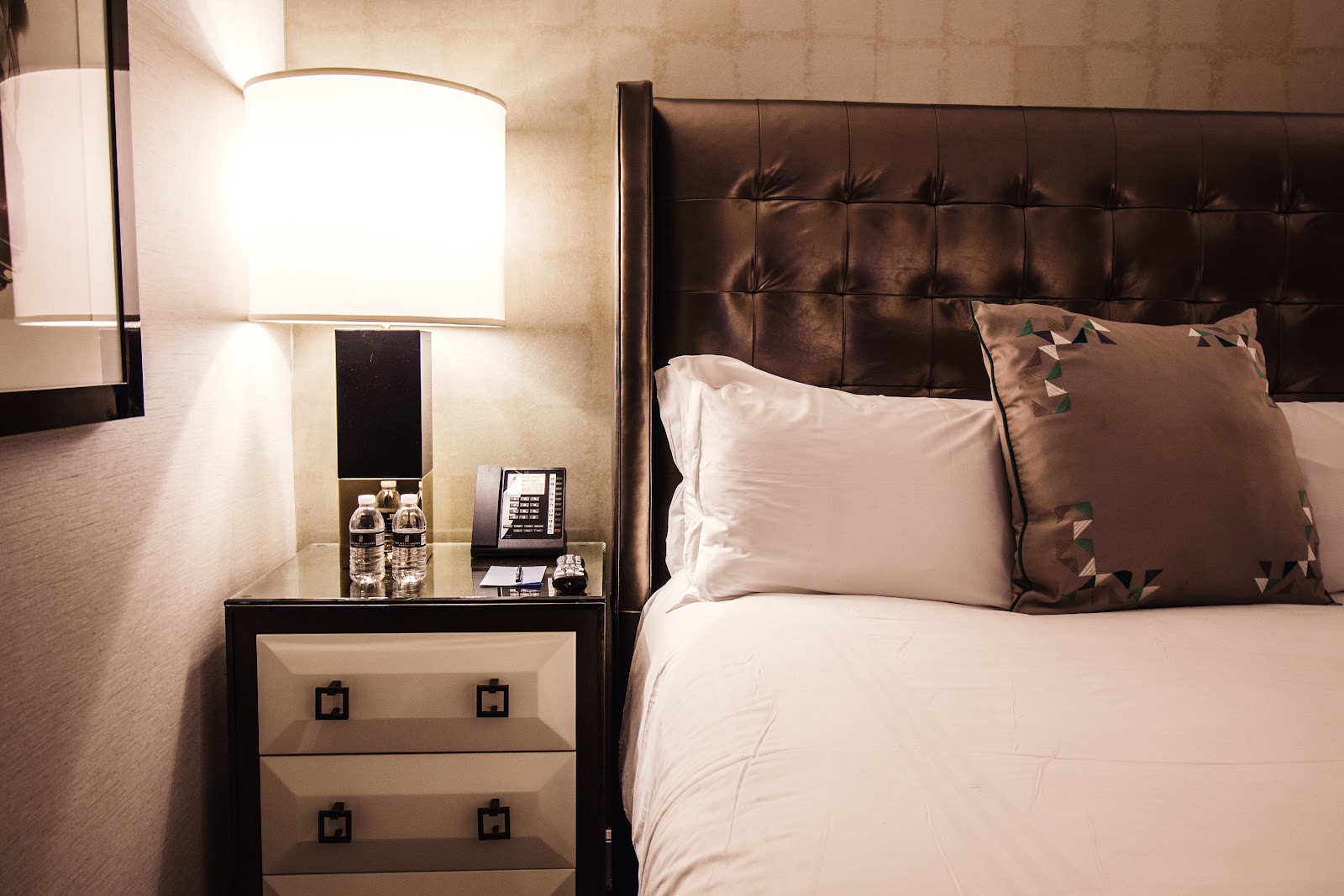
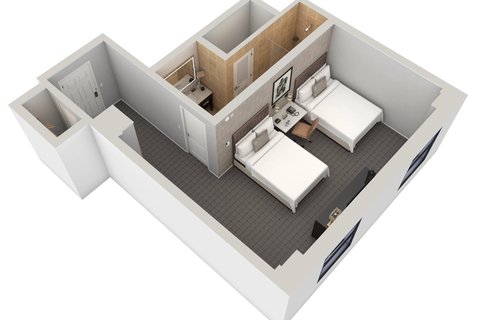
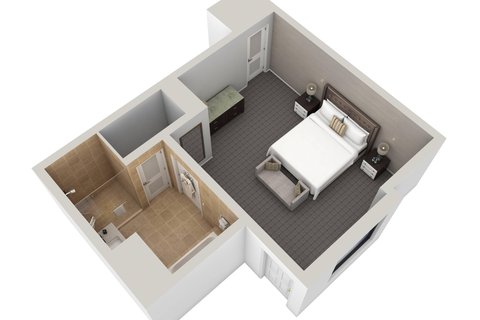
Elsewhere, the hotel follows the familiar pattern. Guest rooms are the best portrait light in the building: domestic-sized windows with close walls that bounce and ceilings low enough that a flash aimed upward returns something usable. Largest window on the shaded side, every overhead fitting off so the room has one colour of light, lamps moved out of frame.
Public floors present the luxury problem — deliberately even light, which erases the gradient across a face, and pale surfaces, which erase the tonal difference between subject and background. One directional source at close to ambient level fixes the first; depth, aperture, dark placement and negative fill fix the second. In a pale room, subtracting light with something dark on the shadow side beats adding another source.
The ballroom is the evening and it is a known quantity: a high ceiling with no usable bounce, warm decorative fittings, overhead sources and a house scheme dimmed low — and steep fall-off, which is the free separation the daytime interiors refuse to provide. Expose for the room, add one warm-gelled source at face height where legibility matters, set white balance to the gel and hold it. Ask whether the lighting can be dimmed to pools rather than set evenly.
The dusk crossing is the one timed frame elsewhere in the building: roughly twenty minutes after sunset at any window, when the street falls to about the brightness of the interior lighting and one exposure holds the lit room, the couple and the city beyond.
- Settle hall access, equipment and time in writing before the schedule
- Know the three hall frames in advance; twenty minutes is then enough
- Fix the dome’s overhead light with a low reflector or a lifted chin
- Add a stop or more on pale stone, and carry a warm gel for it
- Ask which hour the lobby is quietest, and schedule the hall for it
Outside, and Philadelphia's year
Philadelphia’s grid is the planning advantage at any central venue. Center City is oriented close to the compass, which means the east-west streets take low sun straight down their length while the north-south ones do not — plannable from a map rather than discovered on foot, which makes a short portrait excursion genuinely efficient.
The material colour rule matters more at a stone building than elsewhere. Red brick bounces warm and flatters skin; pale stone, limestone and modern glass bounce cool and can grey it. A converted bank is usually clad in the cool kind, which means the warm material is across the street rather than on the building — so which side to stand on is a decision rather than an aesthetic preference.
White marble steps front many Philadelphia rowhouses and act as low reflectors, bouncing light up into a face to fill the shadow overhead sun creates — a located frame that is also a lit one. Cobbles in the older quarters are strong texture in raking light and a genuine trip hazard in heels. Alleys are the most dependable positions in any downtown, giving directional light from walls on both sides and a contained background.
Philadelphia’s four seasons change the outdoor half of the day. Summer is humid with afternoon thunderstorms common rather than rare, which for a hotel is almost entirely an advantage — the day continues indoors without a decision — and the light after a cell passes, with wet streets returning reflections of a lit stone facade, is frequently the best of the day.
Autumn gives the clearest air and the best street light of the year. Winter days are short, with sunset in the middle of the afternoon in December, which moves the outdoor block early and may put it before the ceremony rather than after.
Snow is the compensation and it is the best natural fill there is, lifting exactly the shadows a low sun carves while fooling a meter by about two stops — though against pale stone the two together will clip if the exposure is not watched, which at a limestone-clad former bank is a real rather than a theoretical caution.
One equipment note: a heated dry interior and cold outside air fog a lens in both directions, and a masonry building holds cold longer than a modern one. Let kit come towards the temperature of where it is going before it gets there — and since the hall frames are the ones that matter most, do not carry a cold camera into a warm rotunda expecting to shoot immediately.
More frames from The Ritz-Carlton Philadelphia
The Ritz-Carlton Philadelphia wedding photography: common questions
What is the one decision?
Whether you can work properly in the domed hall, with what equipment and for how long. It is worth more than any other frame in the building and it is a working lobby.
Why is a domed banking hall so good?
Because it combines four things rarely found together: real height, strict symmetry, soft even light from above, and stone surfaces that raise ambient rather than absorbing it.
What does it need from you?
A fix for the overhead direction, a stop or more of added exposure on pale stone, and a warm gel or reflector because stone fills cool and can grey skin.
What about polished stone?
It is partly specular, returning a bright reflection of a source rather than a soft scatter. Angle lights away from polished planes, or place the reflection deliberately.
How long do the hall frames take?
Twenty minutes, if the three frames are known in advance — the axial view, the dome from directly below, and one portrait position. Arriving to look for them makes twenty minutes insufficient.
What is worth asking about timing?
Which hour the lobby is quietest. Early morning is a different place from six in the evening, and scheduling the hall for the quiet hour improves the pictures without changing any equipment.
More Pennsylvania venue guides
We are writing a photographer’s guide to every venue we would happily shoot in Pennsylvania. Here are three more, plus the full index:
- The Simeone Museum, Philadelphia: A Walk Through a Vehicle Collection
- The Union League of Philadelphia: Photographing a Historic Private Club
- The Warwick Hotel, Philadelphia: Field Notes on an All-In-One Venue
Planning a wedding at The Ritz-Carlton Philadelphia?
Settle the hall first; everything else fits around it. Tell us your date.