 The House of Blues, Cleveland: What It Suits and What It Does Not
The Ohio Statehouse, Columbus: A Walk Through the Building
A capitol with no dome. That absence shapes every interior frame.
The distinguishing fact about this building is something it does not have, and it governs the light throughout: there is no dome.
Almost every American state capitol carries a tall dome over a central rotunda, following the Federal model in Washington. This one, completed in 1861 after more than two decades of construction and committee argument, instead has a low drum with a flat top — a cupola rather than a dome, squat and severe, which contemporaries disliked and which is now the building’s most recognisable feature.
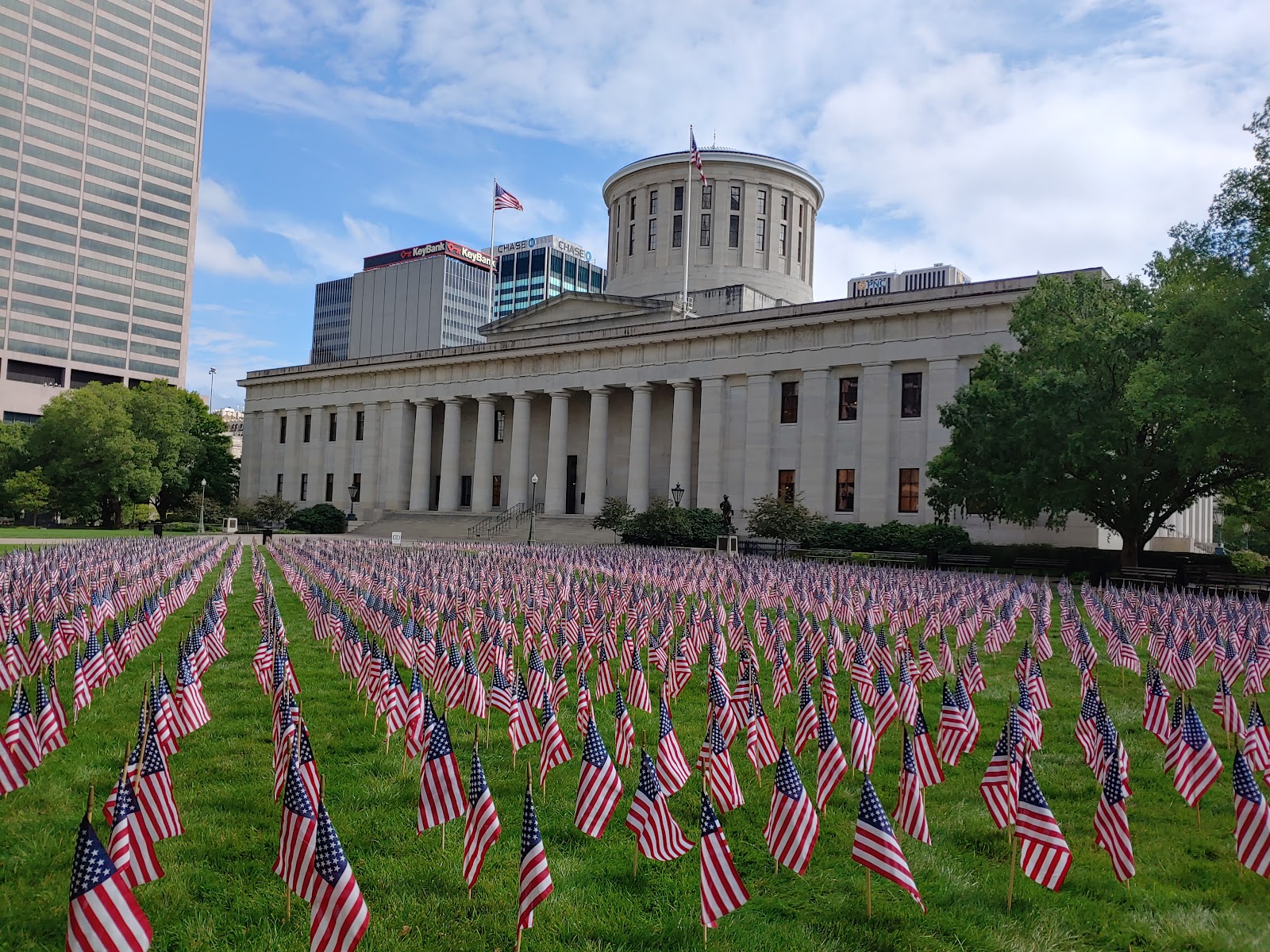
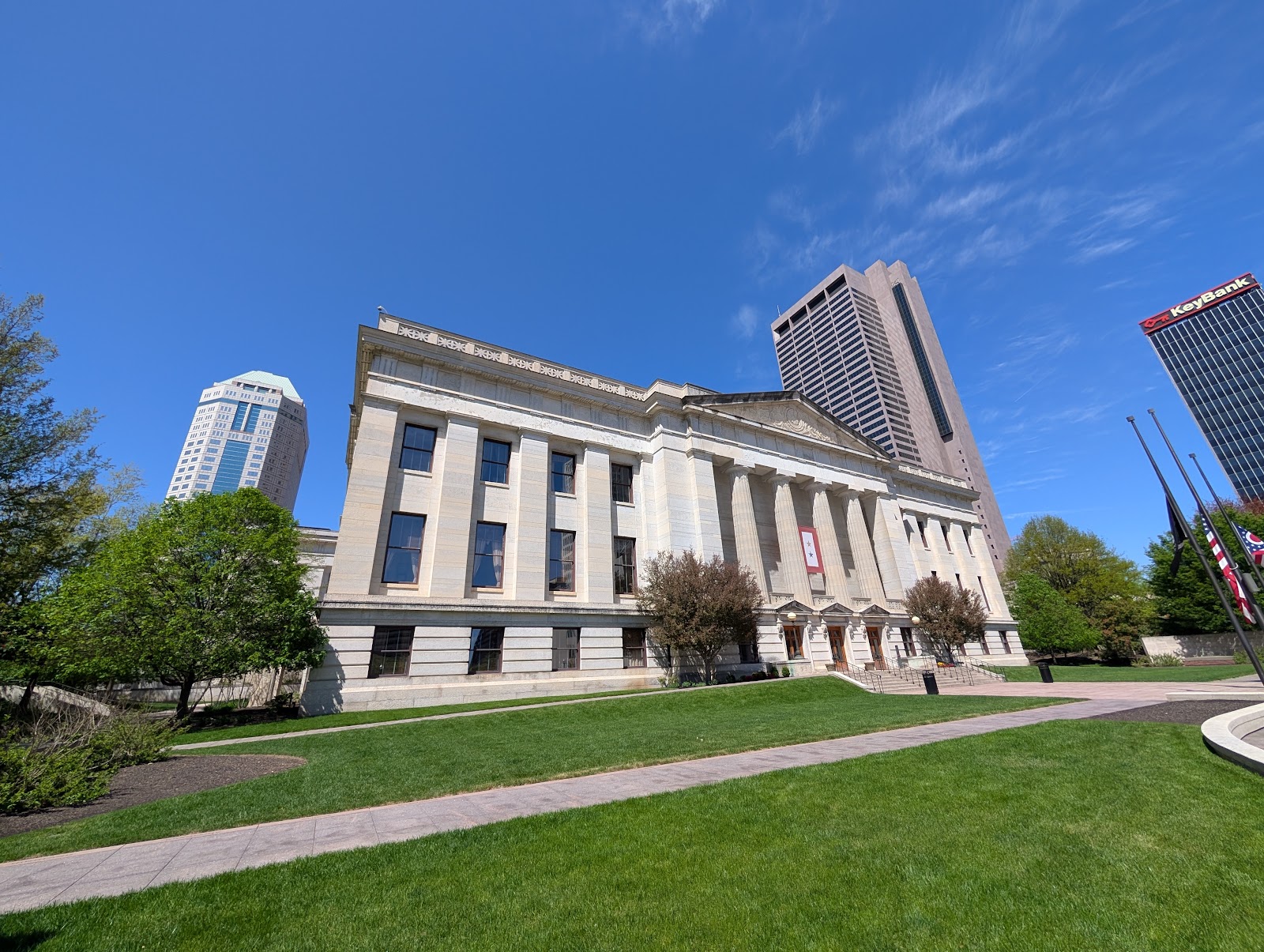
The style is Greek Revival at its most austere: a long low block of local limestone, unfluted Doric columns, a plain entablature, almost no ornament. Greek Revival was the architecture of the early republic precisely because it was plain, and this building is a very committed example.
For a photographer the missing dome matters in one specific way. A tall dome over a rotunda acts as an enormous light well, drawing daylight down from a great height and producing the characteristic soft top light of a capitol interior. A low flat cupola admits far less, from much lower, over a smaller aperture — which means this rotunda is darker than a domed one, and the light in it falls off much faster with distance from the centre.
That is a real working difference, not a curiosity. It means the rotunda here needs supplementary light where a domed one would not, and it means the pool of usable daylight directly under the cupola is small and sharply defined.
The second governing fact is the stone. Local Columbus limestone is pale grey and, on the interior, largely unpainted — which makes the building an efficient neutral reflector, and much easier to light than the gilt and dark timber of a Victorian civic interior.
Columbus sits at about forty degrees north at roughly nine hundred feet on the flat glaciated plain of central Ohio. The June noon sun reaches around seventy-three and a half degrees, the December noon sun about twenty-six and a half, and civil twilight is roughly thirty-one minutes.
What follows is a walk through in the order a wedding uses the building. We have not photographed one here; which rooms are bookable, what the security and access conditions are, and the permitted hours are questions for their team — and a working seat of government has real constraints on all three.
The Ohio Statehouse at a glance
| Where | An 1861 Greek Revival state capitol in Columbus, Ohio |
| The distinguishing fact | A low flat-topped cupola instead of a dome — so the rotunda is dark |
| The material | Pale unpainted local limestone, an efficient neutral reflector |
| The constraint | A working seat of government: security, access and hours are real |
| Ask first | Bookable rooms, access conditions, permitted hours |
The exterior and the approach
Start outside, because Greek Revival is an exterior style and this facade needs the right hour more than most.
The problem is that the building is deliberately plain. Unfluted Doric columns, an unornamented entablature and flat ashlar walls give very little for light to catch — which means a frontal midday sun renders the whole elevation as an even pale grey field with no modelling at all.
The building only reads in raking light. A low sun across the facade throws the columns’ shadows onto the wall behind them, picks out the joints in the ashlar, and gives the portico depth — turning a flat grey block into something with rhythm and mass. So the exterior is a first-hour or last-hour subject and a poor midday one.
The stone colour is the compensation. Pale limestone takes a warm low sun readily and goes a genuine honey colour for the last half hour, which against a deep evening sky is the strongest exterior frame the building offers.
Keep the camera square. A classical facade photographed with the camera tilted up converges the columns inward and the building appears to lean back, which on Greek Revival is immediately and obviously wrong. Keep the sensor plane parallel to the wall, raise the camera rather than tilting it, or correct the convergence afterwards and accept the crop.
The portico steps are the obvious group position and they work, with one caveat: a wide flight of steps photographed from directly in front flattens a group into a wall of faces. From slightly off to one side, with the columns receding, the same group gains depth — and the asymmetry reads as deliberate because the columns supply the structure.
The surrounding ground is a city square on flat glaciated plain, which is worth naming because it limits things. Central Ohio has no relief, so there is no elevated viewpoint, no distant prospect and no valley fog — the building is photographed at ground level from the square, and the frames are about the architecture rather than the setting.
The square’s trees supply the shade and Ohio hardwoods do it properly. A mature sugar maple or oak has a dense rounded crown of broad leaves and casts clean solid cover with no dapple to manage, which makes a midday portrait under one entirely straightforward. That is a regional fact worth stating, because it is not true everywhere.
In mid to late October those same trees are the best exterior frame available: scarlet and orange maple against pale grey limestone is a strong colour pairing, and the timing is reliable to within a fortnight of the third week of the month.
Winter deserves a warning and a note. Central Ohio in December gives a nine-hour day and long stretches of flat overcast, and flat overcast is the one light in which this building cannot be photographed well — a plain stone facade with no shadow has no modelling whatsoever. That is the weather to work entirely indoors.
Snow, though, is genuinely good on Greek Revival: white ground against pale stone reduces the whole frame to tone and line, and the columns read more clearly against snow than against grass.
The rotunda and the chambers
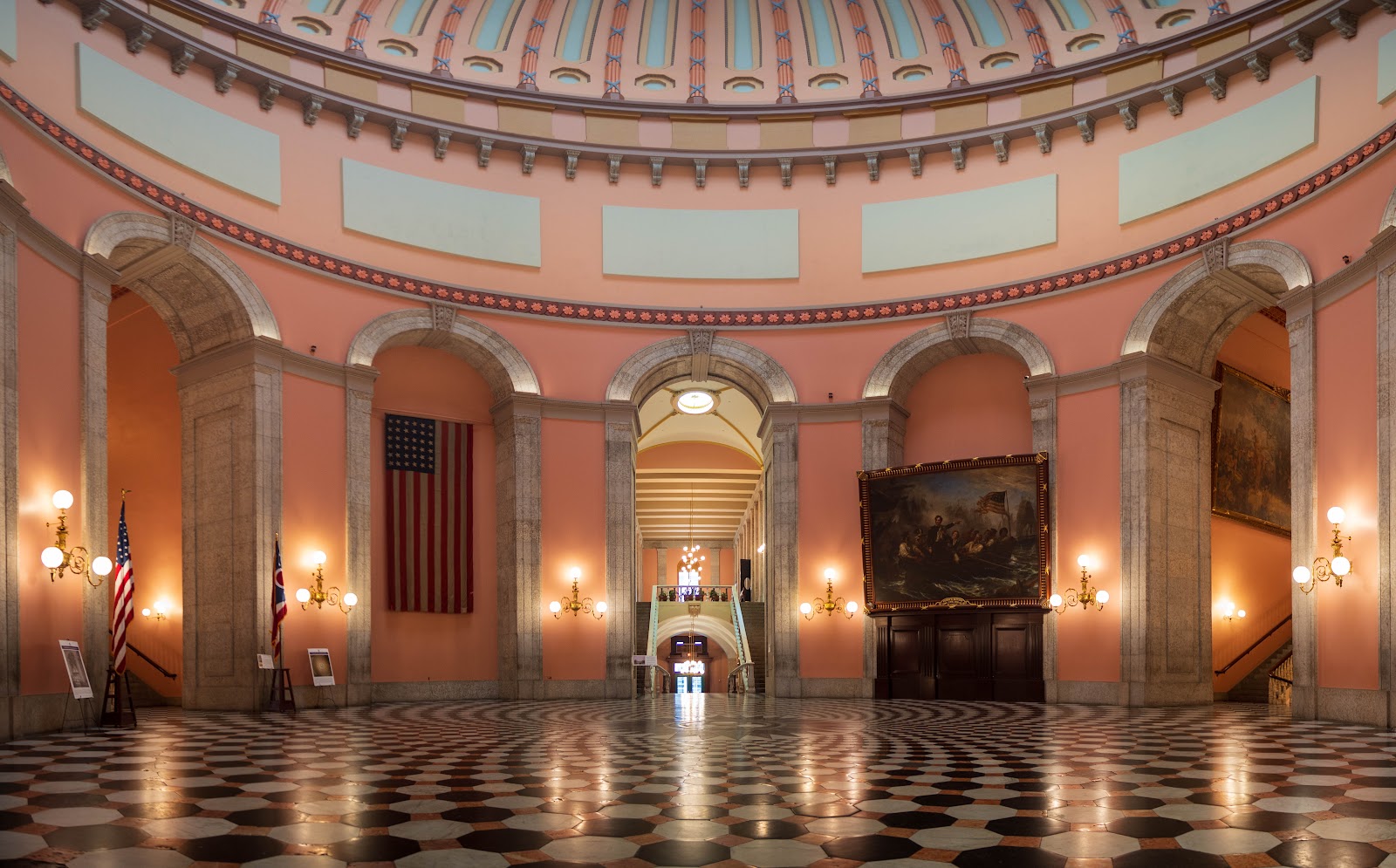
Inside, the rotunda is the centrepiece and it is the space the missing dome most affects.
The light comes down through the cupola onto the rotunda floor, and because the aperture is low and small the pool it makes is correspondingly small and bright with a fast falloff. Directly beneath it the level is workable; five metres out it has dropped two or three stops; at the edges of the space it is genuinely dark.
That gradient is the resource rather than the problem. A couple standing in the centre of the rotunda floor, lit by the cupola, with the surrounding space falling away into shadow, is a frame the architecture makes by itself — theatrical, centred and entirely appropriate to the building.
The exposure is set on them and the rest is allowed to go. Attempting to lift the whole rotunda produces a grey even frame that loses the one effect the space offers.
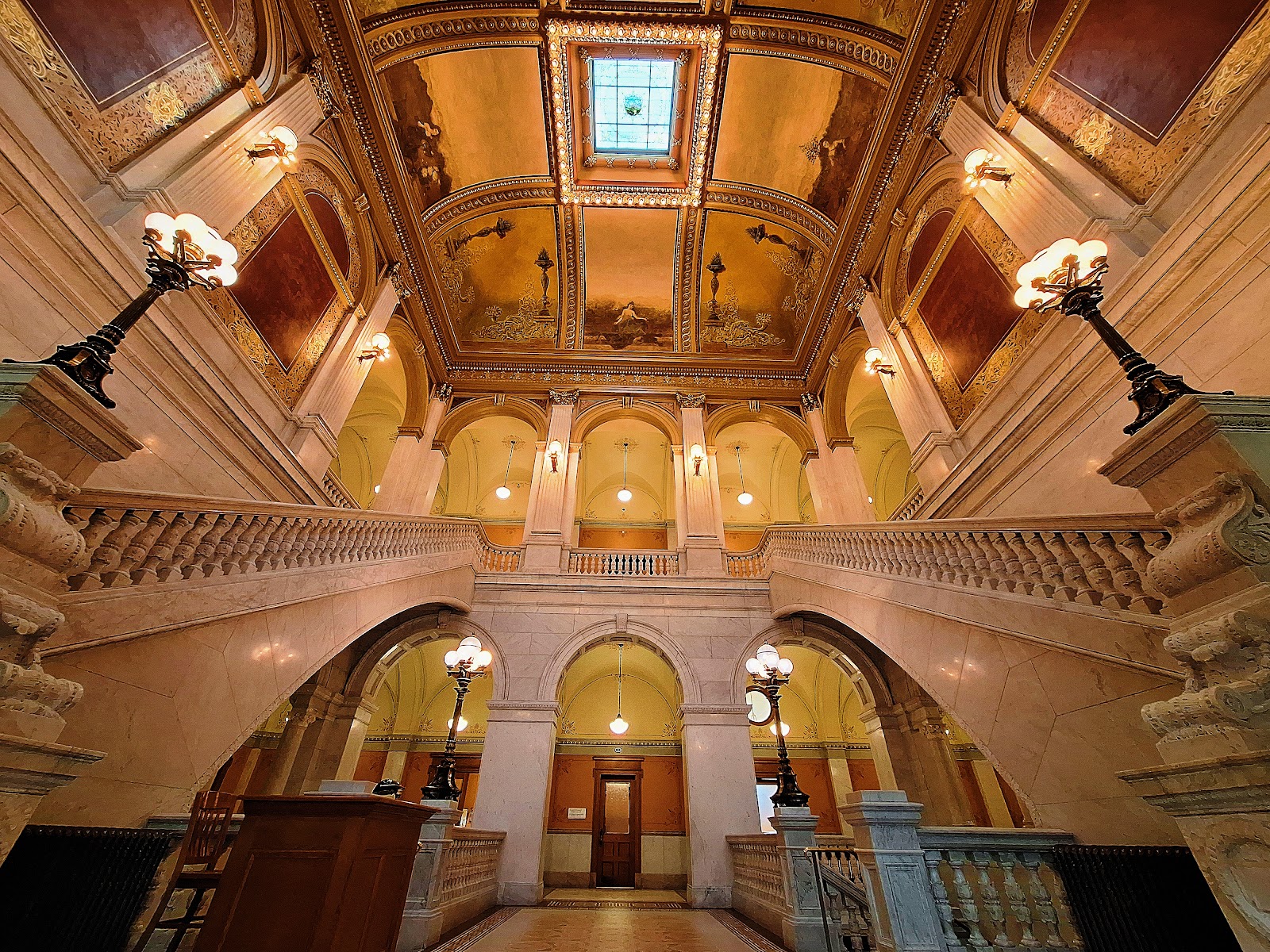
Look up. The underside of the cupola usually carries the most decoration in a building of this austerity — in Ohio’s case a skylight bearing the state seal — and a camera placed on the centre of the rotunda floor pointing straight up gives a symmetrical graphic frame that is completely unlike anything else available.
That frame rewards precision. A camera a foot off centre renders the circle as an ellipse and the symmetry collapses; on centre it is exact. Use the floor pattern to find the middle, which in a rotunda is almost always marked.
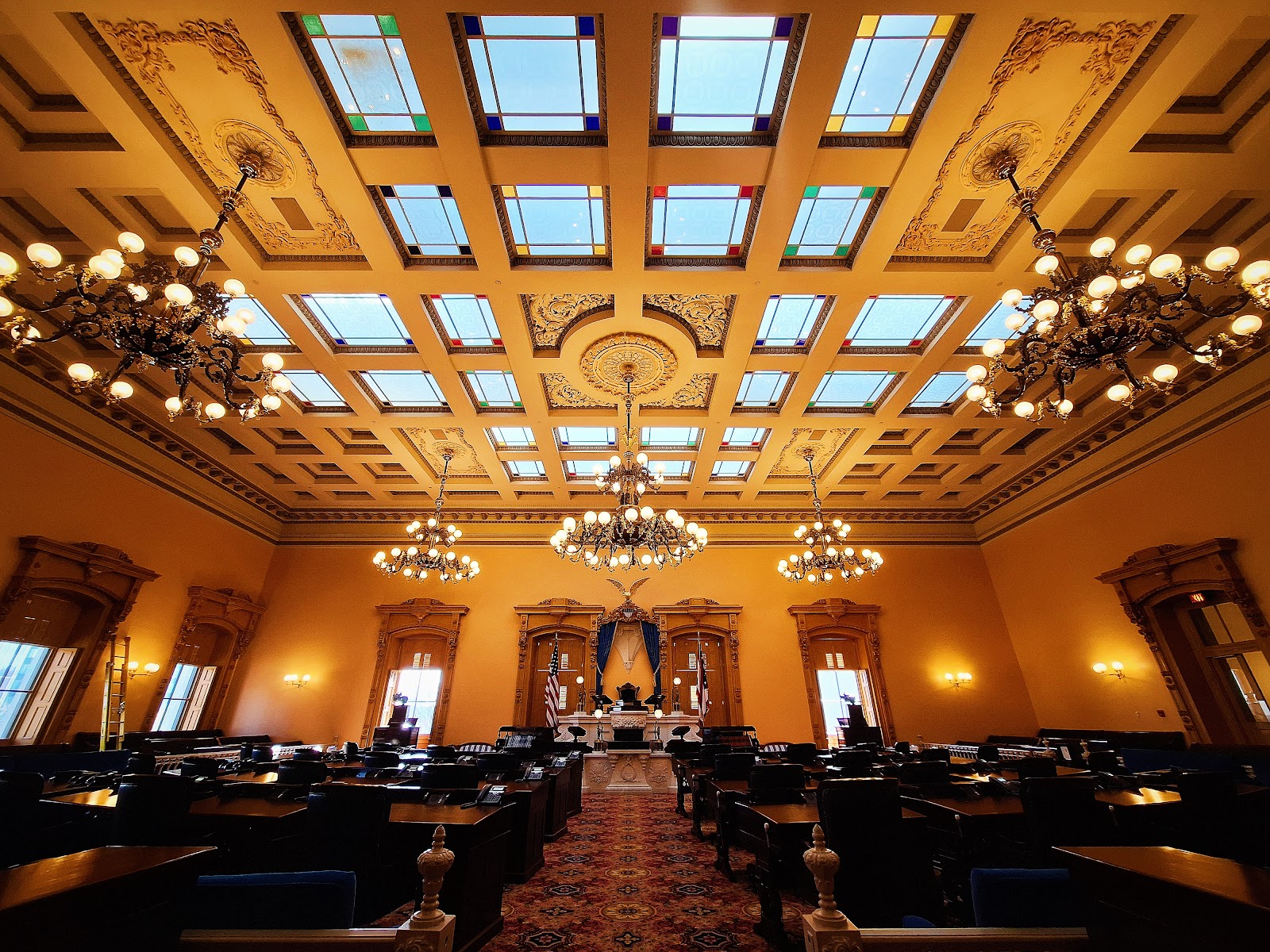
The legislative chambers are the second space and they are the building’s grand interiors. A mid-nineteenth-century chamber gives tiered or curved seating, a raised dais, galleries above, and tall windows along the outer wall — and that window wall is the best portrait light in the building.
A tall chamber window is very tall relative to its width, which produces strong horizontal direction and gentle vertical falloff — a face turned three-quarters toward one is modelled cleanly with no top-light problem. Stand the subject a metre or two in and expose for the lit cheek; the chamber behind falls away and the separation needs nothing added.
Arrange groups parallel to that window wall rather than across the room. Perpendicular puts one end of a row two or three stops below the other, which no amount of care in post recovers.
The galleries give the height, and height is the thing a photographer most often lacks. Shooting from a gallery down into a chamber shows the seating geometry, the dais and the people at once, and it is the frame that explains what the room is. Ask whether the galleries are accessible, because a locked gallery removes the building’s best wide angle.
The atrium — many nineteenth-century capitols acquired a glazed central court in later renovation — is worth checking for. Where one exists it is top-lit and bright, which makes it the building’s easiest space and the sensible location for large group photographs. The same overhead-light caveat applies: even coverage with shadowed eye sockets, fixed by a low reflector or a modest front fill.
The corridors are the connective tissue and they photograph better than they look. A long limestone corridor with a repeating rhythm of doorways and pilasters is a natural perspective frame, and a moderate telephoto compressing the repetition with a couple well down it is a strong picture. They are also where people wait, which is where the unposed frames come from.
- Greek Revival needs raking light — a midday facade is a flat grey field
- Keep the sensor plane parallel; never tilt up at a classical portico
- Expose for the cupola’s pool and let the rotunda go dark around it
- On dead centre, shoot straight up — a foot off and the symmetry collapses
- Arrange chamber groups parallel to the window wall, never across it
Working in a seat of government
A working capitol is unlike any other venue in this library, and the differences are worth knowing before booking rather than on the day.
It is a secure building. There will be screening at entry, and that applies to a wedding party and to a photographer’s equipment — which means arrival takes longer than expected, lighting stands and cases are inspected, and nothing can be left unattended anywhere. Budget time for it and expect to carry less than usual.
It is also a public building with a working function. Legislative sessions, committee hearings and public tours take precedence over events, which means the available rooms and hours are determined by a calendar that has nothing to do with weddings. A date may be bookable and a specific room may not.
That makes the room question more important here than almost anywhere. Establish exactly which spaces are included, and what happens if the legislature sits — because the rotunda being unavailable changes the entire plan.
Tripods and lighting stands are frequently restricted in historic public interiors, and the restriction is usually about egress and public safety rather than the building. Where stands are not permitted, the plan becomes hand-held or assistant-held sources, which works perfectly well and needs knowing in advance.
Flash is generally permitted in a capitol, unlike in an art museum, because there is no light-sensitive collection — which makes this building substantially easier to work in than a gallery of similar grandeur. Confirm it, but expect a yes.
The technical approach throughout is simple because of the stone. Pale unpainted limestone is an efficient near-neutral reflector, which means a single source bounced off a wall gives a large soft key with real direction and no colour cast to correct. That is a genuine luxury after a Victorian interior of dark timber and gilt.
Gel to match the house lighting rather than fighting it. A nineteenth-century public building will be lit by warm tungsten or warm LED at modest levels, and a daylight-balanced flash against that puts a blue-white face in a warm stone room. A quarter to a half warm gel with a correspondingly warm white balance resolves it.
Drag the shutter so the building’s own lighting registers. The chandeliers, sconces and uplit stonework are what make the interior look like itself, and a frame exposed only for flash renders them dark and the room anonymous. A thirtieth to a sixtieth on a wide lens is the usual range.
Two closing notes on the year. Civil twilight here runs about thirty-one minutes, which is a workable blue-hour window rather than a scramble — and a Greek Revival facade uplit against a deep blue sky fifteen minutes after sunset is the best exterior frame the building has, better than the honey-stone frame at sunset.
And central Ohio’s humid continental summer has a photographic effect worth naming. High summer humidity scatters light and fills shadows, so a sunlit facade in July has perhaps two stops less contrast than the same sun angle in a dry climate. For a building that depends on shadow for its modelling, that means July renders it flatter than October does — which is another reason the autumn window is the right one.
More frames from The Ohio Statehouse
The Ohio Statehouse wedding photography: common questions
Why does the missing dome matter?
A tall dome acts as a light well drawing daylight down from height. A low flat cupola admits far less over a smaller aperture, so this rotunda is dark with a fast falloff.
How do I use the rotunda then?
Put them in the bright pool under the cupola, expose for them, and let the space fall away into shadow. Lifting the whole room loses the only effect it offers.
What is the best exterior hour?
First or last. Greek Revival is deliberately plain, so it only reads in raking light — a frontal midday sun makes it an even grey field with no modelling.
Is flash allowed?
Generally yes, unlike an art museum, because there is no light-sensitive collection. Confirm it, but expect permission.
What should I ask about access?
Exactly which rooms are included, and what happens if the legislature sits. A working capitol’s calendar outranks events, and losing the rotunda changes everything.
Any practical warnings?
Security screening on entry for the party and the equipment, nothing left unattended, and tripods or stands often restricted. Budget time and carry less.
More Columbus, OH venue guides
We are writing a photographer’s guide to every venue we would happily shoot in Columbus, OH. Here are three more, plus the full index:
- The Bluestone, Columbus: Field Notes
- The Columbus Museum of Art: The Venue’s Own Logic
- The Columbus Zoo: Field Notes
Planning a wedding at The Ohio Statehouse?
Austere stone, a dark rotunda, and no dome at all. Tell us your date.