 The House of Blues, Cleveland: What It Suits and What It Does Not
The Valley Dale Ballroom, Columbus: The One Decision That Governs Everything
One decision: whether the ceiling is in the frame.
This room has one feature that everything else has to accommodate, and the decision is whether it appears in a given photograph or not.
The ceiling is painted as a sky. Ballrooms of the big-band era frequently were — the conceit was that dancers were outdoors under the stars, and the execution ranged from simple blue with painted clouds to elaborate twinkling installations with concealed lighting. A room built in 1918 and run through the dance-band decades will carry some version of it.
That produces a genuine photographic fork. A painted sky ceiling is the thing that makes the room distinctive and it is dim, high, low in contrast and often lit by nothing at all — so including it means exposing for a dark decorative surface, and excluding it means the photographs could be of any ballroom.
Those two paths need different techniques, different exposures and different shutter speeds, and a photographer who has not chosen in advance will end up with neither properly done.
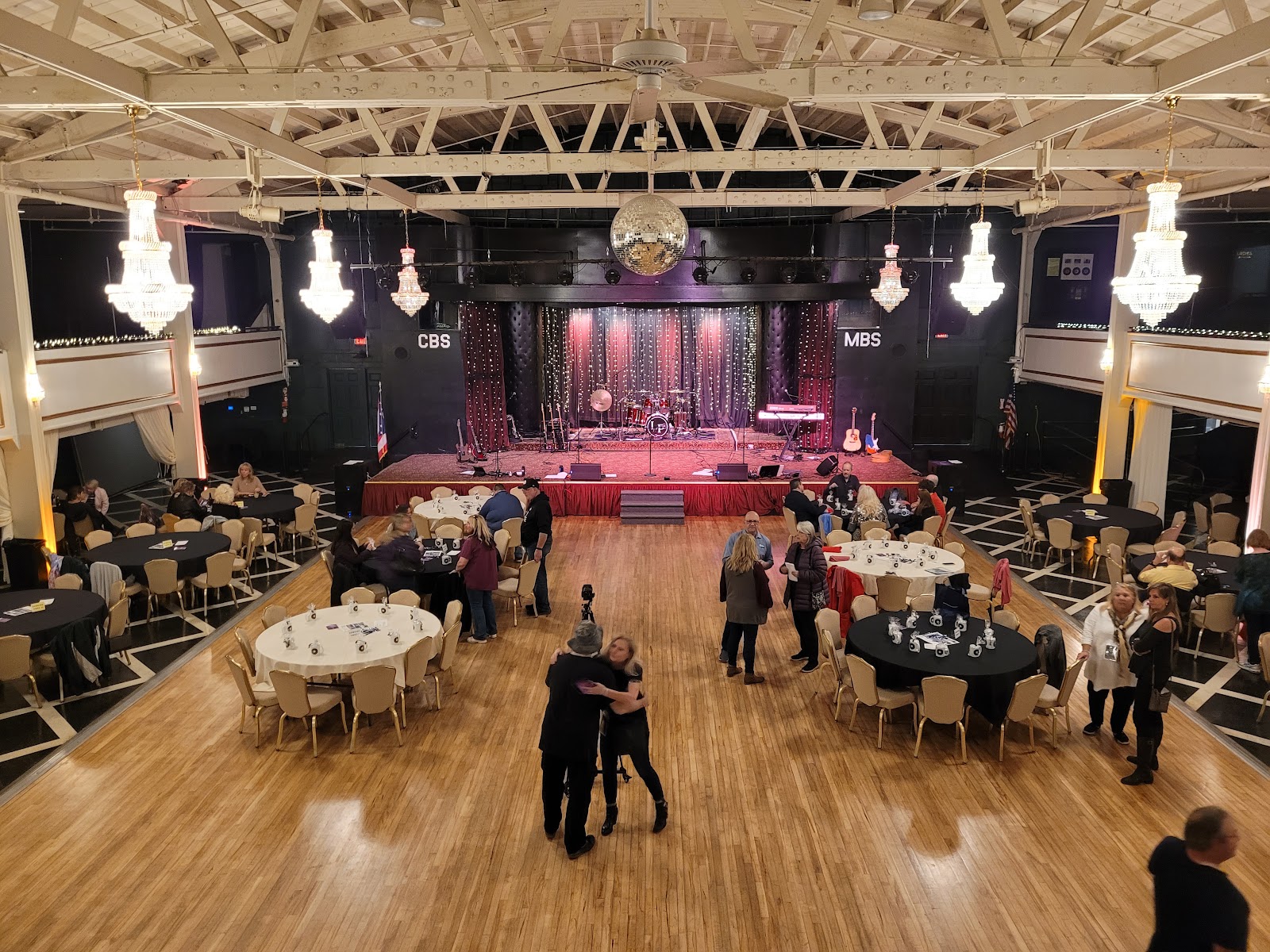
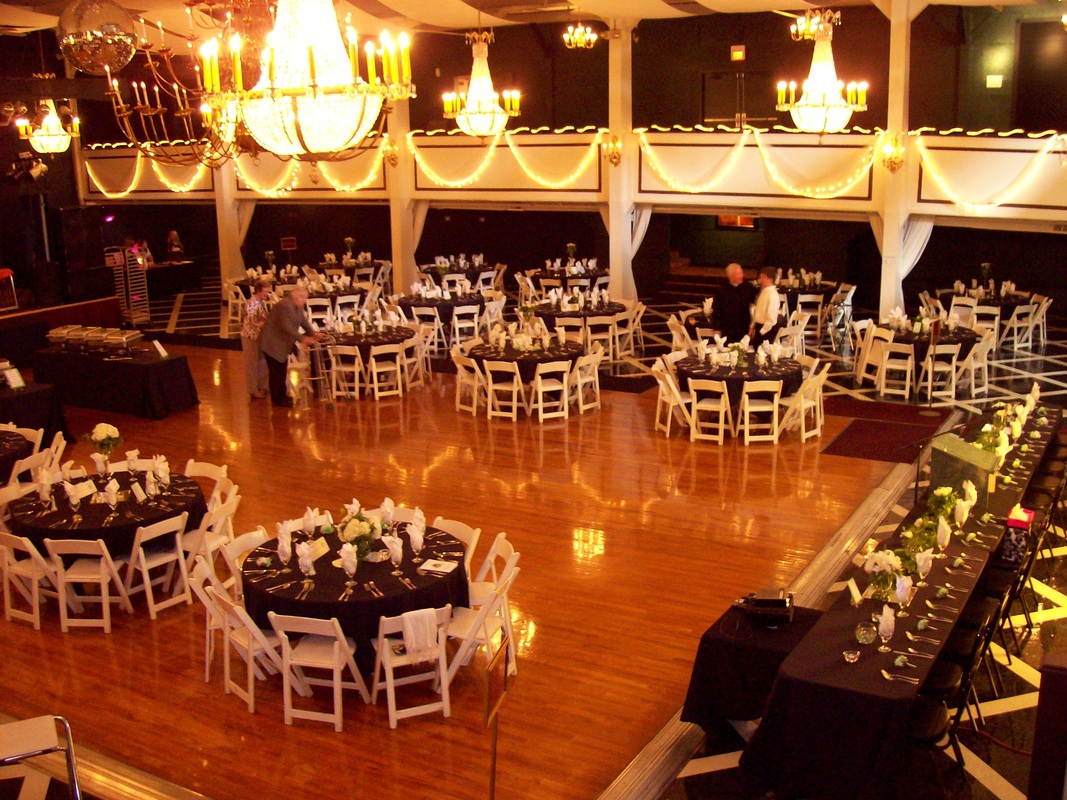
The other feature worth knowing is underfoot. A dance hall of this period will have a sprung maple floor — boards laid over a resilient subframe so the surface flexes under dancers, which is what made these rooms famous and what makes them still worth dancing on.
Photographically a maple floor is a pale, warm, highly reflective surface with a strong linear grain, and it does two useful things: it bounces a great deal of light back up, and its board lines give every wide frame a built-in perspective structure.
Columbus sits at about forty degrees north at roughly nine hundred feet. The June noon sun reaches around seventy-three and a half degrees, the December noon sun about twenty-six and a half, and civil twilight is roughly thirty-one minutes — though how much daylight reaches the inside of a 1918 dance hall is the question below.
We have not photographed a wedding here. What the ceiling lighting actually is, whether it can be controlled separately, and the permitted hours are questions for their team — and the first two decide which of the two paths is even available.
The Valley Dale Ballroom at a glance
| Where | A 1918 big-band ballroom in Columbus, Ohio |
| The decision | Whether the painted sky ceiling is in the frame or not |
| Path one | Include it: long exposure, tripod, ambient-led, ceiling lighting up |
| Path two | Exclude it: flash-led, fast shutter, work the floor and the band shell |
| Ask first | Whether the ceiling lighting is separately controllable |
Path one: include the ceiling
If the ceiling is in the frame, the ambient rules and everything else follows from that.
The problem is straightforward. A painted ceiling eight or ten metres up, in dark blue, lit weakly or not at all, sits perhaps four or five stops below a flash-lit subject. Expose for the subject and the ceiling is black; expose for the ceiling and the subject is a blur.
The answer is a tripod, a long exposure and a subject who holds still. At a second or two the ceiling registers fully, the paint’s colour and any concealed lighting read, and the room becomes what it is meant to be. A couple standing still for two seconds is entirely achievable if they are told it is coming.
Add a small amount of flash at the end of that exposure to freeze them — rear-curtain sync, at low power, gelled warm. That gives a sharp subject inside a fully exposed room, which is the frame this building exists to produce.
The wide version is the one worth setting up properly. Camera low, on a tripod, on the centre line of the room, with the floor’s board lines running away toward the band shell and the painted ceiling filling the upper third. That single frame contains the sprung floor, the ceiling and the room’s geometry, and it is the photograph that says where this was.
If the ceiling has twinkling lights or concealed fixtures, ask whether they can be turned up independently. A ceiling lit at performance level is a completely different subject from one lit at ambient level, and a two-stop difference there is the difference between a feature and a smudge.
Exposing a painted surface needs care about colour. A dark blue ceiling lit by warm tungsten renders muddy green-blue if white-balanced neutrally, and the fix is to set white balance warm — matching the tungsten — and let the blue sit slightly warm rather than trying to make it a pure blue it never was. Painted skies were painted under incandescent light and they were meant to be seen under it.
Long exposures in a working reception need a plan for movement. Guests walking through a two-second frame become transparent streaks, which can be beautiful and can be a mess. The controllable version is to make these frames during a lull — before guests arrive, or during the meal — rather than mid-dance.
One genuinely good frame uses the movement deliberately: a long exposure during dancing, with the couple still in the centre and everyone around them blurred into motion, under the painted sky. It needs the couple briefed and it needs several attempts, and it is the best picture available in a room of this kind.
Path two: exclude the ceiling
If the ceiling is out of frame, everything gets faster and more conventional, and the room has plenty to offer at eye level.
The floor becomes the main resource. A sprung maple floor is pale, warm and polished, which makes it a large low reflector — so a subject standing on it receives substantial bounce from below, which opens eye sockets and fills under the chin without any equipment at all.
That bounce is warm, because the maple is warm, which means it pairs naturally with a warm-gelled key and awkwardly with an ungelled one. Gel everything by a quarter to a half and set a warm white balance.
The board lines are the composition. Maple laid in long runs gives strong parallel lines, and a camera low on the floor with those lines converging toward a vanishing point produces depth that a level eye-height frame cannot. It is the cheapest improvement available in the room: kneel down.
Reflections in the polish are worth using rather than avoiding. A well-maintained dance floor returns a soft inverted image of whatever stands on it, which means a couple photographed from low with their reflection beneath them gets a doubled, symmetrical frame. It works best with a dark background behind them so the reflection has something to read against.
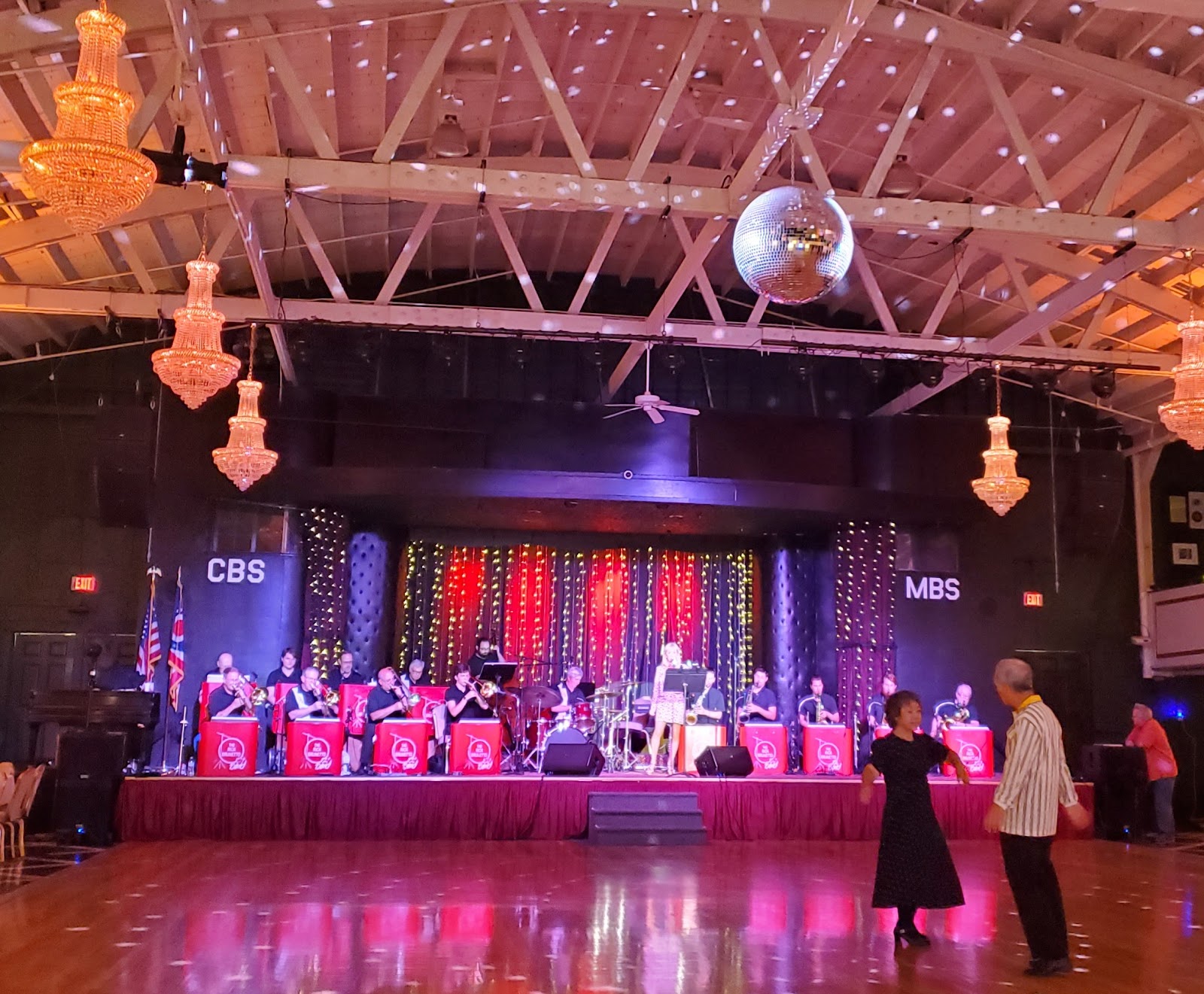
The band shell or stage is the room’s second feature and it is the natural place for a formal frame. A period bandstand gives a proscenium, usually some ornament, and a raised platform — which means a couple standing on it is framed by architecture and elevated above the camera, both of which flatter.
Light it from the front at forty-five degrees with a rim from behind. The rim matters in a room like this because the background is busy with ornament and drapery, and a subject lit only frontally merges into it.
The perimeter is where the unposed pictures are. Ballrooms of this era have a raised or recessed edge with tables and seating around the dance floor, and that band of the room is where people sit, talk and watch. A photographer working the perimeter with a fast lens gets the register of the evening that arranged frames cannot.
Windows, if there are any, are worth finding early. A 1918 dance hall may have tall windows along one or both long walls, often covered for events — and a tall window is a superb portrait source, giving strong horizontal direction with gentle vertical falloff. If the drapes can be opened for ten minutes during the day, that is the best light in the building and it costs nothing.
If there are no usable windows, the room is a night venue regardless of the hour, and the plan is entirely artificial. That is not a hardship: a consistent room is easier to work than a variable one, and the lighting plan that works at two in the afternoon works identically at midnight.
Bounce depends on the surfaces and they need checking. A ballroom with pale plaster walls at a reasonable height takes bounce well; one with dark timber panelling, heavy drapery or a ceiling too high to reach returns almost nothing. In the latter case the answer is direct sources through modifiers with the room left deliberately dark, which suits a period ballroom better than flat overall light does.
- Choose the path before the day: ambient-led with a tripod, or flash-led and fast
- Rear-curtain sync at low power freezes a subject inside a long ceiling exposure
- Kneel — the maple board lines give depth an eye-height frame cannot
- The floor is a warm low reflector; gel everything to match it
- A rim light is what separates a subject from a busy period background
What the room suits, and the year around it
A historic ballroom is a specific proposition and it is worth being straight about where it is strong.
It suits dancing, obviously and genuinely. A sprung floor is not a decorative claim — it flexes underfoot and it is materially better to dance on than a rigid floor, which means the dancing at a wedding here will actually be better and will last longer. For a photographer that means more of the evening is worth covering.
It suits a large single-room event. A ballroom of this period is one big volume with a defined edge, which holds two or three hundred people in a way that feels full rather than sparse, and which keeps everyone in the same space — so nothing happens out of sight in a side room.
It suits a period register. A 1918 dance hall photographs as itself, and a wedding styled anywhere near the era will look coherent in it. That is a real advantage over a neutral modern space, which needs the styling to supply all of the character.
It suits bad weather completely. Central Ohio’s climate is humid continental and genuinely variable — thunderstorms through the summer, weeks of flat overcast in winter, and a shoulder season that can produce frost and heat in the same fortnight. A single-room indoor venue does not care about any of it, and on this flat glaciated plain there is no landscape to miss.
That last point deserves emphasis because it is the honest strength here. Columbus sits on a till plain with no relief, which means no distant views, no valley fog, no elevated vantage points — so an outdoor component adds less than it would elsewhere, and a venue that is entirely interior loses correspondingly little.
It does not suit a party wanting an outdoor ceremony with a landscape. Whatever grounds exist will be flat and suburban, and the building’s value is inside it.
It does not suit a photographer unwilling to bring light. There is no daylight to fall back on in most of the room, the ceiling is high, and the ambient is warm and dim — which means the pictures are as good as the lighting plan and no better.
And it does not suit a schedule with no slack, if the ceiling frames matter. Those need a tripod, a lull and a couple willing to stand still for a few seconds, which is perhaps fifteen minutes of cooperation somewhere in the evening. Fifteen minutes is nothing if it is planned and impossible if it is not.
As to the year: October is the best month for anything outdoors here, with sugar and red maple turning scarlet and orange in the third week or thereabouts, and Ohio hardwoods casting dense solid shade that makes even a midday portrait straightforward — no dapple to manage, unlike the filigree canopies of drier regions.
Summer’s humidity has a real effect worth naming: water vapour scatters light and fills shadows, so a sunlit exterior in July has around two stops less contrast than the same sun angle in a dry climate. Softer, paler, easier for faces and less dramatic for architecture.
Winter is when this venue earns its keep. A nine-hour December day with flat grey overcast and regular snow is a problem for almost every venue in this library and no problem at all for a ballroom — and the blue hour arrives around five in the afternoon, which means a lit exterior frame is available before the reception has even started rather than requiring the evening to be interrupted.
Civil twilight runs about thirty-one minutes, which is a workable window rather than a scramble. Ten minutes outside at that point, with the building lit and the sky still holding colour, is the one exterior frame worth leaving the room for.
More frames from The Valley Dale Ballroom
The Valley Dale Ballroom wedding photography: common questions
What is the one decision?
Whether the painted sky ceiling is in the frame. Including it means a tripod and a long ambient exposure; excluding it means a fast flash-led approach. They are different jobs.
How do I expose the ceiling and the couple together?
A one-to-two second exposure on a tripod for the ceiling, with a low-power warm-gelled flash on rear-curtain sync to freeze the subject at the end of it.
Why set white balance warm for a blue ceiling?
Painted skies were made to be seen under incandescent light. Neutralising the tungsten renders the blue a muddy green; letting it sit warm reads correctly.
What does the sprung floor give a photographer?
A pale warm reflector that fills from below, and strong parallel board lines. Kneel — a low camera turns those lines into real depth.
Is there any daylight?
Possibly tall windows along the long walls, usually draped for events. If they can be opened for ten minutes it is the best light in the building.
Does the venue suit winter?
Better than almost anything else here. A nine-hour overcast December day is irrelevant to a single-room interior, and there is no landscape to miss on this flat plain.
More Columbus, OH venue guides
We are writing a photographer’s guide to every venue we would happily shoot in Columbus, OH. Here are three more, plus the full index:
- The Ohio Statehouse, Columbus: A Walk Through the Building
- The Bluestone, Columbus: Field Notes
- The Columbus Museum of Art: The Venue’s Own Logic
Planning a wedding at The Valley Dale Ballroom?
A sprung floor and a painted sky. Tell us your date.