 Salmonberry Inn, Anchorage: One Frame, and How It Is Made
Inn at Tern Lake, Cooper Landing: A Walk Through the Site
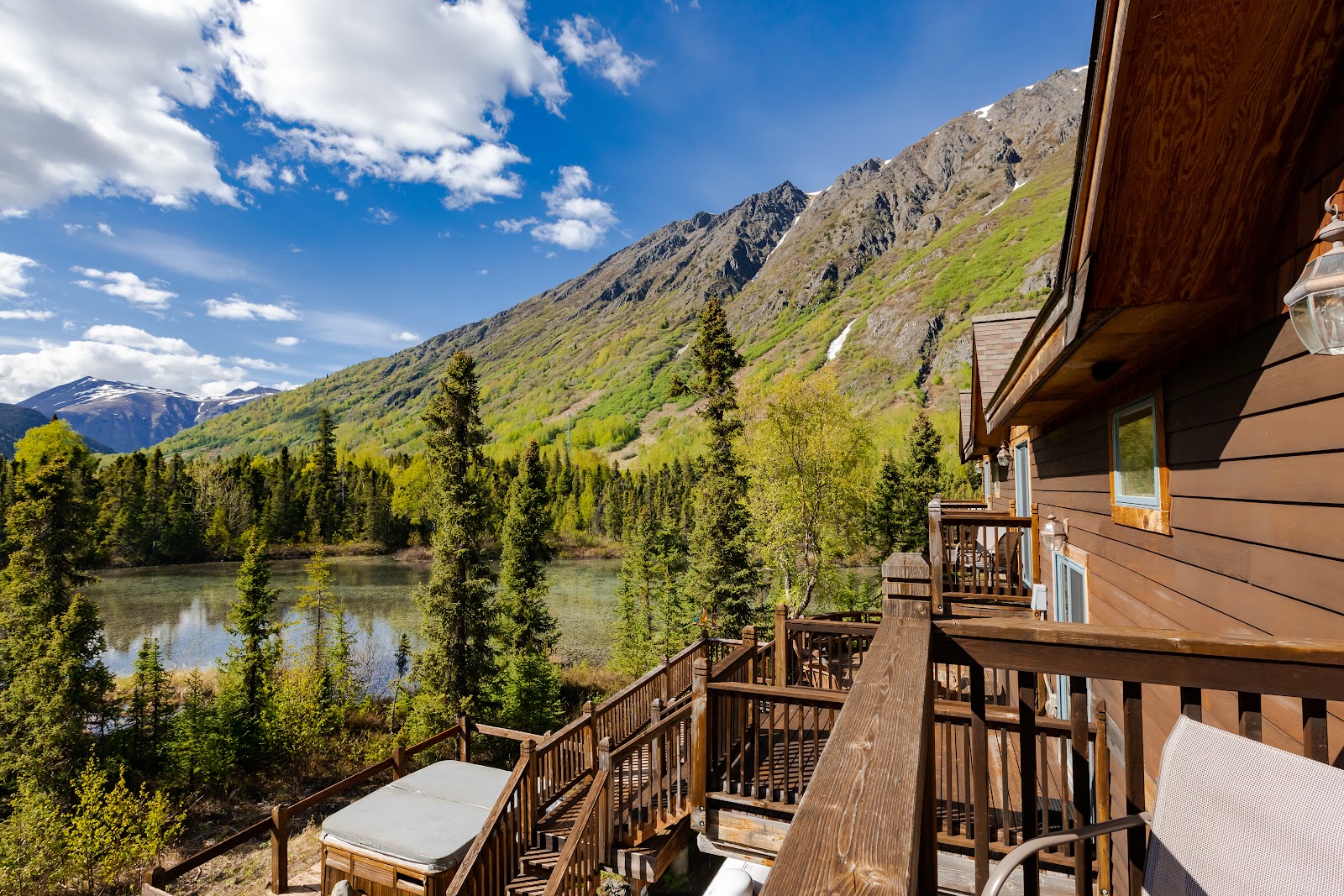
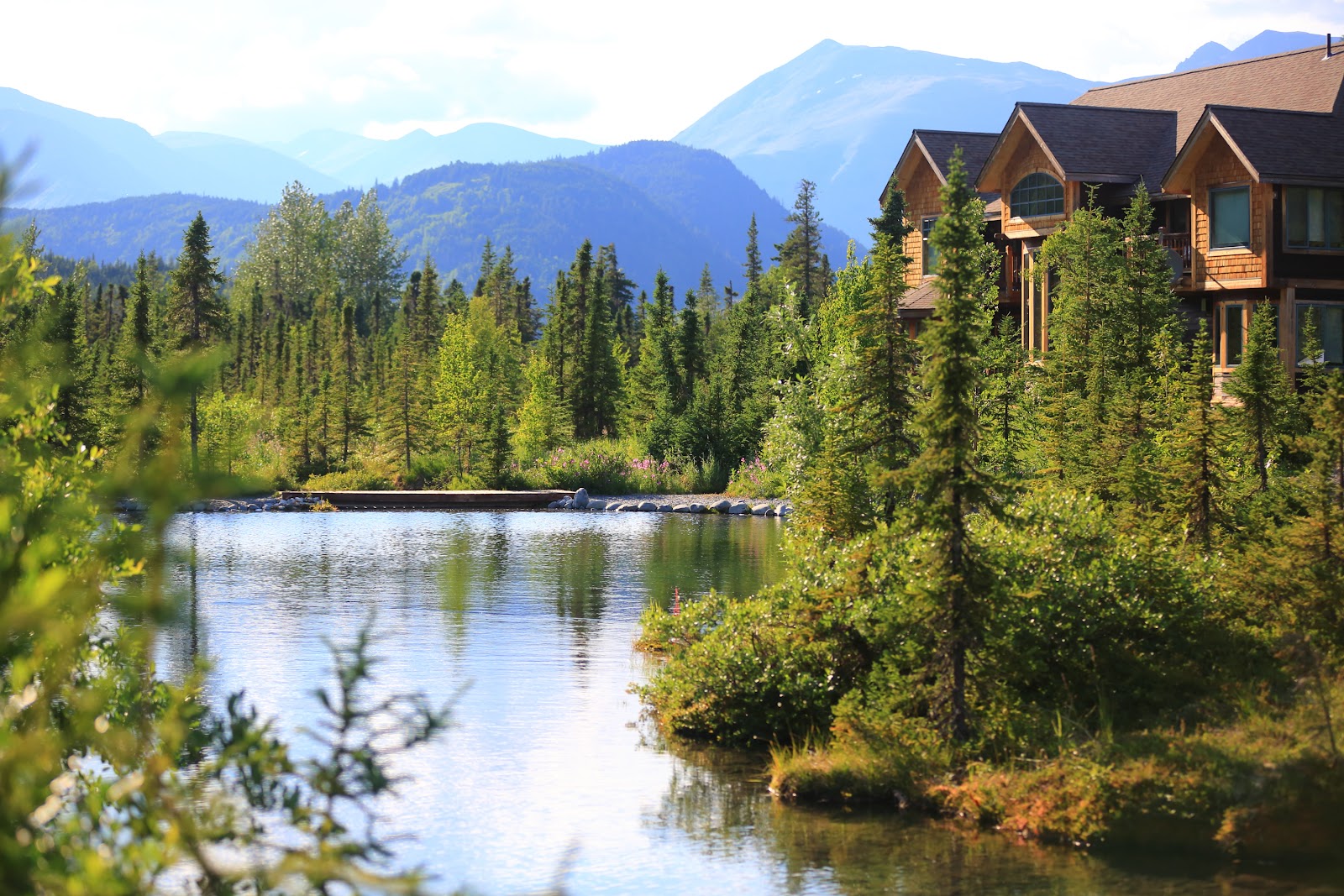
A shallow sheltered lake is the best mirror in this guide. And there are usually swans on it.
This is a walk through the site in the order a wedding day tends to use it, and the governing fact is that a shallow wetland lake behaves differently from a deep one.
It is shallow, which means it warms faster, it produces mist more readily, it grows emergent vegetation at the margins, and it supports birds in numbers that a deep cold lake does not. It is also sheltered, sitting in a basin surrounded by mountains, which means it has very little wind fetch — and a small sheltered body of water goes genuinely flat far more often than a large or exposed one.
Flat fresh water with no swell in it is the best mirror available anywhere. A mirror doubles whatever is composed above it — mountains, spruce, sky, a couple at the margin — which roughly doubles the interest in a frame and gives depth that no dry site can. That is the reason to choose a site like this and it is worth building the day around.
The second fact is the wildlife, and here it is genuinely part of the site rather than a possibility. A shallow wetland in the Kenai Mountains supports waterfowl, including trumpeter swans, and the mountains above it hold Dall sheep — which show as white specks on grey rock and are visible from the valley floor.
That means a long lens earns its place here more than at most venues, and it means a frame with a wedding party and a swan in it is not a fantasy.
The third element is the setting: the Kenai Mountains rise steeply around the basin, which means the site loses the sun early and gains it late, and the slopes are the wide subject.
We have not photographed a wedding at the Inn at Tern Lake; lake and wetland sites in this range behave consistently. Which spaces are included, what access there is to the water’s edge and where the boardwalks or paths run, the covered alternative, and what the bear and wildlife guidance is are questions for their team.
Inn at Tern Lake at a glance
| Where | A shallow sheltered lake in the Kenai Mountains at Cooper Landing |
| The water | Shallow and sheltered, so it mirrors more reliably than a deep lake |
| The wildlife | Waterfowl including swans, and Dall sheep on the slopes above |
| The mountains | Steep on all sides — the site loses the sun early and gains it late |
| Ask first | Water’s edge access, paths, covered alternative, wildlife guidance |
The water: the mirror, the mist and the margins
Start at the water in the first hours of the day, because that is when it is at its best and it is the part of the day almost nobody uses.
Two things coincide early. The water is at its calmest, because wind builds through the day rather than overnight — and a sheltered shallow lake on a still morning is a perfect mirror, doubling the mountains, the spruce and the sky. A reflection runs about a stop darker than what it reflects, which is the single technical thing to know when metering a frame containing both.
And mist forms. A shallow lake warms faster than a deep one, which means the water is frequently warmer than the air above it in the morning — and that produces surface mist through much of the year, heaviest in autumn when the water is still warm and the mornings have turned cold.
Mist on a mountain lake is the most atmospheric condition the site produces. It separates the near shore from the far, which gives depth a clear morning does not; it makes shafts of low sun visible in the air; and it renders everything in tonal layers rather than in detail. A longer lens is the right instrument, because mist reads as layers only when the distances are compressed.
The margins are the second element and a wetland has a great deal of them. Emergent vegetation — sedge, reed, willow and alder at the water’s edge — gives a foreground layer that a hard-edged lake does not, and in low sun thin blades and leaves transmit light rather than blocking it, so a backlit margin glows.
Composing low, with that margin across the bottom of the frame, places a picture precisely in this landscape and gives the water depth. It is the single most effective compositional move at a wetland site.
The water’s colour is worth knowing. A shallow lake in this range is fed partly by snowmelt and partly by clear streams, which means it is less silt-laden than a glacial river and reads green-blue to brown depending on the bottom and the light. It is not the turquoise of a glacial river and it is not the grey of a tidal arm — and a custom white balance set on a face at the water’s edge handles whatever it is on the day.
The birds are the third element and they need a plan rather than luck. Waterfowl on a lake are most active early and late, which coincides with the best light — and a long lens kept ready during the portrait session costs nothing. A swan lifting off water behind a couple is a frame that belongs to this place.
The practical caution is distance: wildlife is not a prop and an approach that disturbs nesting birds is both wrong and counterproductive. A long lens from where the party already is, rather than a walk toward the water’s edge, is the whole of the technique.
Wind is the water’s enemy and it builds through the afternoon. It removes the reflection, which is the site’s main asset, and it makes a lightstand a liability and a held modifier a sail — so handheld or bracketed sources are the working configuration, and the calm periods are the morning and the evening rather than the middle of the day.
The practical note about a wetland is the ground. Margins are soft, boardwalks may be narrow, and the footing between the paths is frequently wet — which is a real consideration for a party in formal shoes and worth raising in advance rather than discovering.
The slopes, the forest and the long evening
Moving up from the water, the mountains are the site’s wide subject and the Kenai Mountains are steep and close.
That closeness is what makes the frame work. A longer lens compresses the slopes and brings them forward as a mass behind a couple, where a wide lens reduces them to a band above a great deal of water and margin. The air here is clean and cool, so the compression holds detail well.
The exposure goes on the slopes rather than on skin, with the faces lifted by a close warm-gelled source — because metering on faces gives a white sky and a washed-out mountain. Close matters because nothing over water bounces enough to lift a backlit face: a source at two metres needs roughly a quarter of the output it needs at four.
The Dall sheep are worth looking for on those slopes, because they are frequently there and almost nobody notices them. They show as white specks on grey rock, usually high up and usually moving slowly — and on a long lens they are a genuine subject rather than a curiosity. Spotting them takes a minute of looking rather than any skill.
The slopes also control the timing and they do it firmly. A basin surrounded by steep mountains loses the sun well before a table says — frequently by an hour or more in summer — and gains it correspondingly late, which means the direct-sun day here is considerably shorter than the sky above it suggests.
That produces the interval frame, which is the best mountain frame of the day: the lake and the basin floor in soft even shade while the slopes above are still brilliantly lit, for twenty or thirty minutes. It is made by exposing for the lit slope and lifting the faces with a close warm-gelled source, not by underexposing the mountain to match them.
And because the lake is flat at that hour, the lit slope appears twice — once above and once in the water. That doubling is the strongest frame this site produces and it is worth being in position for rather than discovering.
The forest is the shade. This is spruce and birch country, and spruce blocks almost everything, which makes the canopy edge the most reliable position on the property: a metre or two inside at the margin of an opening gives soft directional light in front and near-darkness behind, three or four stops of free separation.
The metering trap is severe at a lake site: dark spruce makes a meter overexpose a face by a couple of stops and bright water fools it hard the other way, and those positions can be five paces apart. Manual, metered on skin, reset at every transition — and a custom white balance in each place, because the forest bounces green and the water does not.
Birch and cottonwood are the counterpart: bright white bark makes a birch stand a pale background of vertical lines, and broad thin leaves transmit rather than block, giving soft green-tinged light beneath them.
The light at this latitude needs no management in the way it does further south. At around sixty degrees north the sun reaches only about fifty-two degrees above the horizon at midsummer noon and far less the rest of the year, which means it rakes rather than falls — so there is no hour at which the sun is high enough to flatten a face.
And the evening is long. Because the sun’s path is shallow, the twilight after the basin loses the sun lasts for hours rather than minutes, and in June the usable light runs until near eleven at night. That partly solves the basin’s early shade: the direct sun goes at seven and the light is still perfectly good at ten, which means a portrait session can be placed late without any loss.
Indoors, a building in this climate is timber and it absorbs, which means the ambient is a stop or two below what the eye estimates and the background drops away for free. A subject a metre from a window turned about forty-five degrees to it gets horizontal light with steep fall-off — room lights off, custom white balance on a face — and because the sun is low all year that light travels much further into the room than it would further south.
- The first hours give a flat mirror and mist — and almost nobody uses them
- Get low and put the wetland margin across the bottom of the frame
- A reflection runs about a stop darker than what it reflects
- Look for Dall sheep on the slopes; they are white specks and usually there
- The interval frame is doubled in the water — be in position before it starts
The Kenai Mountains year
This basin has a transitional Kenai Peninsula climate — wetter than the interior, drier than the outer coast — with the enormous daylight swing that defines Alaska.
Midwinter gives about five and a half hours of daylight with the sun reaching only about six degrees above the horizon, which in a basin surrounded by steep mountains means the floor may receive no direct sun at all for weeks. That sounds like a loss and it is the easiest light of the year: entirely soft, entirely even, and workable for the whole short day.
Winter changes the water completely. A shallow lake freezes early and thoroughly, which turns a mirror into a flat pale plane — sometimes snow-covered, sometimes wind-scoured into patterned ice — and that is graphic rather than reflective. A frozen lake with steep white mountains around it is one of the cleanest landscapes in this guide.
Snow is the winter asset: the best natural fill available, lifting every shadow and throwing light upward into faces. Snow against near-black spruce is the widest brightness range in this guide — expose for the snow and let the conifer go black, overexposing deliberately relative to the meter, which snow fools by about two stops.
The safety note is that lake ice is a matter for local knowledge rather than for anyone’s judgement on the day, and the venue’s guidance is followed.
Winter is aurora season from roughly September to April on clear nights, and a mountain basin away from town has dark skies. Northern lights over a frozen lake with mountains around it is available nowhere else in this guide — tripod, wide fast lens, a few seconds to half a minute, and a party willing to stand still in the cold.
Break-up in April and May is the least attractive time of year: rotting grey ice on the lake, dirty snow, mud, bare willow and nothing green. Early May here is not spring in any recognisable sense, and a wetland in break-up is at its worst.
June is when it turns and it turns fast. The green arrives within a fortnight, the lake clears and warms, the birds arrive and nest, and the days are enormous. Mosquitoes arrive with the green and at a wetland they are a serious consideration in June and early July rather than a mild one — which is worth raising with a couple, because a wetland is the worst possible place for them.
July is the warmest month and the greenest, and fireweed gives the strongest colour of the Alaskan summer — tall magenta spires along the cleared ground in quantity, a genuine foreground rather than a detail.
Late August into September is the best season overall and at a wetland it is exceptional. Birch and cottonwood turn gold in late August; the willow and alder at the margins turn yellow; the alpine tundra on the Kenai Mountains turns red and orange; the first snow appears on the peaks; and the nights are dark enough for aurora while the days are still long.
And a flat lake doubles all of it. Autumn colour reflected in still water is roughly twice the colour, which is why lake venues photograph better in September than any other kind of site — and autumn is also when the morning mist is heaviest, because the water is still warm and the mornings have turned cold.
A September morning here can give mist, a flat mirror, gold margins, red tundra and fresh snow on the peaks in one frame. That is the single best thing this site produces and the window is roughly the last week of August through the middle of September.
The swans are worth a final note: waterfowl gather on wetlands during autumn migration, which means late August and September are when the bird life is most concentrated as well as when the light and the colour are best.
October brings the rain and the dark, and by November the lake is icing and the season has closed.
More frames from Inn at Tern Lake
Inn at Tern Lake wedding photography: common questions
Why does a shallow lake mirror better?
It is sheltered and small, so there is almost no wind fetch — and flat fresh water with no swell is the best mirror available anywhere.
When is the water calmest?
The first hours of the day and the last. Wind builds through the afternoon and removes the reflection, which is the site’s main asset.
What is the best compositional move?
Get low and put the wetland margin across the bottom of the frame. It gives the water depth and places the picture in this landscape.
Are the animals really part of it?
Yes. Waterfowl including swans use the lake, and Dall sheep are usually on the slopes above as white specks. A long lens earns its place here.
Does the basin lose the sun early?
By an hour or more in summer. The compensation is that the twilight afterwards lasts for hours, so a session at ten in the evening is fine.
When is the site at its best?
A September morning: mist, a flat mirror, gold margins, red tundra and fresh snow on the peaks — all doubled in the water.
More Alaska venue guides
We are writing a photographer’s guide to every venue we would happily shoot in Alaska. Here are three more, plus the full index:
- Kenai Fjords Lodge, Seward: The One Decision That Governs Everything
- Kenai Princess Lodge, Cooper Landing: The Light Through the Day
- Moose Meadow Lodge, Willow: What It Suits and What It Does Not
Planning a wedding at Inn at Tern Lake?
A shallow lake and a basin full of birds. Tell us your date.