 The JW Marriott Austin: What It Suits, and What It Does Not
The Houstonian Hotel, Houston: One Frame, and How It Is Made
One frame, under a canopy that is the same in January.
This guide is about a single photograph, and it depends on a tree that behaves unlike almost anything else in this library.
The frame is the couple beneath a mature live oak, in its shade, with a shaft or patch of sunlit ground visible beyond them — a portrait that uses the canopy as a roof and the gap in it as a background.
What makes it possible is the species. Live oak is an evergreen broadleaf: it holds its leaves through the winter and exchanges them gradually in spring rather than dropping them in autumn. And it grows into a very broad, low, dense crown — a mature specimen can be far wider than it is tall, with heavy horizontal limbs that sometimes reach the ground and re-root.
For a photographer that produces three things no deciduous tree offers. Genuine solid shade with no dapple, because the canopy is dense rather than open. Availability in every month, because the leaves never leave. And those heavy horizontal limbs, which are a compositional element in their own right — a limb running across a frame is better background structure than most built architecture.
The fourth property is the one that makes the frame work: a live oak canopy is dark. A dense evergreen crown at low height blocks a great deal of light, so the space beneath it sits several stops below the open ground outside — which gives a natural, enormous, free contrast ratio between a shaded subject and a sunlit background.
That is the whole picture. A four-stop differential, supplied by a tree, available at any hour of any day of any month.
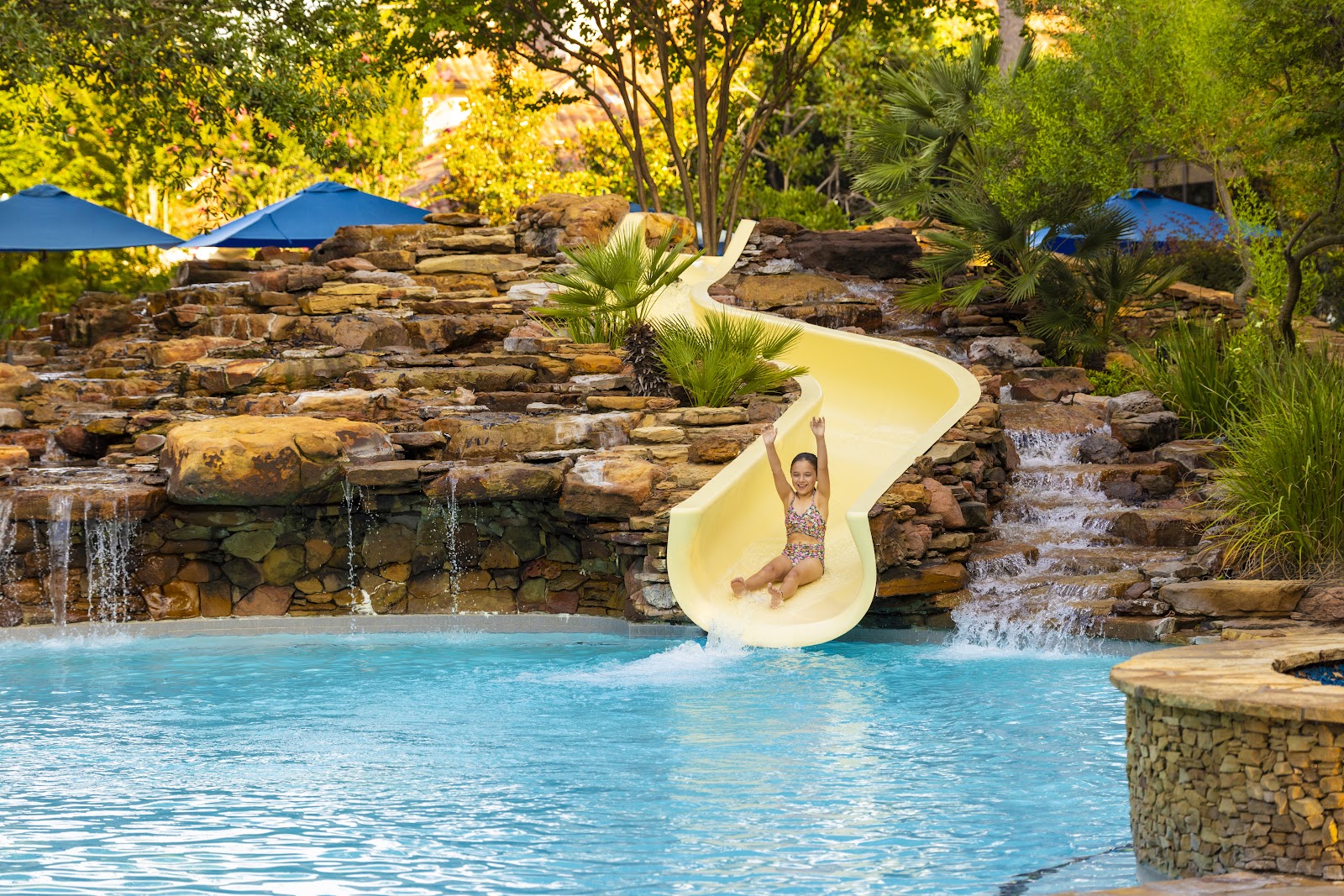
The setting is a hotel in substantial wooded grounds inside Houston, which is itself unusual — an urban property with mature woodland rather than a lawn and containers.
Houston sits at about twenty-nine and three-quarter degrees north at roughly fifty feet above sea level on the Gulf coastal plain. The June noon sun reaches around eighty-three and a half degrees, the December noon sun about thirty-seven, days run from about ten hours fifteen to fourteen hours, and civil twilight is roughly twenty-two minutes — the shortest figure in this library.
We have not photographed a wedding here. Which grounds and rooms are bookable and the permitted hours are questions for the hotel.
The Houstonian Hotel at a glance
| Where | A hotel in mature wooded grounds inside Houston, Texas |
| The frame | The couple in live oak shade with sunlit ground visible beyond them |
| Why it works | An evergreen canopy several stops darker than the open ground — free ratio |
| The advantage | Available in every month, because live oak never drops its leaves |
| Ask first | Which grounds and rooms are bookable; permitted hours |
Building the frame
Five decisions, and the first is about the tree rather than the camera.
**Choose the canopy.** Not every live oak makes this frame. The one you want has a dense crown with a clear, high-enough underside to stand beneath, and — crucially — a defined gap or edge nearby where sunlight reaches the ground. A canopy in the middle of continuous woodland has no bright background to work against; one at the edge of a lawn has it in abundance.
The heavy horizontal limbs are the second thing to look for. A limb crossing the frame at head height or above gives the composition a structural line, and a mature live oak’s limbs are thick enough to read as architecture rather than as branches.
**Set the position.** The subject stands under the canopy and a metre or two inside its edge, not in the middle. At the edge the light is brighter and more frontal; deep inside it is dim and the background is more canopy. A metre or two in is where the ratio is dramatic and the background still contains something bright.
Turn them so the brightest ground is behind them rather than in front, which puts the contrast where the frame needs it.
**Anchor the exposure on the faces.** This is the decision that separates the frame from a failure. The instinct is to protect the highlights, but a sunlit Houston lawn is four or five stops above a subject in live oak shade, and holding it means the faces go black.
So expose for the shaded faces and let the background blow. A blown bright background reads as summer light and as depth; it does not read as an error. What reads as an error is a correctly exposed lawn with two silhouettes in front of it.
**Decide whether to fill.** Unfilled, the subject is lit by whatever skylight reaches under the canopy — soft, even, slightly cool, and adequate. That is a perfectly good frame and it needs no equipment.
Filled, with a source at about a stop under the sunlit background, the subject gains modelling and the frame gains a professional cleanliness. Use a modifier and place it at forty-five degrees; a bare flash under a dark canopy looks exactly like a bare flash.
Gel it warm by about a quarter. Light reaching under an evergreen canopy is filtered through green leaves and arrives from a blue sky, which makes it both cool and green — and an ungelled source under those conditions gives faces that read slightly off against warm bark.
**Watch for the dapple.** A dense live oak canopy is not solid, and there will be gaps that throw hard bright spots. A patch across a face is unusable and the fix is a step — move half a metre and look again. This is the one part of the frame that has to be checked rather than planned, because the gaps move as the sun does.
One last element worth including if it is present. Spanish moss hangs from live oak limbs in the Gulf South, in grey-green translucent streamers, and it glows when backlit against a low sun. A frame with moss hanging into it and a bright gap beyond is as specifically Gulf Coast as anything available.
The rest of the grounds, and indoors
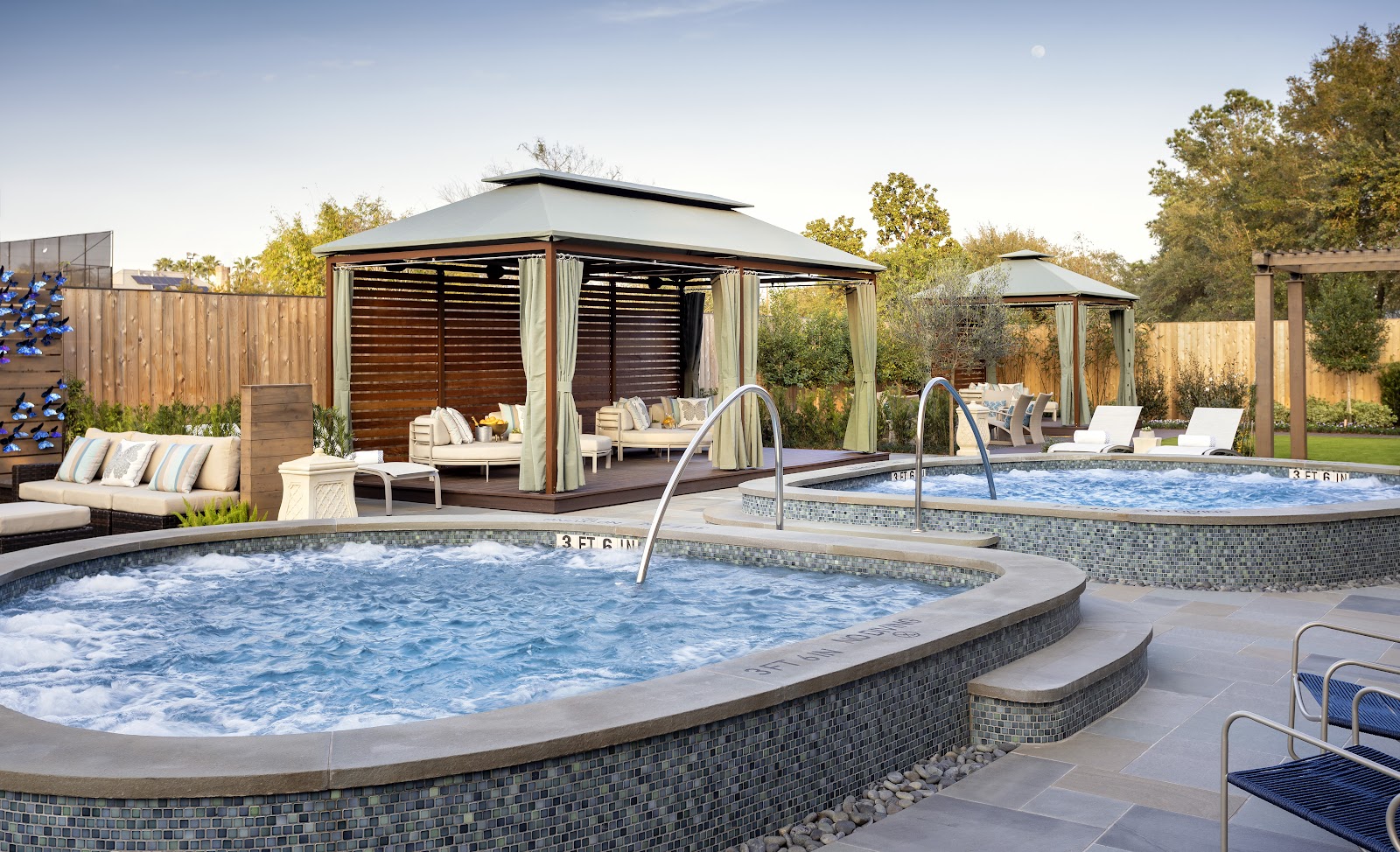
Beyond the signature frame the grounds offer three further things, and the woodland is the reason to be here rather than at a downtown hotel.
The canopy edge is the most reliable free light on any wooded property. A metre or two inside a tree line, a subject has soft directional light arriving from the open ground in front of them and three or four stops of darkness behind — which is separation without equipment and it works at any hour in any weather.
That is worth walking the perimeter to find, because the best edge is the one facing the right way for the hour you will use it.
The understorey in Gulf Coast woodland is worth knowing. Beneath the live oaks there will often be yaupon holly, wax myrtle and palmetto — all evergreen, which means the woodland floor is green year-round rather than bare in winter. Dwarf palmetto in particular is distinctive: a fan-shaped evergreen that reads as subtropical and places the frame geographically in a way an oak alone does not.
Azaleas are the seasonal event. Older Houston properties are heavily planted with them, and in March they flower in mass — pink, white and magenta — for perhaps three weeks. That is the single strongest colour the Gulf Coast produces and it is worth a date decision.
Crape myrtle is the long-season alternative: a small ornamental tree that flowers in pink, white or magenta from June through September, which covers exactly the months when nothing else is in bloom. It also has smooth mottled bark that peels in patches, which photographs well at close range.
Water, if the grounds have any, is disproportionately valuable in a wooded site. A pool or a pond is the one place the eye can see a distance, and it reflects the sky, which makes it a large low-angle source that fills under the chin — strongest at low sun angles, which conveniently coincides with the best light.
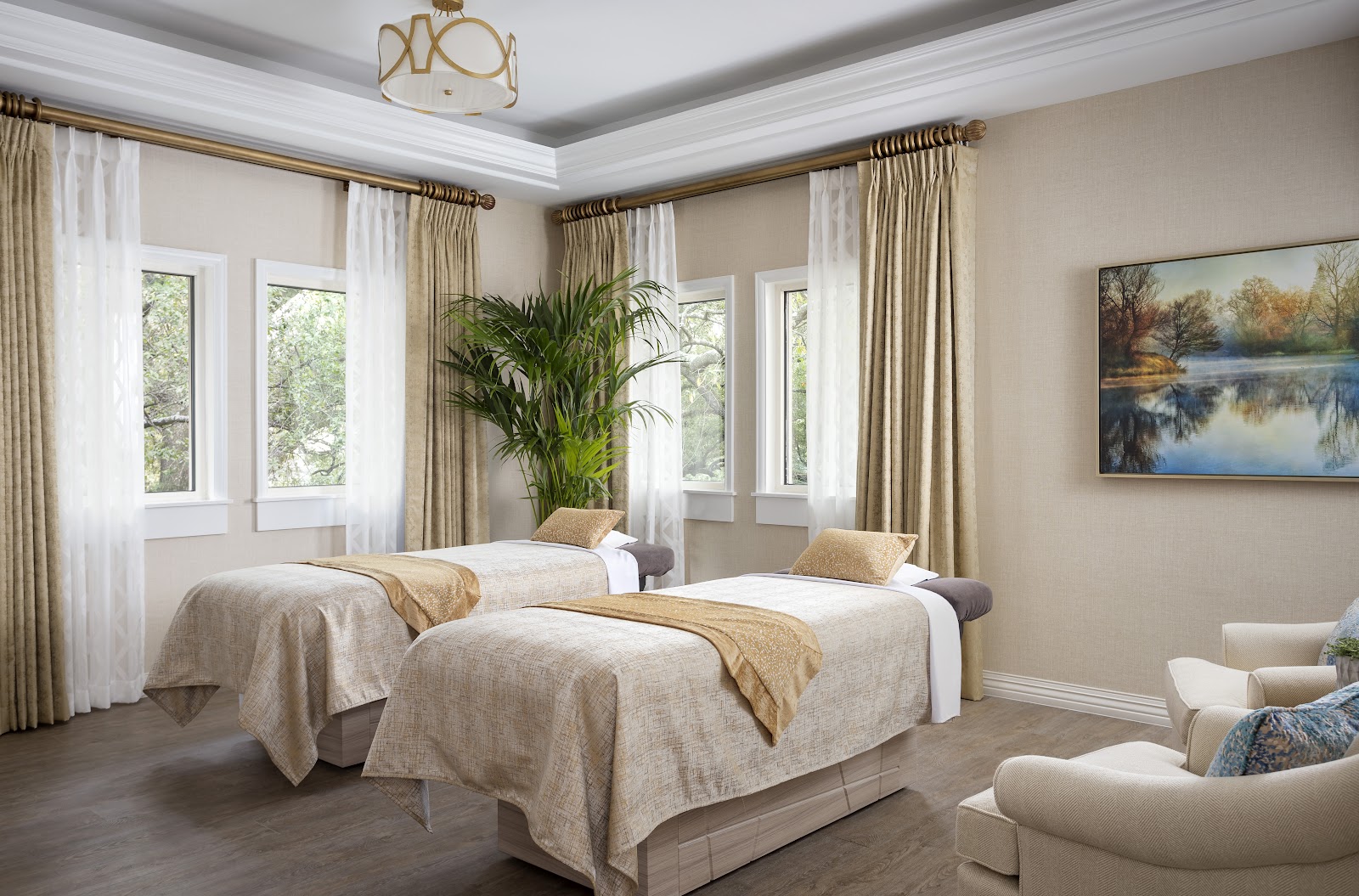
Indoors, the standard hotel approach applies with one qualification worth making. A hotel in wooded grounds usually has glazing that looks into the trees rather than at a city, and that changes the light coming through it: daylight filtered through a green canopy arrives softer, dimmer and greener than daylight off a street.
So a window-lit portrait here is gentler than the same position in a downtown hotel, and it needs a white balance set on skin rather than a preset, because the green cast is real and a preset will not catch it.
Ballrooms are the usual proposition: high-level recessed downlights on a low dimmer, producing strong top light with shadowed eye sockets and a chin shadow. The fix is to stop treating the house light as a key — bounce a warm-gelled source for a directional key, drag the shutter to a thirtieth or sixtieth so the room’s own light registers behind the subject, and use real sources on stands because the distances are large.
Where the ballroom has windows onto the trees, use them while they last. Three or four metres in from glazing is the best unassisted light in any building, and arranging groups parallel to the glass rather than across the room is the difference between an even row and one end three stops down.
- Expose for the shaded faces and let the sunlit background blow — it reads as depth
- Stand them a metre or two inside the canopy edge, not in the middle
- Warm-gel the fill: light under an evergreen canopy is cool and green
- Check for dapple before every frame; the gaps move as the sun does
- Backlight Spanish moss — it is translucent and it places the frame
Houston's climate, and why the trees matter
Houston is the most humid location in this library, and understanding that explains both why the canopy is valuable and what the light actually does.
The city sits at about fifty feet above sea level on the Gulf coastal plain, roughly fifty miles from open water, with prevailing onshore flow for much of the year. Summer dewpoints reach the seventies, which is genuinely tropical.
Water vapour scatters light in all directions, and the consequences are mostly favourable. Shadows are filled: a sunlit lawn here in July carries perhaps two and a half stops less contrast than the same sun angle in Arizona, which means shadow edges are soft, eye sockets retain detail, and a midday portrait outdoors is workable in a way it is not in a dry climate.
That is worth stating because it changes the advice. The desert rule — that midday is unusable without cover — does not apply here with the same force. Houston’s atmosphere is doing the fill that an Arizona sky refuses to do.
The costs are haze and a pale sky. Long lenses lose contrast quickly, so a compressed view across the grounds will read softer in August than in January; and high humidity gives a whitish rather than a saturated blue, which means an empty summer sky contributes nothing and the interest has to come from cloud.
The cloud is reliable. Gulf Coast summer afternoons generate convection from sea-breeze convergence almost daily — towering cumulus building through the afternoon and frequently a thunderstorm late. That gives structure overhead most summer days, and the half hour after a cell passes is the best light of the year: washed air, wet paving and foliage, saturated colour and a low sun beneath a broken ceiling.
Wet live oak is the specific prize. Rain darkens and saturates the bark and the leaves, which deepens the whole canopy and makes the green read properly rather than as a washed-out grey-green. A frame under a wet canopy half an hour after a storm is the best that tree will ever look.
It also means an outdoor ceremony in summer needs a covered alternative that genuinely exists, because a Gulf Coast storm arrives fast and heavily.
The heat is the honest constraint. June through September brings afternoon temperatures in the nineties with humidity that makes them feel considerably worse, and a sun reaching eighty-three and a half degrees at midsummer noon. For a party in formal clothing that is a welfare matter rather than a comfort one.
Which is exactly why the canopy matters. Deep shade under a mature live oak is measurably cooler than open ground — not by a couple of degrees but noticeably, because the canopy blocks the direct radiant load entirely. A wooded property in Houston is a materially more comfortable venue than a lawn, and that is a practical advantage with photographic consequences: people stay outside longer, which means more of the day is available.
Hurricane season runs June through November and is a genuine planning consideration for a date in that window.
October through April is the comfortable season and it is long. Winters here are mild, the December noon sun at thirty-seven degrees models rather than flattens, and — because the oaks are evergreen — the grounds look essentially the same in January as in July. A winter wedding here is a positive choice rather than a compromise, which is unusual.
March is the azalea fortnight and the strongest colour of the year. There is almost no deciduous autumn colour, since live oak stays green and the natives are largely evergreen, so nothing in an October frame says autumn — what October and November give instead is the clearest air of the year and the first comfortable temperatures.
And the twilight is the shortest in this library at about twenty-two minutes, which means the end of the day is genuinely brief. Two or three frames known in advance and walked to; no improvisation. Under a canopy that dusk is shorter still, because the trees take the last light before the sky does — so the final frames belong in whatever open ground the property has, not beneath the oaks.
More frames from The Houstonian Hotel
The Houstonian Hotel wedding photography: common questions
Why does live oak make this frame possible?
It is evergreen with a dense low crown, so the shade beneath it sits four or five stops below open ground — a large free contrast ratio, available every month.
What should I expose for?
The shaded faces. A blown bright background reads as summer light and depth; a correct lawn with two silhouettes in front reads as a mistake.
Where exactly do they stand?
A metre or two inside the canopy edge, turned so the brightest ground is behind them. The middle of the canopy has no bright background to work against.
Why gel the fill warm?
Light reaching under an evergreen canopy is filtered through green leaves and arrives from a blue sky, so it is both cool and green. An ungelled source reads off.
Does Houston humidity help?
Substantially. It fills shadows — about two and a half stops less contrast than Arizona at the same sun angle — so midday outdoors is workable here.
Is a winter date sensible?
Yes, unusually. The oaks are evergreen, so the grounds look much the same in January as in July, with better light and none of the heat.
More Houston, TX venue guides
We are writing a photographer’s guide to every venue we would happily shoot in Houston, TX. Here are three more, plus the full index:
Planning a wedding at The Houstonian Hotel?
A canopy that never leaves, and a free four stops. Tell us your date.