 The Fairmont Austin: What It Suits, and What It Does Not
The JW Marriott Austin: What It Suits, and What It Does Not
Built for conferences. That is the strength and the problem.
A convention hotel is designed around a different event from a wedding, and knowing which one explains everything a photographer meets in it.
The design brief is throughput. A large convention property exists to move several thousand delegates through registration, breakout rooms, plenary sessions, catered lunches and an exhibition floor, repeatedly, efficiently, with minimal friction. Every dimension follows from that: wide corridors, generous pre-function space, column-free ballrooms that subdivide with air walls, service corridors that keep staff out of sight, and lift banks sized for crowds.
That produces a building of genuine operational excellence and almost no architectural character, and both halves matter.
The excellence is real and it shows up in photographs indirectly. A meal that runs to time means the light outside is where the schedule said it would be. Level loading means equipment arrives without being carried. Adequate power, proper lift capacity and staff who keep a timetable all protect the coverage in ways nobody notices until they are absent.
The absence of character is equally real and it is the honest problem. A convention ballroom is a large neutral box with a patterned carpet, a high coffered or baffled ceiling, air walls down one or more sides, and recessed downlighting on dimmers. There is nothing in it that says Austin, or says anything at all.
So the pictures will be carried entirely by the light, the people, the styling and whatever is visible outside — and a photographer who expects the venue to contribute will produce a competent record of a large beige room.
The second thing to establish is which spaces exist. Convention properties are extensive, and the difference between the grand ballroom, a junior ballroom, a pre-function foyer, a terrace and a top-floor suite is very large. Some of those have daylight and some have none.
Austin sits at about thirty degrees and a quarter north at roughly five hundred feet. The June noon sun reaches around eighty-three degrees, the December noon sun about thirty-six and a half, days run from about ten hours ten to fourteen hours five, and civil twilight is roughly twenty-three minutes — short.
We have not photographed a wedding here. Which spaces are included, which of them have windows and the permitted hours are questions for the hotel.
The JW Marriott Austin at a glance
| Where | A large convention hotel in downtown Austin, Texas |
| The design brief | Throughput — moving thousands of delegates efficiently |
| Suits | Very large counts, flawless logistics, weather-proofing, styled weddings |
| Does not suit | Anyone wanting character, grounds, or a sense of place indoors |
| Ask first | Which spaces are included, and which of them have daylight |
What it suits
It suits a very large wedding better than almost any venue type. A column-free ballroom built for a plenary session holds four or five hundred for dinner without feeling crowded, and it does so in a single room rather than spread across several — which means nothing important happens out of sight.
For a photographer, column-free is the specific gift. Converted venues at large headcounts always have structure in the way, and a room with no columns means every position has a clear sightline to the top table and the dance floor. That is worth more than it sounds over a long evening.
It suits the pre-function space, which is the building’s best photographic asset and the one nobody books deliberately. Convention hotels put large circulation areas outside their ballrooms — for registration desks and coffee breaks — and those spaces are often the most generous in the building: high ceilings, frequently glazed to the street, and empty between sessions.
A glazed pre-function foyer is a very large side source, and three or four metres in from the glass is the best unassisted light in the entire property. Arrange groups parallel to the glazing, never across it — perpendicular puts one end of a row three stops below the other.
It suits logistics absolutely. A property of this scale has multiple kitchens, a real loading dock, service lifts, adequate power everywhere and event staff whose profession is running a schedule. A wedding that starts on time finishes on time, which means the golden hour happens when the plan said — and at twenty-three minutes of civil twilight, a half-hour overrun costs the day’s best exterior frames entirely.
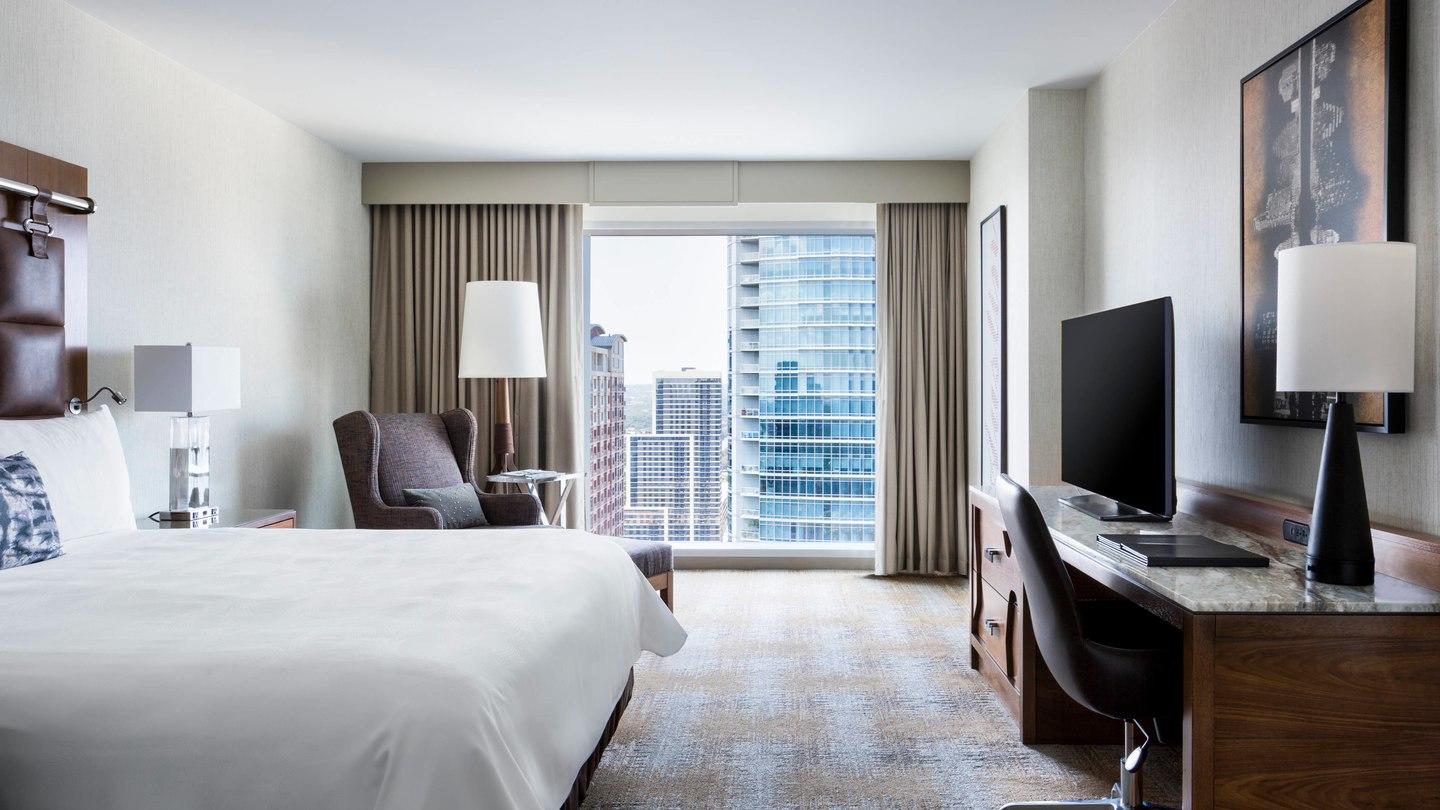
It suits a styled wedding, and this is the key insight about neutral rooms. A blank box is a canvas: florals, linen, lighting design and table styling read clearly against it because nothing competes. In a Victorian ballroom strong styling fights the wallpaper; here it is the only thing in the frame.
Uplighting works for the same reason. Colour-changing wash fixtures on pale neutral walls take colour and return it; the same fixtures aimed at exposed brick or dark timber do almost nothing. Uplighting looks better in convention venues than in rustic ones, which is worth telling a couple who are paying for it.
It suits weather-proofing completely. Central Texas gives an active severe-weather season from late March through May and sustained heat above a hundred degrees from June to September. A building where everything happens indoors with air conditioning is indifferent to both, and on a downtown site there is no landscape to miss.
And it suits an out-of-town guest list, which for Austin is most of them. Everyone sleeps in the building, nobody drives, and the getting-ready rooms are upstairs from the ceremony — a continuous day rather than one broken by transport.
What it does not suit
It does not suit a couple who want the venue in the photographs. A convention ballroom is a neutral box, and no technique makes it look like anything else. Expecting otherwise leads to disappointment.
The honest framing is that this building gets out of the way. For some weddings that is exactly right — the pictures are about the people and the styling — and for others it is the reason to book somewhere else.
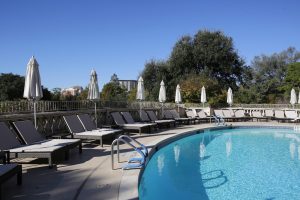
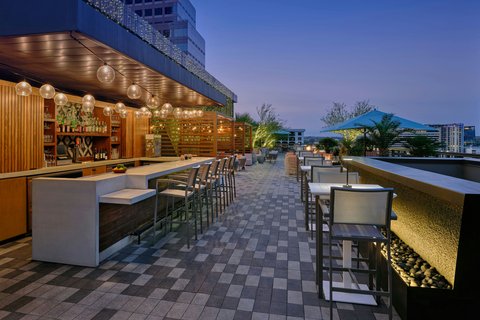
It does not suit anyone wanting grounds. A downtown convention property has a forecourt, a porte-cochère, perhaps a pool deck, and no landscape at all. Any greenery is in containers.
It does not suit a photographer unwilling to bring light. Ballrooms here are windowless as a rule, because the perimeter of a hotel is more valuable as guest rooms and function space sits in the core. That means the reception is lit entirely by what you brought, at distances that need real sources on stands rather than anything on-camera.
And the house lighting is the trap. Recessed downlights at high level on a low dimmer produce strong top light with shadowed eye sockets and a chin shadow — the single most common failure in coverage of large hotels. The dimmers being set low for atmosphere makes it worse, not better.
The fix is to stop treating it as a key. Bounce a warm-gelled source off a wall or the ceiling for a soft directional key, drag the shutter to a thirtieth or sixtieth so the room’s own light and any uplighting register behind the subject, and accept that two or three sources are needed for a room this size because the inverse-square law is unforgiving at twenty metres.
It does not suit a photographer who has not scouted. A convention property is a maze of similar corridors, and the handful of genuinely good positions — the glazed foyer, a particular stair, a terrace, a service corridor with good light — cannot be found during a wedding. Half an hour beforehand is worth more here than at a venue with obvious features.
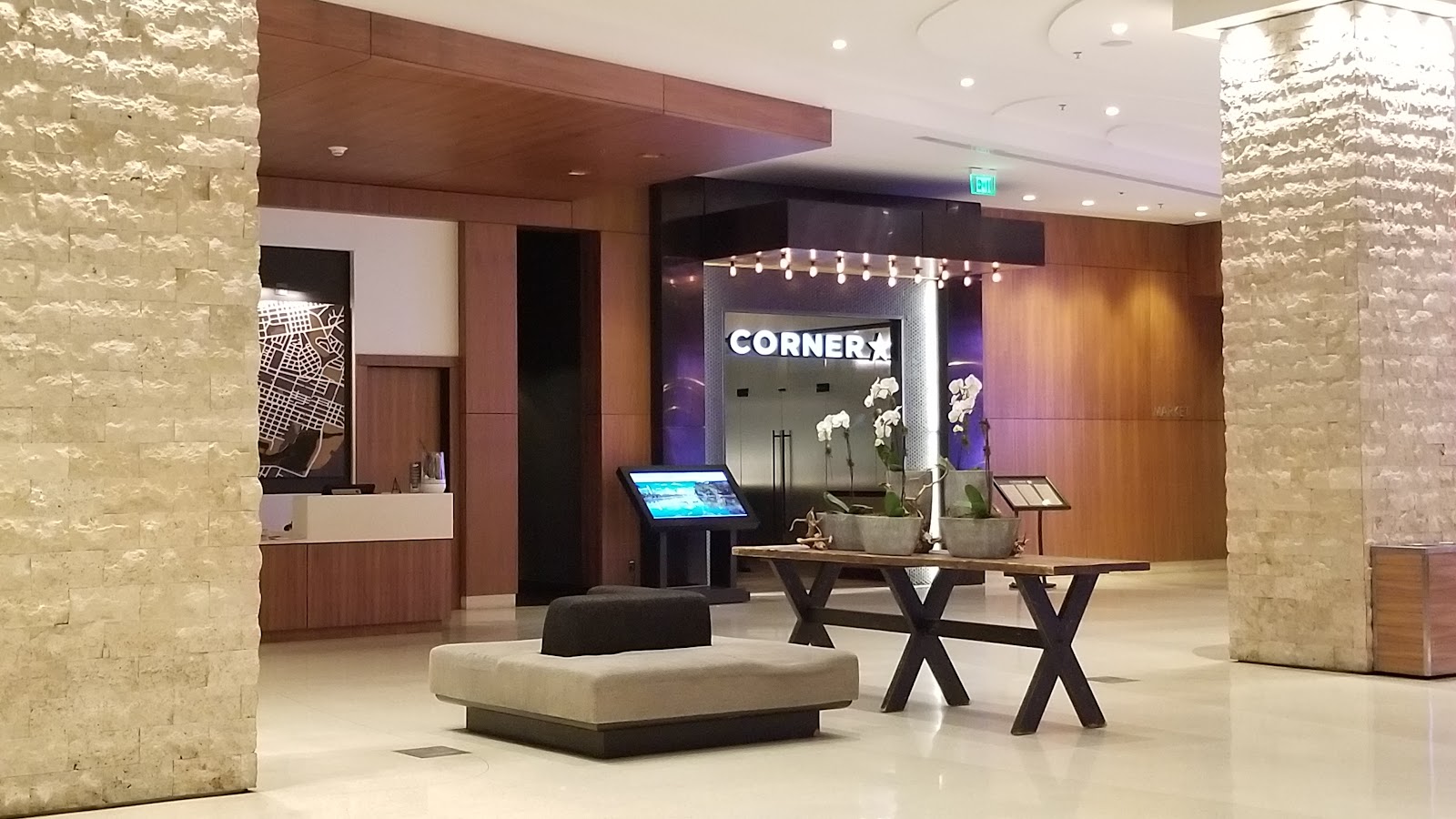
It does not suit exclusivity in any sense. A convention hotel will very likely have a conference running alongside the wedding, which means delegates with lanyards in the lobby, signage for someone else’s event in the pre-function space, and a photographer working around a crowd that has nothing to do with the day.
That is entirely normal and it needs expecting. It also argues for scouting, because knowing which corridor is quiet at six in the evening is genuinely useful information.
And it does not suit a tight budget. Properties of this class carry minimum spends, mandatory catering, service charges and sometimes preferred-supplier arrangements with real consequences for anyone outside them — which bears directly on photography and is worth asking about before anything else is agreed.
One final honest note about carpets. Convention ballrooms are carpeted in busy patterns, chosen to hide wear across thousands of delegates, and that pattern appears in every wide frame and in every bounced reflection. It is the single most dating element in the room, and the only fixes are to crop it out, to shoot from higher so less floor is in frame, or to let it go.
- The glazed pre-function foyer is the best light in the building — three metres in
- Never use ballroom downlights as a key; bounce warm and drag the shutter
- Two or three sources for a large room, not one brighter one
- Scout: the good positions cannot be found during the wedding
- Expect a conference running alongside, with signage and lanyards in shot
Technique, and the Austin year
Five things raise a day at a convention hotel above the default, and none is complicated.
Find the daylight first and use it while it exists. A glazed foyer, a terrace, a high-floor suite — whichever the property has, that is where the portraits belong, and the window is only open for part of the day. Everything else can be lit at any hour; this cannot.
Bounce, because you can. Neutral pale walls and a ceiling within reach return a great deal, which makes this the venue type where bouncing genuinely works. After the brick warehouses and windowless casinos elsewhere in this library, that is a real luxury and it should be exploited rather than ignored.
Gel to match. House lighting is warm tungsten or warm LED, so a quarter to a half warm gel on the key with a correspondingly warm white balance keeps faces in the same colour world as the room. An ungelled flash gives blue-white faces in a warm room — the commonest error and the easiest to avoid.
Add a rim. Neutral rooms are visually flat, and a subject lit only frontally sits in the same tonal band as the wall behind them. A rim at about a stop over the key on the far shoulder is the single biggest improvement available indoors, and it matters more in a characterless room than in a busy one.
And work the dance floor from three sides. A purpose-built ballroom has room around the floor, which means expressions rather than backs — and a rim light on a stand at the far edge firing back toward the camera separates dancers from the darkness behind them.
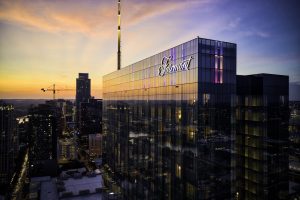
Outside, the city is the compensation for the interior and Austin’s downtown is substantially glass.
That matters because a glass tower has no texture of its own — its appearance is borrowed entirely from what it reflects. So the skyline is flat grey-blue under an even sky and genuinely spectacular under a broken one, which means the city frames want structure overhead, the ends of the day, or darkness.
The skyline wants a long lens: a wide lens renders towers at true angular size and they become a low strip, while a moderate telephoto compresses them into mass. Expose for the buildings and lift the subjects with a warm-gelled source at about a stop over the ambient on them.
The best exterior frame is the twilight balance, and it is brief. For roughly ten minutes during civil twilight the sky holds deep blue while the building lights are fully on and both read in one exposure. Ten usable minutes inside twenty-three is short, and the frame needs composing before it starts rather than during it.
The Austin year then governs whatever happens outside.
October through April is the comfortable season and it is unusually long. Winters here are mild, the December noon sun at thirty-six and a half degrees models rather than flattens, and any terrace is usable throughout — so a January wedding is a positive choice rather than a compromise.
Late March through May is the severe-weather season, which for an indoor venue is a non-event and which gives the city its best skies: the half hour after a front passes, with washed air and wet paving reflecting the buildings, is the best urban light of the year.
Summer is the constraint. June through September brings sustained heat above a hundred degrees with high humidity, which means any outdoor component belongs at the ends of the day. The humidity also hazes distance, so a skyline will read with noticeably less contrast in August than in November — worth knowing on a venue whose only real view is the city.
Autumn has almost no deciduous colour in central Texas, because live oak is evergreen and most native species are evergreen or drought-deciduous. What October and November give instead is the clearest air of the year, which on a view-dependent site matters more than foliage.
And one Austin detail worth knowing. The Congress Avenue bridge, a short walk south, hosts the largest urban bat colony in North America — over a million Mexican free-tailed bats emerging in a continuous column at dusk from roughly March to October. It coincides exactly with the blue hour, which means it competes for the same ten minutes as the skyline frame. Choosing between them is a real decision rather than a bonus.
More frames from The JW Marriott Austin
The JW Marriott Austin wedding photography: common questions
What is this building designed for?
Throughput — moving thousands of delegates efficiently. That gives column-free ballrooms, wide corridors and excellent logistics, and almost no character.
What is its best photographic asset?
The pre-function foyer. Convention hotels build large glazed circulation space outside their ballrooms, and three metres in from that glass is the best light in the property.
Why is the ballroom windowless?
A hotel’s perimeter is more valuable as guest rooms, so function space sits in the core. The rooms with the best light are the ones you cannot fit a hundred people in.
Why does styling work so well here?
A neutral box is a canvas. Florals, linen and uplighting read clearly because nothing competes — and wash fixtures on pale walls actually return colour.
Should I expect other events?
Yes. A conference will very likely run alongside, with delegates and someone else’s signage in the public spaces. Scout to find which corridors are quiet.
What about the carpet?
It is the most dating element in the room and it appears in every wide frame. Crop it, shoot from higher so less floor shows, or accept it.
More Austin, TX venue guides
We are writing a photographer’s guide to every venue we would happily shoot in Austin, TX. Here are three more, plus the full index:
- The Austin Central Library: The Venue’s Own Logic
- The Contemporary Austin: One Frame, and How It Is Made
- The Fairmont Austin: What It Suits, and What It Does Not
Planning a wedding at The JW Marriott Austin?
A building that gets out of the way. Tell us your date.