 The JW Marriott Austin: What It Suits, and What It Does Not
The Austin Central Library: The Venue’s Own Logic
Every decision here was made to get daylight to a reader.
A modern library has one organising principle and it is unusually favourable to photography: get natural light to every reading position.
That is a genuine design driver rather than a stated aspiration. Daylit reading rooms reduce energy load, they are measurably more pleasant to occupy, and contemporary civic libraries are judged on it — so the section, the atrium, the glazing and the shading are all determined by the need to move daylight deep into the plan without glare.
The result is a building type that solves, as its central problem, exactly what a portrait photographer wants: large quantities of soft directional daylight, distributed rather than concentrated, with the harsh component controlled.
The mechanisms are worth knowing because each one behaves differently for a face.
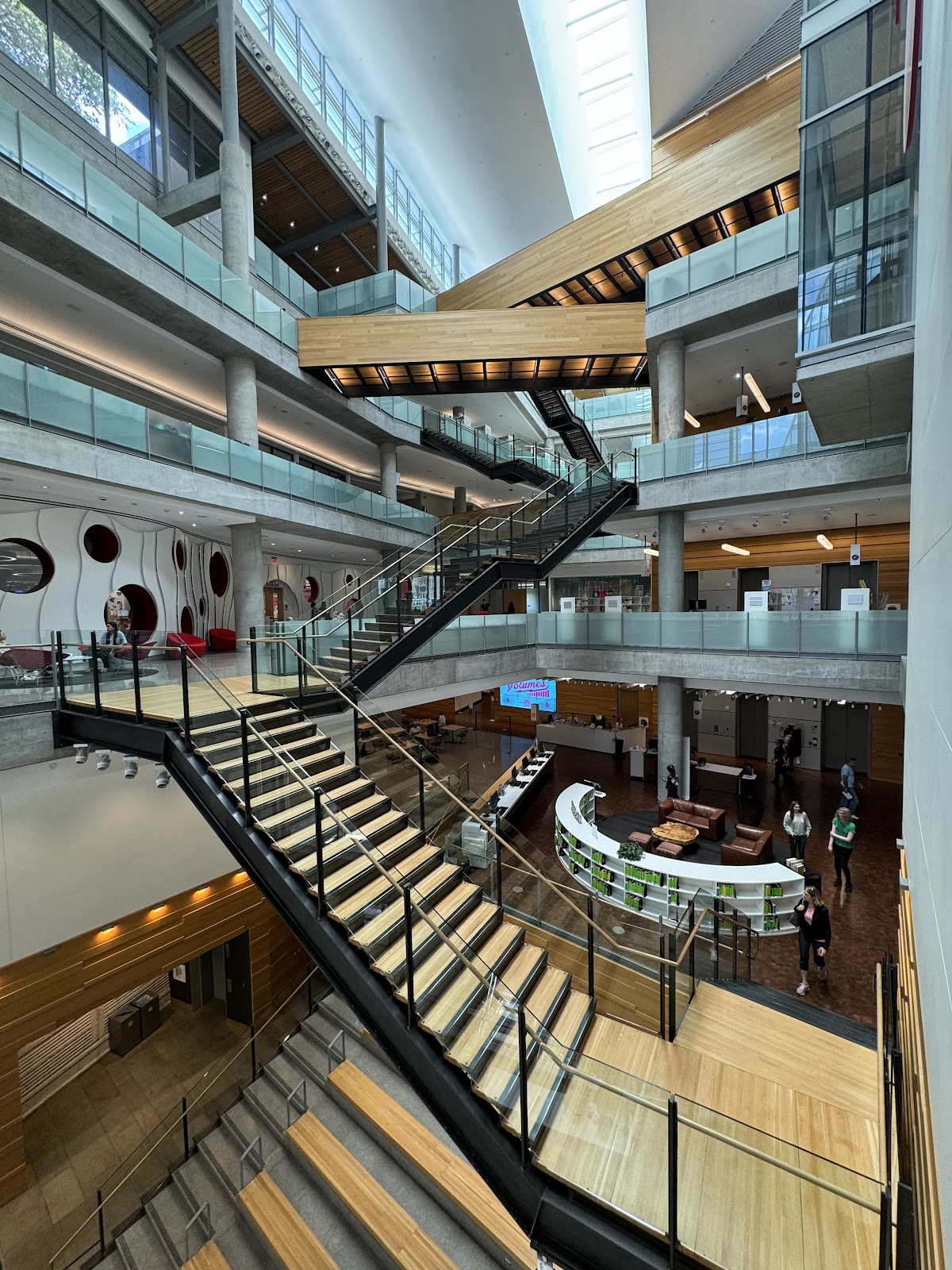
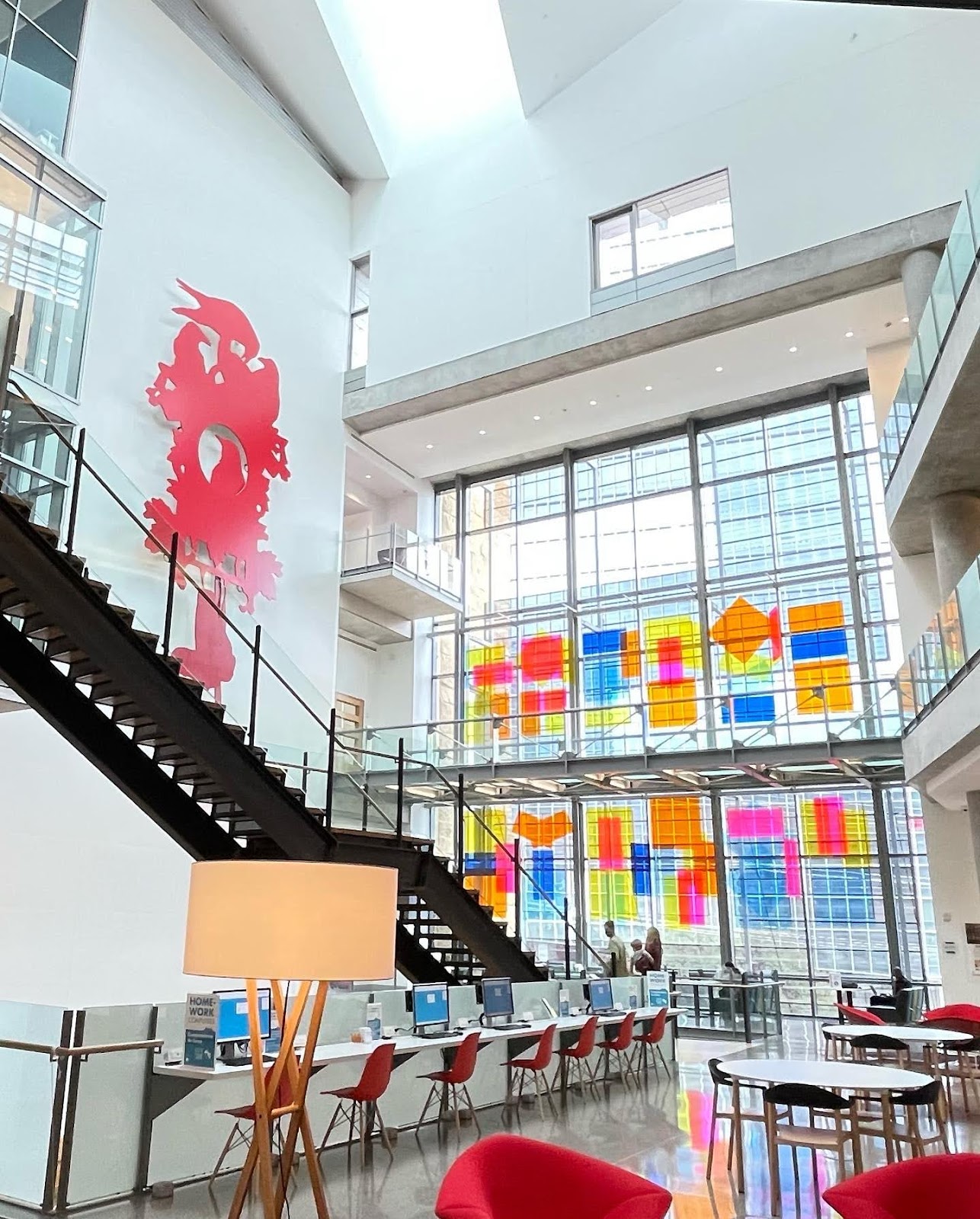
A central atrium is the primary device: a full-height void with top glazing, which brings light down through the building and lets it spill sideways onto each floor. That gives a very large overhead source — excellent for general illumination and, on a face, the standard top-light problem of shadowed eye sockets and a chin shadow.
Clerestory and high-level glazing bring light in above eye level and bounce it off pale ceilings, which is the gentlest light in any building: it arrives already diffused, from a broad angle, with no hard edge anywhere.
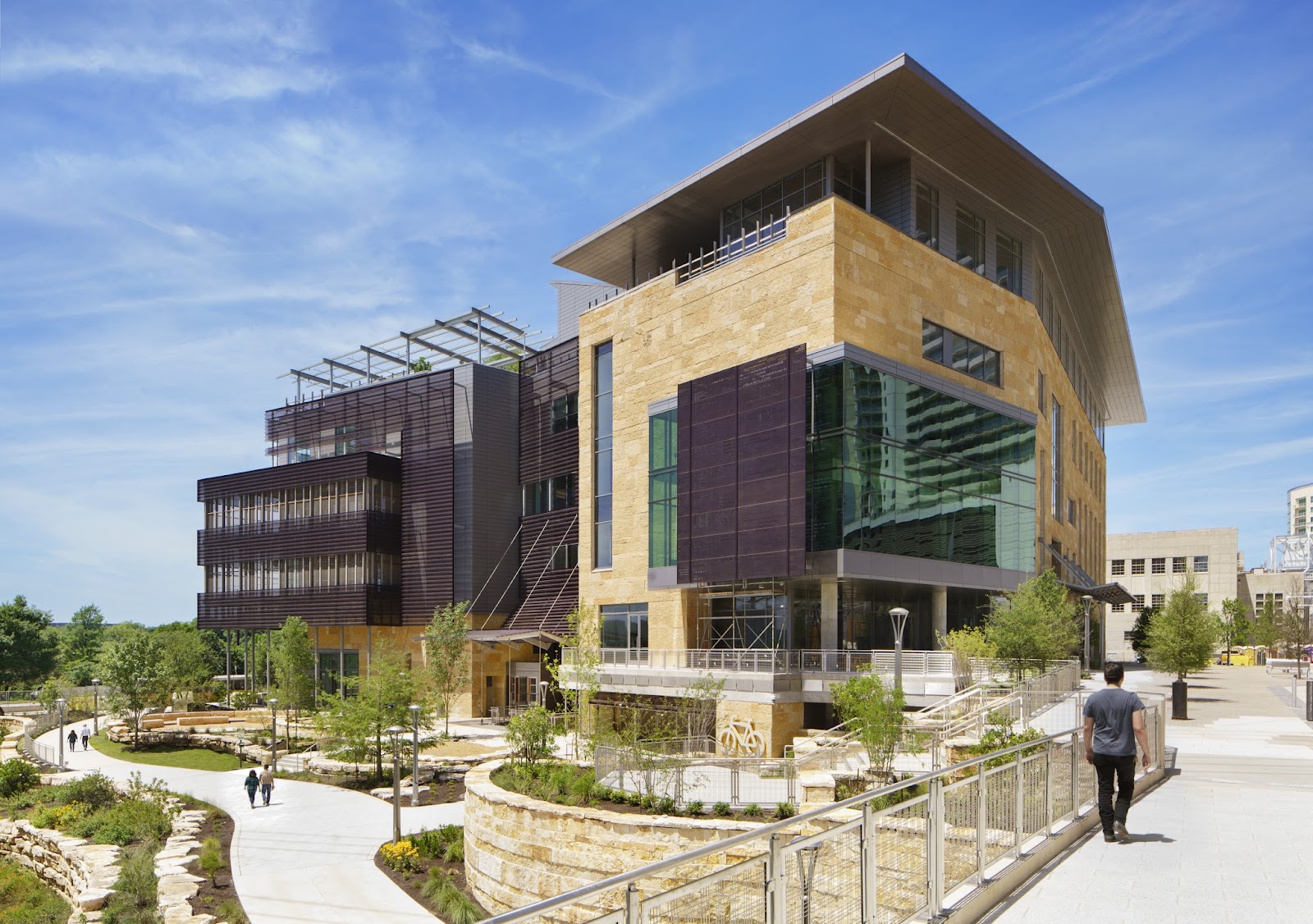
External shading — fins, louvres, deep reveals, perforated screens — exists to block direct sun while admitting sky, and it is the most photographically interesting element, because shading devices cast patterns. A perforated or louvred screen throws a graphic shadow across floors and walls that moves through the day.
And the large glazed elevations give the thing a library actually wants least and a photographer wants most: a big directional side source.
Austin sits at about thirty degrees and a quarter north at roughly five hundred feet on the Colorado River. The June noon sun reaches around eighty-three degrees, the December noon sun about thirty-six and a half, days run from about ten hours ten to fourteen hours five, and civil twilight is roughly twenty-three minutes — short, which matters at the end of the day.
We have not photographed a wedding here. Which spaces are bookable, what the public access arrangements are and the permitted hours are questions for their team — and a working public library has real constraints on all three.
The Austin Central Library at a glance
| Where | A contemporary civic library in downtown Austin, Texas |
| The logic | Every element exists to move daylight to reading positions without glare |
| What that gives | Large quantities of soft directional daylight, already diffused |
| The best element | Glazed elevations — a big side source, which is what a face wants |
| Ask first | Public access arrangements, bookable spaces, permitted hours |
Using the daylight
The glazed elevations are the best light in the building and they are the simplest to use.
A large glazed wall is a single very big side source, and a subject standing three or four metres in from it has clear modelling, a soft shadow edge and no top light at all — which is precisely what a portrait wants and needs nothing added.
Distance from the glass is the control. At the glass the light is bright and nearly frontal with a low ratio; three or four metres in it has direction and an ideal ratio; ten metres in the subject is dim and the frame is about the building rather than the face.
The corollary is that the side away from the glazing is dark, which means groups must be arranged parallel to the glass rather than across the room. Perpendicular puts one end of a row three or four stops below the other, and no amount of care in post recovers that.
The atrium is the building’s signature space and it needs the opposite approach. Top-lit means the light comes from above, which on a face gives even coverage with shadowed sockets — so the fix is to find a low reflective surface, or to add a modest fill from the front at about a stop under the ambient.
In a modern library the low reflector is usually available: pale terrazzo or polished concrete floors are efficient, and a subject standing on a bright patch of floor gets a genuine lift from below. Turning them so the brightest floor is in front of them rather than behind lifts the eye sockets noticeably.
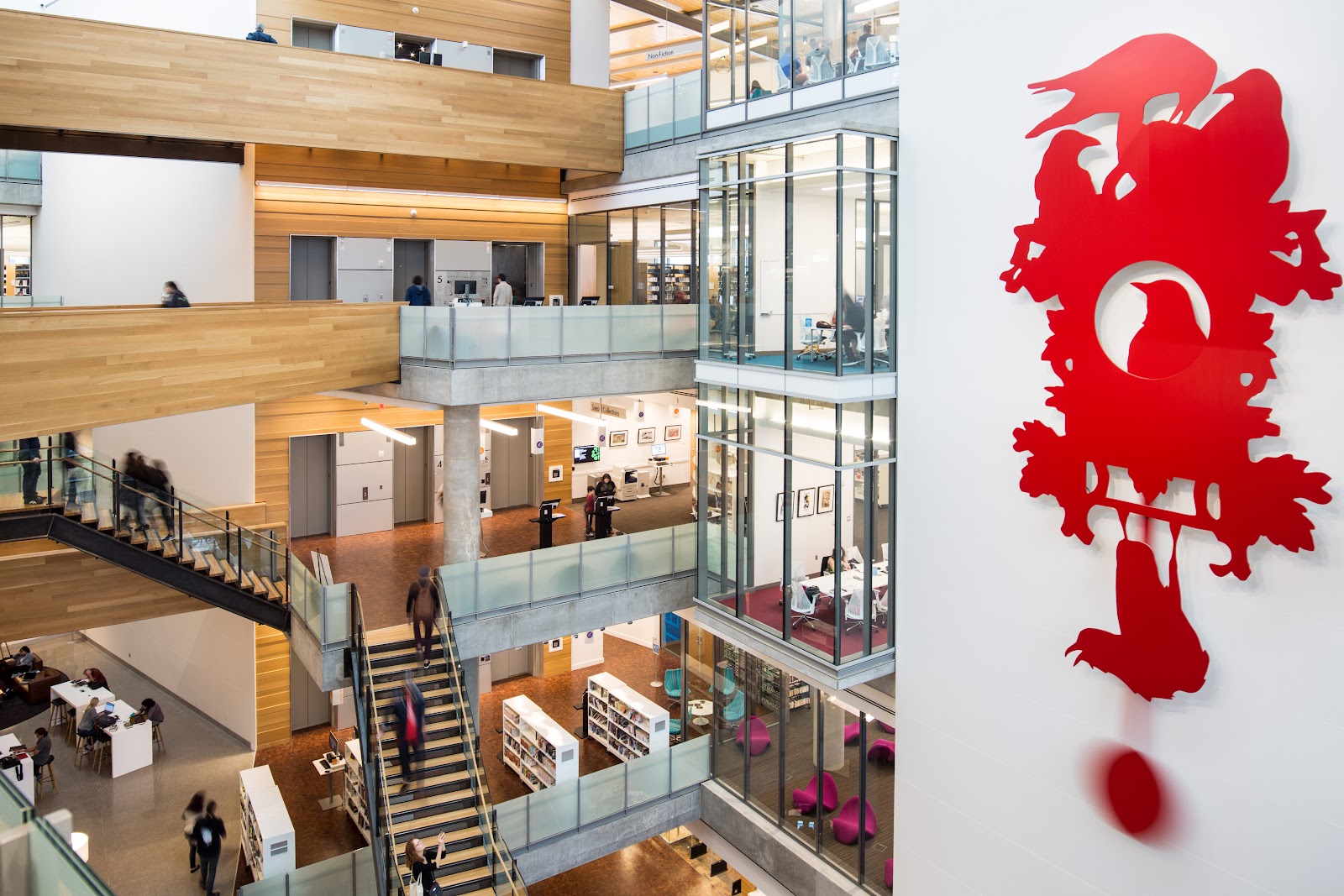
The atrium’s real value is the vertical frame. A full-height void with galleries, stairs and bridges crossing it is a composition available nowhere else, and the two frames to take are straight up and straight down. Both need the camera precisely placed — on a centre line or on a corner — because a void photographed slightly off axis reads as a mistake rather than a choice.
Looking down from an upper gallery onto a group below gives separation, shows the geometry and puts the architecture in frame at once. That is the single most useful position in the building and it costs nothing but asking whether the upper levels are accessible.
The shading devices are the element to work deliberately. Fins, louvres and perforated screens throw patterned shadow, and that pattern moves through the day as the sun crosses — which means it is predictable and worth timing.
A subject placed in a strong louvre shadow is striped, which is unusable on a face. A subject placed just clear of it, with the pattern running across the wall or floor behind them, is in a frame with real graphic interest. The difference is half a metre, and looking at the pattern before positioning is the whole technique.
Stairs are the other modern-building asset. A contemporary library stair is typically a sculptural object — open treads, a clean balustrade, a strong diagonal — and it gives the reliable three frames: from below looking up, from a landing looking down, and from across the void at landing height, which is the one that shows the stair as architecture and the one most people skip.
One caution about glass and reflections. From inside at night the glazing becomes a mirror and reflects the room back, which is useful — a couple and their reflection in a dark window is a good frame. From outside in daylight it reflects the sky and the street rather than showing the interior, and the fix is angle before filter: reflections are weakest near perpendicular, and a polariser does little at forty-five degrees on a vertical surface.
The material palette, and the roof
A contemporary civic building has a restrained material palette and that has consequences worth anticipating.
Exposed concrete is usually the primary surface, and it is a mid-grey near-neutral reflector — which is genuinely convenient, because it bounces a useful amount of light without adding a colour cast. A source aimed at a concrete wall gives a soft neutral key, unlike the strongly tinted bounce that brick or coloured plaster produces.
Board-marked or formwork-patterned concrete is worth close attention. The grain and tie-holes read as texture only in raking light, so a concrete wall that looks flat at midday shows its whole surface at a low angle. That makes the material a morning or evening subject at close range.
Timber appears as the warm counterpoint — usually as ceiling slats, joinery or stair treads — and it is the one surface that will tint a bounce. Where the ceiling is timber, bounce off it will come back warm, which is flattering and needs acknowledging in white balance rather than corrected away.
Metal mesh and perforated panels are common and they behave oddly. A perforated screen photographed straight on reads as a flat grey plane; photographed at an angle, the perforations align and misalign into moiré patterns that can be distracting. A step sideways resolves it.
Minimalism cuts both ways for a photographer. Clean lines demand a level horizon — half a degree of tilt that would pass unnoticed in a rustic building is glaring against a concrete and glass grid. And the absence of ornament means the frame is carried by the light and the people rather than the setting, which is easier to do competently and harder to make memorable.
Symmetry is available and worth using once. A glazed hall or an atrium photographed square on its centre line with the subjects centred is a formal frame that suits the architecture.
The roof is the element worth asking about specifically, because contemporary civic buildings frequently have accessible roof terraces and they are the best outdoor space in a downtown site.
A roof terrace gives three things a ground-level courtyard cannot. A horizon — which in a downtown surrounded by buildings is otherwise unavailable. Unobstructed sky, which means the full colour of a dusk rather than a fragment between towers. And elevation, so the city reads as a skyline rather than as the base of the building next door.
The city frame wants a long lens. A wide lens from a roof renders downtown towers at their true angular size and they become a low strip along the horizon; a moderate telephoto compresses them into something with mass. Expose for the city and lift the subjects with a warm-gelled source at about a stop over the ambient falling on them.
The gel matters here because of what downtown lighting is. Street and architectural lighting is warm tungsten or warm LED, and an ungelled daylight flash against it puts blue-white faces in a golden city. A half gel with a correspondingly warm white balance keeps them in the same world.
And the timing matters more in Austin than further north. Civil twilight here runs about twenty-three minutes, which is among the shortest figures in this library — so the balance point where the sky and the city lights are equal lasts perhaps ten minutes. Being in position before it starts is the difference between getting the frame and getting a version of it.
- Three or four metres in from the glazing; arrange groups parallel to it, never across
- Turn subjects toward the brightest floor — pale terrazzo fills from below
- Shoot the atrium void from a gallery down; it is the best position in the building
- Stand just clear of louvre shadows, with the pattern running behind
- Twenty-three minutes of twilight — be in position before it starts
A working public building, and the Austin year
Two practical matters shape a wedding in a civic library and both need settling early.
It is a working public building. It has opening hours, members of the public using it, staff, and a primary function that outranks events — which means the bookable spaces are a defined subset, and a booking during opening hours means strangers in the background of every frame.
An evening or after-hours booking is a materially different product: empty floors, the atrium to yourselves, and the freedom to place people where the light is rather than where the public is not. That is the question to ask first because it changes everything downstream.
There will also be constraints on food and drink near collections, on what may be moved, and on a firm finish time because the building has to be secured. Those are reasonable and absolute.
Flash is generally unproblematic in a library — unlike an art museum, there is no light-sensitive collection on display in the way paintings are — but confirm it rather than assume, and expect restrictions on stands and tripods for egress reasons rather than conservation ones.
The Austin climate is the other governing factor and it is more constraining than the latitude suggests.
Summer here is severe. June through September brings sustained heat with afternoon temperatures frequently above a hundred degrees and high humidity, and a sun reaching eighty-three degrees at midsummer noon. For a party in formal clothing, an outdoor component in that window is a welfare matter rather than a comfort one — which makes a fully air-conditioned indoor venue with good daylight an unusually sensible choice for an Austin summer wedding.
That is worth stating as a positive. A building whose best frames are all interior and all daylit is immune to the one thing that makes an Austin summer difficult.
The humidity has a photographic effect worth knowing. Water vapour scatters light and fills shadows, so even a sunlit exterior in July carries perhaps two stops less contrast than the same sun angle in a dry climate — softer shadow edges, less black in the eye sockets, and a paler less saturated sky. It also means haze on long lenses: a downtown skyline compressed from a roof terrace will read with noticeably less contrast in August than in November.
October through April is the comfortable season and it is long. Austin winters are mild, the light is good, the December noon sun at thirty-six and a half degrees models rather than flattens, and the outdoor spaces are usable throughout. A January wedding here is a genuinely pleasant proposition, which is not true of most venues in this library.
Late March into April is the best window in Texas and the reason is the bluebonnets. The state flower blooms in mass roadside and meadow displays for perhaps three weeks, and in a good year the Hill Country west of Austin carries sheets of it. That is not on this site — a downtown library has no meadow — but it is worth knowing if any part of the day travels.
Spring also brings storms. Late March through May is the active severe-weather season for central Texas, with genuine thunderstorm risk, and a downtown indoor venue is the correct answer to that rather than a compromise.
One local detail worth a frame if the timing suits. Austin’s Congress Avenue bridge hosts the largest urban bat colony in North America — well over a million Mexican free-tailed bats — which emerge in a continuous column at dusk from roughly March to October. It is a genuinely extraordinary sight, it happens within walking distance of downtown, and it coincides exactly with the blue hour. Whether it fits a wedding schedule is another matter, but it is the most specifically Austin thing available.
More frames from The Austin Central Library
The Austin Central Library wedding photography: common questions
Why does a library suit photography?
Its organising problem is getting soft daylight deep into the plan without glare — which is exactly the light a portrait wants, already solved by the architecture.
What is the best light in the building?
Three or four metres in from a glazed elevation. It is a single very large side source with clear modelling and no top-light problem.
How do I handle the atrium?
It is top-lit, so expect shadowed eye sockets. Turn subjects toward the brightest floor for fill, and shoot down from an upper gallery for the best frame.
What do I do about louvre shadows?
Stand the subject just clear of the pattern, with it running across the wall or floor behind them. Half a metre is the difference.
Is a daytime booking a problem?
It means strangers in every frame. An after-hours booking is a materially different product and it is the first thing to ask about.
Does the building suit an Austin summer?
Unusually well. Its best frames are all interior and all daylit, which makes it immune to hundred-degree afternoons.
More Austin, TX venue guides
We are writing a photographer’s guide to every venue we would happily shoot in Austin, TX. Here are three more, plus the full index:
- The Contemporary Austin: One Frame, and How It Is Made
- The Fairmont Austin: What It Suits, and What It Does Not
- The Four Seasons Austin: The One Decision That Governs Everything
Planning a wedding at The Austin Central Library?
A building that already solved the light. Tell us your date.