 The Laniakea YWCA: A Building Organised Around Its Courtyard
Ho’omaluhia Botanical Garden, Kaneohe: One Frame and How It Is Made
An avenue pointed at a two-thousand-foot wall. That is the frame.
There is one frame at Ho’omaluhia that is worth planning the day around and it is almost architectural in its simplicity: an avenue running straight toward the Ko’olau wall, with the subjects on it.
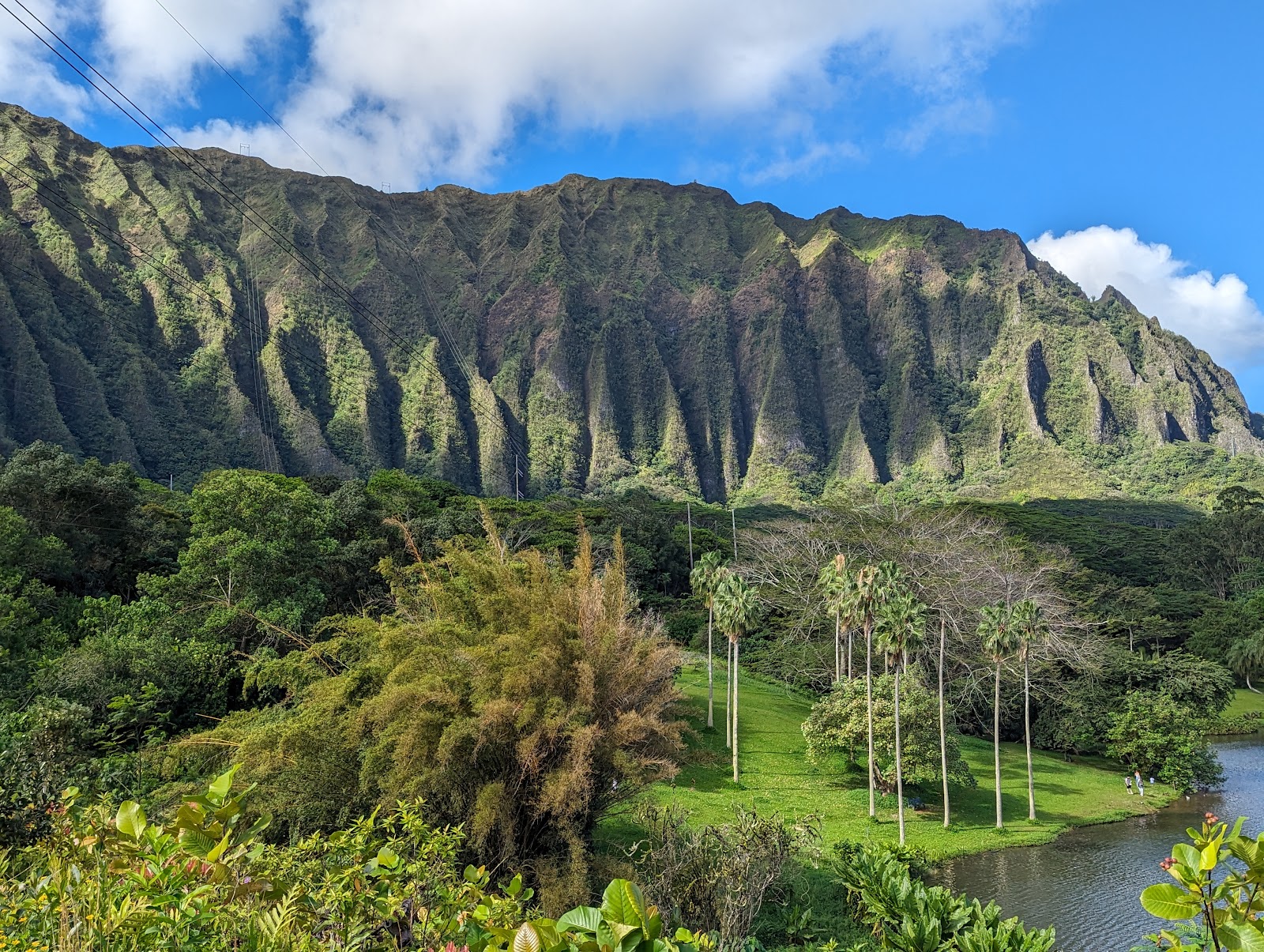
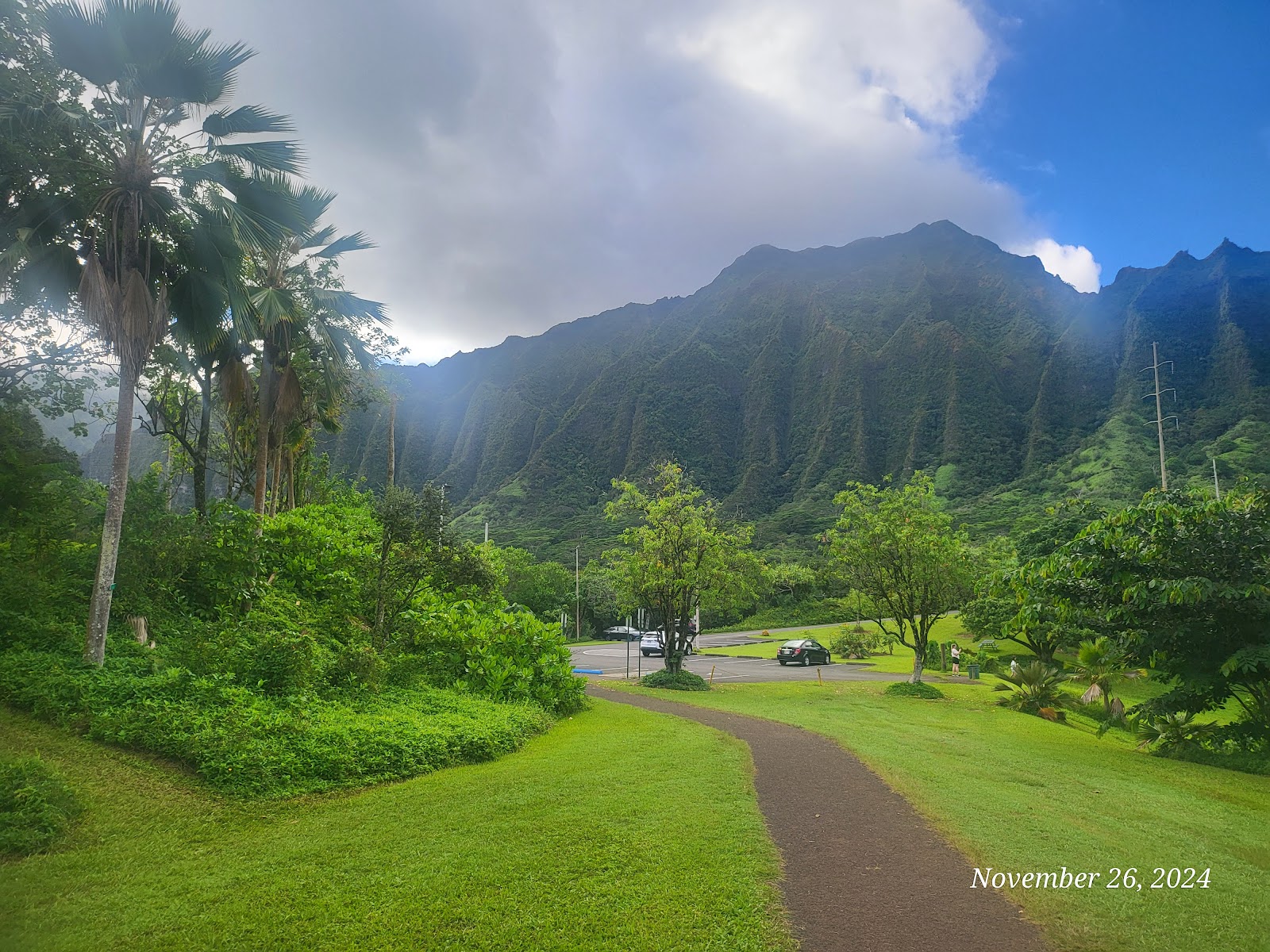
The garden sits in a basin directly beneath the Ko’olau range on the windward side of O’ahu. The range here is not a distant backdrop but an immediate one — a wall of eroded volcanic rock rising almost vertically, deeply fluted into hundreds of parallel ridges and gullies, and green to the top.
An avenue of trees pointed at that wall does something no other composition in these islands does. It supplies perspective — a receding rhythm of trunks and canopy converging toward a vanishing point — and it puts at that vanishing point not a building or a horizon but a two-thousand-foot cliff. The eye runs down the avenue and stops against the wall.
That is the frame, and it is made of four decisions: whether the wall is visible at all, where the subjects stand in the avenue, how the two planes are exposed, and what the weather is doing — which on the windward side is the one that decides the rest.
The weather needs stating first. The Ko’olau intercepts the trade winds from the north-east and forces that moist air upward, where it cools and condenses. The consequence is that this side of O’ahu is among the wetter places in the islands, that the cliff tops are in cloud a great deal of the time, and that brief showers pass through frequently rather than occasionally.
A photographer who waits for a clear view of the wall will often not get one. A photographer who knows that cloud tearing across the ridge gives the wall depth, scale and movement — and that a clear blue sky behind it gives a flat field behind a flat green mass — will find the normal condition better than the rare one.
Kaneohe sits at about twenty-one and a third degrees north. The June noon sun reaches about eighty-eight degrees, the December noon sun about forty-five, days run only from about eleven hours to thirteen and a quarter, and civil twilight is around twenty-two minutes — the shortest in this guide.
We have not photographed a wedding at this garden. Whether ceremonies are permitted, what permit is required, which areas may be used, what group sizes are allowed and what the hours are, are questions for the garden — and at a public botanical garden those are rules rather than preferences.
Ho'omaluhia Botanical Garden at a glance
| Where | A botanical garden in a basin directly beneath the Ko’olau wall, windward O’ahu |
| The frame | An avenue running straight at the cliffs, with the subjects on it |
| Why it works | Perspective from the avenue, and a two-thousand-foot wall at the vanishing point |
| The weather | The trades hit the Ko’olau and rise: frequent showers and cloud on the tops |
| Ask first | Permits, permitted areas, group limits and hours — public garden rules |
Building the frame
Check whether the wall is there before planning anything else, and be prepared for it not to be. The cliff tops are in cloud on a large proportion of days, and the frame has three usable versions rather than one.
Wall fully visible: the classic version, with the flutes reading from base to ridge. This needs low light to work properly and it is the least frequent of the three.
Wall partly in cloud: cloud sitting on or tearing across the ridge, with the lower face visible. This is the most common condition and it is usually the better photograph, because the cloud gives the wall scale and motion that a clear ridge does not.
Wall gone: cloud down to the base. The frame then becomes the avenue alone, receding into white — which is a genuinely good photograph and one that nobody plans, and it means a completely overcast day is not a lost day here.
Knowing all three in advance means the day works in any conditions, which at a windward venue is not a small thing.
Then the position in the avenue, and there is one decision that matters: how far down it the subjects stand. Close to the camera they are large and the avenue and the wall are context; far down it they are small and the composition is about the perspective and the cliff.
The second is the stronger version and it is the one people resist. A couple occupying a tenth of the frame height, well down an avenue, with the trunks converging past them and the wall filling the top of the frame, states the scale of the place in a way a portrait cannot. The instinct at the moment of shooting is always to move closer; the frames that survive are taken from further back than felt right.
Two people at that size need separation from each other to read as two — a gap of light between them, an arm extended, a slight offset in depth — because at a tenth of frame height two figures standing together are one shape.
The alignment matters as much as the distance. An avenue has a centre line, and a camera on it gets symmetrical convergence while a camera off it gets an awkward asymmetry that reads as carelessness rather than as a choice. Standing on the line, with the camera level and at about the subjects’ chest height so the trunks do not lean, is a minute’s work that makes the difference.
The exposure is the third decision and it is a two-plane problem. The avenue is in shade under its own canopy; the wall behind is either lit or in cloud. Where it is lit, the range between the two can be three or four stops.
Expose for the wall, because the wall is what the frame is about, and lift the subjects with a close source at about a stop over the ambient falling on them. Metering on the faces renders the cliff as a pale green wash and removes the reason for pointing the camera that way.
The gel decision depends on the condition. Under cloud the ambient in the avenue is cool and green and the source should be warm-gelled to compensate; in low direct sun the wall is warm and the shade is lit by a blue tropical sky, so a warm gel is right for a different reason. In both cases a daylight-balanced flash is wrong.
The fourth decision is the light on the wall, and the geometry settles it. The Ko’olau on this side face broadly east, which means they take the morning light — and a fluted cliff face only reads as texture when light crosses it at a shallow angle. Under a high sun the wall is a flat green mass; in the first hours it is hundreds of modelled ridges.
So the frame belongs to the morning. That is the single most useful scheduling fact about this venue and it is not negotiable, because by afternoon the wall is in its own shade and the flutes have gone.
The garden, the water and the vertical sun
The garden itself is the second environment and it is organised by geography rather than by design — collections grouped by the region of the world the plants come from, rather than arranged for effect.
The photographic consequence is the same as at any botanical garden: the quality of shade changes abruptly at the boundary between collections rather than gradually across the site, which means the light can change by two or three stops and by a noticeable amount of colour in a walk of thirty metres.
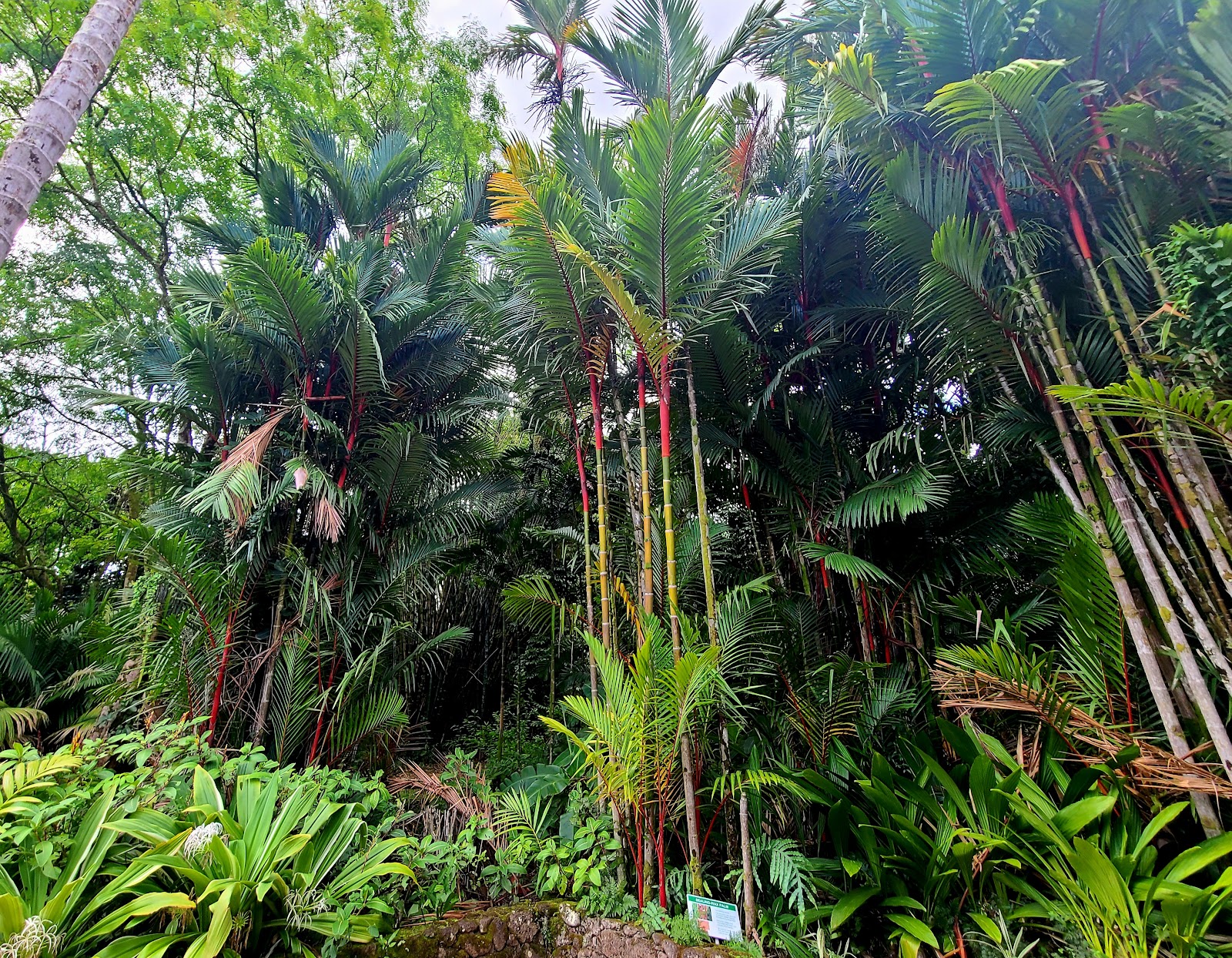
The species distinction that governs every venue in these islands is absolute and it decides where a portrait can be made. Broadleaf tropical canopy — monkeypod, mango, and the dense understorey — blocks almost all light and gives soft, reliable shade. Palms do the opposite: a frond is a row of stiff parallel blades, and with the sun near vertical its shadow falls straight down a face as a set of hard stripes that no exposure recovers.
In a garden with palm collections that distinction is the difference between a usable position and a wasted one, and it takes five minutes on arrival to map.
The canopy edge is the reliable free position throughout: two metres inside the edge of a dense broadleaf planting, facing out toward the brighter ground, which puts the open sky in front of the subject rather than above and gives soft directional light with three or four stops of dark behind.
Two metres, not four. Deeper in, the level drops, the direction goes and the green cast arrives — and the green cast is the garden’s technical problem. Light transmitted through and reflected off tropical foliage is strongly green, and skin deep under canopy reads sallow. The fix is positional, or a warm-gelled source at a stop over ambient. A global white balance correction turns the whole garden grey.
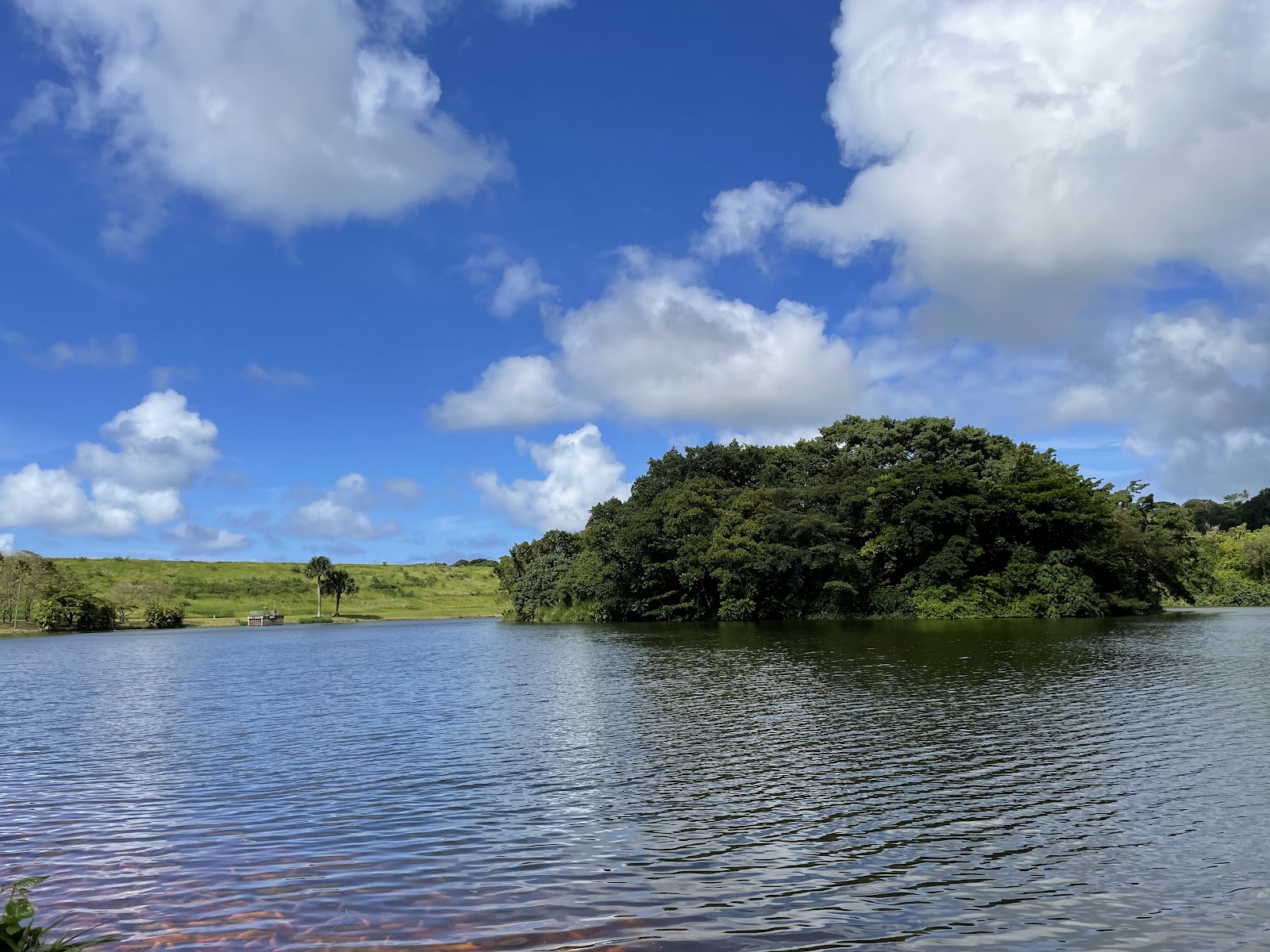
The lake is the third element and it does what still water always does: it returns light upward onto faces from below — precisely where a near-vertical sun leaves them dark — and it mirrors when calm.
Calm on the windward side means the early morning, because the trades blow steadily rather than intermittently and build through the day. And the composition makes the reflection easy: compose so the reflection is of the dark cliff wall and the dark canopy rather than of the bright sky, and the two sit within a stop of each other and need nothing at all.
A lake reflecting the Ko’olau wall at first light is the second-best frame on the property and it belongs to the same hour as the first.
The vertical sun is the latitude’s defining fact. At twenty-one degrees north the June noon sun reaches about eighty-eight degrees, which is effectively overhead: eyes in shadow, foreheads lit, and no position on open ground that fixes it. Between roughly ten and three the only usable positions are under broadleaf canopy or in any roofed structure.
And two further latitude facts that change how a day is planned. Day length barely varies — eleven hours at the winter solstice to thirteen and a quarter in June — so there is no long summer evening and no short winter day, and the low light arrives at roughly the same hour all year.
And the sun descends very steeply at this latitude, which compresses civil twilight to about twenty-two minutes. That is the shortest dusk in this guide and the fall from usable light to dark is abrupt — which means a plan assuming a leisurely golden hour will lose most of it, and that the blue period is a separate short session rather than the tail of the last one.
One practical note: mosquitoes are a genuine consideration in a wet windward garden with standing water, at any time of year rather than seasonally.
- Have three versions of the frame ready: wall clear, wall in cloud, wall gone
- Put the subjects further down the avenue than instinct wants, and separate them
- Stand on the avenue’s centre line, level, at chest height
- Expose for the wall and lift the faces — the cliff is what the frame is about
- The morning is the hour: the Ko’olau face east and the flutes need raking light
The windward year
Hawai’i has two seasons rather than four and the difference is rain rather than temperature — and directly beneath the Ko’olau, rain is the whole calendar.
The wetter season runs roughly November to March. The trades still dominate but they are interrupted more often by frontal systems and by Kona weather — a reversal bringing wind and rain from the south-west, which produces heavier and more widespread rain than the brief showers the trades give.
For this venue the wetter season is mostly better. The cliffs are at their greenest, the gullies run with water after rain, cloud on the ridge is more dramatic, and rainbows are at their most frequent — because a rainbow needs sun behind the photographer and rain in front, which on a windward coast in winter is a regular combination.
And the light is better. The December noon sun at about forty-five degrees is the lowest of the year, which means the wall is modelled for a substantially longer period than the hour after dawn that summer allows — so the frame this page is about has a wider window in winter.
The cost is that a Kona event brings rain that lasts rather than passes, which cannot be waited out and which can put cloud down to the base for a whole day.
The drier season runs roughly May to September. The trades are steadier, showers are briefer and more localised, and the ground is firmer.
The costs are the sun and the wind. A near-vertical noon sun is at its worst in these months, which pushes the whole usable day to its ends. And steadier trades mean the lake is broken earlier in the morning, which shortens the reflection window.
There is a compensation specific to the drier months and it is worth knowing: the windward side stays green when the leeward side browns, because the trades keep delivering moisture even when the rest of the island is dry. The contrast between a lush windward garden and a dry leeward coast is at its strongest in summer.
There is no autumn colour in these islands and no dormant season. Tropical vegetation holds its leaves year-round, which removes the seasonal cue photographs in the rest of this guide depend on — and it means nothing in an image made here says what month it is except the angle of the light and the state of the cloud.
What does change is flowering, and in a botanical collection that is the useful question to ask rather than assume. The garden’s staff will know what will be out on a date, and at a venue whose colour comes entirely from planting and from green, that matters.
Two seasonal practicalities. The wetter months bring higher surf to the windward coast, which affects any beach frames nearby rather than the garden. And central Pacific hurricane season runs from June to the end of November, though direct strikes on the islands are rare — a planning conversation for a late-summer date rather than a forecast.
The honest summary: the morning is the hour in every month, the winter months give the wall a longer modelling window, the showers are an asset rather than an obstacle, and the twenty-two-minute dusk means nothing at the end of the day can be improvised.
More frames from Ho'omaluhia Botanical Garden
Ho'omaluhia Botanical Garden wedding photography: common questions
What is the frame?
An avenue of trees running straight toward the Ko’olau wall, with the subjects well down it and the cliff filling the top of the frame.
What if the cliffs are in cloud?
They often are, and it is usually the better photograph. Have three versions ready: wall clear, wall partly in cloud, and wall gone with the avenue receding into white.
How big should the subjects be?
Smaller than instinct wants — about a tenth of the frame height, with a gap of light between them so they read as two people rather than one shape.
How do I expose two planes?
For the wall, because that is what the frame is about, and lift the subjects with a close source. Metering on faces renders the cliff as a pale green wash.
Which hour is the frame?
The morning. The Ko’olau face east, and a fluted cliff only reads as texture when light crosses it at a shallow angle.
Which season gives a longer window?
Winter. A December noon sun at about forty-five degrees models the wall for far longer than the hour after dawn that summer allows.
More Hawaii venue guides
We are writing a photographer’s guide to every venue we would happily shoot in Hawaii. Here are three more, plus the full index:
- Hotel Wailea: The Problem and Four Ways Out of It
- Kualoa Ranch, Kaneohe: The Problem and Four Ways Out of It
- Lumeria Maui, Makawao: How the Light Moves Upcountry
Planning a wedding at Ho'omaluhia Botanical Garden?
An avenue pointed at a green wall, and a morning to do it in. Tell us your date.