 The Redd on Salmon Street: Building the Shot List
The Duniway Hotel, Portland: What It Suits and What It Does Not
A central hotel’s best feature is often what is within ten minutes of its front door.
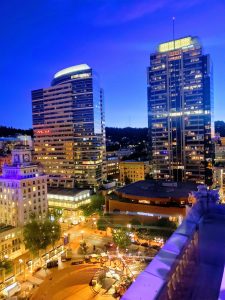
The Duniway Hotel sits in the heart of Portland and, as its own description emphasises, offers easy access to the city’s scenes — lush gardens, historic buildings, modern towers and busy streetscapes.
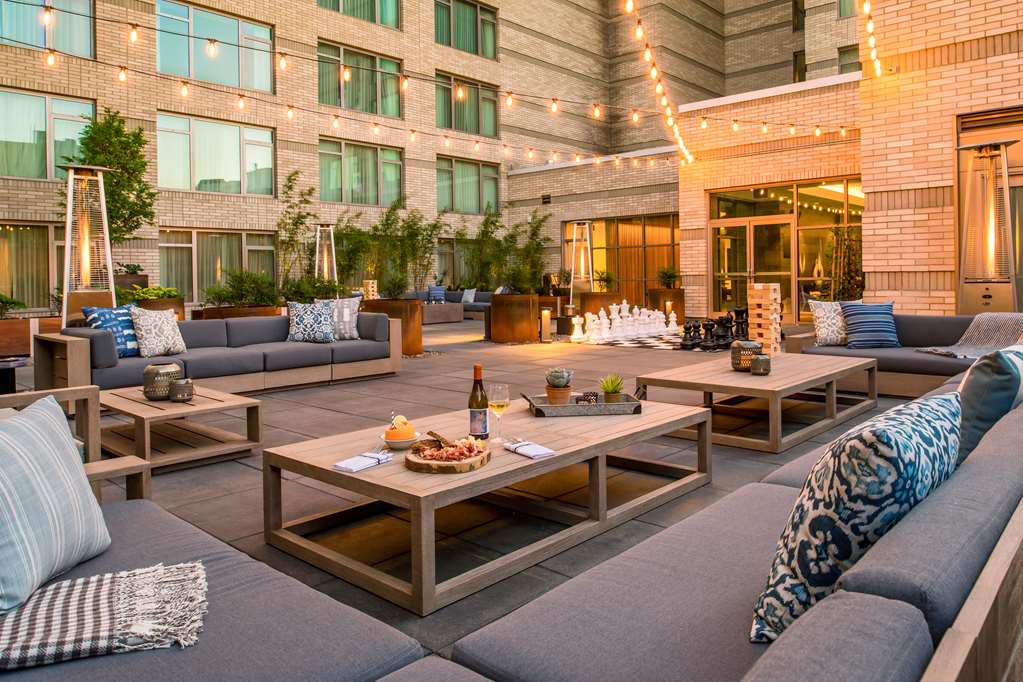
That is an unusually honest framing of what a large central hotel actually provides, and it is worth taking at face value. The building supplies capacity, service, climate control, accessible circulation, rooms for travelling guests and a genuine indoor fallback — a combination no other venue type offers at once, and in a city with a long wet season the last of those matters more than it would elsewhere. What the building does not supply is a look that is specifically its own; contemporary hotel interiors converge everywhere.
The location does supply that, which is the real argument here. This is written as suits and does not suit. We have not photographed a wedding at the Duniway; large central hotels behave consistently. Which rooms are included, whether the ballroom lighting is adjustable, and what upper-floor or terrace access exists are the questions for their team.
The Duniway Hotel at a glance
| Where | Central Portland, Oregon |
| Character | A large hotel with contemporary interiors in the heart of the city |
| Suits | Capacity, service, travelling guests, weatherproofing, access |
| Does not suit | Couples who want the venue itself to supply the character |
| Ask first | Rooms included, ballroom lighting control, upper-floor access |
The two interior conditions
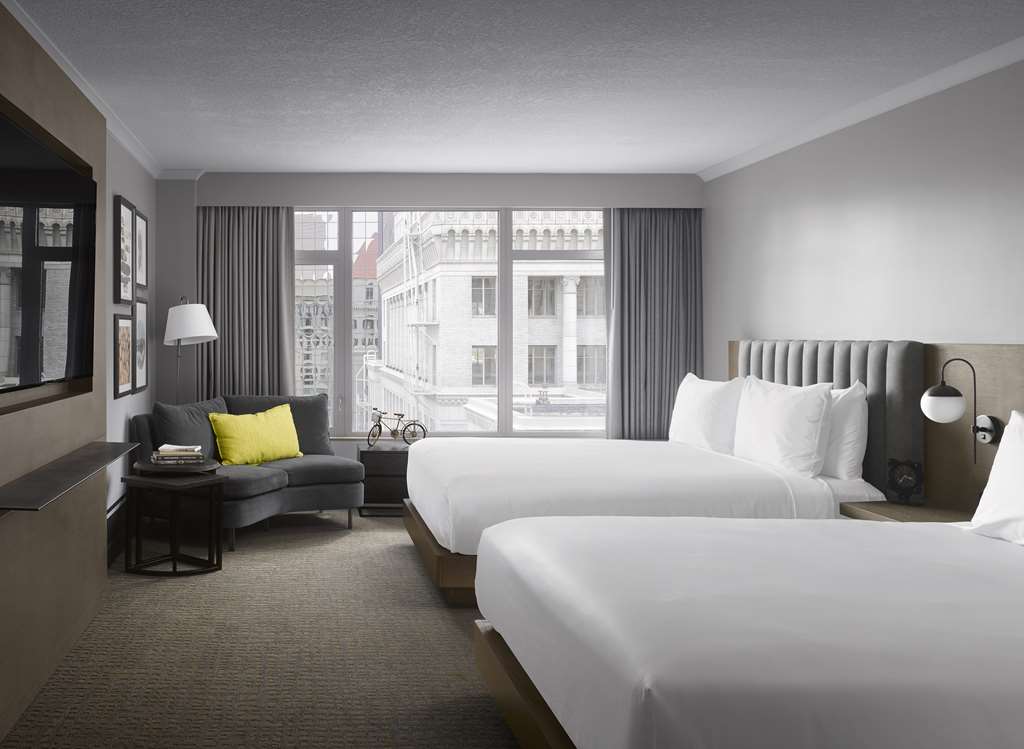
A contemporary hotel is built on two principles and both are photographic problems disguised as qualities. Light should be even, because unevenness reads as cheap. Surfaces should be pale and uncluttered, because that reads as calm and expensive.
Even light removes modelling. A face looks three-dimensional in a photograph because one side is brighter than the other, and the gradient between them is what the eye reads as shape. Light arriving from many directions at similar intensity erases that gradient, so a technically correct exposure can still produce a flat face.
The fix does not need to be strong. One directional source, off the camera axis at face height, set close to the ambient level rather than above it, restores a shadow side without making the frame look lit. Adding half a stop in one direction does more than adding two stops overall.
Pale surfaces remove separation, which is the default failure in every hotel of this class: a pale dress against a pale wall under even light has almost nothing distinguishing the two. Four tools address it and they stack — depth so the background sits well behind, a wide aperture so it goes soft, placement against the darkest element available, and negative fill.
Negative fill is the under-used one and it costs nothing. Placing something dark on the shadow side of a face — a coat, a panel, an open doorway to an unlit space — subtracts bounced light from that side and deepens the gradient. In a pale lobby that single move can be the difference between a flat frame and a modelled one.
The ballroom is the exception because a reception is lit low: expect a high ceiling with no usable bounce, warm fittings, overhead sources and steep fall-off. That fall-off is the free separation the rest of the hotel refuses to provide. Ask whether the lighting can be dimmed to pools rather than set evenly, because it usually can and the difference exceeds any equipment decision.
Guest rooms remain the best portrait light in the building: biggest window on the shaded side, every overhead switched off so the room has one colour of light, and the lamps moved out of frame.
Who it suits
The logistics are the product and they fit a recognisable set of intentions — particularly ones involving numbers, travel, accessibility and a climate that removes outdoor options for half the year.
These briefs are well served here:
- Larger guest counts, which the function space absorbs without strain
- Guests travelling from elsewhere, who need rooms and no separate logistics
- Anyone who wants Portland’s wet season to be irrelevant to the day
- Weddings where accessibility and step-free circulation matter
- Couples who want the city’s variety without having to travel to reach it
Who should look elsewhere
The reverse list is not a criticism. A large central hotel is built to be excellent and unobtrusive across an enormous range of events, and the qualities that make it dependable are the same ones that make it unspecific.
Several reasonable briefs run against the grain here:
- Couples who want the venue immediately recognisable in the photographs
- Anyone whose references are timber, brick, forest or period texture
- Small intimate weddings, which read as sparse in rooms built for hundreds
- Briefs where the interior should carry the gallery rather than the city
- Anyone wanting an outdoor ceremony with character of its own on site
Where the character comes from, and Portland weather
The honest plan at a venue like this is that the character comes from outside, and the hotel’s own description names the four things available: gardens, historic buildings, modern towers and streetscapes. Each behaves differently and it is worth choosing rather than wandering.
Historic downtown is the most reliable. Portland’s older commercial core is brick, stone and cast iron at a largely low-rise scale on a regular grid, which means low sun reaches street level and runs the length of a street rather than being cut off. Both brick and cast iron show their texture only when light runs along them, so a short walk to find which side is raked is worth more than any accessory. Alleys give directional light from walls on both sides, a contained background and shelter.
Gardens give the opposite register — soft, green and enclosed — with two cautions that always apply. Dense foliage bounces green onto nearby skin, so set a custom white balance on a face in the position being used. And dapple, where sun comes through leaves, puts hot spots several stops above the surrounding shadow and shifts with any breeze: full shade, open light, or wait.
Modern towers are a long-lens subject rather than a wide one. Compression stacks facades into layered geometry behind a couple, where a wide lens turns them into converging lines and a lot of sky. Glass towers also reflect the sky as a large pale field in the last two hours, which makes a whole facade behave as a soft source — a genuinely useful and underused effect.
Portland’s light is the regional fact that changes planning most, and it is largely good news. Overcast is the default for much of the year, and an overcast sky is an enormous diffuser: soft even light with open shadows and no hard edge anywhere. Position stops mattering, groups are easy, and nothing needs carrying. Add half a stop for the bright grey sky, fix the slightly overhead direction with a low reflector or a lifted chin, and bring shape back subtractively.
Summer here is long-day country, with sunset late enough in June that the golden hour arrives after the reception has started — worth agreeing in advance as a short deliberate excursion. Winter is short-day territory, with an outdoor window that may be only a few hours long, which means the hotel carries more of the gallery in December than in June.
Rain is workable rather than disabling, which is the strongest practical argument for a central hotel here. Portland rain is persistent and light rather than violent, so an outdoor block does not need abandoning when it starts — it needs different positions, and doorways, awnings and alleys were the best ones anyway. And with the hotel a few steps away, nothing is ever more than a short walk from dry.
More frames from The Duniway Hotel
The Duniway Hotel wedding photography: common questions
What is a large central hotel good at?
Capacity, service, accessibility, rooms for travelling guests and a genuine indoor fallback — which in a city with a long wet season matters more than it would elsewhere.
What does it not give?
A look of its own. Contemporary hotel interiors converge everywhere, so the gallery’s character has to come from the city outside rather than from the building.
Why does even light cause a problem?
Because shape in a photograph comes from the gradient between a bright and a dark side of a face, and light arriving from many directions at similar intensity erases it.
What is the best fix for pale-on-pale?
Negative fill. Something dark on the shadow side of a face subtracts bounced light and deepens the gradient, and in a pale lobby it beats adding light.
What is worth asking about the ballroom?
Whether the lighting can be dimmed to pools rather than set evenly. A few lit areas with the rest falling away is dramatically better, and it is a request rather than equipment.
How do you use the modern towers nearby?
With a long lens. Compression stacks facades into layered geometry; and in the last two hours glass reflects the sky as a large pale field, which makes a whole facade behave as a soft source.
More Oregon venue guides
We are writing a photographer’s guide to every venue we would happily shoot in Oregon. Here are three more, plus the full index:
- The Eliot Center, Portland: Photographing a Daylit Modern Venue
- The Evergreen Airport, Portland: A Walk Through a Restored Early-Century Building
- The Jupiter Hotel, Portland: Four Ways Out of the Courtyard Problem
Planning a wedding at The Duniway Hotel?
If logistics matter most, the city supplies the rest. Tell us your date and we will plan the walk.