 Dry Tortugas National Park: A Walk Through an Island Fort
Busch Gardens Tampa Bay: What It Suits and What It Does Not
Everything here was built to be looked at. That cuts both ways.
A theme park is a particular proposition and the honest way to describe it is by what an engineered entertainment site suits and does not suit.
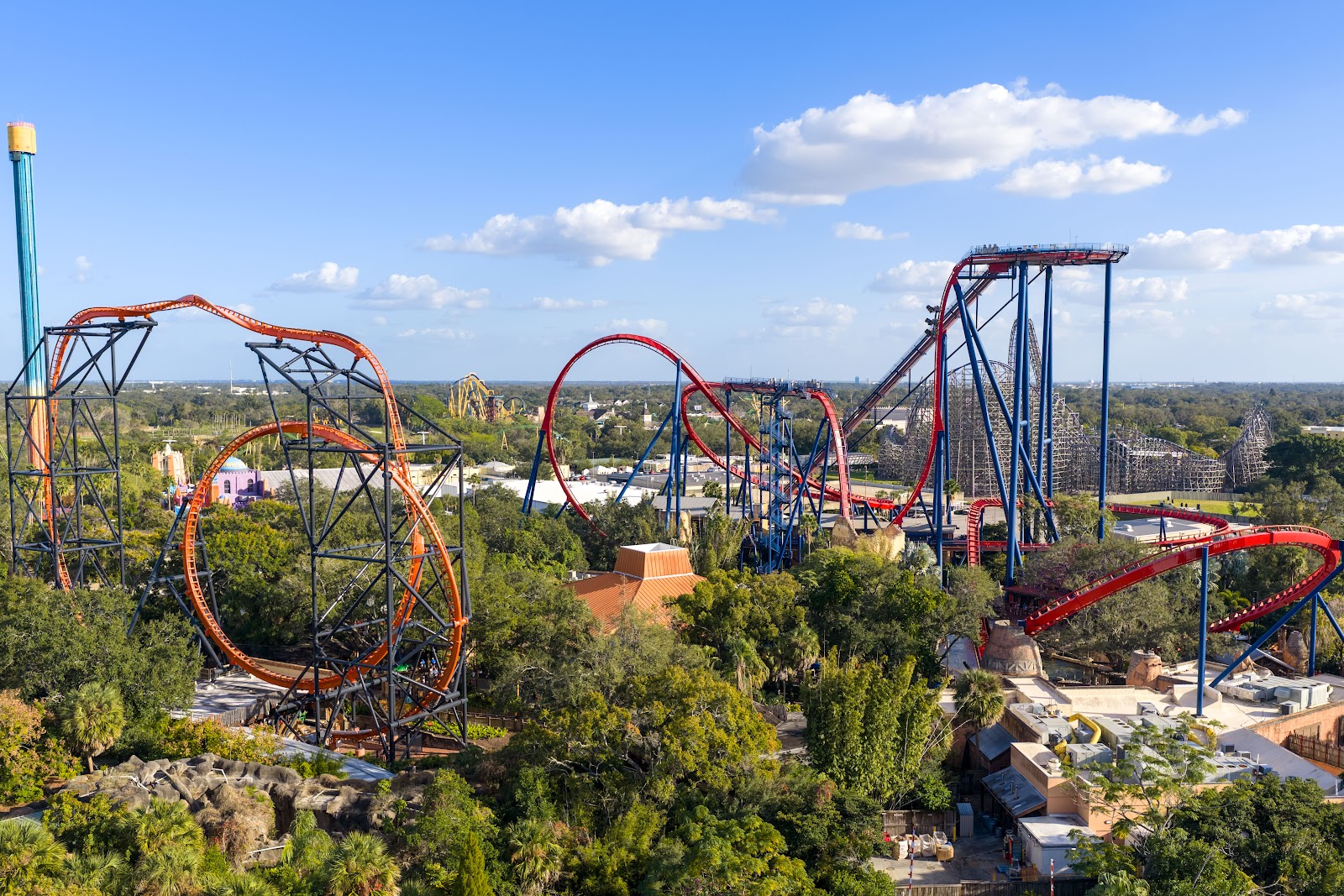
The shape of it is a large area in north Tampa combining rides, animal enclosures, open savannah-style paddocks, themed built areas, planting and a great deal of hard landscaping. Everything on the site was designed to be visually striking, which is a genuine asset and a genuine problem.
The asset is that a site built for spectacle supplies more distinct backgrounds within walking distance than any garden or hotel can. Colour, scale, structure, animals, water, planting and architecture are all present within a few hundred metres, which means a set of photographs made here has variety without anybody having to travel.
The problem is that everything was built to be looked at, which means everything competes. A brightly painted structure, a ride, a sign, a crowd, an animal — each of these takes attention, and a photograph of two people in front of any of them is a photograph of the thing with two people in it.
A second structural problem is that a theme park is a working facility for a large public and it operates during daylight. That puts most of the photography into the hours between ten and four, which at Tampa’s latitude is the hardest light of the day — the June noon sun reaches about eighty-five degrees, effectively vertical, and there is a great deal of open hard landscaping.
We have not photographed a wedding at Busch Gardens. Which areas are included, what access is available outside public hours, what the restrictions are around the rides and the animal enclosures, and what setup is permitted are questions for their team — and the question about access outside public hours is the one that most changes what is possible.
Busch Gardens Tampa Bay at a glance
| Where | A large theme park and animal attraction in north Tampa |
| Suits | Variety of background, colour, scale, animals and water in one place |
| Does not suit | Quiet, intimacy, neutral backgrounds, or an unplanned midday |
| The crowds | A daytime public facility; access outside hours changes everything |
| Ask first | Included areas, out-of-hours access, ride and enclosure restrictions |
What it suits
It suits variety, and that is worth more than it sounds. Most venues in this guide give three or four genuinely different environments and then repeat themselves. Here there are a dozen within walking distance, and they differ in ways that matter: open paddock, dense tropical planting, themed masonry, water, a bridge, a colonnade, a painted wall, a stretch of open hardstanding.
A set of wedding photographs is judged partly on whether it looks like one place or several, and a site like this solves that problem without any travel — which is a real advantage on a day where time is short.
It suits colour. A theme park is painted in saturated hues because it was designed to read from a distance, and a saturated background is a legitimate and under-used resource. A white dress against a strong colour field is a simple, graphic and surprisingly formal picture, and it is the kind of frame that no historic venue can produce.
The technical caution is that a large saturated surface in sunlight bounces its own colour onto skin — a red wall puts red into the shadow side of a face at close range. That is either an effect or a mistake depending on whether it was chosen, and the control is distance: at two metres it dominates, at eight metres it is a warm or cool cast, and at twenty metres it has gone.
It suits scale. Large built structures, big open paddocks and long sightlines let a photograph place people against something substantial, which is hard to do at a garden and easy here. A couple small in front of a large structure is a straightforward picture that works, and the site provides several.
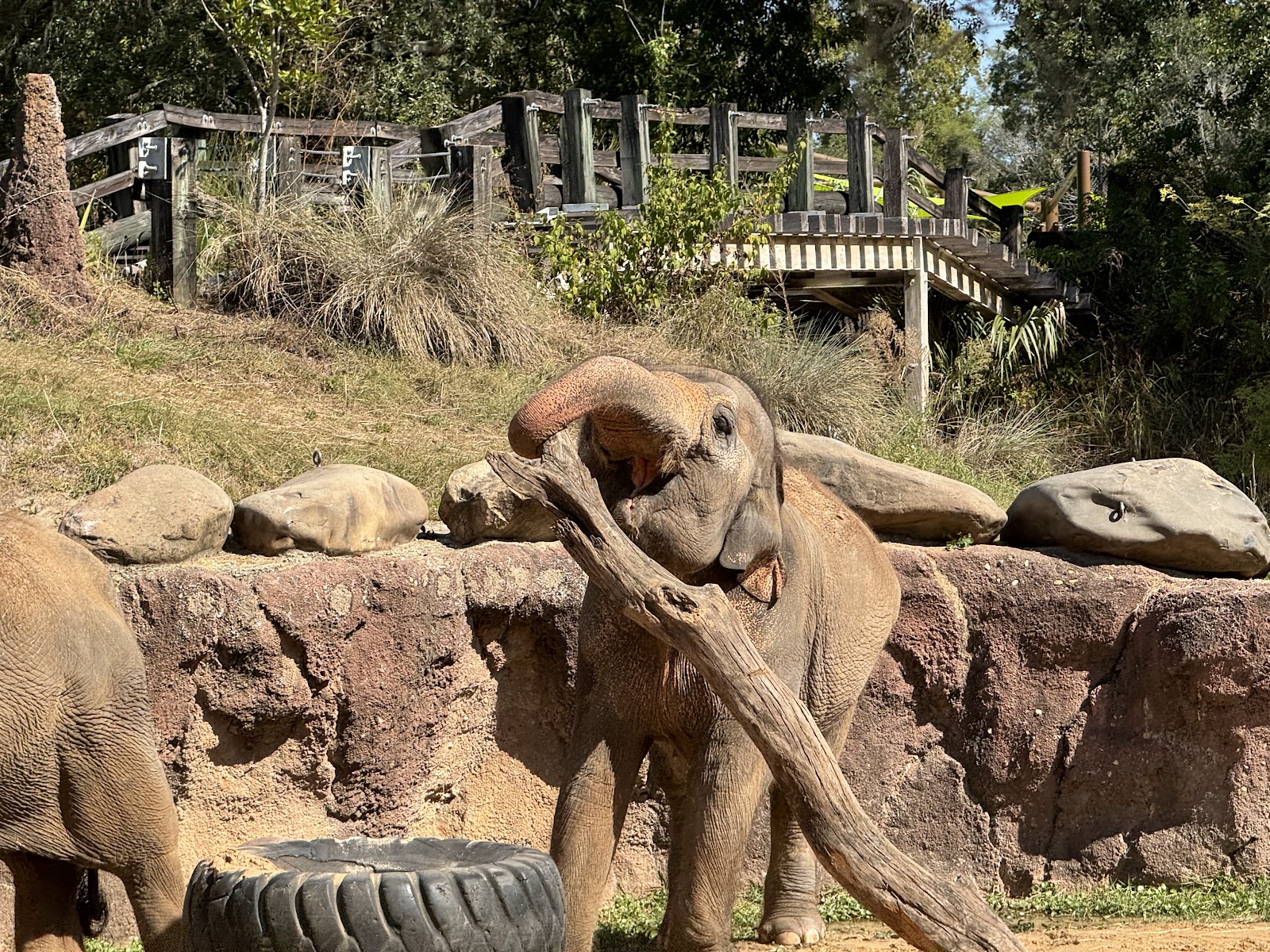
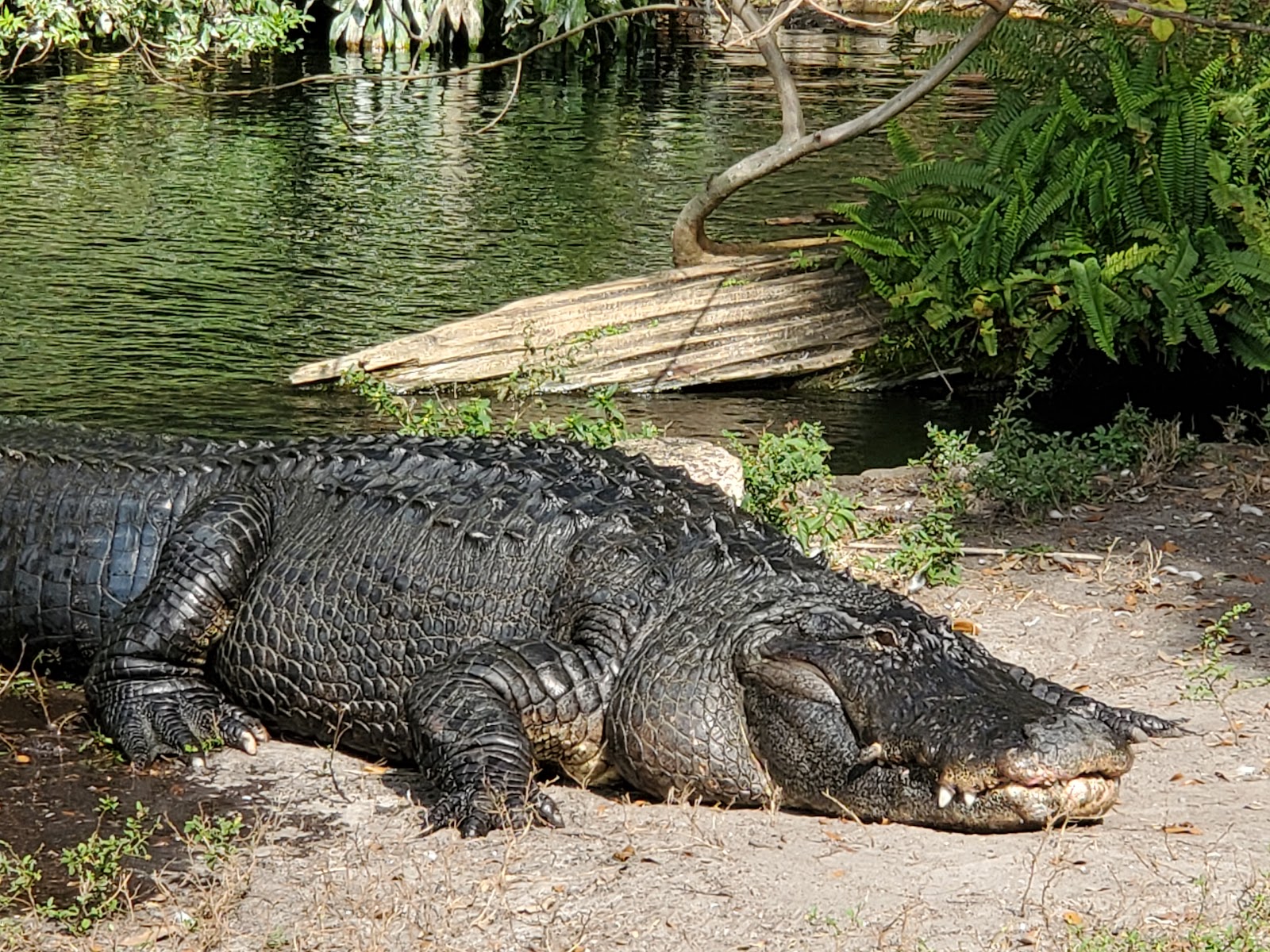
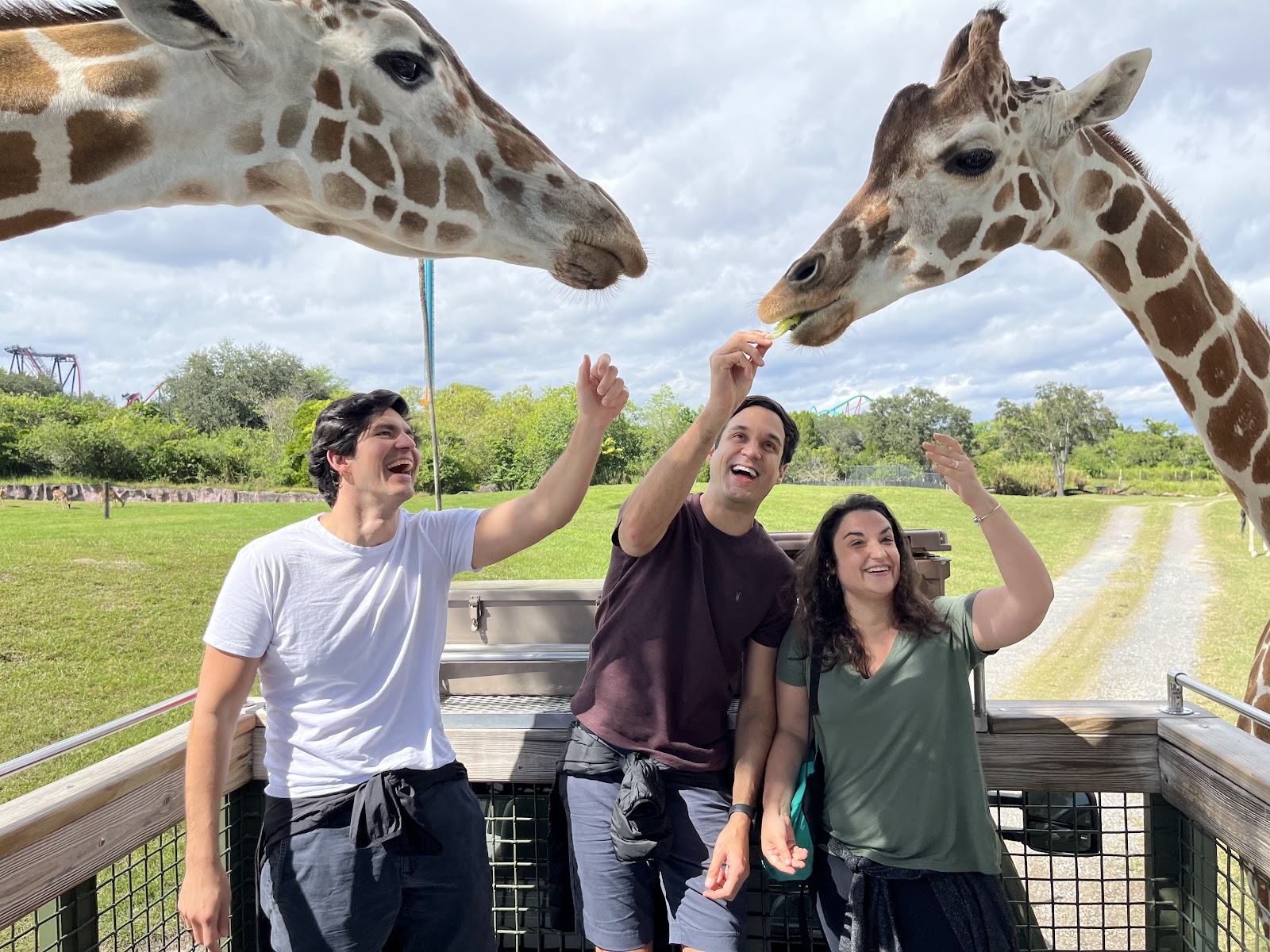
It suits the animal frames, and the same rule applies as at any zoo: an animal in the frame is the subject, so it has to be fully visible, clearly placed and given the time it needs. The open paddocks are the best opportunity, because animals in an open enclosure can be photographed with a long lens at a distance that keeps fences out of the frame — which is not true of a mesh enclosure.
It suits the water. Any pool, lagoon or channel is a horizontal reflector, filling under brows and chins where a high sun leaves people dark, and a mirror when calm. Calm at this latitude means the early morning, before the day’s heating starts the air moving.
And it suits the planting, which is the site’s most under-appreciated asset. A park of this kind is heavily planted for screening and shade, and in Florida that means mature broadleaf canopy — which is the single most valuable thing a venue in this state can have. Under a dense broadleaf tree at noon the light is soft, even and entirely usable; a metre or two inside the canopy edge facing out is a free directional portrait with a dark background.
The species distinction is absolute and it applies here as everywhere in Florida: broadleaf blocks, palms slat. A palm frond is a row of stiff parallel blades and its shadow on a face at this sun angle is unusable. In a park with a great many palms, knowing which tree you are standing under is the difference between a good frame and a wasted one.
What it does not suit
It does not suit quiet, and that is the honest headline. A theme park during opening hours contains a large public, queues, music, announcements and movement, and a wedding party is inside all of it. Photographs of two people alone are difficult to make and the ones that succeed are made with long lenses and tight framing rather than by finding an empty place.
The practical answers are timing and compression. Early in the day before the site fills, late in the day as it empties, or outside public hours if that is on offer — and, throughout, a longer focal length, which throws a crowd thirty metres away into a soft texture rather than a group of identifiable strangers.
It does not suit intimacy. A site designed for spectacle is designed to be impressive, not tender, and the frames that work here are graphic and bold rather than quiet. That is worth saying plainly to a couple who want a set of soft, still, unpeopled photographs, because they will get better ones somewhere else and no amount of skill changes the character of the place.
It does not suit neutral backgrounds, which is the inverse of the colour advantage. There is almost nowhere on the site that is simply plain — no blank stone wall, no long stretch of unornamented anything. Every background says something, and a photograph where the couple should be the only content is hard to make.
The best approximations are the dense planting, which is at least uniformly green, and the sky, reached by putting the camera low so that the horizon falls below the subjects’ shoulders. Those two are the closest thing to a neutral field here and they are worth locating in advance.
It does not suit the middle of the day without a plan. Open hardstanding under a near-vertical sun is the hardest light in this guide, and a theme park has a great deal of open hardstanding. The bright paving also raises the ground albedo enough to fill from below without softening, so a face at noon in the open is lit from above and below with nothing modelling it.
The solutions are the broadleaf canopy, the themed structures with roofs, the colonnades and covered walks, and the indoor spaces. All of them exist; none of them will be where the schedule happens to put people unless somebody plans it.
It does not suit the unexamined frame. The density of visual information here means that a photograph taken without checking its edges will contain a sign, a bin, a queue barrier, a safety railing or a ride structure. The discipline is to read the whole frame before releasing rather than after — and to accept that the fixes are ordinary: a step sideways, a lower camera, a longer lens at a wider aperture, a tighter crop.
Two further notes. Rides impose real restrictions — safety zones, no-access areas, operating noise — and where they can be photographed at all they are best treated as structure rather than as attraction: a section of track as a graphic line, not the whole ride as a background.
And the standing Florida hazard applies acutely at a site with frequent indoor-outdoor movement. In the warm half of the year an air-conditioned building sits far below the outdoor dew point, so a lens carried out of one fogs instantly and takes ten to twenty minutes to clear. Two bodies with separate jobs is the only real answer.
- Suits variety, colour, scale, animals, water and broadleaf shade
- Does not suit quiet, intimacy, neutral backgrounds or an unplanned midday
- A saturated wall bounces its colour onto skin — control it with distance
- Long lenses turn a crowd into texture
- Broadleaf canopy blocks; palms slat. Know which tree you are under
The Tampa year
Two seasons, and the good one is winter — emphatically, at a venue where most of the work happens in the middle of the day.
The dry season, roughly November to April, is the strong half. Humidity drops, the air clears, the afternoon storms stop, and the December noon sun at around thirty-eight degrees models faces instead of flattening them. At a site with a great deal of open hardstanding, that difference converts the whole day from something to survive into something to use.
It is also more comfortable for a party in formal clothes walking a large site, and the animals are more visible and more active in cooler weather, which matters for any frame that depends on one.
The costs are the short day — about ten and three-quarter hours at the solstice — and the fact that the dry season is the busy season, so the crowds are at their heaviest.
The wet season, roughly May to October, is hot, humid and reliably stormy in the afternoon. The planting is at its fullest and deepest green, which helps the portrait positions, and everything else works against the photographs.
Dew points in the mid-twenties Celsius put haze into the air, which softens contrast at distance and shows in every wide frame. The condensation problem is constant at a site with this many transitions. And the animals are least active in the afternoon heat.
The afternoon storms have a mechanism. Sea breezes push inland from the Gulf and the Atlantic and collide over the peninsula, lifting air — the reason Florida records more lightning than any other state. Tampa sits close enough to that convergence that afternoon cells between June and September are close to routine, and a theme park responds to lightning by closing rides and clearing open areas, which means the storm affects the event and not only the photographs.
A named covered alternative is a requirement, and at a site like this the useful question is which specific indoor space and what it holds.
The compensation is real and it is the best light of the wet season: broken cloud after a cell passes, wet paving returning the sky, saturated foliage, and — for the only time in a sunny month — every part of the site usable at once, including the areas shaded only by palms. The crowds also thin after a storm, which is the one weather event that improves a theme park photographically in two ways at once.
Hurricane season runs June to the end of November and peaks mid-August to mid-October. Tampa’s exposure is real, and for a heavily planted site a major storm strips canopy that takes seasons to recover.
The planting gives almost no seasonal signal — subtropical evergreen looks much the same in January as in July — which means the only things in a photograph here that say what time of year it is are the quality of the light and the density of the crowd. Both say winter clearly, and both say it in opposite directions.
More frames from Busch Gardens Tampa Bay
Busch Gardens Tampa Bay wedding photography: common questions
What does this venue suit?
Variety of background, saturated colour, scale, animals in open paddocks, water, and mature broadleaf shade — all within walking distance.
What does it not suit?
Quiet, intimacy, neutral backgrounds, and any part of the day between ten and four without a specific plan.
How do I handle the crowds?
Timing and compression. Early, late, or outside public hours if offered; and a long lens, which turns a crowd thirty metres away into soft texture.
What about the saturated colours?
They are a resource. Just control the bounce with distance: at two metres a red wall puts red into a face; at twenty it has gone.
Where is the midday shade?
Under dense broadleaf canopy and in the roofed themed structures and covered walks. Not under palms, whose fronds throw a hard slatted shadow.
Which season is best?
November to April. Clear air, a modelling midday sun, comfortable temperatures and more active animals — at the cost of bigger crowds.
More Florida venue guides
We are writing a photographer’s guide to every venue we would happily shoot in Florida. Here are three more, plus the full index:
- The Cummer Museum of Art & Gardens, Jacksonville: How the Light Moves
- The Don CeSar, St. Pete Beach: The One Decision That Governs Everything
- Everglades National Park, Homestead: One Frame and How It Is Made
Planning a wedding at Busch Gardens Tampa Bay?
Bold rather than quiet, and a dozen backgrounds in one walk. Tell us your date.