 The Tlaquepaque Arts Village, Sedona: Field Notes on Courtyards
The Omni Tucson National Resort: The Problem, and Four Ways Out of It
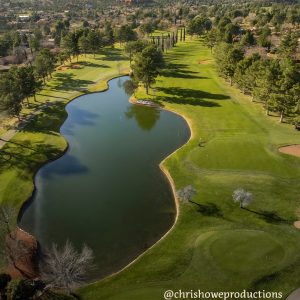
Green turf, tan desert. They do not agree, and that is the problem.
The problem at a desert golf resort is a colour problem and it is more serious than it sounds.
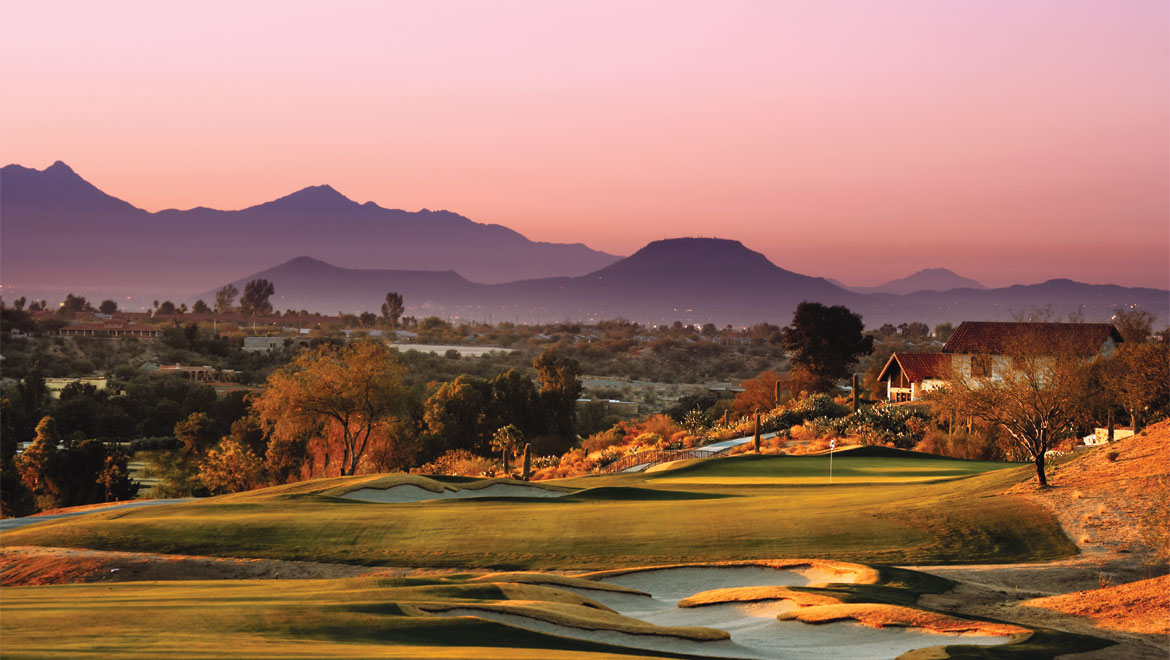
Irrigated turf is an intense, saturated, slightly blue-green. The Sonoran Desert is tan, buff, grey-green and red-brown. Those two palettes sit next to each other on this property with a hard boundary between them, and in a photograph they fight.
The fight has two parts. The first is that saturated green is the most aggressive colour in a landscape frame — it draws the eye harder than anything except pure red, and a bright green field beside a subject will pull attention off a face reliably.
The second is white balance. Grass reflects a lot of green light onto everything near it, which puts a green cast on skin from below and from the side; desert soil reflects warm light, which puts an orange cast on skin. A subject standing at the boundary is being lit by both, and no single correction fixes them.
There is a third, quieter issue. A manicured turf surface has no texture at any distance — it renders as a flat field of one colour, which means it contributes nothing to a frame except area and colour. A hundred square metres of it is a hundred square metres of nothing.
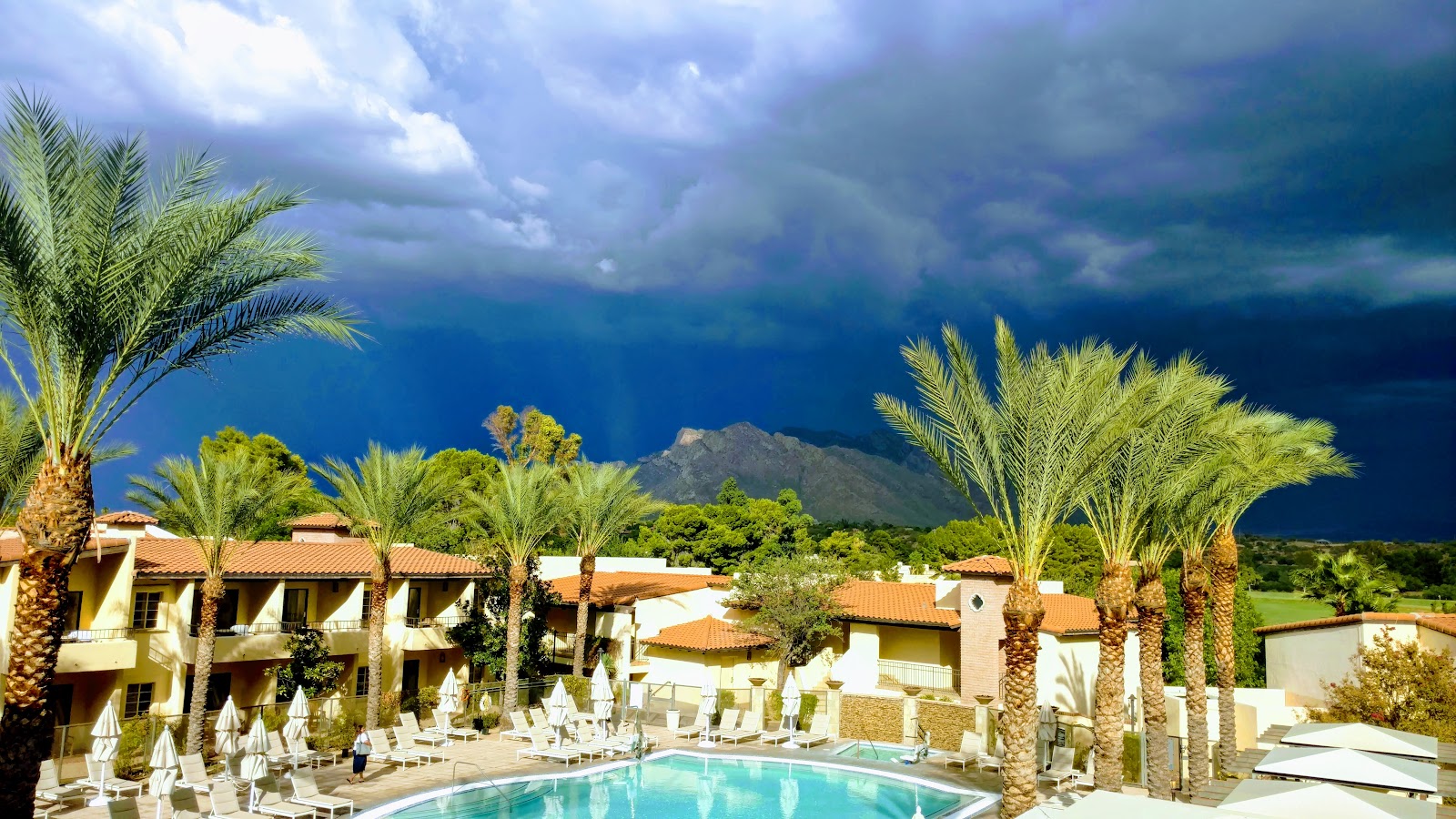
Tucson sits at about thirty-two degrees north; this part of the valley is at roughly twenty-three hundred feet, with the Tucson Mountains and the Santa Catalinas on the horizon. The June noon sun reaches around eighty-one degrees, the December noon sun about thirty-five, and civil twilight is roughly twenty-four minutes — the shortest in these guides.
What follows is that problem and four ways out of it. We have not photographed a wedding here; what is bookable, what course access exists and the permitted hours are questions for the resort.
The Omni Tucson National Resort at a glance
| Where | A golf resort in the Sonoran Desert north-west of Tucson |
| The problem | Saturated irrigated green against tan desert — two palettes that fight |
| Part two | Green bounce from turf and warm bounce from soil, on the same face |
| Part three | Manicured turf has no texture and contributes only area and colour |
| Ask first | Bookable spaces, course access, permitted hours |
Way one: pick a side
The simplest and most effective answer is to stop photographing the boundary and commit to one palette or the other.
Committed to the green, a frame reads as a golf resort: manicured turf, specimen trees, water features, the resort buildings, a clean sweep of lawn. That is a coherent and perfectly good picture — it says something about the place and the choice, and the colour behaves because there is nothing to fight it.
The technique for a green frame is to control the saturation in camera rather than in post. Shooting a green field in direct sun at midday produces a colour so intense it looks artificial; the same field at low sun with a warm cast across it reads as gold-green and sits comfortably. So the green frames belong at the ends of the day, which is when a warm beam neutralises the blue-green bias.
Committed to the desert, a frame reads as Sonoran: saguaro, palo verde, ocotillo, tan bajada slopes, mountains behind. That is the more distinctive picture and it is the reason people choose Arizona, which makes it the one worth more of the schedule.
The technique for a desert frame is exclusion. There will usually be turf somewhere in the direction the camera is pointing, and the discipline is to walk far enough or shoot low enough that it is out of frame entirely. A strip of bright green along the bottom edge of an otherwise desert composition is worse than either full commitment.
The boundary itself can be the subject, and this is the sophisticated version of picking a side. A frame composed deliberately around the line between irrigated and unirrigated ground — the sharp edge where green stops and tan begins — is a genuine statement about the American Southwest and about what it takes to keep a golf course alive in a place that receives twelve inches of rain a year.
That works as a wide graphic frame with the line running through it and the couple positioned on one side or straddling it. It does not work as a portrait background, because the eye goes to the line rather than the face.
One practical note about the transition. Desert golf courses are usually designed with the fairways as green corridors through untouched desert, which means the boundary is not a single line but a long sinuous edge with desert on both sides of every fairway. That is useful: it means desert frames are available a short walk from anywhere rather than at the far end of the property.
Ways two and three: the bounce, and the water
The second way out is to manage the reflected colour rather than fight it, and it starts with recognising how strong the effect is.
A large sunlit surface acts as a coloured light source, and the effect scales with how much of the subject’s view it fills. Someone standing in the middle of a fairway on a sunny day has a green field filling the lower half of their entire surrounding hemisphere, which means a substantial fraction of the light reaching their face from below is green.
That shows up in skin most visibly under the chin and in the eye sockets, where the fill dominates. It reads as a slightly ill, slightly grey-green tone that is difficult to correct globally because the rest of the frame is correctly balanced.
There are three fixes and they are all positional. Move the subject off the turf — onto paving, a path, a bridge or bare ground — which eliminates the source. Move them to the turf’s edge so a wall, a building or a desert slope fills part of the lower hemisphere instead. Or add a warm light from the front at a level that overwhelms the green fill, which is the technical answer and needs a real source rather than an on-camera unit.
The warm gel is not optional in any of this. At this latitude in dry air the sky is a deep saturated blue, which means open shade is lit by a blue source and reads cool while direct sun reads warm. Add green bounce from turf and a frame can have three distinct casts in it. A warm-gelled key gives the face one consistent colour and lets the rest read as environment.
The third way out is the water, and a desert golf resort has more of it than the surrounding landscape does.
Ornamental lakes and water hazards give the one thing the desert withholds, which is a reflective surface — and in a landscape of tan ground and blue sky a body of water reflecting that sky is the strongest tonal element available. It also fills from below with sky-coloured light rather than green, which makes a water’s-edge position better for skin than a fairway one.
The reflection is a dusk proposition. Still water mirrors the sky, and a desert sky at dusk goes more saturated than a humid one because the dry dust-carrying air scatters long wavelengths efficiently — so the water doubles the best thing the climate produces. A reflection is about a stop darker than the sky it reflects, which brings the whole frame into a single exposure’s range.
Whether it is still depends on the hour. Desert afternoons build a thermal breeze as the ground heats, which breaks the surface into texture, and mornings are calm. So mirror frames are a morning thing here and sparkle is the evening’s, which is the reverse of the standard advice.
Broken water has its own frame. A low sun on a rippled surface produces a path of bright speculars running toward the camera, and a subject silhouetted against that path from a low camera position is one of the strongest pictures a resort property offers.
Water also concentrates wildlife. Any permanent water in the Sonoran Desert attracts birds in quantity — herons, egrets, ducks, and a great deal else — which means a bird lifting off behind a couple is a realistic possibility rather than a fantasy. Desert golf courses in particular are known for it, because they are effectively large irrigated oases.
- Commit to green or to desert; a strip of turf along the bottom edge is the worst frame
- Green frames belong at the ends of the day, when a warm beam neutralises the blue-green
- Move the subject off the turf to kill the green fill, or overwhelm it with a warm key
- Water’s-edge positions fill with sky rather than green — better for skin
- Mirror reflections are a morning thing; the thermal breeze builds all afternoon
Way four: the specimen trees, and the season
The fourth way out is the planting, and it is the resort’s most underused resource.
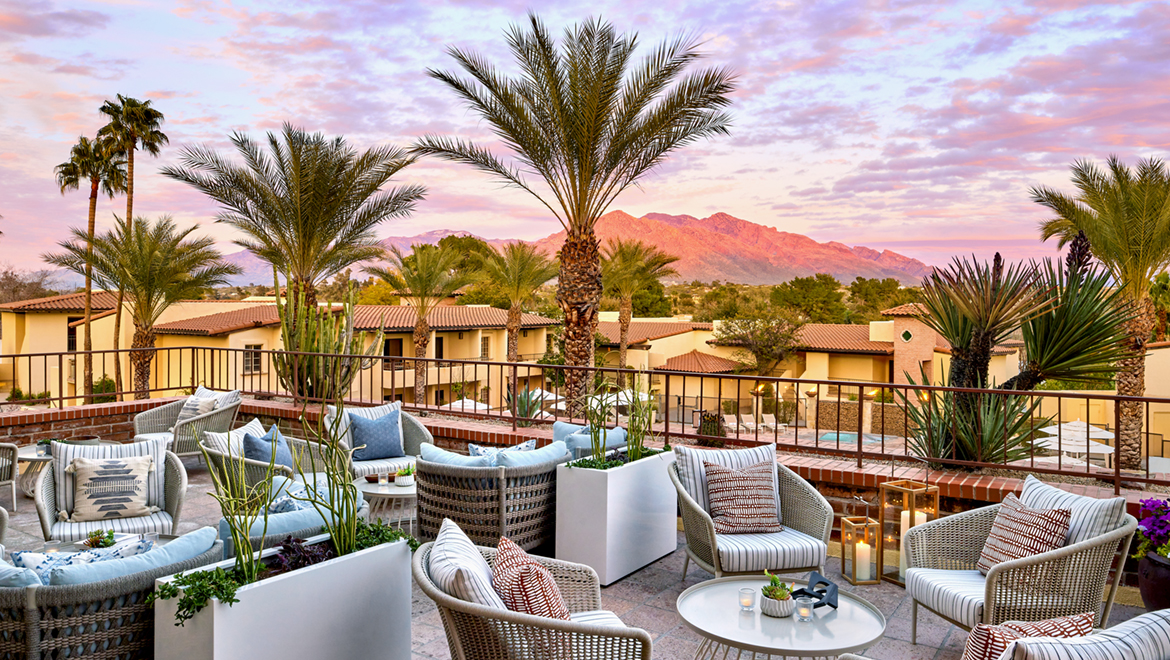
An irrigated property in the Sonoran Desert can grow things the surrounding landscape cannot, and desert resorts are typically planted with large specimen trees that would not survive fifty metres away — date palms, eucalyptus, olive, Aleppo pine, jacaranda, and mature mesquite grown far larger than any on natural ground.
Those trees are the only solid shade on the property, and that is the thing to understand. The native Sonoran trees — palo verde and mesquite on unirrigated ground — have millimetre-scale leaves on open branches and cast a hard dapple rather than cover. An irrigated olive or Aleppo pine has enough canopy to give genuine shade, and on a site where the midday sun reaches eighty-one degrees that is the difference between a usable portrait and none.
Each has a distinct character. Olive is grey-green, fine-leaved and open — it gives partial shade with a silvery quality and its trunk becomes gnarled and sculptural with age, which makes it a good portrait background at any hour. Aleppo pine is dense, dark and high-crowned, giving real shade with a strong shaft pattern beneath.
Date palms are the distinctive Southwest resort tree and they need thinking about. A palm gives almost no useful shade — the crown is high, the fronds are sparse and the shadow is a small pattern on the ground far from the trunk — so it is a background element rather than a shelter. As a background it is graphic: a tall clean trunk with a burst at the top, which reads as a strong vertical and photographs best against sky rather than against other vegetation.
Jacaranda is the one to time. Where it grows in this region it flowers a startling blue-violet in late spring, usually May, and drops the flowers into a carpet of the same colour beneath. That is the single most striking colour event on any irrigated Southwest property and it lasts a few weeks.
Bougainvillea is the reliable one. Its colour is in bracts rather than petals, which means papery magenta, orange or white that holds for months rather than weeks — and against a warm stucco resort wall it is the strongest dependable colour available.
The seasons govern the rest and the low desert’s calendar runs opposite to most of this guide.
November to April is the season: mild, dry, sunny and calm, with a December noon sun at about thirty-five degrees that models rather than flattens, which means a midwinter wedding here has good light from morning to dusk with no bad hour at all. Tucson is a few degrees cooler than Phoenix year-round, which helps at both ends.
February to April is the best window in the state, because the Sonoran Desert flowers in spring rather than autumn. Brittlebush yellow across the bajada from February, Mexican gold poppy and lupine in March in a year with adequate winter rain, ocotillo red on the tips of its whip-like stems, and palo verde in mass yellow bloom through April into May. In May the saguaros flower white at the crown, five metres up, which needs a long lens.
May to September is the honest constraint. Afternoons regularly above a hundred and five degrees are a welfare matter for a party in formal clothes, and the specimen trees help but do not solve it — which means a summer schedule belongs at the ends of the day with the middle indoors.
The Tucson monsoon is the compensation and it is substantial: about half the city’s annual rain arrives between July and September, which is enough to green the desert visibly for a few weeks in August. That has a particular consequence here — it is the one time of year when the desert and the turf are roughly the same colour, and the boundary that causes all the trouble briefly stops mattering.
More frames from The Omni Tucson National Resort
The Omni Tucson National Resort wedding photography: common questions
What is the core problem?
Saturated irrigated green against tan desert. The two palettes fight, and green is the most aggressive colour in a landscape frame after pure red.
What does turf do to skin tones?
A sunlit fairway fills the lower half of the subject’s surrounding hemisphere with green light, which shows as a grey-green cast under the chin and in the eye sockets.
How do I fix the green cast?
Positionally. Move them off the turf, or to its edge where a wall or slope fills part of the lower hemisphere, or overwhelm the fill with a warm-gelled key from the front.
Where is the real shade?
Under the irrigated specimen trees — olive, Aleppo pine, mature mesquite. Native palo verde and mesquite on dry ground cast a hard dapple rather than cover.
Are palms useful for shade?
No. The crown is high and the fronds sparse, so the shadow is a small pattern far from the trunk. Use a palm as a graphic vertical against sky instead.
When does the colour problem go away?
August. The Tucson monsoon greens the desert enough that it roughly matches the turf, and the boundary briefly stops mattering.
More Arizona venue guides
We are writing a photographer’s guide to every venue we would happily shoot in Arizona. Here are three more, plus the full index:
- The Paseo, Scottsdale: The Light Through the Day
- The Phoenician, Scottsdale: What It Suits, and What It Does Not
- The Pinnacle Peak Patio, Scottsdale: The Problem, and Four Ways Out of It
Planning a wedding at The Omni Tucson National Resort?
Green, tan, and a line between them. Tell us your date.