 The Rio Grande Zoo: Cottonwood Shade and the Enclosure Problem
Drury Plaza Hotel Santa Fe: The Venue’s Own Logic
Built for something else. The original logic is still the useful one.
This building was not built to be a hotel, and the logic that matters photographically is the one it was built with rather than the one it now has.
A large institutional building of the earlier twentieth century — and this one served the city in a quite different capacity before it was converted — is designed around requirements that no hotel has: long corridors for circulation, rooms of standardised size, tall windows for daylight in an era before reliable artificial lighting, high ceilings for air, and a plan built around access rather than around views.
Every one of those decisions is a decision a photographer inherits, and several of them are better for photography than anything a purpose-built hotel would offer.
The tall windows are the first and they are the reason to be interested. A building designed to be lit by daylight, before electric lighting could be relied on, has more glazing and larger openings than a modern building of the same size — and the light entering a tall window is more horizontal than the light entering a short one, which means it reaches further into a room and falls on a face at a better angle.
The long corridors are the second. A circulation spine with a window at its end is a directional source with several stops of fall-off along its length, and a subject placed three or four metres in gets studio separation from a piece of architecture. Institutional buildings have longer corridors than hotels do, which makes the effect stronger.
The high ceilings are the third and they do something specific: they put the top of a window well above head height, which means the light comes down at a steeper angle than in a low-ceilinged room, and a subject standing close to a tall window is lit from slightly above rather than from directly beside. That is a more flattering angle than a low window gives.
And the standardisation is the fourth. A building of rooms the same size, with windows in the same place, means a lighting setup that works in one room works in all of them — which is a practical advantage on a day with a tight schedule and no time to reassess.
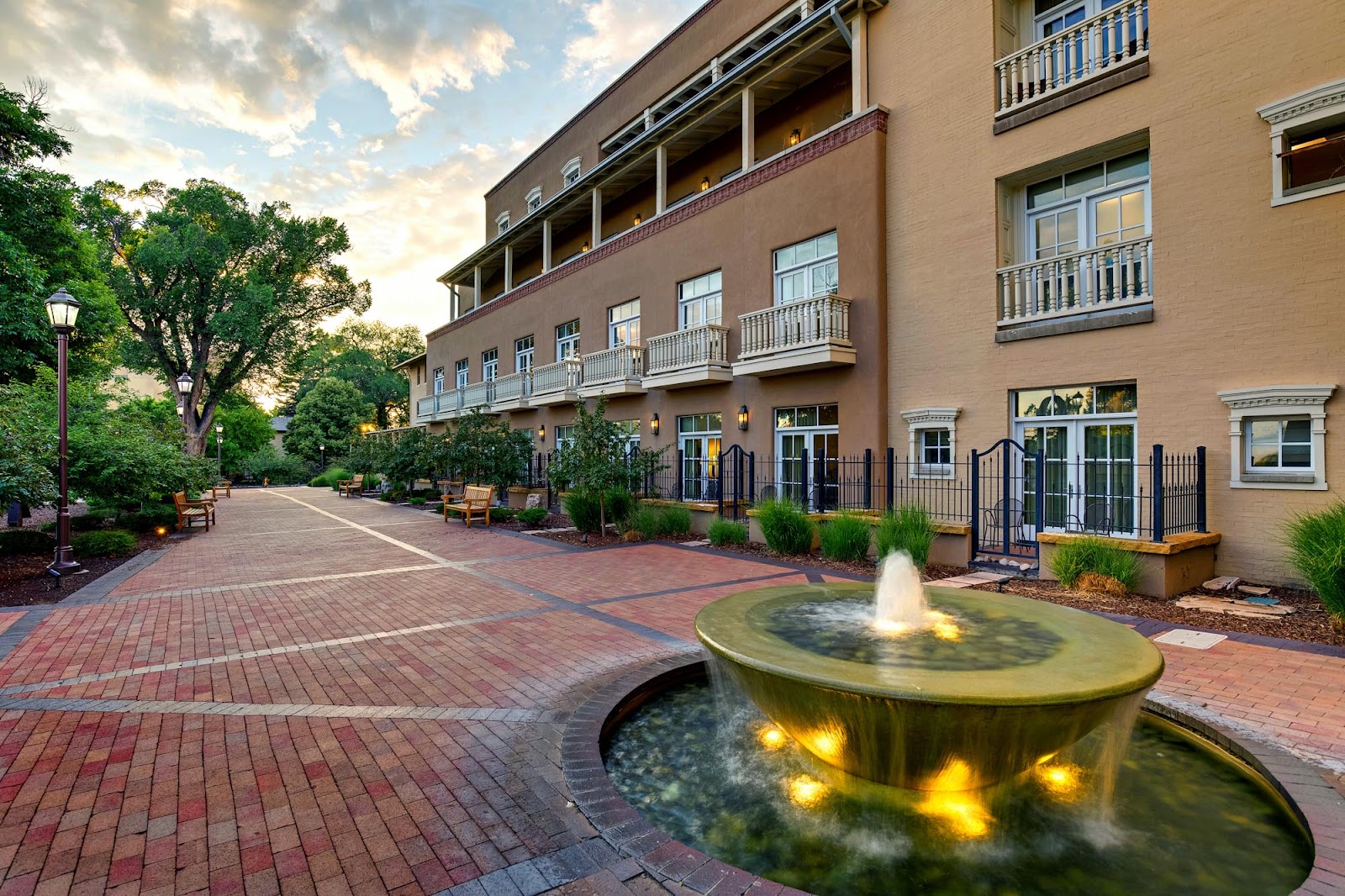
The exterior is Santa Fe’s rather than the building’s: the historic district requires earth-tone finishes, which means whatever the original brick or stone was, the outside now reads as part of the city’s coherent warm palette.
Santa Fe sits at about thirty-five and two-thirds degrees north at roughly seven thousand feet. The June noon sun reaches around seventy-seven and a half degrees, the December noon sun about thirty-one, and civil twilight is around twenty-seven minutes.
We have not photographed a wedding at this hotel. Which rooms and spaces are included, what access there is to any roof terrace, and what the permitted hours are, are questions for their team.
Drury Plaza Hotel Santa Fe at a glance
| Where | A converted institutional building off the plaza in Santa Fe |
| The logic | Built for another purpose: tall windows, long corridors, high ceilings, standard rooms |
| The gift | More glazing than a modern building, and light that reaches further into a room |
| The corridors | Longer than a hotel’s, with several stops of fall-off along their length |
| Ask first | Included rooms and spaces, roof terrace access, permitted hours |
Reading the original logic
Work the tall windows first, because they are the building’s inherited advantage and they behave differently from modern glazing.
The method is the standard one: subject at forty-five degrees to the window, at a distance that sets the ratio, metered on skin, with the room falling away behind. What a tall window changes is the vertical character of the light — a full-height opening acts as a strip source rather than as a box, which gives a long gradient down a standing figure rather than a single pool on a face.
That is genuinely useful for a full-length portrait, which a small square window cannot light evenly. And it means the distance from the glass controls something slightly different: close to a tall window the gradient down the body is steep, and further out it evens up.
The high ceiling adds the second property. With the top of the window well above head height, the light arrives from slightly above rather than from directly beside — which fills the eye sockets and models the cheekbone in a way a low window does not. A subject standing close to a tall window in a high room is lit at close to the angle a photographer would choose.
The corridors are the second resource and at an institutional building they are the reason to walk the whole floor before deciding anything.
A long corridor with a window at one end is a directional source with a very long fall-off: light at the far end, a gradient along the length, and near-darkness at the back. A subject placed three or four metres in is separated from the background by nothing but distance, and the corridor’s own perspective — receding walls, a repeating rhythm of doors — does the composition.
The rule for using it is to shoot along the axis rather than across it. On the centre line, level, at about the subjects’ chest height so the verticals do not lean, the corridor is a symmetrical frame with the subject at its centre. Off the line it is an awkward asymmetry that reads as carelessness.
The doors are the rhythm and they reward precision: a camera moved a few inches decides whether a door frame bisects a head, frames it, or disappears.
The standardisation is the third and it is a scheduling asset rather than an aesthetic one. In a building where every room is the same size with the window in the same place, a setup established in one room transfers to every other — which means the second and third rooms cost almost no time, and the whole getting-ready sequence can be worked quickly.
That matters more than it sounds in a city where the outdoor window is short: twenty-seven minutes of civil twilight and a hard midday mean the indoor time has to be efficient.
The stairs are the fourth and at an institutional building they are usually generous, because a building designed for movement has stairs built for volume. A wide stair with a landing window gives a level change, a balustrade line at exactly leaning height, and a directional source — which is the strongest single interior structure in any building of this period.
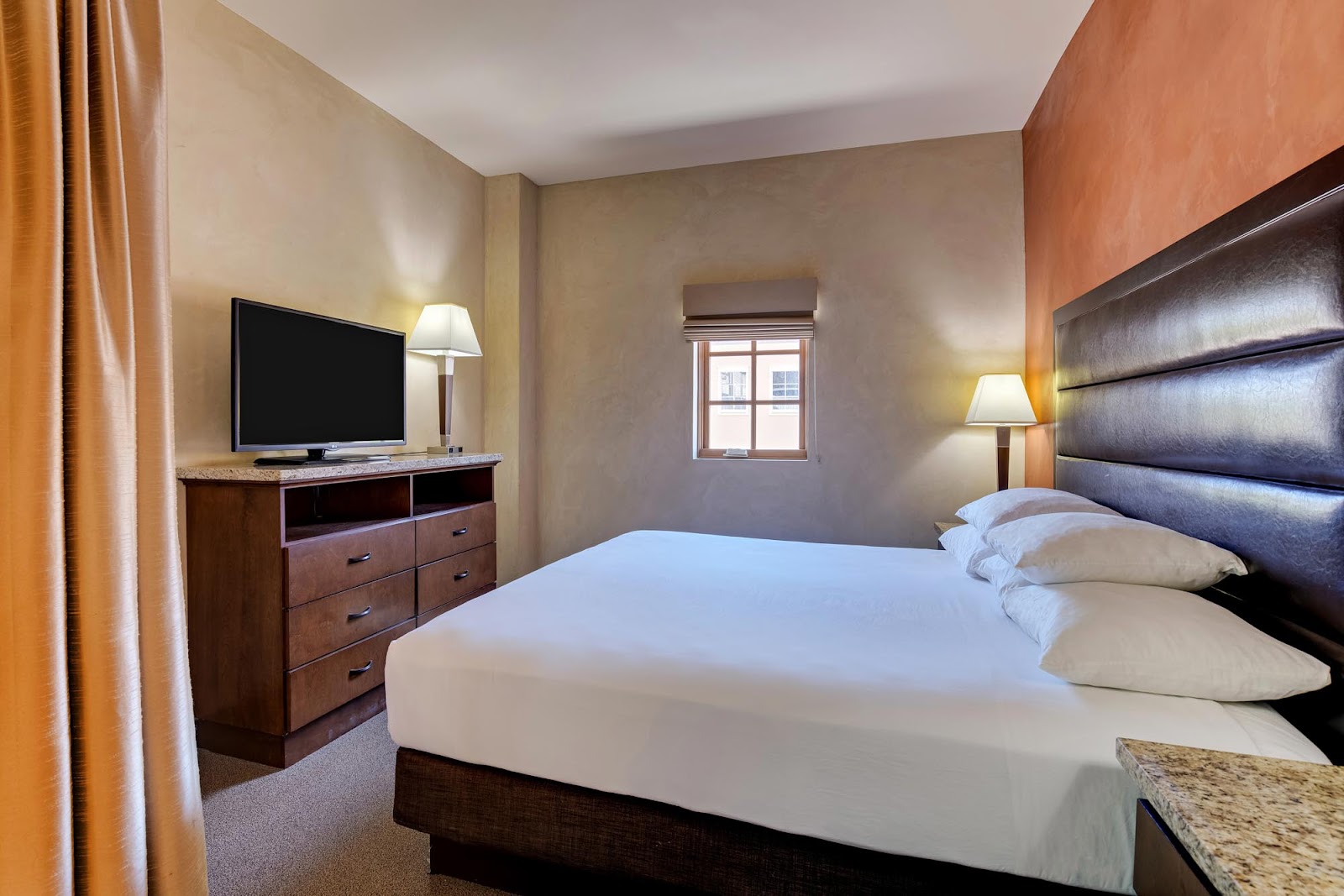
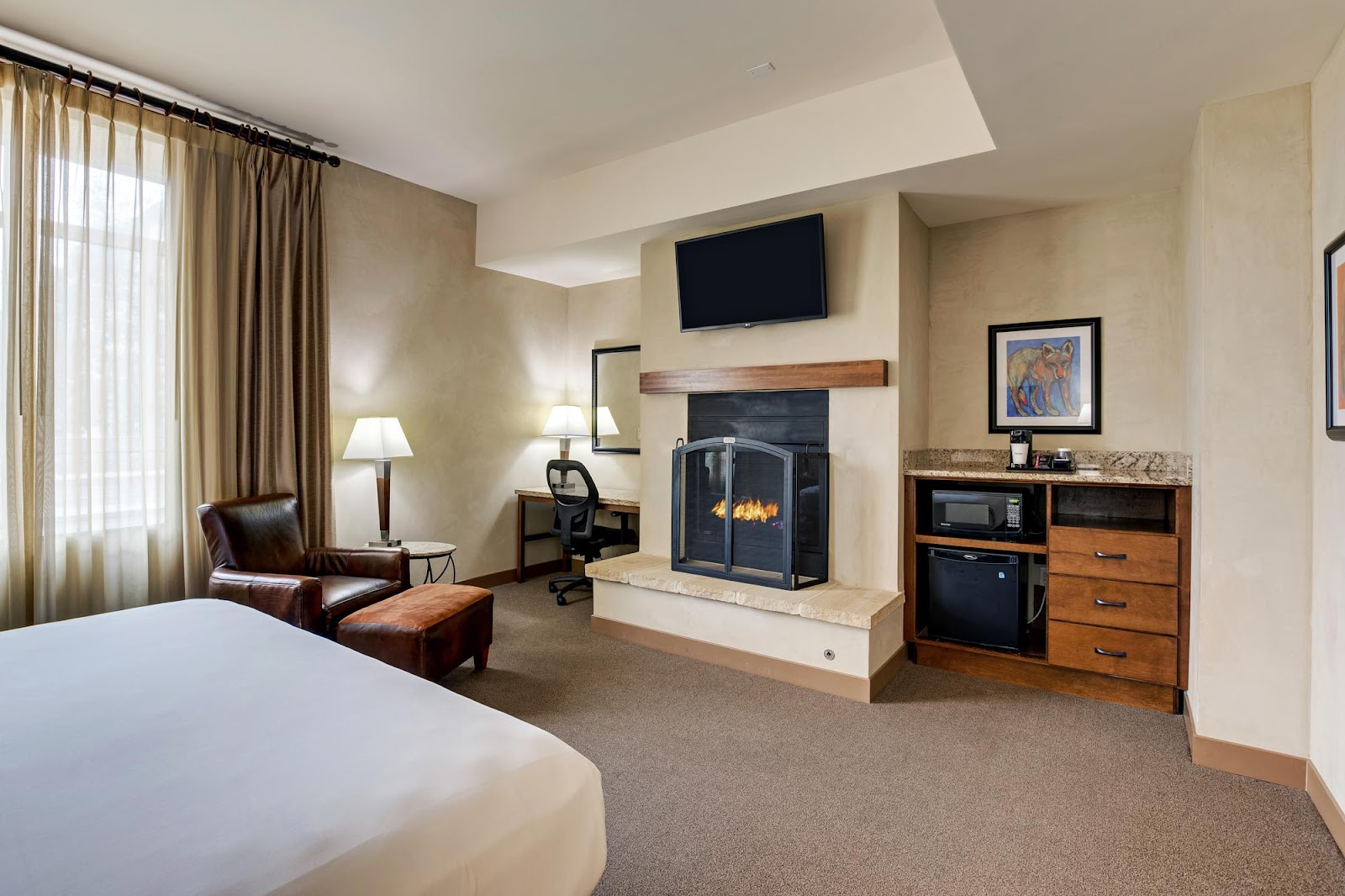
One note on the conversion itself. A converted building has two layers: the original structure and the later fit-out, and the second is usually the less interesting one. The frames worth making are the ones that use the first — the window proportions, the corridor lengths, the ceiling heights, the stair — rather than the furnishings, which are a hotel’s rather than the building’s.
Outside, and the city
The exterior follows Santa Fe’s rules rather than the building’s origins. The historic district requires earth-tone finishes, which means the outside reads as part of the city’s coherent warm palette of tans, browns and ochres whatever it was originally.
That material is the region’s most useful photographic surface. Earth-toned stucco is a warm mid-toned reflector, which means a large sunlit elevation bounces warm light — and at seven thousand feet, where open shade is lit by a very deep blue sky and reads markedly cool, that warm bounce partly corrects the split that defines high-desert light.
Standing a subject three or four metres from a sunlit earth-toned wall is the most flattering free light in northern New Mexico, and it is why a Santa Fe portrait in shade is warmer and more neutral than the same portrait in shade at the same altitude elsewhere.
The portals are the exterior’s best light and this part of the city is lined with them: covered arcades of columns over a walkway, where depth back from the open edge is the whole lighting control. At the edge flat and frontal; two or three metres back dramatic, with the sunlit street beyond four or five stops down.
At this altitude that ratio is more extreme than the same depth would give at sea level, because thin dry air makes the direct sun harder and the shadows deeper. It is the best unassisted portrait in Santa Fe and it is available all day.
The midday problem is the city’s: at seventy-seven and a half degrees of June elevation, with thin air behind it, open ground is unusable for portraits. At this venue that matters less than at most, because the building’s tall windows and long corridors are available at any hour and are lit identically at noon and at four.
The city’s colour is worth using. The earth-tone requirement makes the whole historic district one tonal family, and the accent is turquoise — on doors, window frames and trim. Turquoise against tan adobe is the region’s signature combination and the strongest colour available in an otherwise entirely warm streetscape.
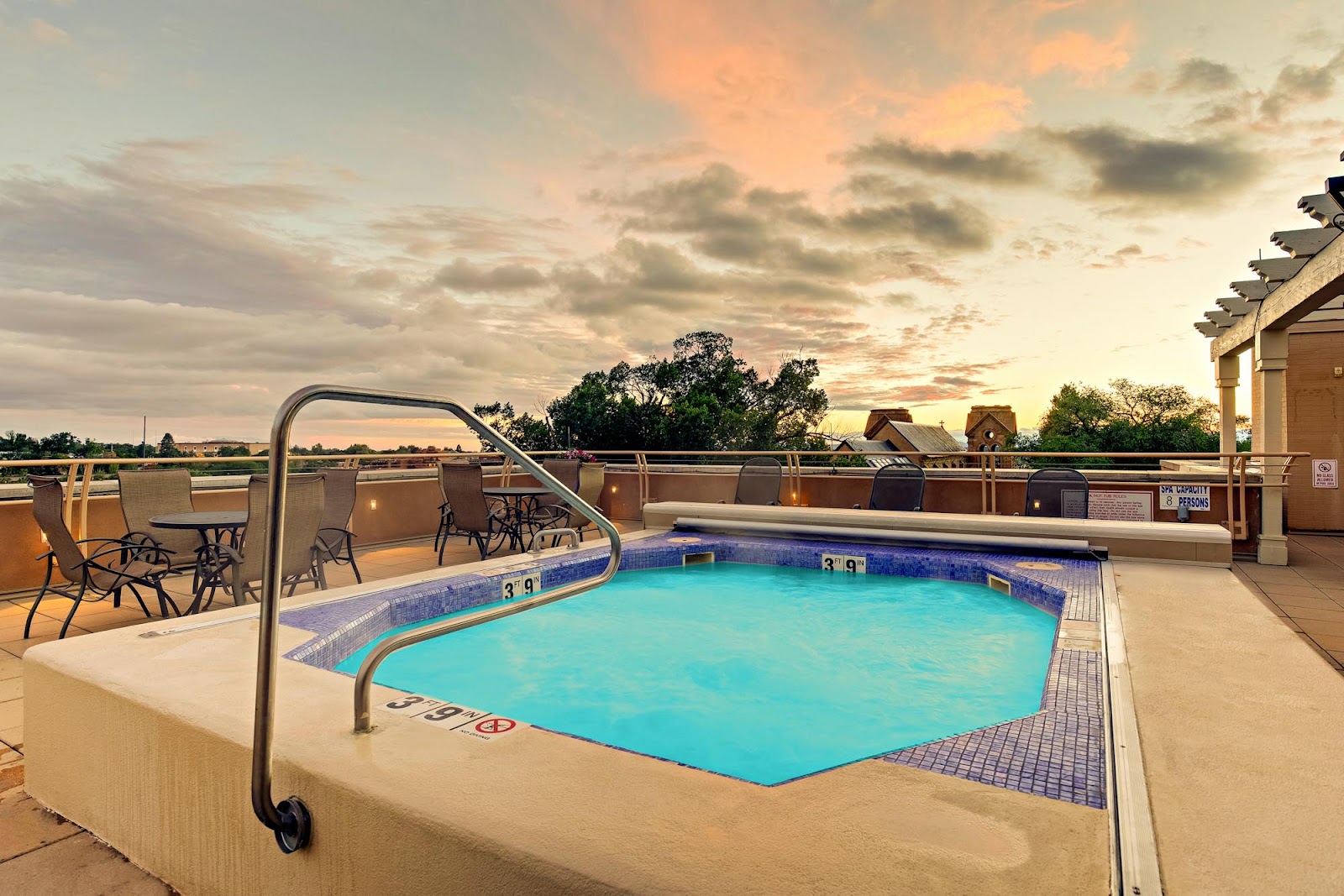
A roof terrace, if the building has one, is the site’s most valuable exterior position and worth asking about specifically. Elevation in Santa Fe gives the city’s signature frame: the flat adobe rooflines of the historic district in the foreground and the Sangre de Cristo range beyond, turning a strong red as the low sun hits it — the effect the range is named for, and a real repeatable one.
That needs a moderate telephoto to bring the range forward, because a wide lens renders it at its true angular size and flattens it into a band. Expose for the mountains and lift the subjects with a close warm-gelled source at about a stop over the ambient on them.
The gel is not optional at this altitude. Open shade is lit by a very deep blue sky and reads distinctly cool while the low sun is strongly warm, which means an ungelled flash puts cold faces into a red landscape. A warm gel is the fix rather than a global white balance correction.
Then dusk, at twenty-seven minutes of civil twilight — workable and short. The crossing point applies if the building or the street is lit: sky and lit earth-toned walls within about a stop for roughly ten minutes, and at seven thousand feet the blue at that moment is deeper and more saturated than at sea level, which makes the frame stronger here than elsewhere.
Scout the position in daylight, because ten minutes is not searching time. And in December, when the farolitos are up along the walls and rooflines of the historic district, that same frame is the best exterior photograph this part of the city produces all year.
- A tall window is a strip source: it gives a long gradient down a standing figure
- A high ceiling puts the light slightly above the face rather than beside it
- Shoot a corridor along its axis, on the centre line, level, at chest height
- Standardised rooms mean a setup transfers — which buys time on a tight schedule
- Use the building’s original structure, not the hotel’s fit-out
The Santa Fe year
Northern New Mexico has four real seasons and seven thousand feet does more to them than the latitude does — and at an interior-led venue the building is largely indifferent while the city is not.
That division is the practical argument for this venue: the tall windows, the corridors and the stair produce the same photographs in February as in July, which in a city with a windy dusty spring and hard summer middays is worth something real.
Winter is the best season for the interiors, and the reason is counter-intuitive. Snow outside a tall window is a very large bright neutral reflector, which raises the light level coming into a room substantially and shifts it cooler and more neutral — and in a building with more glazing than a modern one, that gain is multiplied.
The December noon sun at about thirty-one degrees also enters a tall window far more horizontally than a summer sun does, which means the light reaches deeper into a room and a low shaft crossing the floor is available for much of a winter day rather than for forty minutes at each end. On the interior light alone, a clear winter day here is the best of the year.
Outdoors, winter is the city’s best-looking season: the whole short day rakes rather than floods, which is exactly what adobe’s texture and the projecting vigas want, and snow lies on flat roofs and along the beams and picks out the architecture’s geometry. It melts fast at this altitude, which makes the snow-on-adobe condition a morning rather than a day.
And December brings the farolitos: paper lanterns along adobe walls and rooflines through the Christmas season, which combined with the earliest dusk of the year — sunset a little before five — puts the best exterior frame of the year at a civilised hour, before the reception rather than in the middle of it.
Spring is the weak window and it should be said plainly. March through May is the windy season in northern New Mexico — persistent strong winds, blowing dust that hazes the air and gets into everything, and a landscape brown before it is green. The apricots bloom in early April and are frequently frosted.
For an interior-led venue that matters far less than it would elsewhere, which is a genuine argument for a spring date here: the windows, the corridors and the stair are entirely unaffected, and only the city’s exteriors and long views suffer.
Summer is long-day and hard-light — over fourteen and a quarter hours at the solstice, a noon sun at seventy-seven and a half degrees, and thin air making it harder still — which pushes the outdoor work to the portals and the ends of the day and makes the interiors the sensible place to be in the middle of one.
The compensation outdoors is the monsoon. From roughly July into September the North American monsoon brings moisture north: clear mornings, towering cloud building over the Sangre de Cristos through the afternoon, and thunderstorms in the late afternoon or evening.
That is the best light of the year. Structured cloud over a mountain range at the hour the light goes low is the strongest background this landscape has, the half hour after a cell passes gives the cleanest air of the summer, and wet adobe is darker and more saturated than dry — which makes the whole city look better for an hour after rain.
Autumn is the finest season here. Late September brings aspen gold high on the Sangre de Cristos, and because an aspen grove is clonal — genetically one organism — a whole stand turns at once, which from a roof terrace reads as blocks of uniform gold on the mountain.
Late October into early November brings the cottonwoods at town level, a clean bright gold. Gold cottonwood against tan adobe under a deep blue high-altitude sky is the strongest colour combination Santa Fe offers, and it coincides with the clearest air and the calmest weather of the year — which for a roof-terrace frame of the red mountains is exactly what is needed.
If a date can move at all, that fortnight is the one to move it to.
More frames from Drury Plaza Hotel Santa Fe
Drury Plaza Hotel Santa Fe wedding photography: common questions
What is the building's logic?
It was built for another purpose entirely, which gave it tall windows, long corridors, high ceilings and standardised rooms — all of which suit photography better than a purpose-built hotel.
What does a tall window give me?
A strip source rather than a box, which produces a long even gradient down a standing figure — and a high ceiling puts that light slightly above the face rather than beside it.
How do I use a long corridor?
Along its axis: on the centre line, level, camera at about the subjects’ chest height. Off the line it reads as carelessness.
Why does standardisation matter?
A setup established in one room transfers to every other, which buys time in a city where the outdoor window is twenty-seven minutes and midday is unusable.
Which layer of a converted building should I use?
The original structure — the window proportions, corridor lengths, ceiling heights and stair. The later fit-out is a hotel’s rather than the building’s.
When are the interiors at their best?
A clear snowy winter day. Snow outside a tall window is a big bright neutral reflector, and a low sun reaches far deeper into the room.
More New Mexico venue guides
We are writing a photographer’s guide to every venue we would happily shoot in New Mexico. Here are three more, plus the full index:
- Santa Fe Community Convention Center: What It Suits and What It Does Not
- The Hyatt Regency Tamaya, Bernalillo: The Light Through the Day
- The Santa Ana Star Casino, Bernalillo: Suits and Does Not Suit
Planning a wedding at Drury Plaza Hotel Santa Fe?
A building with a previous life and better windows for it. Tell us your date.