 The Laniakea YWCA: A Building Organised Around Its Courtyard
Hotel Wailea: The Problem and Four Ways Out of It
The ocean is a view here, not a location. That is the problem to solve.
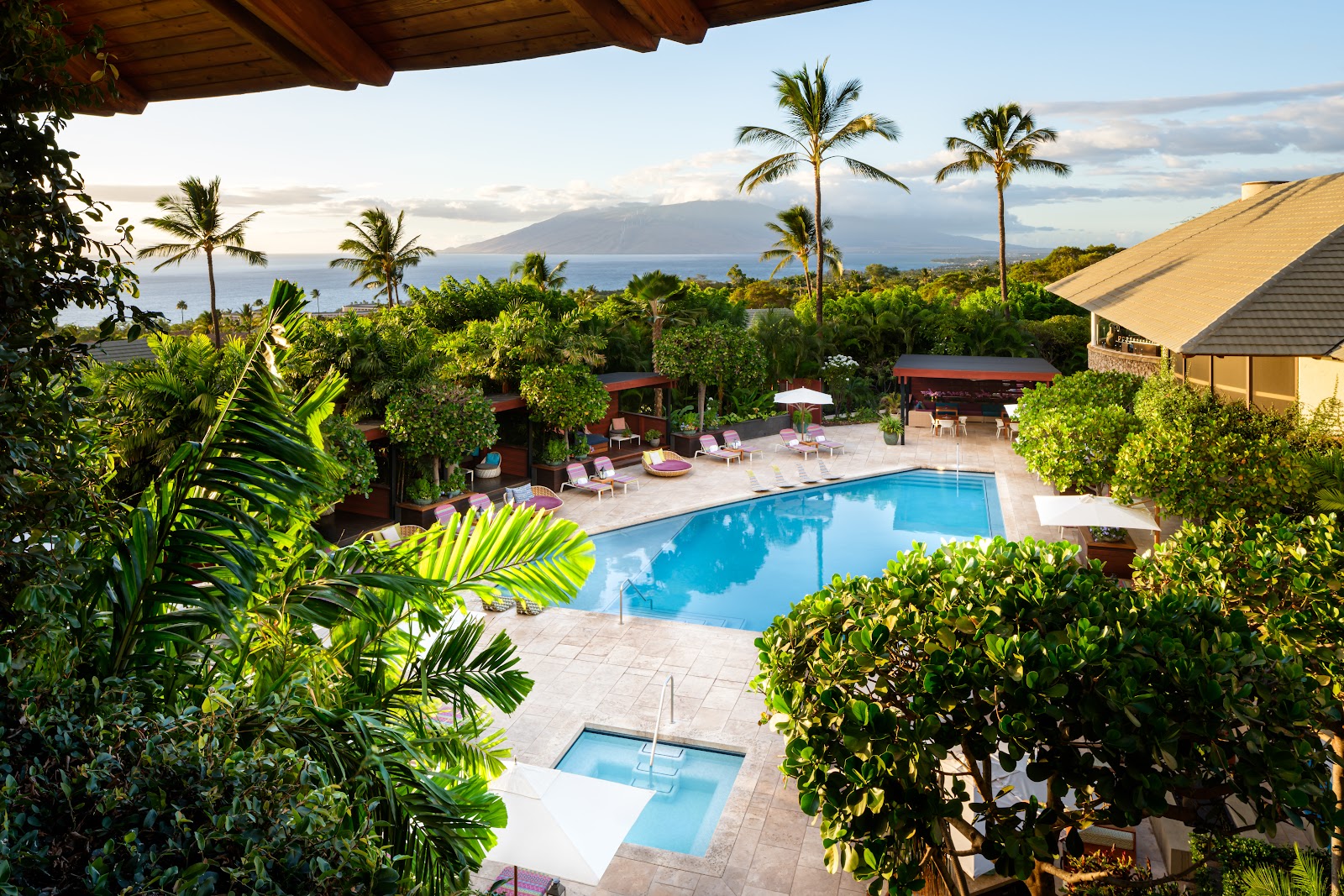
A hillside hotel above a coast presents a problem that a beachfront one does not: the water is visible and unreachable.
This is a small property set back and above the leeward south shore of Maui, which means the ocean is in every wide frame and in none of the close ones. A couple cannot stand on the sand, the sunset cannot be reflected in wet beach, and the frames that a shoreline venue produces — the backlit couple at the water’s edge, the silhouette against a clean horizon — are simply not available on the property.
What is available instead is elevation, and that turns out to be worth a great deal. A property above a coast gets three things a beachfront one cannot: a view over the water rather than across it, which means a layered frame rather than a flat one; a gradient, which is the most useful topographic feature a photographer can have; and a clear western horizon from above, which means the whole of the low light rather than the part that clears the buildings.
The second problem is the one every venue at this latitude has. Wailea sits at about twenty and seven-tenths degrees north, which means the June noon sun reaches about eighty-eight degrees — effectively vertical — and it passes exactly through the zenith twice a year, in late May and mid-July, when a vertical object casts essentially no shadow at all.
And the third is the scale of the property. A small hotel has fewer locations than a large resort, which means the frames have to be found rather than chosen — and it has a real advantage, which is that everything is within a short walk and the transit costs nothing.
Those problems have four solutions between them and each produces a different photograph. Days run only from about eleven hours to thirteen and a quarter, and civil twilight is around twenty-two minutes — the shortest in this guide.
We have not photographed a wedding at this hotel. Which spaces and grounds are included, whether beach access is arranged, what covered alternatives exist and what the permitted hours are, are questions for their team — and the beach access question is the one that decides whether a shoreline half of the day exists at all.
Hotel Wailea at a glance
| Where | A small hotel on a hillside above the leeward south coast of Maui |
| The problem | The ocean is a view, not a location — the beachfront frames are unavailable |
| What replaces them | Elevation: a layered view, a gradient, and a clear western horizon |
| Four ways out | Use the layers; use the gradient; use the planting; use the ends of the day |
| Ask first | Whether beach access is arranged, included grounds, covered alternatives, hours |
The first two ways out
The first way out is the layered view, and it is the frame a hillside gives that a beach cannot.
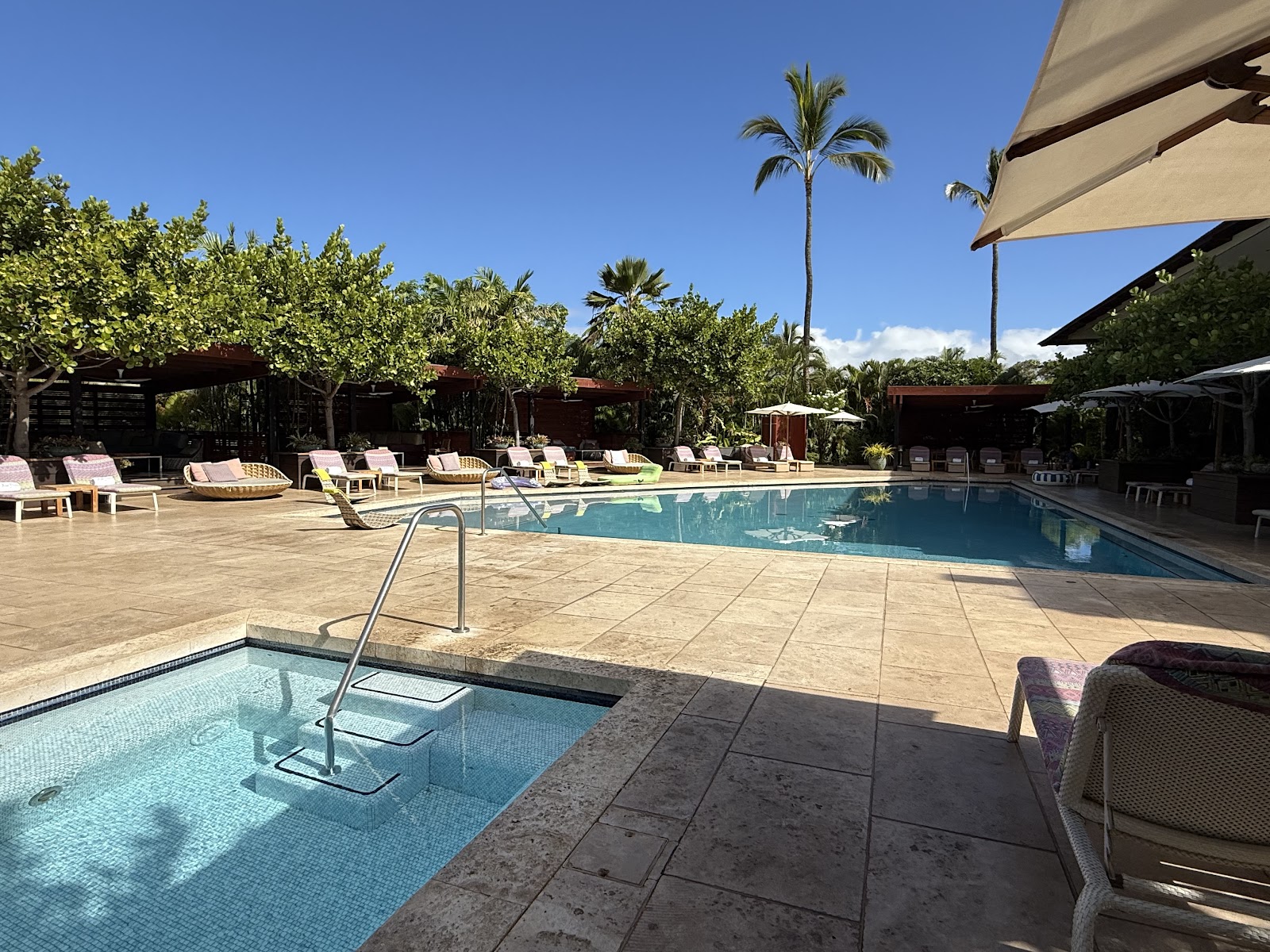
From elevation on Maui’s south coast, looking west, the landscape stacks: the hotel’s own planting in the foreground, the slope falling away, the coastal strip, the ocean, and — because this shore faces the channels — other islands on the horizon beyond it.
That is four or five distinct planes at different distances, and a frame containing them has depth in a way a flat coastal view does not. It is also the property’s distinctive photograph and the reason to choose it over a beachfront.
It needs a moderate telephoto rather than a wide lens, and this is the decision most often got wrong. A wide lens renders each plane at its true angular size, which means the islands become a thin band, the ocean becomes most of the frame, and the layering flattens into stripes. Compression stacks the planes so they read at something closer to the scale the eye perceives — which requires the camera a long way back from the subjects, on a hillside where that distance exists.
The exposure follows: expose for the distance, because the layers are what the frame is about, and lift the subjects with a close source, warm-gelled where the light is warm, at about a stop over the ambient on them. Metering on faces gives a white sky and a washed-out horizon and removes the reason for being above the coast at all.
The layering is also entirely dependent on air clarity, and on leeward Maui that is a variable. Vog — volcanic haze carried on the trades from Hawai’i Island’s vents — drifts onto this coast with some regularity, and it softens distance in a way no adjustment restores. On a clear day the islands are sharp; on a voggy one they are a suggestion.
That is worth knowing rather than fixing: the layered frame is available on clear days and not on hazy ones, and a hazy day’s plan should weight toward the close frames instead.
The second way out is the gradient, and on a hillside it is available everywhere.
From below the subjects they stand against open sky with no horizon behind them, which is the cleanest background available in any conditions and any weather — and which drops the buildings, the paths, the planting and the other guests out of frame in one move. On a small property where the locations are limited, that frame can be made almost anywhere, which effectively multiplies the number of available positions.
From above them, the coast and the ocean fill the space behind, which is the layered version at portrait distance rather than at landscape distance.
Two completely different frames from one spot, decided by walking twenty metres uphill or down — and on a small hillside property, that is the technique that makes a limited number of locations into a varied set.
The gradient also solves groups. A group needs everyone visible, which on level ground means a raised camera or a compromise; on a slope the level change is free. Arrange the group up the hill with the camera downhill and every face is visible without anyone standing on anything — and with the ocean behind them, which is the frame most couples at a coastal venue actually want.
The second two, and the vertical sun
The third way out is the planting, and at a small hillside hotel it does two jobs.
The first is shade, and it is urgently needed. At a near-vertical noon sun there is no position on open ground that fixes a face, and a small property has fewer covered structures than a resort. The species distinction that governs every venue in these islands is absolute: broadleaf canopy — monkeypod above all, which has an enormous spreading crown of small dense leaves and gives the best natural shade in Hawai’i, plus banyan and mango — blocks almost all light and gives soft reliable cover.
Palms do the opposite. A frond is a row of stiff parallel blades and with the sun within two degrees of vertical its shadow falls straight down a face as hard stripes that no exposure recovers. A hillside property is planted with a great many palms and they are background material only.
The second job is colour and mass, which a coast of sand, water and pale architecture lacks. Dense tropical planting gives strong colour at close range and genuine dark mass — and on a property whose wide frames are all pale blues and whites, one saturated or one near-black background is disproportionately valuable.
The bounce caution applies: a large mass of saturated colour in sunlight reflects its own hue onto skin at close range, which is an effect if intended and a problem if not. Control it with distance — at two metres it dominates, at six it is a cast, at fifteen it has gone.
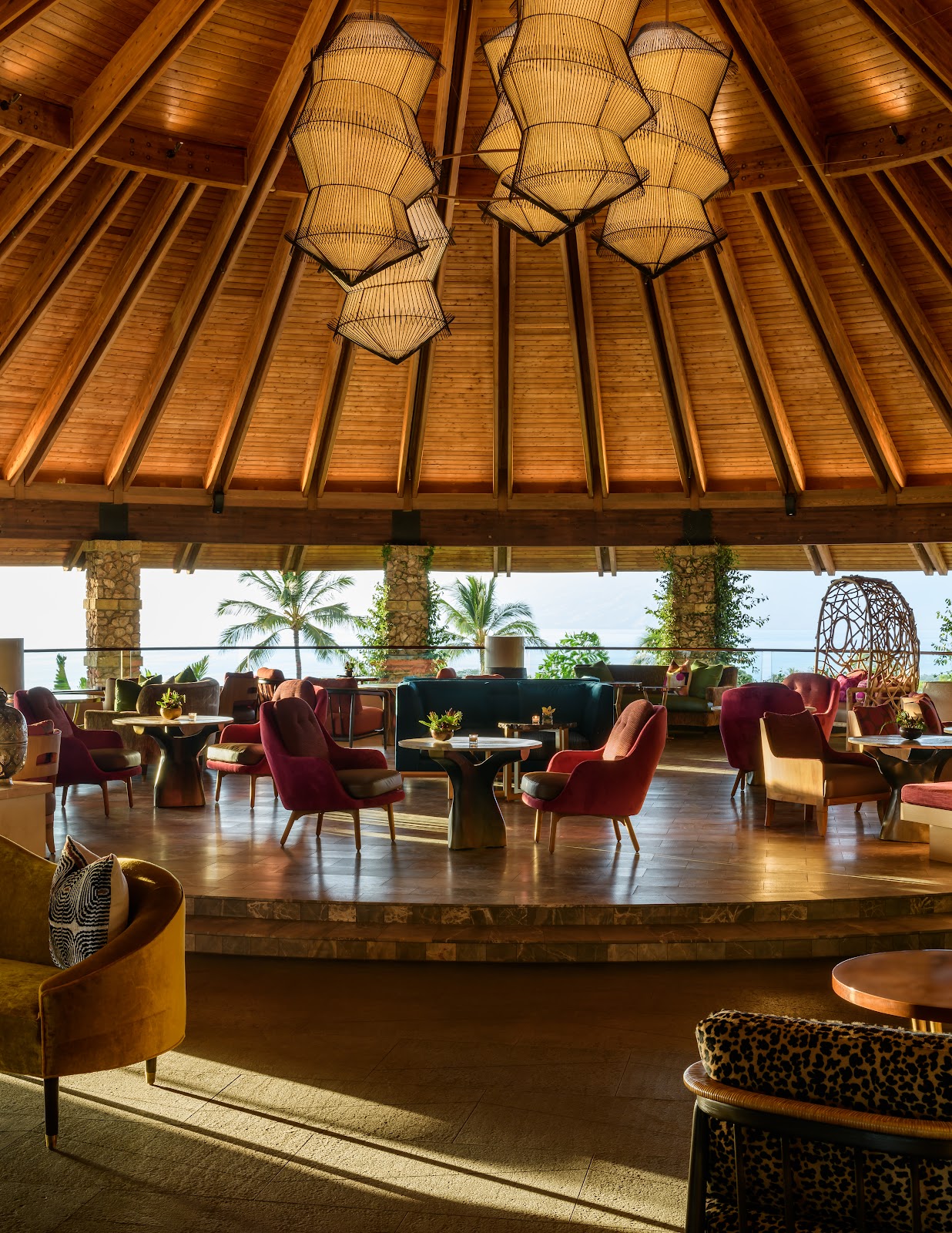
The architecture is the other cover, and on a small hotel it is likely to be more useful than at a large one because the buildings are closer together and more of them have covered edges. Depth back from any covered edge is the whole lighting control: at the edge flat and frontal, two or three metres back dramatic with the sunlit ground beyond four or five stops down.
A doorway is the purest version and the best free setup anywhere: a subject a metre inside an open door is lit by the whole sky in front and backed by the dark interior, a giant softbox and a four or five stop black backdrop, in any weather.
The fourth way out is the ends of the day, and on a hillside above a west-facing coast they are better than at a beachfront property.
The reason is the horizon. A beachfront venue’s low light is interrupted by the buildings and the palms along the shore; from elevation, the western horizon is clear and the sun’s last light arrives unobstructed — which means the whole of the low-light period is usable rather than the part that clears the obstacles.
The frames for that window: the couple with the sun behind them over the water, exposed for the sky and the ocean and lifted by a close warm-gelled source; the couple with the sun behind the camera and the layered view behind them, which needs nothing; a low-camera frame against the deepening sky; and a silhouette against the ocean horizon, which works because a clean sea horizon gives a simple graphic field.
The gel is not optional. A sun close to the horizon is extremely warm and the open shade is lit by a blue tropical sky, so a daylight-balanced flash puts cool faces into a gold landscape.
Then dusk, and it is short: about twenty-two minutes of civil twilight, with the sun descending steeply at this latitude and an abrupt end. From elevation the whole of it is usable, which is the hillside’s last advantage — but it is still twenty-two minutes, and a plan assuming a leisurely golden hour will lose most of it.
Work faster than instinct suggests, get the direct-light frames first, and treat the blue period as a separate short session. And from above a coast, the afterglow over the ocean lasts visibly longer than it does from sea level, which is worth staying out for.
- Compress the layered view with a telephoto; wide flattens it into stripes
- Camera below subjects gives a clean sky background almost anywhere
- Arrange groups up the slope with the camera downhill — and the ocean behind
- Monkeypod is cover; palms are background and never cover
- From elevation the whole twenty-two-minute dusk is usable — and still short
The leeward year
Hawai’i has two seasons rather than four and the difference is rain rather than temperature — and on a leeward hillside in the rain shadow of a ten-thousand-foot volcano, the rain barely arrives.
That makes this a weather-reliable venue, which matters more at a small property than at a large one: there is less indoor space to retreat into, so the reliability of the outdoor plan carries more of the day.
The drier season runs roughly May to September. The trades are steadiest, the rain shadow is at its most effective, and the sunset over water is available on most evenings.
The costs are the sun and the vog, and both are worse at a hillside venue than at a beachfront one. The near-vertical noon sun is at its worst in these months — it passes exactly overhead in late May and mid-July — and a small property has less cover than a resort. And vog, which is more persistent in the drier months as the trades carry emissions north-west from Hawai’i Island, removes the layered island view that is this property’s distinctive frame.
That second point deserves emphasis: at a beachfront venue vog costs some atmosphere; at a hillside venue whose principal asset is a long layered view, it costs the frame.
The wetter season runs roughly November to March and on this coast it is not very wet. What changes is that the trades are interrupted more often by Kona weather — a reversal bringing wind and rain from the south-west — and that cloud is more frequent generally.
For photographs the wetter season is better in four ways at this venue. The December noon sun at about forty-six degrees is the lowest of the year, which means the middle of the day is workable rather than hostile. Cloud is more frequent, which softens the extreme contrast an undiffused tropical sun produces. Vog is less persistent, which means the layered view is clear more often — and clarity is what that frame depends on entirely.
And it is whale season. Humpbacks are in Hawaiian waters from roughly December to April, and the channels off south Maui are where they concentrate most densely — which from elevation means they are visible as part of the layered view rather than as a close subject, and a long lens will find them in it.
Winter also brings the calmest sea of the year to a south-facing coast, which is the reverse of the north shores: the big swells arrive on the north side from November to February while the south stays placid, and the south’s swells come in summer. That matters for any beach access and for how the water reads in a wide frame — a glassy channel is a different background from a broken one.
And a chance of snow on Haleakala’s summit, which from a south Maui hillside is visible above and behind — a snow-capped volcano in the same frame as a tropical hillside is one of the more improbable things available in these guides.
There is no autumn colour here and no dormant season: tropical vegetation holds its leaves year-round, which removes the seasonal cue photographs elsewhere in this guide depend on. Nothing in an image made here says what month it is except the angle of the light, the clarity of the air, and whether the channel has whales in it.
What does change is flowering, and at a planted hillside property that is the useful question to ask rather than assume. Central Pacific hurricane season runs from June to the end of November, though direct strikes are rare.
More frames from Hotel Wailea
Hotel Wailea wedding photography: common questions
What is the problem with a hillside venue?
The ocean is a view rather than a location — the beachfront frames are simply not available on the property.
What does elevation give instead?
A layered view with four or five planes, a gradient that works everywhere, and a clear western horizon so the whole of the low light is usable.
What lens for the view?
A moderate telephoto. A wide lens renders each plane at its true angular size and flattens the layering into stripes.
How do I multiply a small property's locations?
The gradient. A camera below the subjects gives a clean sky background almost anywhere, and above them gives the coastal view — two frames from one spot.
What removes the layered frame?
Vog. Volcanic haze carried from Hawai’i Island softens distance in a way nothing restores, and it is more persistent in the drier months.
When is the venue at its best?
The winter months: a lower sun, more cloud, less vog so the layers are clear, the calmest sea of the year on a south coast, and whales in the channel.
More Hawaii venue guides
We are writing a photographer’s guide to every venue we would happily shoot in Hawaii. Here are three more, plus the full index:
- Kualoa Ranch, Kaneohe: The Problem and Four Ways Out of It
- Lumeria Maui, Makawao: How the Light Moves Upcountry
- Maui Tropical Plantation, Waikapu: The Venue’s Own Logic
Planning a wedding at Hotel Wailea?
Elevation instead of sand. Tell us your date and we will use the layers.