 The Laniakea YWCA: A Building Organised Around Its Courtyard
Maui Tropical Plantation, Waikapu: The Venue’s Own Logic
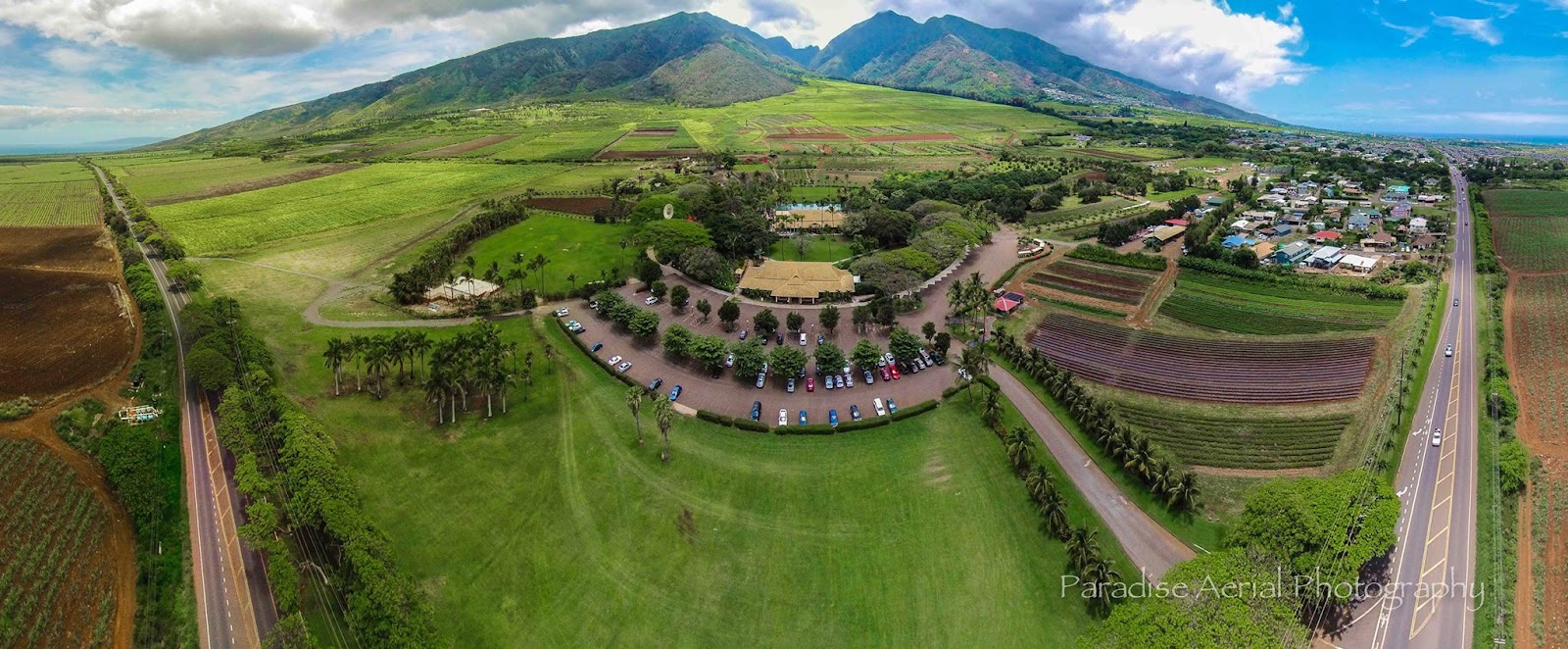
Planted in rows, and sited in the gap between two volcanoes.
This venue has two organising facts and they work at completely different scales: the planting is agricultural, and the site sits in the isthmus between two volcanoes.
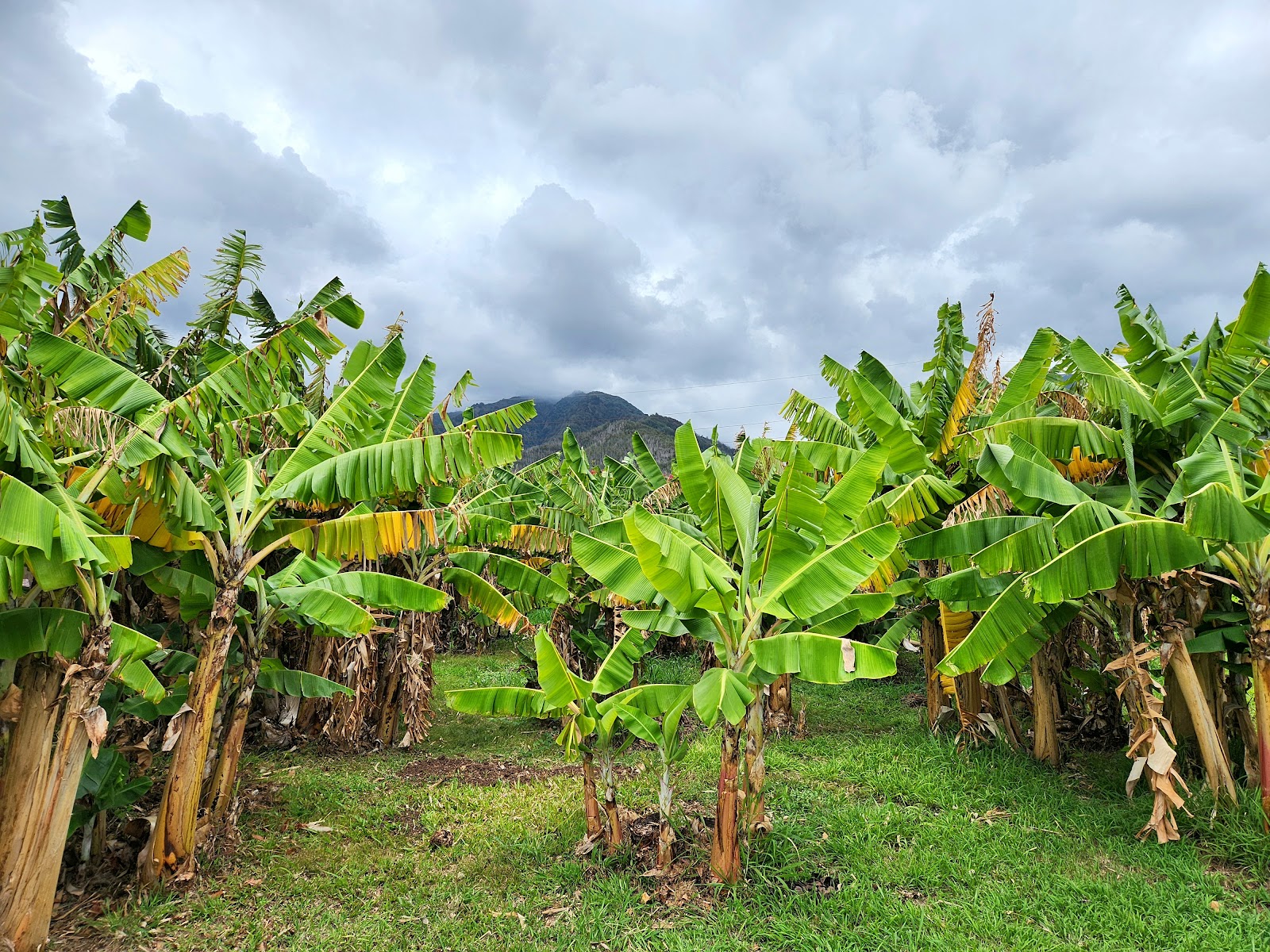
The planting first, because it decides every close and middle-distance frame. A working plantation grows crops in rows — that is what agriculture is — and rows are a compositional structure whether or not anyone intends them to be.
A row photographed straight down its length is a corridor: strong converging perspective, a clear vanishing point, and a natural place to put two people. A row photographed square across is a rhythm: repeating verticals at regular intervals, which is one of the strongest graphic structures available. A row photographed at any angle between those two is converging clutter — lines crossing lines with no order, which reads as a mistake.
So the rule at any agricultural venue is: down a row, or square across it, and never between. That single discipline accounts for most of the difference between good and poor work on planted ground.
The isthmus is the second fact and it decides the light. Central Maui is a low flat plain between Haleakala to the east and the West Maui mountains to the west — a gap between two large volcanic masses. The trade winds funnel through that gap, which makes it the windiest part of the island, and the two ranges on either side shape when the light arrives and when it goes.
The practical consequences are three. The wind is persistent rather than occasional, which makes a lightstand a liability and hair and fabric unpredictable. The West Maui mountains take the evening sun earlier than the published sunset, so the low light window is shorter than the almanac suggests. And Haleakala to the east takes the morning sun later, for the same reason in reverse.
The middle of the day, by contrast, is fully lit — which at twenty and nine-tenths degrees north means a sun within two degrees of vertical in summer and still forty-six degrees at the winter solstice. That inverts the normal schedule: this is a site whose direct light is in the middle of the day and whose ends are soft.
Days run only from about eleven hours to thirteen and a quarter, and civil twilight is around twenty-two minutes — the shortest in this guide.
We have not photographed a wedding at this plantation. Which spaces and grounds are included, whether the working areas and the rows are accessible, what covered alternatives exist and what the permitted hours are, are questions for their team.
Maui Tropical Plantation at a glance
| Where | A working plantation in the central Maui isthmus, between two volcanoes |
| The planting | Rows: down one or square across it, and never at an angle between |
| The site | A gap between two volcanic masses — persistent wind, and shortened light at both ends |
| The inversion | The direct light is in the middle of the day; the ends are soft |
| Ask first | Included grounds, access to the rows and working areas, covered alternatives, hours |
Reading the rows
Down a row is the frame worth planning, and it has specific requirements.
The camera needs to be on the row’s centre line, because a corridor read from off-centre converges asymmetrically and looks careless rather than deliberate. It needs to be level, because the rows give strong horizontals and verticals that show a tilt immediately. And it needs to be at about the subjects’ chest height, so the plants do not lean and the perspective stays honest.
The subjects then go into the corridor rather than in front of it — standing within the rows with plants on both sides, which is what makes the frame about the plantation rather than merely set in it. How far down the row they stand decides whether the picture is a portrait with context or a landscape with people: close is the first, well down it is the second, and both are worth taking.
Square across the rows is the other frame and it is the one people miss. A crop planted at regular intervals, photographed perpendicular to the rows, gives a repeating rhythm of verticals with light and shade alternating between them — and a subject placed in one gap, with the rhythm continuing on both sides, is framed by the planting the way a colonnade frames a figure.
That works particularly well with tall crops, where the plants are above head height and the gap becomes a genuine opening rather than a space between low plants.
The crop’s height is the variable that changes everything and it is worth asking about before the date. A low crop is a surface: it reads as texture at the bottom of a frame and the subjects stand above it against sky. A tall crop is a wall: it fills the frame behind standing subjects, which is a completely different photograph and usually a better background, because a dense uniform field of foliage at head height is a clean backdrop.
The limitation of a tall crop is that it is green, and green is the least useful background colour there is — skin sits close to it in luminance and complementary to it in hue. The answers are the ones that apply at every green venue: get close enough that it goes soft, or find the non-green surfaces, or lower the camera so the background is sky.
The working infrastructure is the plantation’s other content and it needs the same decision every farm requires: an implement, a truck, a shed, a flume, a stack of crates is a strong object and it will be the second thing the eye finds after the faces — which means it belongs fully in the frame, deliberately placed, or not in it at all. Half-cropped at the edge is the worst option.
The red soil is worth a specific warning. Hawaiian volcanic soil on the older islands is deeply oxidised and runs a strong red-brown, and it stains fabric permanently. That is a genuine hazard to a white dress and it belongs in the conversation before anyone walks into a field rather than afterwards.
It is also a photographic asset used deliberately: red soil is the only strongly saturated non-green element on a plantation, and a subject standing on a red dirt track between green rows is a three-colour frame — red, green and sky — that no other venue type in these islands offers.
One further note on the tropical planting: the species distinction that governs every venue here applies. Broadleaf canopy blocks and gives soft reliable shade; palms give hard slatted stripes under a near-vertical sun and are background only. A plantation with palm plantings has a great many of the second kind.
The isthmus, the wind and the volcanoes
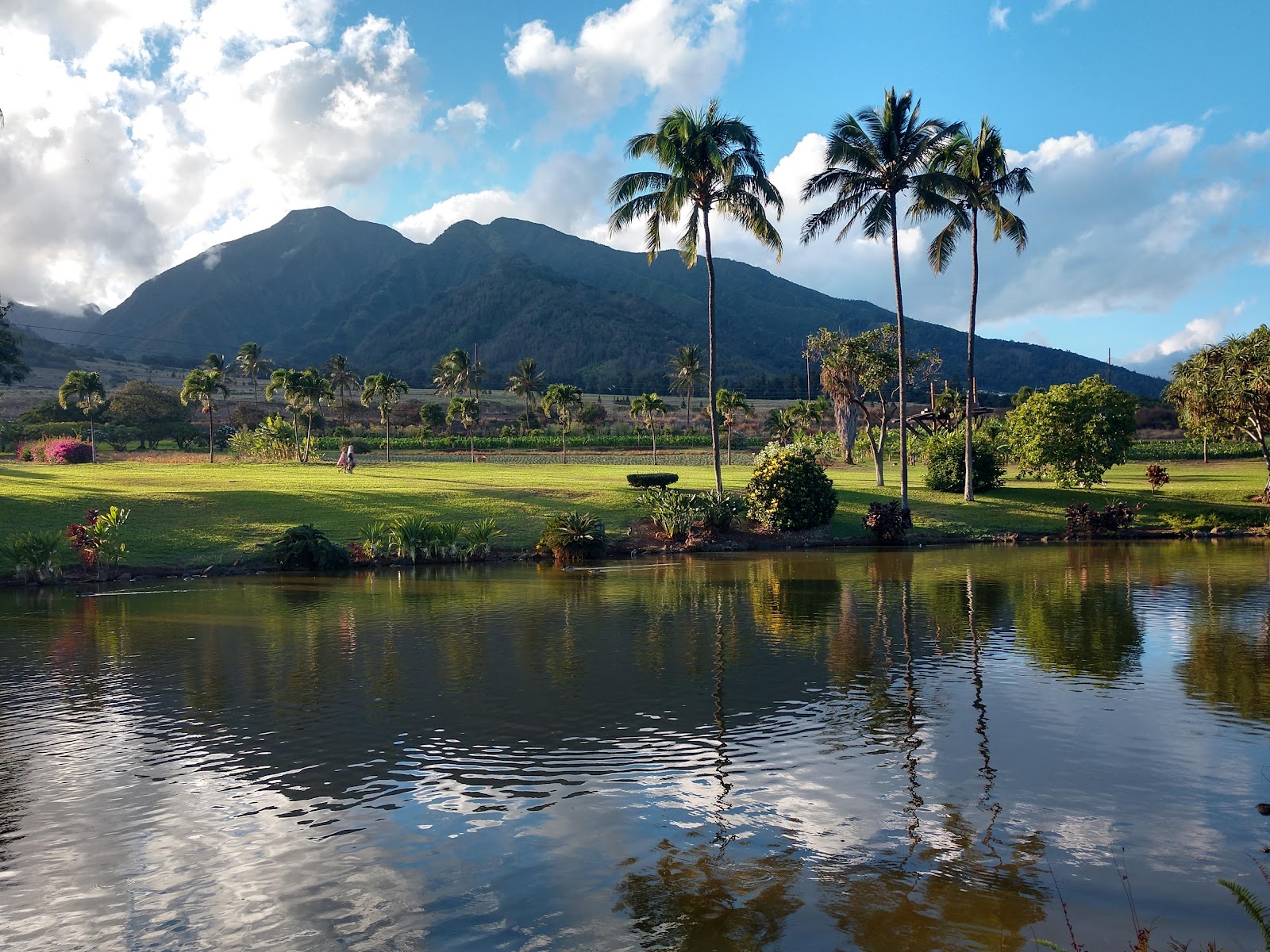
The two volcanoes are the site’s setting and they are worth treating as two different backgrounds rather than one.
Haleakala to the east is a single enormous shield volcano rising to over ten thousand feet — smooth-sloped rather than eroded, because it is geologically young, and so large that from the isthmus it fills a whole side of the sky. Its slopes take the evening light frontally, which means in the late afternoon there is a vast lit mountain flank behind subjects standing in shade.
The West Maui mountains are the opposite: much older and deeply eroded into fluted valleys and sharp ridges, green to the top, and taking the morning light. A fluted range only reads as texture when light crosses it at a shallow angle, which means the West Maui side is a morning subject and a flat green mass by afternoon.
So the two ranges swap: the morning frame faces west at the eroded range, and the evening frame faces east at the smooth one. Knowing that means the schedule can put a mountain frame at either end of the day rather than gambling on one.
Both need the same lens decision, and it is the one most often got wrong. A wide lens renders distant mountains at their true angular size, which is modest even for something ten thousand feet high and twenty miles away — so a wide frame makes a volcano look like a hill. A moderate telephoto compresses, which brings the mass forward so it reads at something closer to the scale the eye perceives, and it requires the camera a long way back from the subjects.
The exposure follows: expose for the mountain, because that is what the frame is about, and lift the subjects with a close warm-gelled source at about a stop over the ambient on them. Metering on the faces gives a white sky and a washed-out range.
The cloud is the variable. Both ranges generate their own cloud through the day — orographic lift builds it on the slopes from mid-morning — which means a summit that is clear at seven is often capped by ten. The practical response is to take the mountain frames early if the peak matters, and to treat cloud on the slopes as an asset rather than an obstacle, because it gives a smooth volcanic flank the scale and depth that a clear one lacks.
The wind is the isthmus’s defining condition and it is not occasional. Trade winds funnelling between two large volcanic masses accelerate, which makes central Maui reliably the windiest part of the island — and that has practical consequences rather than aesthetic ones.
Every source is handheld or weighted; a stand on open ground is not a proposition. A veil is unmanageable in the open and a long dress behaves unpredictably. Loose paper, petals and anything light-weight moves. And a tall crop in wind is in constant motion, which means a slow shutter will blur it — that is either an effect or a problem, and it should be chosen.
The shelter is the answer and there are three kinds. Any covered structure works as a directional soft source with a hard mask, where depth back from the open edge is the whole control. The lee side of a dense broadleaf stand or a windbreak row is genuinely calmer. And a tall crop itself is a windbreak at ground level — standing between rows of a head-high crop is the most sheltered position in an open field.
Two practical notes. The isthmus is low and dry compared with the windward slopes, which means the ground is firm and dusty rather than muddy — and dust in a strong wind is a consideration for equipment as well as for clothes. And at twenty-two minutes, civil twilight here is the shortest in this guide, with the West Maui mountains taking the direct light before it even begins.
- Down a row or square across it, never at an angle between
- Ask the crop’s height before the date — a wall and a surface are different venues
- Red volcanic soil stains fabric permanently, and is the only strong non-green colour
- West Maui in the morning, Haleakala in the evening — the ranges swap
- Handhold every source: the isthmus is the windiest part of the island
The isthmus year
Hawai’i has two seasons rather than four and the difference is rain rather than temperature — and in the isthmus, which is low and sits between two rain shadows, the rain is moderate in both.
The drier season runs roughly May to September. The trades are steadiest, which in the isthmus means the wind is at its strongest and most persistent — and that is the season’s defining practical fact rather than the sun.
The sun is the other one. At twenty and nine-tenths degrees north the June noon sun reaches about eighty-eight degrees, and it passes exactly through the zenith twice a year, in late May and mid-July, when a vertical object casts essentially no shadow at noon. That is the hardest lighting condition in these guides.
On a plantation the answer is unusually good, though: a tall crop is both shade and shelter, and standing between rows of a head-high crop at midday gives filtered overhead light and a break from the wind at the same time. That is a position no other venue type offers and it is worth knowing.
The drier season also brings the clearest views of both ranges, which matters because the mountain frames are the site’s widest subject — and the crops are at their fullest, which means the tall-crop backgrounds are available.
The wetter season runs roughly November to March, and in the isthmus it brings intermittent rather than constant rain: trade showers pass over from the windward side, and Kona events bring heavier rain from the south-west.
For photographs the wetter season is better for the light and worse for the ground. The December noon sun at about forty-six degrees is the lowest of the year, which means the middle of the day is workable rather than hostile and both ranges are modelled for a long period rather than an hour. Cloud is more frequent, which softens the extreme contrast a tropical sun produces.
And it is whale season: humpbacks are in Hawaiian waters from roughly December to April, and while the isthmus itself is inland, the coast on either side is a short distance away and the channels off Maui are where they concentrate most densely.
Winter also brings a chance of snow on Haleakala’s summit, which from the isthmus is directly visible — and a snow-capped volcano above a green tropical plantation is one of the more improbable frames available anywhere in these guides.
The cost is the ground. Red volcanic soil in wet weather is soft and it stains more readily than when dry, which on a working plantation limits where a party in formal clothes can go and makes the tracks and built surfaces the only reliable positions.
There is no autumn colour in these islands and no dormant season for the vegetation, but a plantation does have an agricultural calendar and it is the one seasonal signal available. What is planted, how tall it is, and whether a field is in crop, harvested or bare changes across the year — and unlike weather it is knowable in advance.
That makes one question the most useful piece of preparation for this venue: what will be growing, and how tall, on the date. The answer decides whether the rows are a wall or a surface, and that decides half the frames.
Central Pacific hurricane season runs from June to the end of November, though direct strikes on the islands are rare.
More frames from Maui Tropical Plantation
Maui Tropical Plantation wedding photography: common questions
How should I use planted rows?
Straight down a row for a corridor, or square across them for a rhythm of verticals. Any angle between gives converging clutter and reads as a mistake.
What is the most useful thing to ask beforehand?
What will be growing and how tall. A head-high crop is a wall behind standing subjects; a low crop is a surface they stand above. They are different venues.
What about the red soil?
It stains fabric permanently, which belongs in the conversation before anyone walks into a field. Used deliberately it is the only strong non-green colour on a plantation.
Which mountain when?
The eroded West Maui range takes the morning light and only reads as texture then. Smooth-sloped Haleakala takes the evening light frontally.
Why is the wind such a problem?
The trades funnel and accelerate between two large volcanic masses, which makes the isthmus reliably the windiest part of Maui. Every source is handheld.
Where is the shelter at midday?
Between the rows of a tall crop. It gives filtered overhead light and a break from the wind at the same time — a position no other venue type offers.
More Hawaii venue guides
We are writing a photographer’s guide to every venue we would happily shoot in Hawaii. Here are three more, plus the full index:
- Montage Kapalua Bay, Maui: Field Notes, Problem and Solution
- Olowalu Plantation House, Lahaina: The Venue’s Own Logic
- The Ritz-Carlton Maui, Kapalua: The One Decision That Governs Everything
Planning a wedding at Maui Tropical Plantation?
Rows, wind and two volcanoes. Tell us your date and we will ask what is growing.