 The Rio, Las Vegas: A Walk Through an Off-Strip Resort
The MGM Grand, Las Vegas: The Problem, and Four Ways Out
At a resort this size the enemy is not the light. It is the walk between one space and the next.
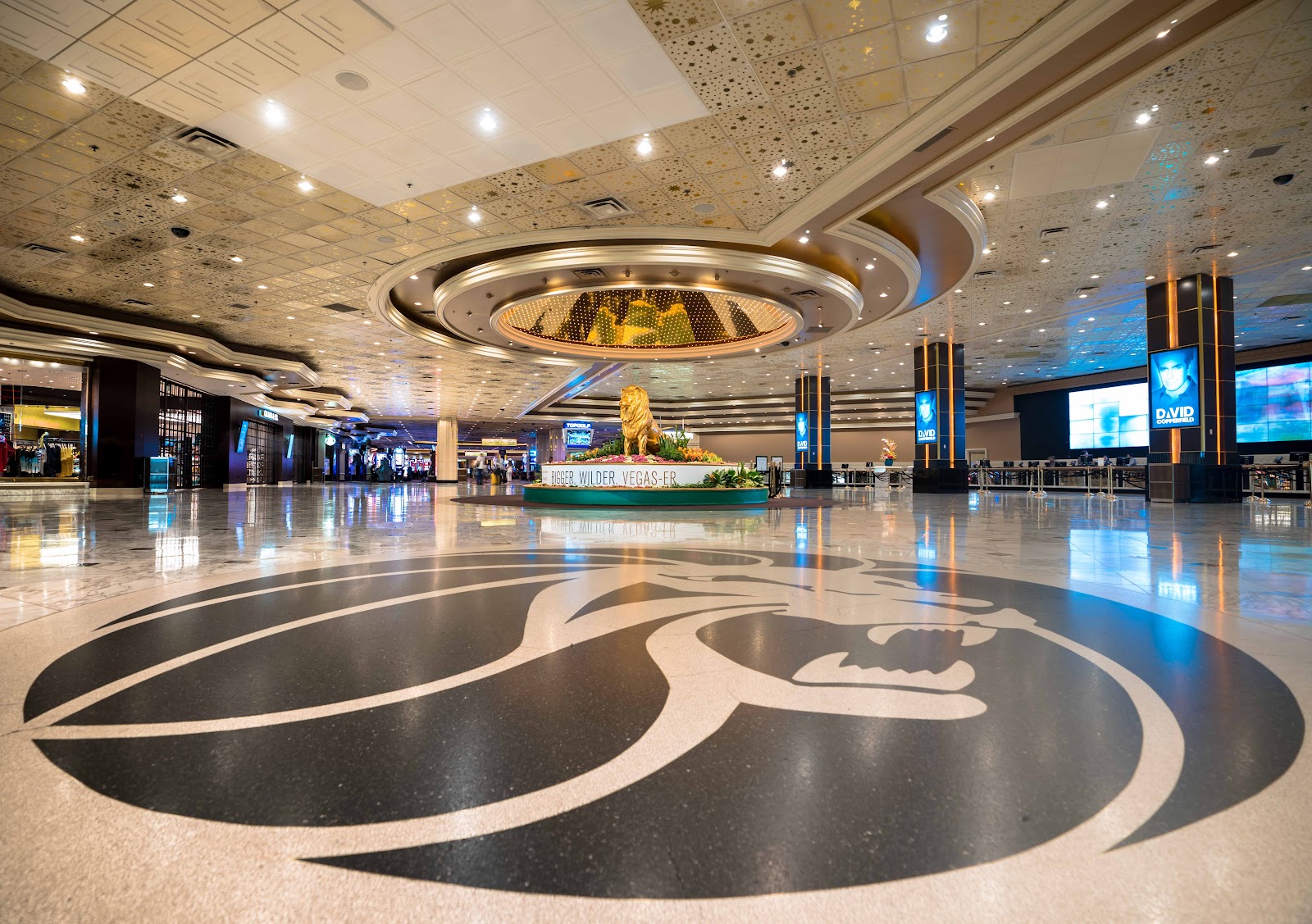
At a very large Strip resort the photographic problem is not primarily lighting. It is scale: the ceremony space, the reception space, the guest rooms and the exit to the street can be four or five minutes apart from each other, indoors, through public areas.
That sounds trivial and it eats a wedding day. A portrait block of thirty minutes with two eight-minute walks in it is a portrait block of fourteen minutes. And the twenty-five-minute dusk window — the only frame in this city that cannot be rescheduled — can be entirely consumed by getting from a ballroom to a door.
There are four ways out and all of them are planning rather than technique. That is the honest shape of the problem at a venue this size, and it is why the good galleries here come from schedules rather than from equipment.
We have not photographed a wedding at the MGM Grand; very large Strip resorts behave consistently in this respect. Which spaces are included, how they connect, and whether the lighting is adjustable are questions for their team.
The MGM Grand at a glance
| Where | Las Vegas Strip, Nevada |
| The problem | Spaces four or five minutes apart, indoors, through public areas |
| Way one | Walk the route in advance and time it honestly |
| Way two | Photograph the transitions instead of losing them |
| Way three | Cluster by location. Way four: protect the one unmovable window |
Ways one and two: time the route, and photograph it
The first way out is to walk the route before the day and time it with a watch rather than estimating it. Estimates at this scale are wrong by a factor of two, because the distances are longer than they look, the public areas are crowded, and a wedding party does not move at one person’s pace.
What the walk produces is a real number for each leg, and those numbers go into the schedule as blocks rather than as assumptions. It also produces the lift and corridor knowledge that makes the difference on the day: which route avoids the gaming floor, which lift serves the tower the guest rooms are in, which door actually opens onto the street. None of that is discoverable while carrying two cameras and following a bride.
The second way out turns the problem into the solution: photograph the transitions rather than treating them as dead time. A wedding party moving through a long corridor, a lift lobby, a wide passage or a stair is doing something, which is more than they are doing standing in a ballroom waiting to be arranged.
The frames these spaces give are specific. A corridor gives depth and repetition, with a subject at the far end sitting against a background that darkens by itself — the cheapest separation in any building. A doorway frames. A lift lobby is usually plain, which at a themed resort is valuable in itself. And a wide passage lets a group walk towards the camera with nothing behind them competing.
The requirement is a camera configuration that is already correct — a fast lens, a known ISO, a source on a bracket or in a hand — rather than a setup that has to be rebuilt at each stop. At this scale the rebuild costs more than the walk does.
The transitions also solve a resort-specific problem. The installed lighting on the main floors is dense and overhead, which shadows eye sockets and cuts a line under every chin; corridors and lobbies are frequently lit differently, sometimes from the side, and they are always less busy. A face photographed in a corridor looks better than the same face photographed on a casino floor, before any equipment is involved.
And one useful technical note: ceilings over the largest floors in these buildings are unusually low for their span, three or four metres across a hundred-metre space, which means bounce flash returns something usable. Test it with one frame on arrival — a dark or coloured ceiling absorbs or tints — but where it works, a bounced source is a very large soft one that needs no stand and survives a walking pace.
Ways three and four: cluster, and protect the window
The third way out is to cluster the day’s photography by location rather than by type. The instinct is to work through a list — details, then dress, then first look, then formals, then couple — and at a large resort that list produces four round trips.
The alternative is to finish everything in each place before moving. Everything in the guest room while there: details, dress, the getting-ready coverage, the window portraits, and the small-group frames. Everything in the ceremony area while there. Everything outdoors in one excursion. It produces exactly the same gallery with an hour of walking removed, and the hour goes back into photographs.
The cost is that it requires the couple’s agreement in advance, because it changes the order they expect. That conversation is easier before the day than during it.
The fourth way out is to protect the one window that cannot be moved. Everything inside this building is available at any hour, because there is no daylight in the public spaces and the interior does not change. The single exception is the twenty-five minutes after sunset, when the sky still holds light while the Strip’s illumination comes up and one exposure holds couple, sky and lit city together.
That frame happens once. At a venue where the nearest exterior door might be six minutes away, protecting it means booking the movement rather than the moment — leaving the reception fifteen minutes before sunset rather than at sunset, with a route already known and a destination already chosen.
It is worth saying plainly to a couple: ten minutes at the right time is the difference between having the picture of their wedding in Las Vegas and not having it. Most agree readily when it is put that way in advance.
Underneath all four ways, the standing interior conditions apply. Pale or evenly lit spaces give no natural separation, which is fixed geometrically: distance between subject and background, the darker end of the room, depth behind rather than a near wall, and a source brighter on the face than the room is on the wall. Patterned carpet competes at the same spatial frequency as a face, fixed by camera height that excludes it or distance that dissolves it. Reflective stone, glass and metal will show a badly placed light, fixed by fifteen seconds of checking from the camera position.
And colour is mixed everywhere: warm decorative fittings, cooler recessed downlights, coloured accents, illuminated signage and any uplighting installed for the event. Pick the temperature that should be correct, set white balance to it, and switch off or overpower what else lands on skin.
- Walk the route with a watch; estimates at this scale are wrong by half
- Photograph the transitions — corridors give the cheapest separation there is
- Finish each location completely before moving to the next
- Leave for the dusk frame fifteen minutes early, route already known
- Test bounce once; low casino ceilings usually return something
Outside, and the desert year
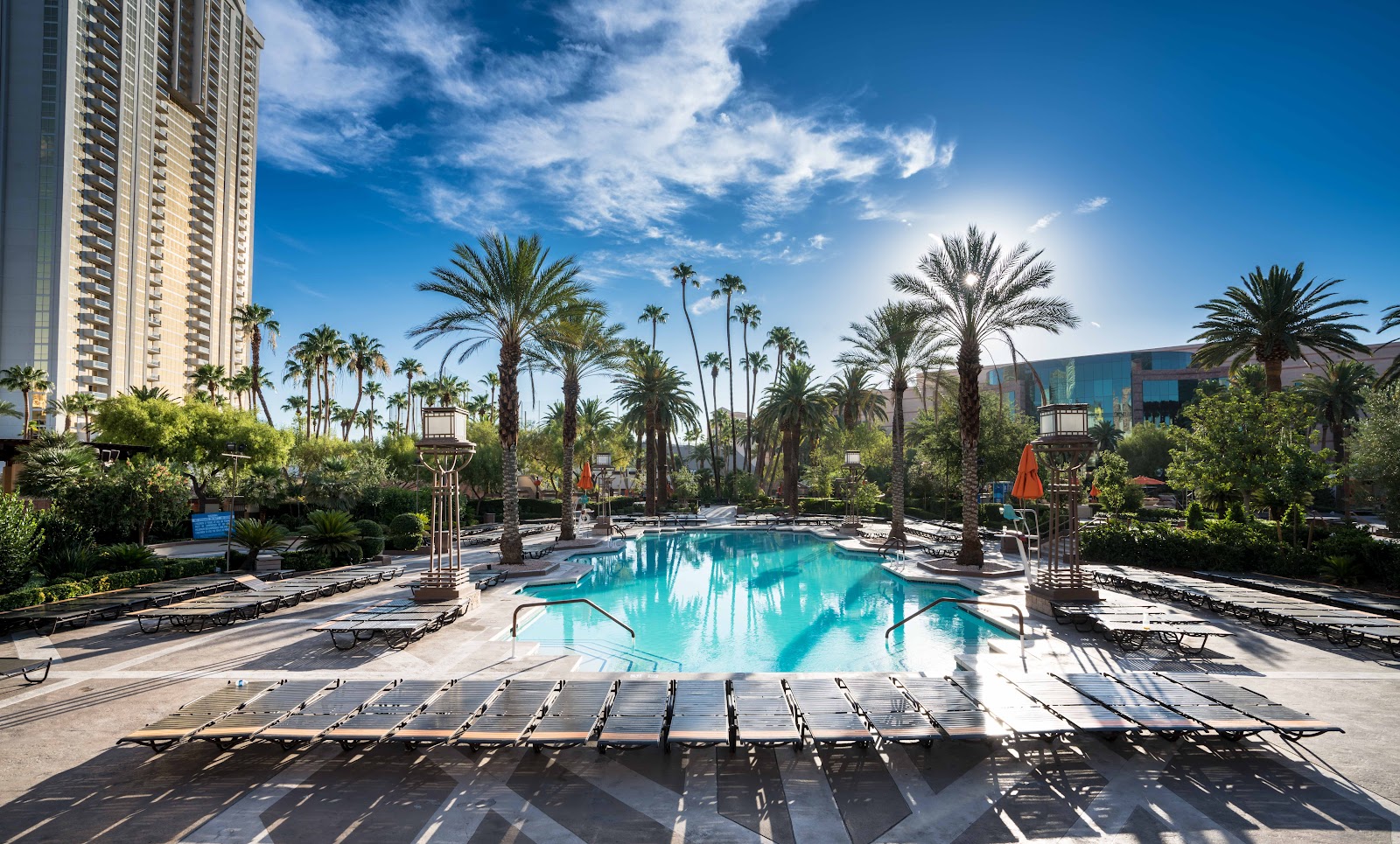
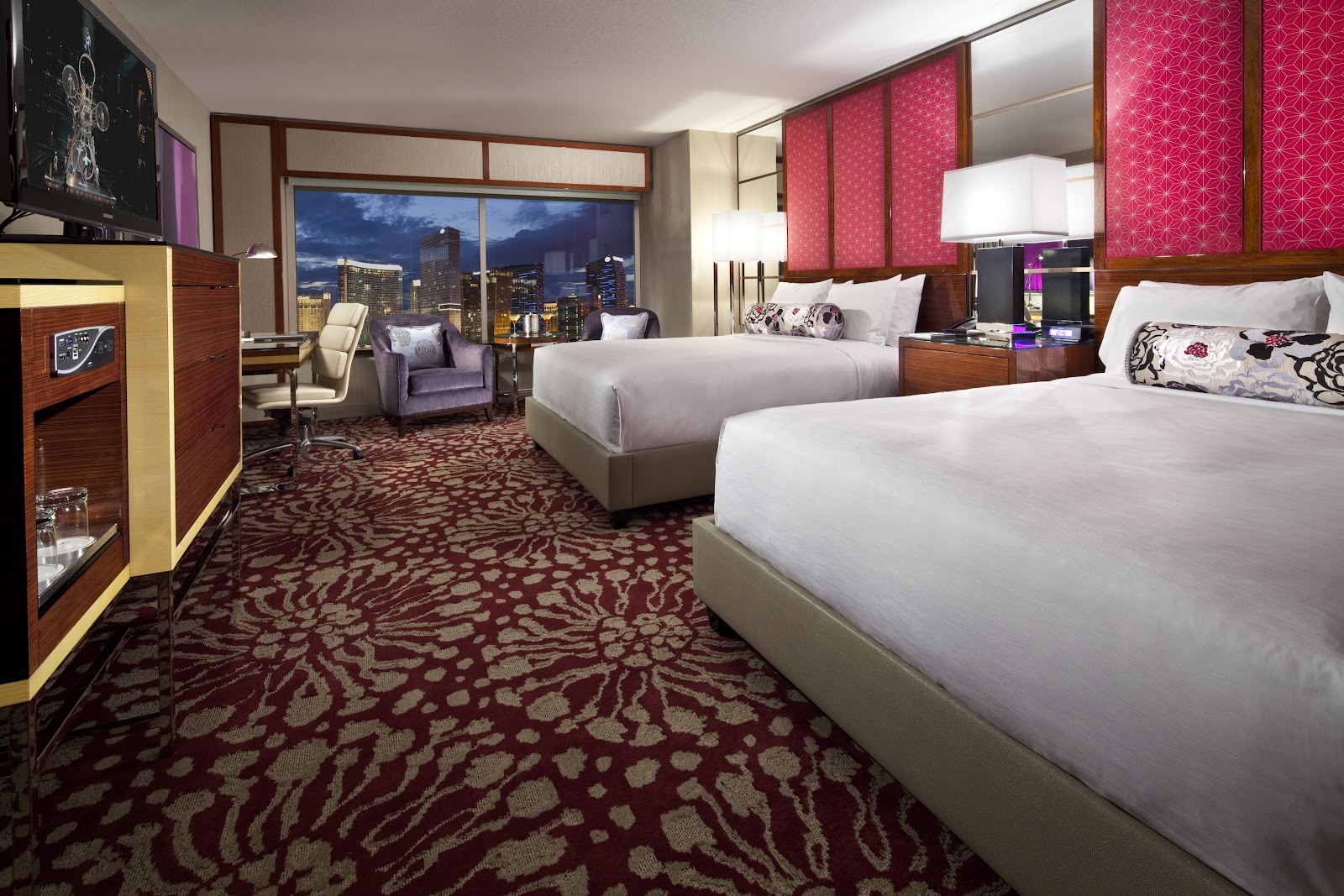
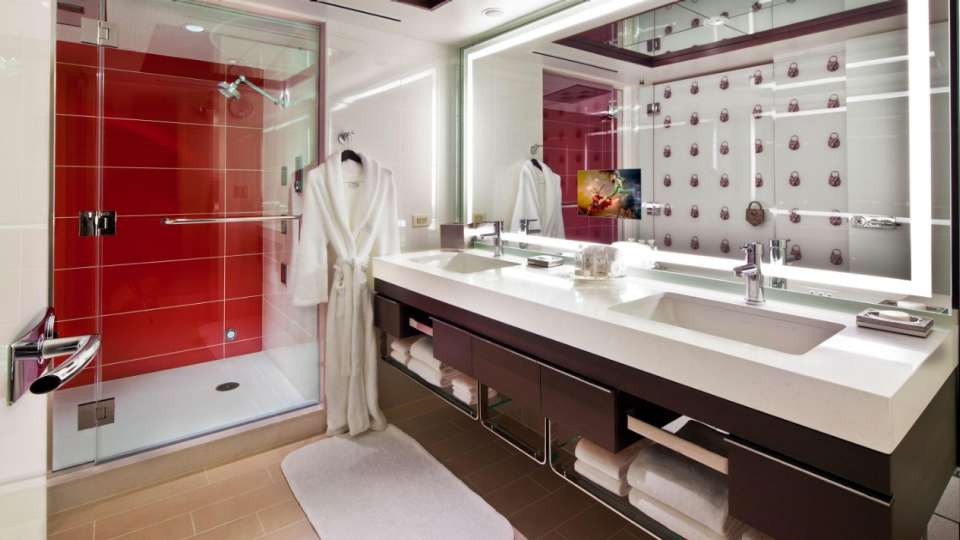
The guest rooms are the only interior daylight, and in a building of this kind they are correspondingly valuable. Largest window on the shaded side, every overhead fitting off so the room has one colour, lamps out of frame, two to three metres back from the glass so the fall-off is even across two faces.
Two local specifics. Direct sun through glass in this climate is among the harder sources a photographer meets, because the sun is high and the air is dry — the shaded side is the whole difference rather than a refinement. And floor height matters less here than in a dense city, because the towers are far apart and the sky is not blocked, so orientation is the question worth asking.
Outside, the Mojave gives the most extreme natural light of any major American city, because the sun gets very high — roughly seventy-seven degrees above the horizon at midday in June, at this latitude — and the air is very dry, so nothing scatters the light and the shadows are harder than the same angle would give in a humid climate. With close to three hundred sunny days a year, cloud is a bonus rather than a plan.
So there are two windows and no middle: the first hour after sunrise, the last hour before sunset, and the twenty-five minutes after it. Open shade in the desert is better than it sounds, because pale ground bounces light up into exactly the shadows a high sun carves — the cost being uplight under chins, so shade with a wall to one side beats shade in the open.
After dark the Strip is one of the brightest exterior environments in the world, so night portraits outdoors need nothing added. The caveat is spectral: saturated signage and neon put most of their energy into a narrow part of the spectrum, so they do not render skin the way broad-spectrum light does and one channel clips before the others. Background, not key.
The year is two and a half seasons. Summer, June into September, has daytime highs regularly above forty degrees Celsius, which makes an outdoor excursion a matter of minutes at the edges of the day — and at a venue where the door is six minutes away, that is an argument for choosing the nearest exit rather than the best view.
The monsoon from July into September brings occasional afternoon thunderstorms and blowing dust, the one time cloud is likely. Winter is the good season: mild, the clearest air of the year, sunset in mid-afternoon, which puts the unmovable window at a civilised hour and makes the whole protecting-it problem easier.
Spring is windy, and wind here means dust — haze that flattens distance and grit in everything. And fogging runs one way only in this climate: a cold body from air conditioning taken into forty-degree air fogs immediately. Twenty minutes of warming before the excursion is the entire fix, and at a venue this size the warming can happen during the walk.
More frames from The MGM Grand
The MGM Grand wedding photography: common questions
What is the real constraint at a resort this size?
Distance. Spaces four or five minutes apart turn a thirty-minute portrait block into fourteen minutes, and can consume the dusk window entirely.
What is the first thing to do?
Walk the route in advance with a watch. Estimates at this scale are wrong by a factor of two, and the lift and door knowledge is not discoverable on the day.
Why photograph the transitions?
Because a party in a corridor is doing something, and a corridor gives depth and repetition — the cheapest separation in any building.
What does clustering mean?
Finishing everything in each place before moving, rather than working through a list by type. It produces the same gallery with an hour of walking removed.
Which frame cannot be moved?
The twenty-five minutes after sunset. Everything indoors is available at any hour; that one is not, so leave fifteen minutes early with the route already known.
What should be asked about the guest room?
Orientation rather than floor height — the towers are far apart here so the sky is not blocked, but direct sun through glass in this climate is unusably hard.
More Las Vegas, NV venue guides
We are writing a photographer’s guide to every venue we would happily shoot in Las Vegas, NV. Here are three more, plus the full index:
- The Mirage, Las Vegas: One Frame, and How It Is Made
- The Neon Museum, Las Vegas: What It Suits, and What It Does Not
- New York-New York, Las Vegas: The One Decision That Governs Everything
Planning a wedding at The MGM Grand?
The schedule is the equipment here. Tell us your date and we will walk the route.