 The Rio, Las Vegas: A Walk Through an Off-Strip Resort
The Neon Museum, Las Vegas: What It Suits, and What It Does Not
Nowhere else looks like this. Nowhere else is this hard to expose.
An outdoor collection of historic Las Vegas signage is the most distinctive venue in the city and one of the most technically demanding anywhere. Both of those are worth stating before a couple books it.
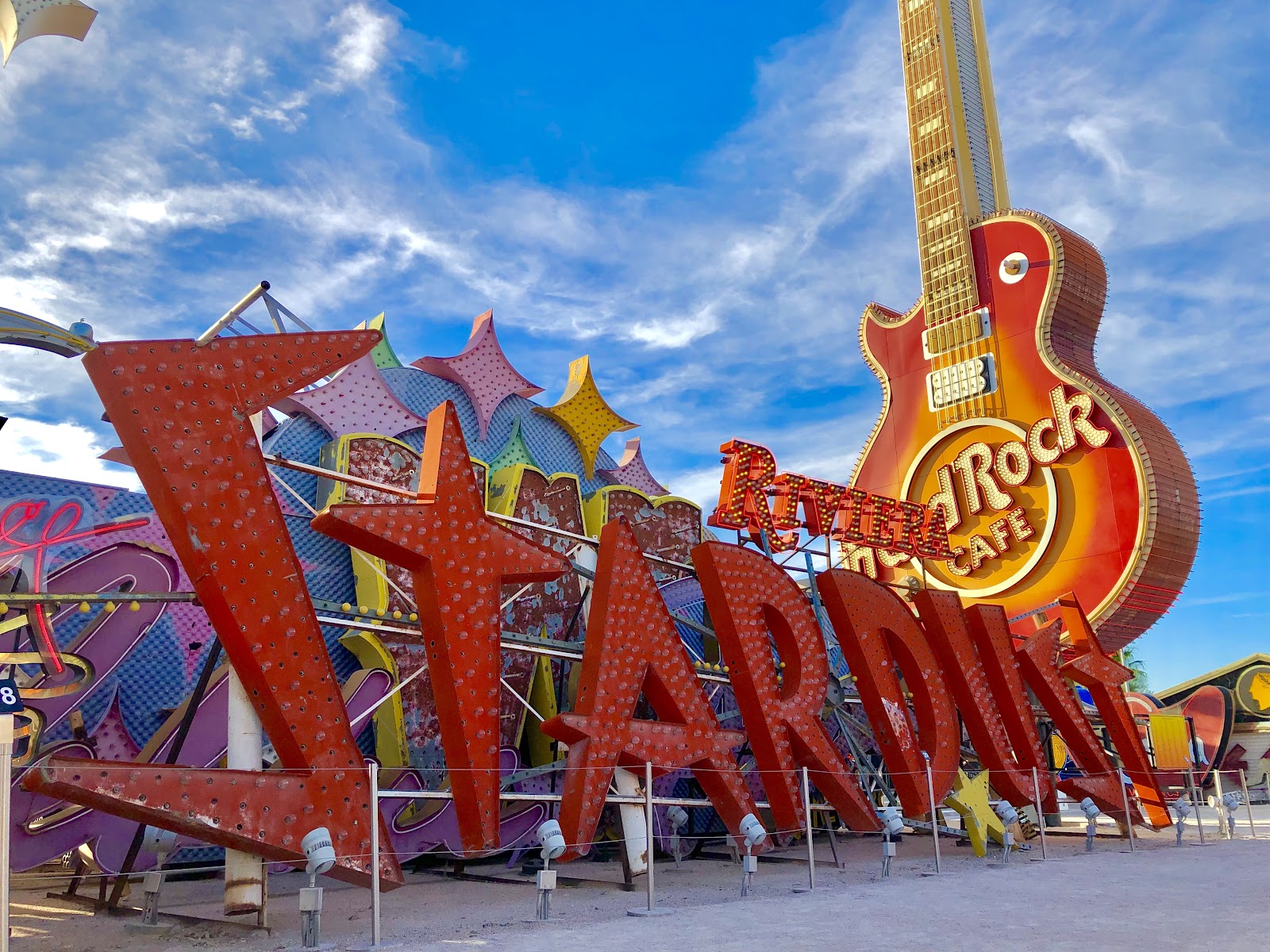
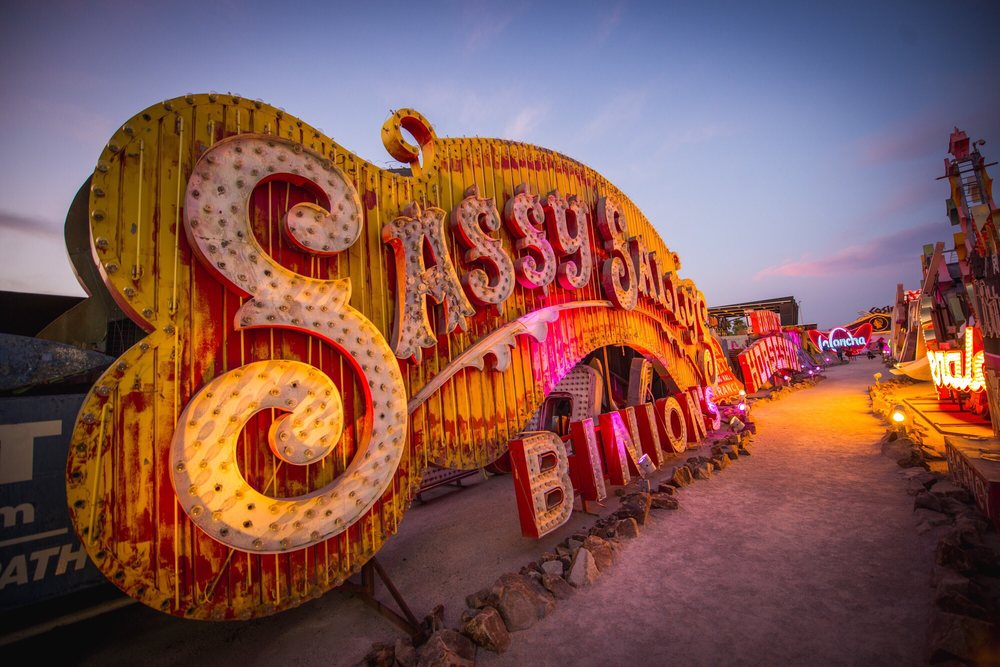
What it gives is a background that exists nowhere else on earth: decades of lettering, colour, metal and glass, in an open desert lot. A gallery made here is identifiable at a glance, which is a rare thing for a wedding.
What it asks is real. It is outdoors in the Mojave, which means the middle of the day is unusable. Many of the signs are unlit, which makes a daytime visit a study in rusted metal rather than glowing colour. And where the signs are lit, they are narrow-spectrum coloured sources that do not render skin — which is a physical fact rather than a stylistic preference.
We have not photographed a wedding at the Neon Museum; outdoor collections of signage behave predictably and neon’s spectral behaviour is fixed. Access rules, which areas are included, whether the signs are lit at the planned hour and what may be brought are all questions for their team.
The Neon Museum at a glance
| Where | Downtown Las Vegas, Nevada |
| Suits | A background that exists nowhere else; night frames; graphic composition |
| Resists | Midday sun, unlit signs by day, and neon as a light on skin |
| The best hour | The twenty-five minutes after sunset, and the hour after that |
| Ask first | Access rules, areas included, whether signs are lit, what may be brought |
What it suits
The night frames first, because they are the reason to be here. Lit historic signage at close range is an extraordinary background: saturated, layered, full of type and pattern, and completely specific to this city. A couple in front of it is unmistakably in Las Vegas in a way that no hotel interior achieves.
The best time is the roughly twenty-five minutes after sunset, when the sky still holds deep blue and the lit signs sit at about the same brightness as it. In that window one exposure holds the couple, the signage and the sky together, and it is the frame the site exists to give. After it, at full dark, the frames become graphic rather than atmospheric — the sky goes black, the signs float, and the pictures are strong in a different way. Both work; only the first is time-limited.
It suits graphic composition, which is the second thing. Large lettering is a compositional element unlike anything else: it has scale, rhythm and meaning, and a couple placed against a single enormous letter or word is a frame that needs no explanation. It rewards deliberate placement far more than most venues do.
It suits long lenses and tight framing. A collection of signs at various distances compresses beautifully, with letters from three different signs stacking into one layered field — which also solves the problem of a background that would otherwise be too busy.
It suits the two ends of the day for texture. Low sun raking across rusted steel, peeling paint, cracked glass and porcelain enamel makes material read in a way flat light never does, and a good deal of this collection is about material rather than illumination. The first hour after sunrise and the last hour before sunset are genuinely good here in a way the middle of the day is not.
And it suits a couple with an appetite for something that does not look like a wedding. That is worth saying plainly: the pictures from here are unusual, saturated and graphic, and they belong to a couple who wanted exactly that. For anyone hoping for soft romantic light and pale backgrounds, the site will fight them, and the honest advice is to choose somewhere else.
What it does not suit
The middle of a Las Vegas day is the first refusal, and it is absolute. At about thirty-six degrees north the June midday sun sits roughly seventy-seven degrees above the horizon — near enough to straight down that eye sockets go black and every chin gets a hard shadow — and the very dry air scatters almost nothing, so the contrast between lit and unlit exceeds what a sensor holds. In an open outdoor lot with little shade, there is nowhere to escape to.
The workarounds are limited and worth knowing. The shadow side of a large sign is real shade and it is directional, because the sign blocks the overhead component and the pale ground bounces light back up — that is a genuinely good position and there are usually several. Bringing a diffusion panel is the other answer and it works, but it needs a person to hold it and it fails in wind.
Unlit signs by day are the second gap and it surprises people. A large proportion of historic signage in a collection like this is not illuminated, either because it is unrestored or because it is not powered during daylight. By day those signs are rusted steel and faded paint, which is a beautiful subject and not the glowing colour a couple pictured when they booked. The fix is expectation rather than technique: ask which signs are lit and when, and plan the day accordingly.
Neon as a light source is the third and it is the physical one. Saturated coloured signage puts a great deal of energy into a narrow part of the visible spectrum and very little into the rest, which means skin lit by it has almost no information in two of its three colour channels. That is not a colour cast that can be corrected — it is missing data, and no editing recovers it.
So the working rule is unconditional: signage goes behind the couple, and one gelled source of your own lights the faces. Gelled warm to roughly match the dominant colour nearby, with white balance set to the gel, so the faces read as though the place is lighting them while remaining correctable.
Exposure is the fourth difficulty and it follows from the same physics. A saturated sign clips one channel long before the others, so a red sign that looks correctly exposed on a histogram may already have lost all its detail in the red channel — leaving a flat shape rather than a lit tube. The habit that prevents it is to watch the individual channels rather than the overall exposure, and to err a stop darker than instinct suggests, because saturated colour holds up much better underexposed than over.
Wind is the fifth and it is specific to an open desert lot in spring: blowing dust, grit in everything, a diffusion panel that becomes a sail, and haze that flattens anything distant. It also makes any lightstand a hazard rather than a tool, which for an outdoor venue means a source on a bracket or in an assistant’s hand instead.
And the physical conditions deserve a plain note: an open lot in summer with metal structures in it is hotter than the ambient temperature, and daytime highs here run regularly above forty degrees Celsius in July. A midday summer visit in formal clothes is not a photographic decision, it is a welfare one.
- Book the twenty-five minutes after sunset; that is the frame
- Signage behind, always — one gelled source owns the faces
- Watch individual colour channels; saturated signs clip one long before the rest
- Use the shadow side of a large sign as directional shade
- Ask which signs are lit, and when, before the schedule is written
The year, and the practicalities
The seasons decide whether this venue is a pleasure or an endurance test, and the difference is larger here than at any indoor venue in the city.
Summer, June into September, has daytime highs regularly above forty degrees Celsius. In an open lot that makes daylight visits a matter of minutes at the very edges of the day — and it makes the after-dark session the whole event, which is no hardship, because after dark is when the place is best. A summer wedding here should be an evening wedding.
The monsoon period from July into September brings occasional afternoon thunderstorms and blowing dust. A thunderstorm is a genuine interruption at an outdoor venue and needs a named alternative, though a desert storm sky over signage at dusk is the most dramatic frame the city can produce, and wet ground reflecting lit signs is better than dry.
Winter is the good season for the light and it has one significant advantage specific to this venue: sunset in the middle of the afternoon in December means the crossing window falls at a civilised hour rather than after nine at night. A winter wedding gets the best frames without anybody having to stay up for them. Cold in an open lot is a real condition though, and coats are the answer rather than stoicism.
Spring is windy, and this is the venue where wind matters most. Blowing dust flattens distance, gets into every camera and every hem, and makes any held or stood modifier unusable. March and April here need a plan that assumes no diffusion panel.
Autumn, particularly October, is the best of both: the clearest air of the year, comfortable temperatures, and a sunset time that is neither absurdly late nor absurdly early. If there is an ideal month for this venue, it is October.
Two practicalities matter more here than at a hotel. The first is that this is a collection of objects rather than a building, which means access is likely to be governed by rules about where people may stand, what may be touched, what may be brought and what may be set down. Those rules exist to protect fragile artefacts and they should be established in advance rather than negotiated on the day — they will also shape the frames, because they decide the working distances.
The second is that everything happens outdoors, which means no ceiling to bounce from, no walls to fill with, and no shelter. A source has to be direct into a modifier, close, and carried. Bodies should be bagged between positions in dust, and a cold body brought from air conditioning into hot dry air fogs immediately — twenty minutes of warming beforehand is the whole fix, and at a venue where the crossing window is twenty-five minutes long, a fogged lens means missing it entirely.
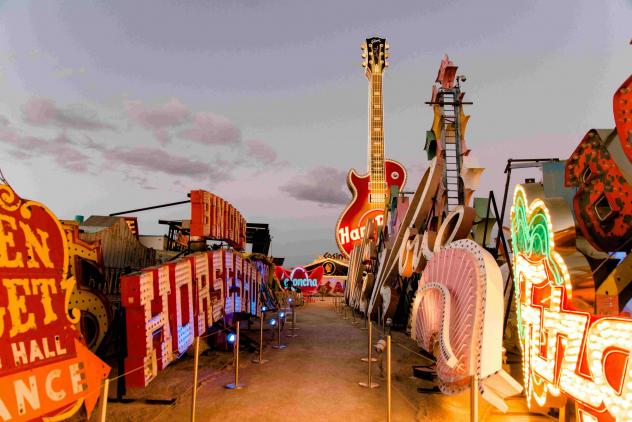
More frames from The Neon Museum
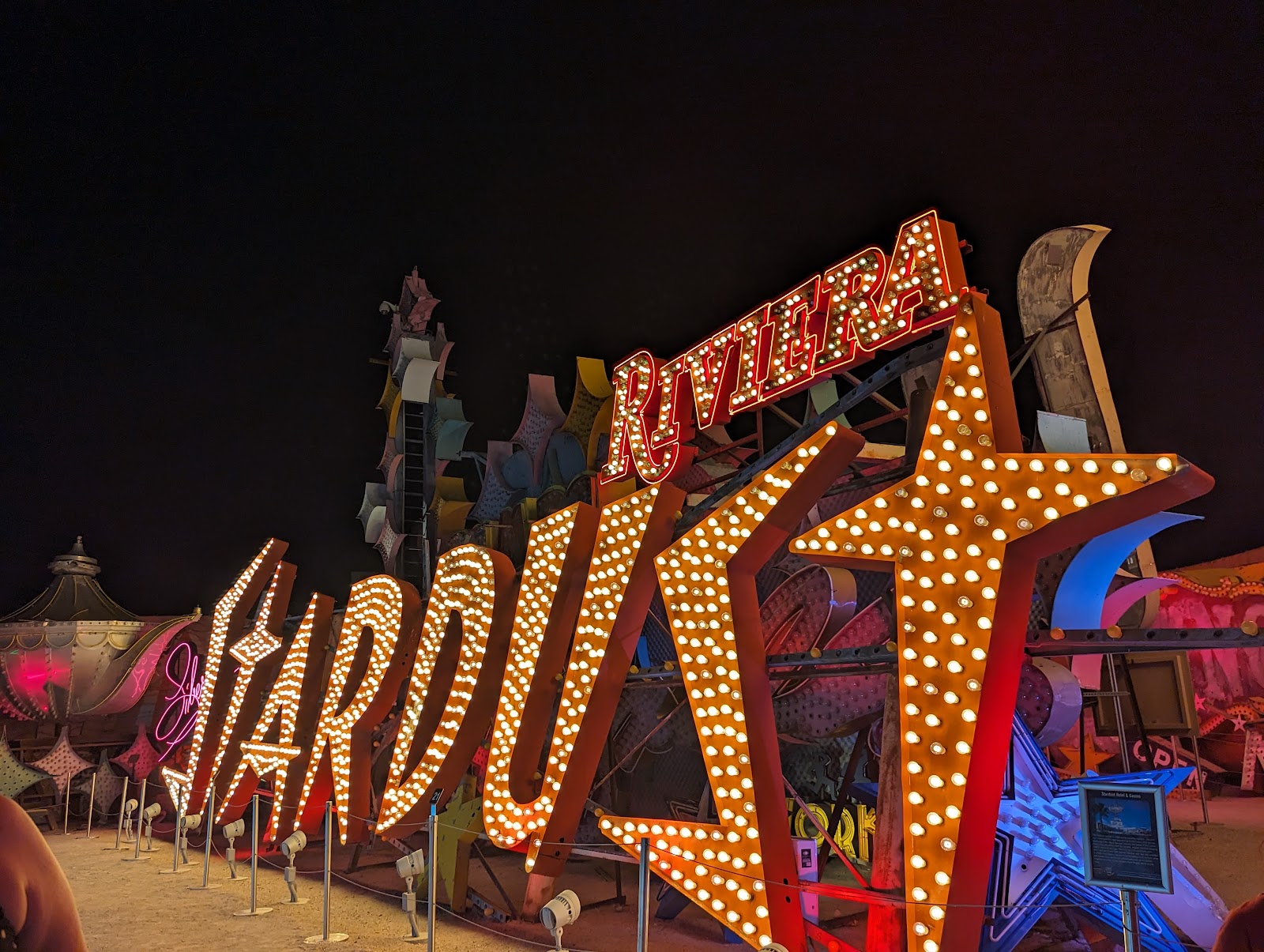
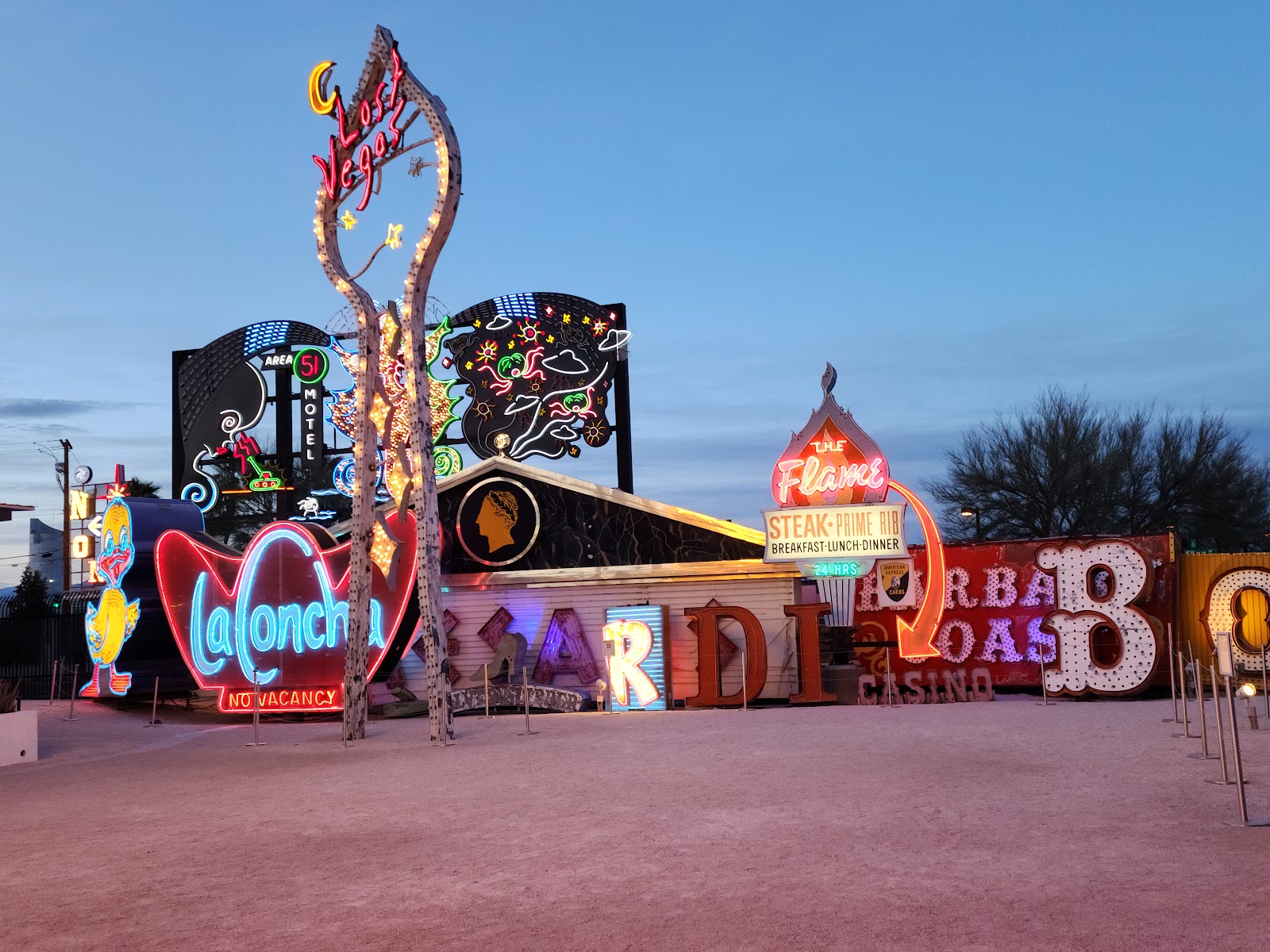
The Neon Museum wedding photography: common questions
What does this venue do best?
Night frames. Lit historic signage at close range is a background that exists nowhere else, and the twenty-five minutes after sunset is when it holds together with the sky in one exposure.
Can it be used in the middle of the day?
Barely. It is an open lot with little shade, and the midday desert sun is unusable. The shadow side of a large sign is the best available position.
Are all the signs lit?
Not necessarily. Much historic signage in a collection is unrestored or unpowered by day, which means rusted steel rather than glowing colour. Ask which and when.
Can neon light the couple?
No. It is narrow-spectrum, so skin lit by it has almost no data in two colour channels. Signage goes behind; one gelled source of your own lights the faces.
How should saturated signs be exposed?
A stop darker than instinct suggests, watching individual colour channels — a red sign clips its red channel long before the overall exposure looks bright.
What is the best month?
October. The clearest air of the year, comfortable temperatures, and a sunset time that is neither very late nor very early.
More Las Vegas, NV venue guides
We are writing a photographer’s guide to every venue we would happily shoot in Las Vegas, NV. Here are three more, plus the full index:
- New York-New York, Las Vegas: The One Decision That Governs Everything
- The Park MGM, Las Vegas: One Frame, and How It Is Made
- Red Rock Canyon, Las Vegas: What It Suits, and What It Does Not
Planning a wedding at The Neon Museum?
Extraordinary, and demanding. Tell us your date and we will plan for both.