 The Rio, Las Vegas: A Walk Through an Off-Strip Resort
The Park MGM, Las Vegas: One Frame, and How It Is Made
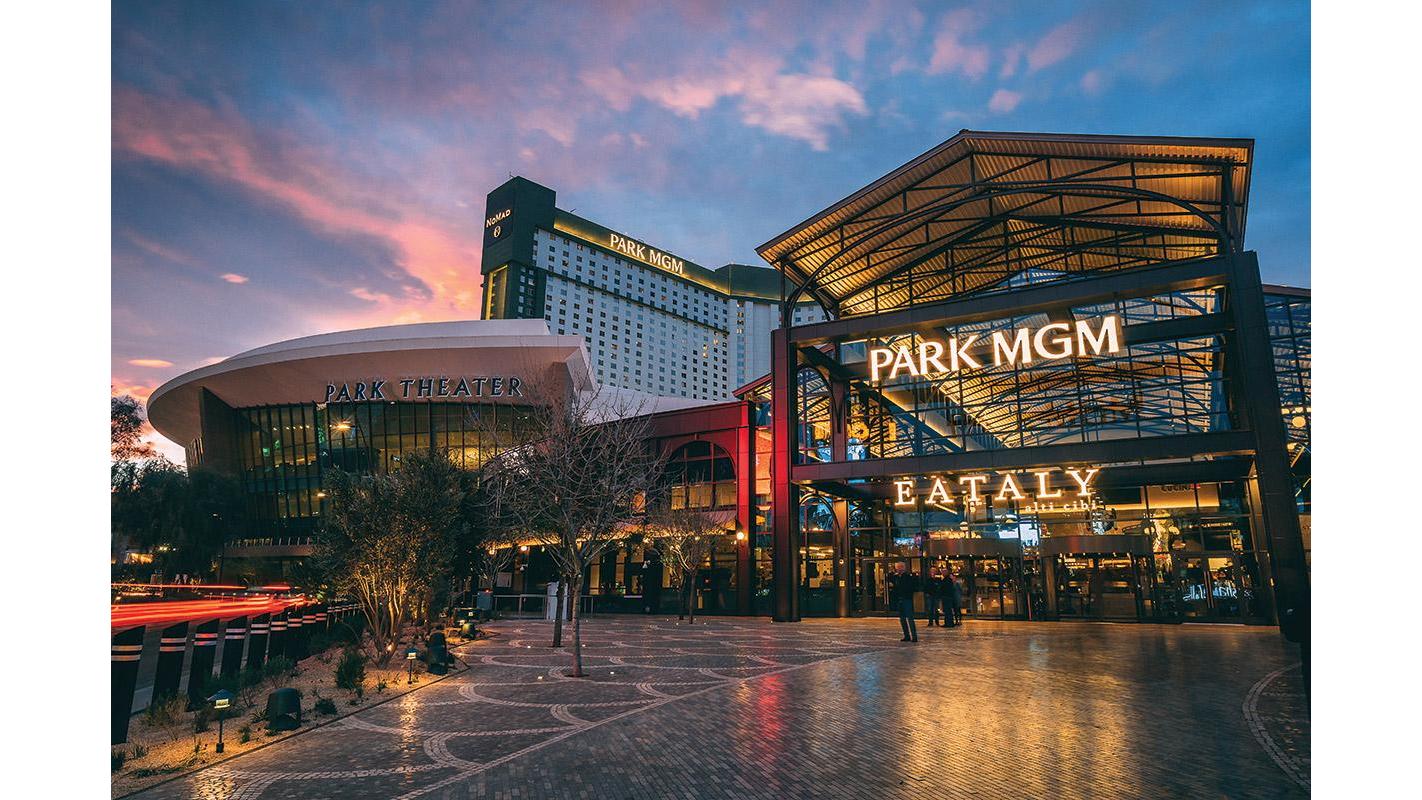
The best exterior frame in this city is not a view. It is a shaded pedestrian space with pale ground.
The best outdoor frame available in Las Vegas is not the one people imagine, which is a couple with the Strip behind them. It is quieter than that and it is a great deal more flattering.
The frame is this. A couple stands in a pedestrian outdoor space — trees or structure above, pale paving below, buildings to the sides. There is no direct sun on them. The light comes from a strip of open sky above, bounces off the pale ground into the shadows under their eyes and chins, and comes sideways off the surrounding walls. Nothing is clipped, nothing is black, and the desert is doing all the work.
That is a frame the desert can only give in a shaded enclosed space, and it takes five decisions to make properly.
We have not photographed a wedding at the Park MGM; shaded pedestrian spaces with pale paving behave the way physics says they do. Which spaces are included, whether the outdoor areas are available and what the rules are around them are questions for their team.
The Park MGM at a glance
| Where | Las Vegas Strip, Nevada |
| The frame | A couple in shaded pedestrian space with pale ground bouncing upward |
| Why it wins | It corrects the exact fault a very high desert sun creates |
| The first decision | Which hour the space is fully shaded |
| Ask first | Outdoor access, spaces included, shade at the planned hour |
Decisions one to three: the hour, the position, the ground
The first decision is the hour, because a partly shaded space is worse than an unshaded one. Half shade means a face with a brilliant patch on it and deep shadow a centimetre away, and that ratio exceeds what any sensor holds — whereas full sun at least lights everything the same amount badly.
So the question to settle in advance is when the chosen space is fully shaded, and the answer depends on the season more than most people expect. At about thirty-six degrees north the midday sun in June sits roughly seventy-seven degrees above the horizon, which means it reaches into almost any space with sky above it; in December it never rises much above thirty degrees, so the same space stays shaded all day. The practical version is that a summer wedding needs the space checked at the actual hour, and a winter one does not.
The second decision is the position within the space, and the rule is to have something solid on one side. Fully open shade — sky above, nothing to the sides — gives light from directly above and from the ground, which produces a flat frame with uplight under the chin. A wall, a column, a hedge or a structure on one side turns that into directional light, which is what makes a face read as three-dimensional.
The best position is therefore an edge rather than a middle: three or four metres out from a wall, with open sky above and the wall to one side, and depth behind. That single position is worth more than any lighting equipment in this city, and it exists at every venue with enclosed outdoor space.
The third decision is the ground, and in the desert the ground is a light source. Pale paving, sand and light stone reflect strongly upward — which fills exactly the shadows a top-down sun carves, and is the one desert effect working in a photographer’s favour rather than against.
It has to be managed rather than merely received. Too much upward light puts a bright patch under the chin and into the nostrils, which looks wrong because no natural light does that. The correction is the wall from decision two, which restores a downward-and-sideways balance; and the diagnosis is simply to look at the chin in the first frame.
Ground colour transfers too. Warm sandstone paving throws warm light upward, cool grey concrete throws neutral, and artificial grass throws a green that is as strong as real foliage. Worth one custom white balance set on a face in the position being used.
Decisions four and five: the background, and the light you add
The fourth decision is the background, and in an outdoor pedestrian space the options separate cleanly.
Depth is the best of them: a long view down a walkway, an avenue of trees, a receding line of structure. It falls away in tone and puts the couple clearly in front of something, which is what makes a portrait read. It is also where a long lens earns its place, compressing the depth into layers.
Sky is the worst, and it is the default error. A couple photographed against open desert sky sits in front of a surface several stops brighter than their faces, which means either clipped white sky or silhouetted people. If sky has to be in the frame, it should be a band rather than a field, and the exposure set for the faces with the sky allowed to go bright.
The Strip itself is the third option and it is the one couples ask for. It works, but it works properly only at two times: the last hour of daylight, when the buildings are raked by low sun and legible, and the twenty-five minutes after sunset, when their own illumination comes up and sits at about the same brightness as the sky. In the middle of the day a Strip background is a flat pale mass with a bright sky above it.
The fifth decision is whether to add light at all, and in this frame the honest answer is usually no. Sky above plus pale ground below plus a wall to one side is already a three-source setup, correctly balanced, and adding to it is more likely to unbalance it than improve it.
Where a source earns its place is when the background has to be darker than the subject — which in bright desert conditions means underexposing the ambient by a stop or two and lighting the faces back up. That produces the dramatic version: a deep sky, a dark Strip and a brightly lit couple, which is a real frame and an obviously constructed one.
It requires more power than people expect. Competing with desert daylight means a source at close range in a small modifier, or high-speed sync, or a neutral density filter and a wide aperture — and the modifier that is soft at two metres is hard at five. The practical answer is close and modest rather than far and powerful.
And after dark the calculation inverts entirely: the Strip is one of the brightest exterior environments in the world, so night frames need nothing added at all. The caveat is spectral — saturated signage puts most of its energy into a narrow band, so it does not render skin properly and one channel clips before the others. Signage behind, one gelled source of your own on the faces.
- Settle which hour the space is fully shaded; half shade is worse than none
- Stand at an edge with a wall on one side, not in an open middle
- Check the chin in the first frame; ground bounce can overfill
- Use depth as the background, not sky
- Add light only to darken the background — and then get close
Indoors, and the desert year
Indoors the building follows the standard resort pattern, which is worth knowing mainly so the outdoor frames get protected.
There is no daylight in the public spaces, so the interior never changes and every indoor frame is movable. The installed lighting is dense and overhead, which shadows eye sockets and cuts a line under every chin — fixed by direction rather than brightness, with one source off-axis at face height, half a stop to a stop above the ambient.
Ceilings over the largest floors are unusually low for their span, which means bounce flash usually returns something usable; one test frame on arrival settles it. Pale modern surfaces give no natural separation, fixed geometrically by distance, the darker end of the room, depth behind, and a source brighter on the face than the room is on the wall. Reflective stone, glass and metal will show a badly placed light, fixed by fifteen seconds of checking from the camera position. And colour is mixed everywhere, fixed by picking one temperature and killing or overpowering the rest.
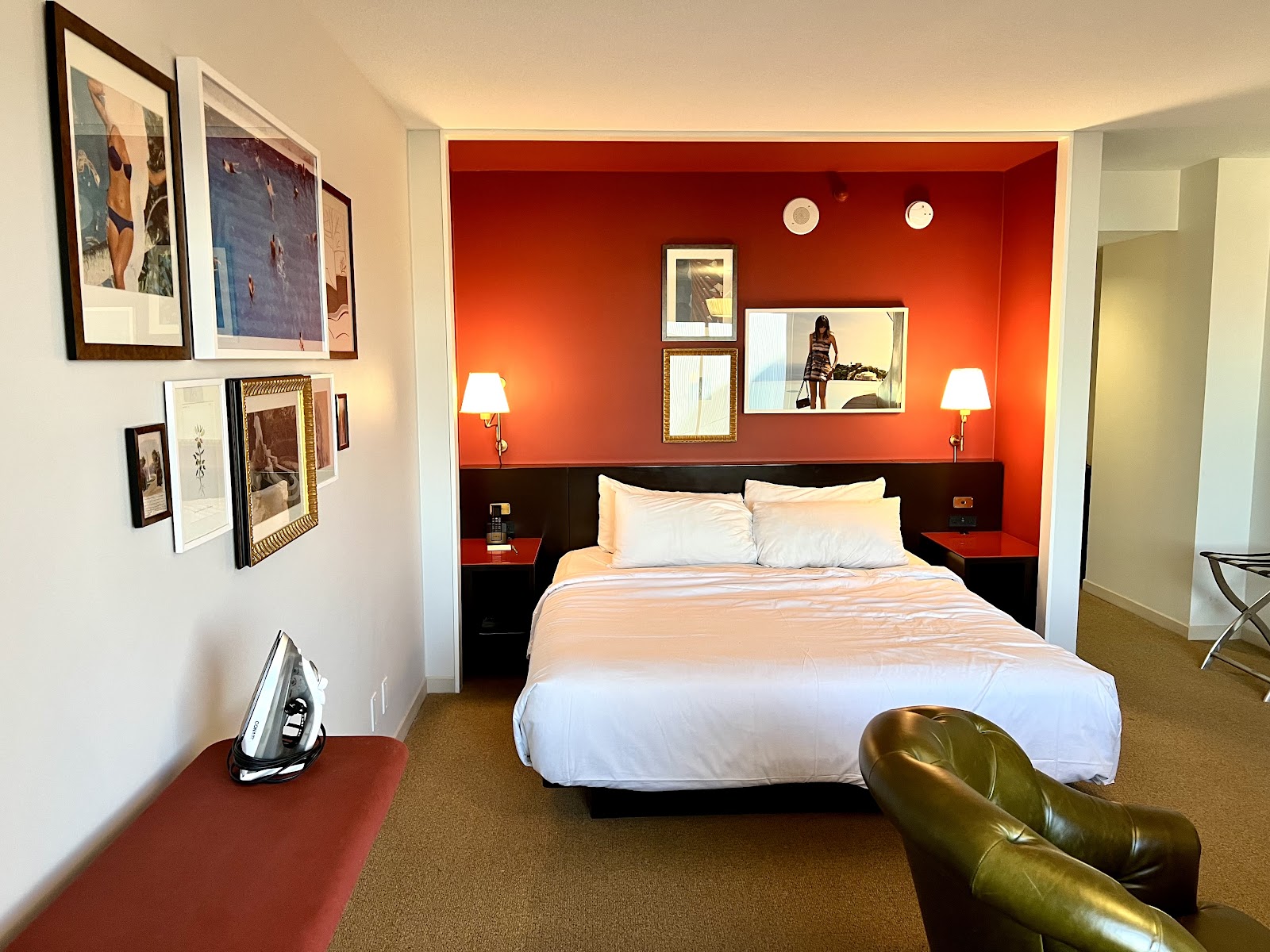
The guest rooms are the interior daylight: largest window on the shaded side, every overhead fitting off, lamps out of frame, two to three metres back. The local specifics are that direct sun through glass in this climate is unusually hard, so the shaded side is the whole difference; and that floor height matters less than in a dense city because the towers are far apart, so orientation is the better question.
The year decides how much of the outdoor frame is available. Summer, June into September, has daytime highs regularly above forty degrees Celsius, which makes an outdoor block a matter of minutes at the edges of the day rather than an hour in the middle — and in a shaded pedestrian space with no breeze the heat is worse rather than better. Early morning is the realistic summer answer.
The monsoon from July into September brings occasional afternoon thunderstorms and blowing dust, which for an outdoor-dependent plan is a real risk needing a named indoor alternative. Wet paving photographs better than dry, though, and a desert thunderstorm at dusk is the most dramatic sky the city offers.
Winter is the good season and it is the season this frame works best: mild, the clearest air of the year, sunset in mid-afternoon so the light windows fall at civilised hours, and a sun low enough that shaded pedestrian space stays shaded from morning to evening. A January wedding gets the venue’s best asset all day.
Spring is windy, and wind here means dust — haze that flattens anything distant, grit that gets into everything, and a reason to keep bodies bagged between positions. And fogging runs one way only in this climate: a cold body from air conditioning taken into forty-degree air fogs immediately. Twenty minutes of warming before stepping out is the whole fix.
More frames from The Park MGM
The Park MGM wedding photography: common questions
What is the best outdoor frame in Las Vegas?
A couple in shaded pedestrian space with pale paving below and a wall to one side — sky as the source, ground as the fill, wall for direction.
Why is partial shade worse than none?
Because a brilliant patch and deep shadow on the same face exceeds what any sensor holds. Full sun at least lights everything equally badly.
Does the season change which hours are shaded?
Substantially. In June the midday sun reaches almost anywhere with sky above it; in December it never rises high enough to get in at all.
What does the pale ground do?
It reflects light upward and fills the shadows a high sun carves. Too much of it puts a bright patch under the chin, which a wall on one side corrects.
What should the background be?
Depth — a receding walkway or avenue. Never open sky, which is several stops brighter than a face. The Strip works only in the last hour of daylight or just after sunset.
Is added light needed?
Usually not. Sky, ground and wall are already a balanced three-source setup. Add light only to deliberately darken the background, and then work close.
More Las Vegas, NV venue guides
We are writing a photographer’s guide to every venue we would happily shoot in Las Vegas, NV. Here are three more, plus the full index:
- Red Rock Canyon, Las Vegas: What It Suits, and What It Does Not
- The Rio, Las Vegas: A Walk Through an Off-Strip Resort
- The Strat, Las Vegas: What It Suits, and What It Does Not
Planning a wedding at The Park MGM?
The quiet frame is the good one. Tell us your date and we will find the shade.