 The Please Touch Museum, Philadelphia: What It Suits and What It Does Not
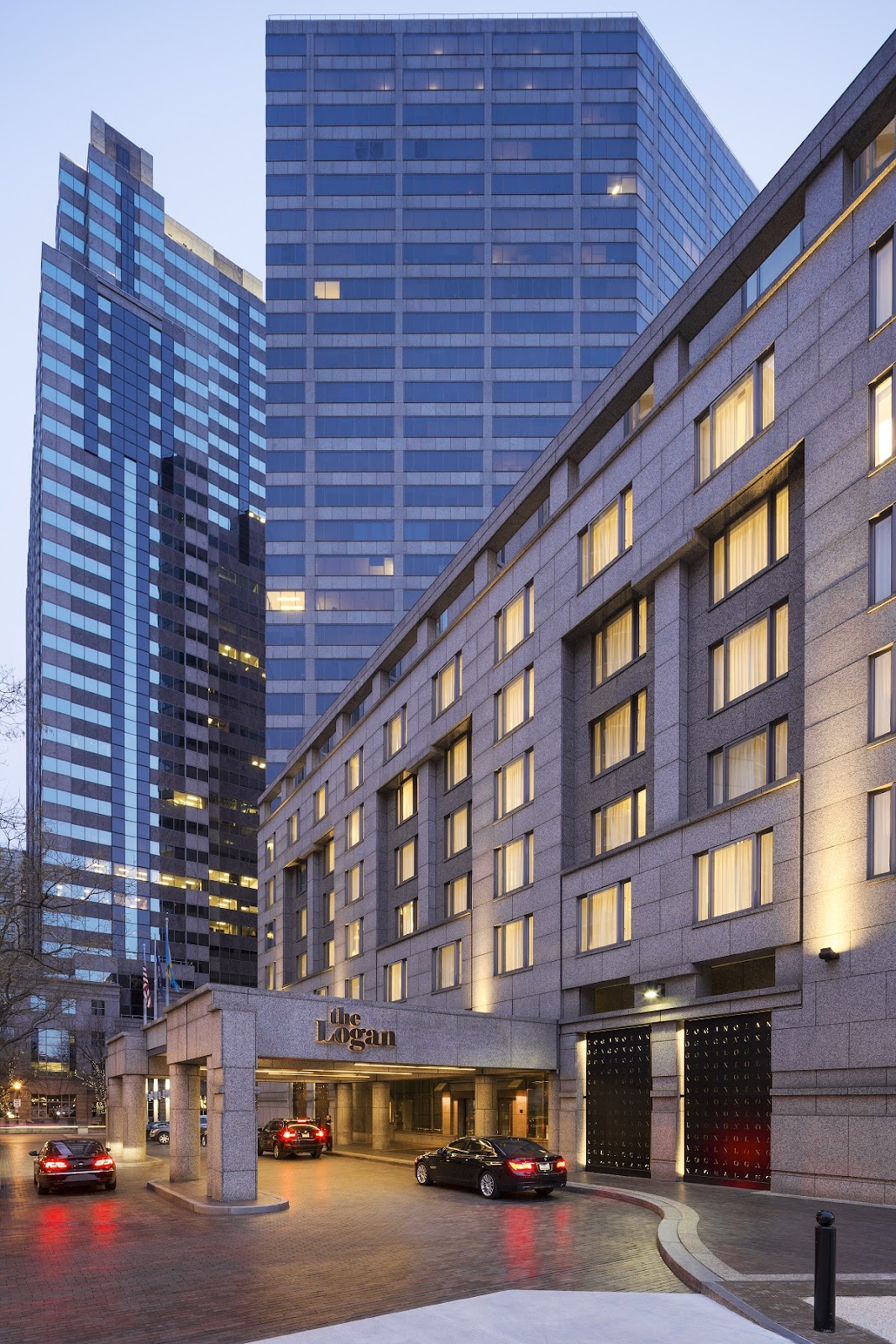
The Logan Hotel, Philadelphia: How the Light Moves
A rooftop has two good windows a day. The hotel beneath it has none and needs none.
The Logan Hotel’s most talked-about feature, by its own account, is its rooftop event space — which is the right thing to lead with, because a rooftop changes how a whole day has to be scheduled.
The reason is that a hotel and its roof run on opposite clocks. The interior is constant: controlled, even, warm and unaffected by the sky from mid-morning to midnight, which means every interior frame can be taken whenever it is convenient. The roof is entirely outdoors, with no ceiling and no walls, which means nothing bounces, the ambient after dark is close to zero, and the good light exists in two narrow windows rather than across an afternoon.
So the roof sets the timetable and the hotel fits around it — and that ordering is the thing most often got wrong, because a roof is easy to visit at a convenient moment and almost never good at one. This is written as a day. We have not photographed a wedding at the Logan; hotels with rooftop spaces behave consistently. Whether the roof is exclusive, at what hour it is available, and what the wind and weather policy is are the questions for their team.
The Logan Hotel at a glance
| Where | The parkway, Philadelphia, Pennsylvania |
| Character | A hotel with contemporary interiors and a rooftop event space |
| Two clocks | The interior never changes; the roof has two good windows |
| The consequence | The roof sets the timetable and the hotel fits around it |
| Ask first | Roof exclusivity, hour of access, wind and weather policy |
Morning and daytime: the rooms and the public floors
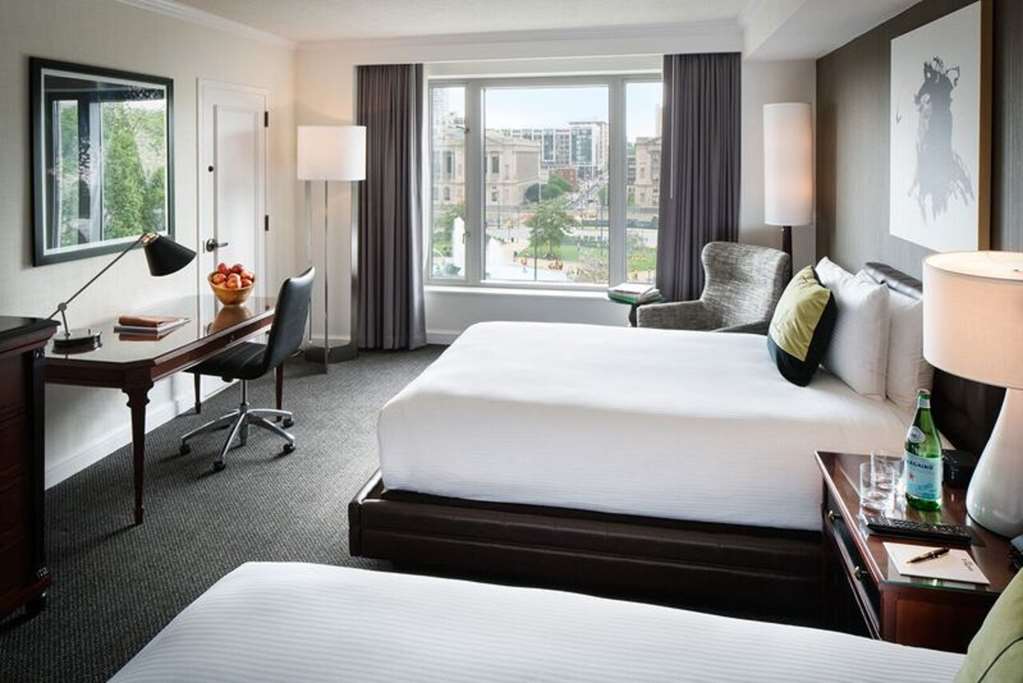
Guest rooms are the best portrait light in any hotel and the place the morning belongs. Windows are domestic in scale but generous relative to the floor area, the walls are close enough to bounce, and the ceilings are low enough that a flash aimed upward returns something usable — a combination the public rooms do not offer.
Three moves set a room up and they never change. Ask for the largest window on the shaded side of the building. Switch off every overhead fitting so the room has one colour of light rather than three, since mixed sources are the commonest single reason preparation coverage looks worse than the room did. And move the lamps out of frame rather than composing around them.
On the parkway side there is a bonus worth asking for: a room facing a tree-lined boulevard gives canopy at window height as a background, which in late October is a wall of colour behind a subject standing at the glass.
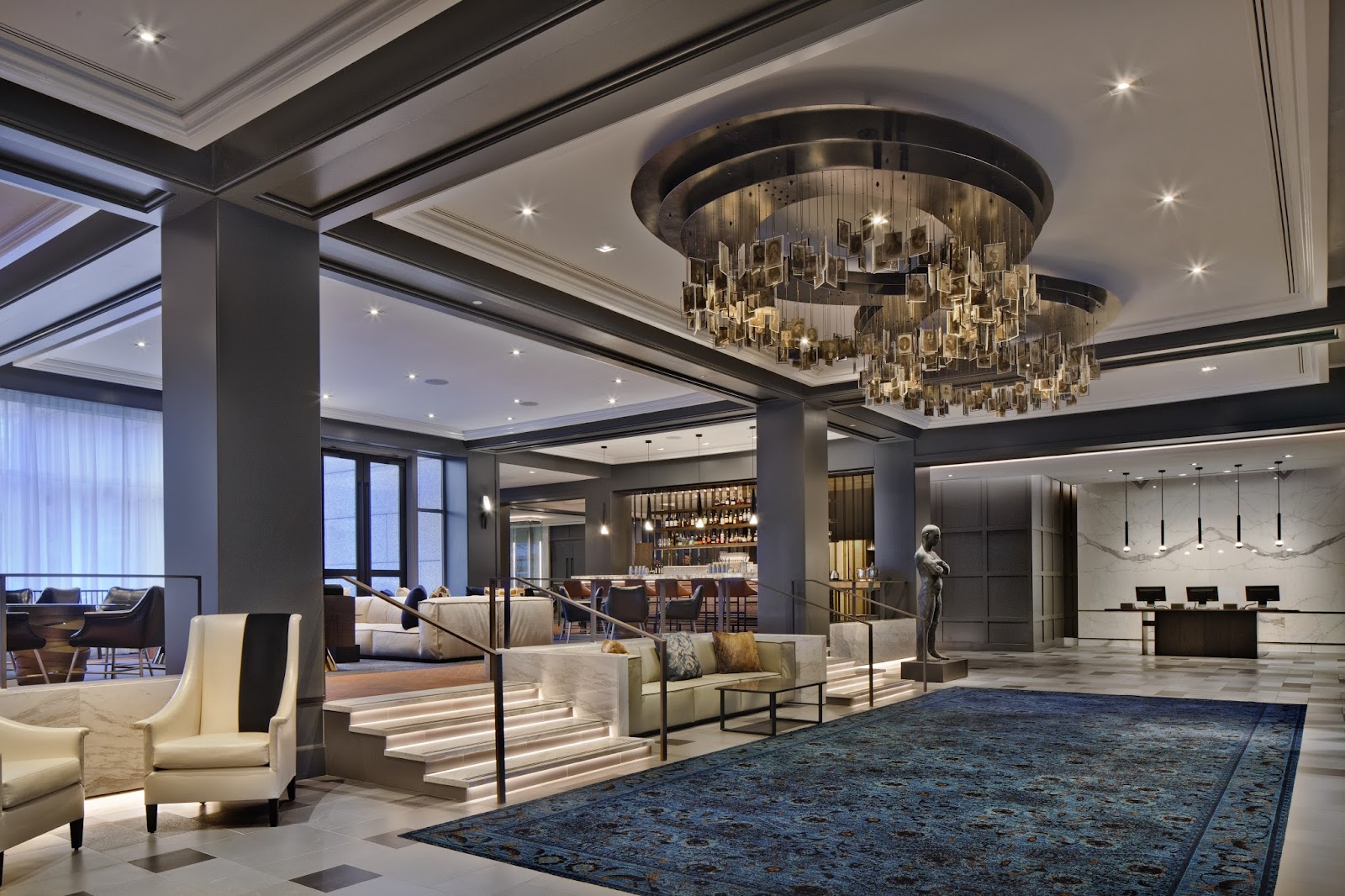
Public floors present the contemporary-hotel problem, which is two problems disguised as qualities. Light is deliberately even, because unevenness reads as cheap; surfaces are pale and uncluttered, because that reads as calm. Even light erases the gradient across a face that the eye reads as shape, so a technically correct exposure can still look flat. Pale surfaces erase the tonal difference between a subject and a background.
Neither needs much correcting but both need correcting deliberately. One directional source, off the camera axis at face height, set close to the ambient level rather than above it, restores a shadow side without making the frame look lit — half a stop in one direction does more than two stops overall. For separation, four tools stack: depth, a wide aperture, placement against the darkest element in the room, and negative fill, which is something dark on the shadow side of a face. In a pale room, subtracting beats adding.
Ceiling height should be tested once with a single frame, because a contemporary hotel may have a normal ceiling where bounce works or a double-height lobby where it does not — and the answer determines the approach for the whole evening.
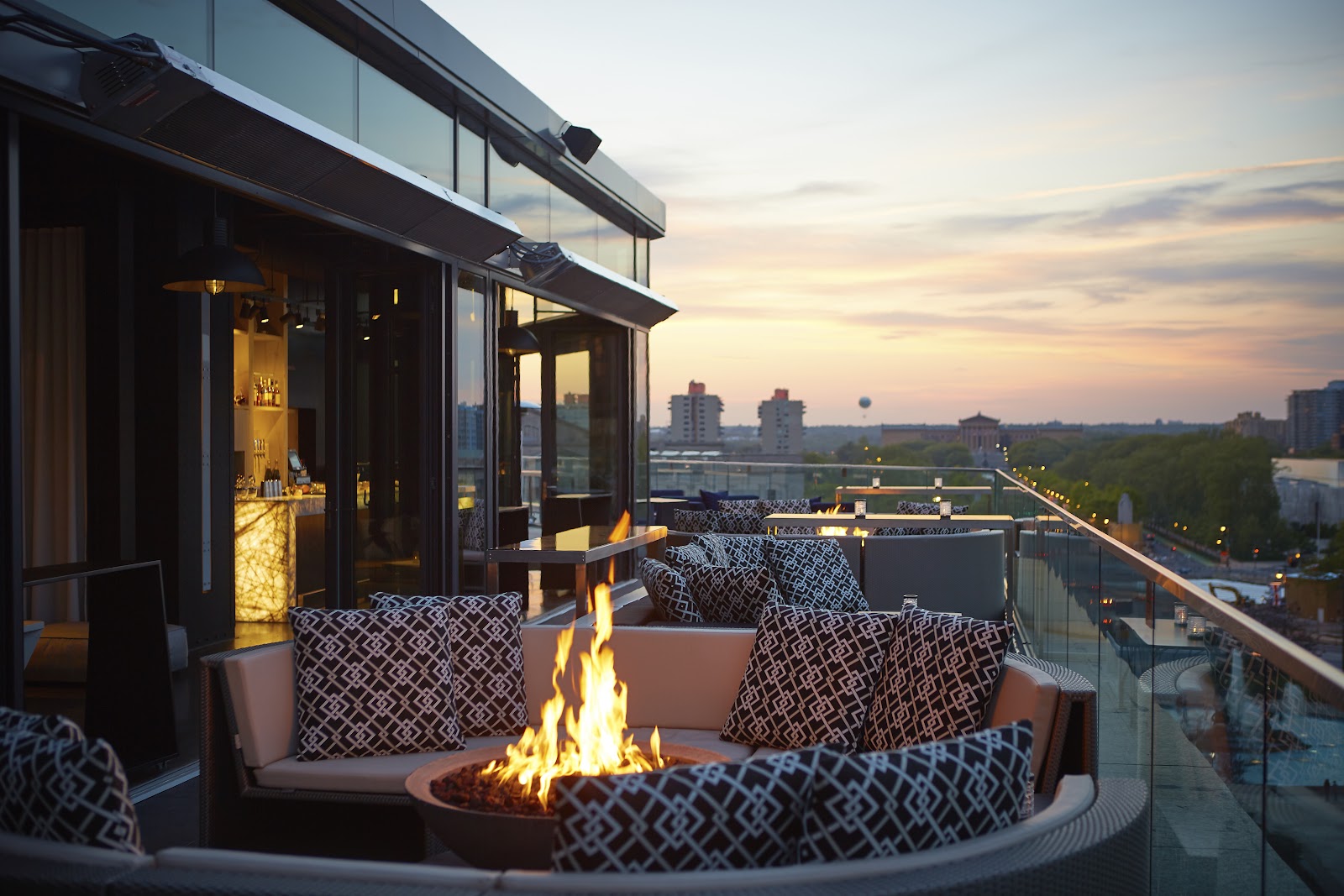
The roof: two windows, and what each one needs
The first window is the last forty minutes of daylight. On a roof that window starts earlier than at street level, because being above the surrounding roofline means low sun arrives while the streets below are already in shadow — worth thirty extra minutes in the schedule, and a genuine advantage of a rooftop over a terrace.
Long lenses matter up there. Compression brings the roofscape, the parkway’s trees and the city close behind a couple, while a wide lens reduces all of it to a strip under a large empty sky. And a low camera helps for the opposite reason: dropping close to the deck puts the parapet or the flooring into the frame as a leading line and lifts the couple against sky rather than against rooftops, which is the cleanest background that exists.
The second window is roughly twenty minutes after sunset and it is the frame the roof exists for. With the sky still holding colour and the city’s lights beginning to read below, one exposure holds a couple, the skyline and a coloured sky — and it needs one warm-gelled source at face height about a stop under the sky, or they silhouette. Take the sunset time, add fifteen minutes, be in position with the couple already there, and bracket a sequence as the sky falls.
Before those windows, a rooftop in a Philadelphia July is genuinely unworkable: no shade whatever, a high sun, and heat and humidity with nowhere to escape to. Anything scheduled up there before late afternoon is a welfare decision as much as a photographic one.
After full dark the roof becomes a straightforward lighting exercise with a city background, and it works well: one source on the couple, the lit skyline behind, a long exposure if the lights should smear or a lit frame if they should read as points. Both are worth taking rather than choosing on the night.
Wind is the standing rooftop constraint and it is stronger and gustier than at street level. A veil becomes a held-or-removed decision, hair needs managing, and any light stand needs a sandbag rather than an intention — on a roof that is a safety matter as much as a photographic one.
Nothing bounces on a roof, so every source is direct and modified, and the ambient after dark is close to zero because there are no reflecting surfaces and no spill from windows. Power and modifiers have to assume that.
- Guest room: biggest shaded window, overheads off, lamps out of frame
- In pale public rooms, subtract with negative fill rather than adding light
- The roof’s golden window starts half an hour early — schedule for it
- Go long on the roof, and get low so the parapet leads in
- Sunset plus fifteen, one warm source a stop under the sky, stands weighted
The parkway, the grid, and Philadelphia's year
At street level, the parkway is the most useful outdoor space in the city for a wedding and it starts at the door. Philadelphia’s Center City is a strict grid oriented close to the compass, which means the east-west streets take low sun straight down their length and the north-south ones do not — plannable from a map rather than discovered on foot, which is unusual and genuinely useful.
The parkway is the exception: it runs diagonally across that grid, so it takes low sun at an angle no other street does, and it is tree-lined, which gives canopy shade along its length. That makes it both the reliable raking-light position and the reliable midday shade, within a few minutes’ walk.
Canopy shade is the summer resource and dapple is its hazard — hot spots several stops above the surrounding shadow, shifting with any breeze — so full shade, open light, or wait for the sun to drop below the trees. Green bounce from foliage is localised and uncorrectable globally, so set a custom white balance on a face in the position being used.
Red brick away from the parkway is the friendly material, bouncing warm and flattering skin where pale stone and modern surfaces bounce cool and can grey it. White marble steps on Philadelphia rowhouses act as low reflectors that fill the shadow overhead sun creates — a located frame that is also a lit one. Cobbles in the older quarters give strong texture in raking light and a genuine trip hazard in heels.
Philadelphia’s four seasons change a rooftop venue more than they change most. Summer is humid with afternoon thunderstorms common rather than rare, and a roof has no cover at all — so the fallback, its capacity and the time by which the call is made all need agreeing rather than assuming.
Autumn is the roof’s best season: clear, cool, stable air gives the sharpest skyline visibility of the year, and late October colour on the parkway below reads as a coloured band at a long focal length. Winter is the hard one — sunset falls in the middle of the afternoon in December, which puts the crossing before or during the ceremony rather than after, and a roof in a cold wind limits a block to three or four minutes.
Winter also gives the best version of the crossing, though, because cold clear air holds a deeper and longer-lasting colour in the sky than humid summer air. Snow on a roof, with a lit city behind, is a frame worth the discomfort — and snow is the best natural fill there is, while fooling a meter by about two stops.
One equipment note: a heated interior and cold roof air fog a lens comprehensively in both directions, and the crossing will not wait. Get a body out to ambient temperature well before the window rather than carrying it up cold.
More frames from The Logan Hotel
The Logan Hotel wedding photography: common questions
Why does the roof set the timetable?
Because the interior is constant from mid-morning to midnight while the roof has only two good windows a day. Every interior frame can wait; neither roof window can.
When does the roof's good light start?
Half an hour earlier than at street level, because above the surrounding roofline low sun arrives while the streets are already in shadow. That is worth extra time in the schedule.
What is the roof's essential frame?
Sunset plus about fifteen minutes: the couple, the skyline and a sky still holding colour in one exposure, with one warm-gelled source at face height about a stop under the sky.
When is the roof unusable?
Before late afternoon in summer. No shade at all, a high sun, and heat and humidity with nowhere to escape — a welfare decision as much as a photographic one.
What does rooftop wind change?
A veil becomes a held-or-removed decision, hair needs managing, and any stand needs a sandbag. At roof level that is a safety matter as well as a photographic one.
Which season suits the roof best?
Autumn. Clear cool stable air gives the sharpest skyline visibility of the year, and late October colour on the parkway below reads as a coloured band at a long focal length.
More Pennsylvania venue guides
We are writing a photographer’s guide to every venue we would happily shoot in Pennsylvania. Here are three more, plus the full index:
- The National Constitution Center, Philadelphia: The One Decision That Governs Everything
- The Philadelphia Museum of Art: One Frame and How It Is Made
- The Philadelphia Zoo: Four Ways Out of the Fencing Problem
Planning a wedding at The Logan Hotel?
The roof has two windows. Tell us your date and we will put the day around them.