 Overhills Mansion: Who This Venue Suits, and Who It Doesn’t
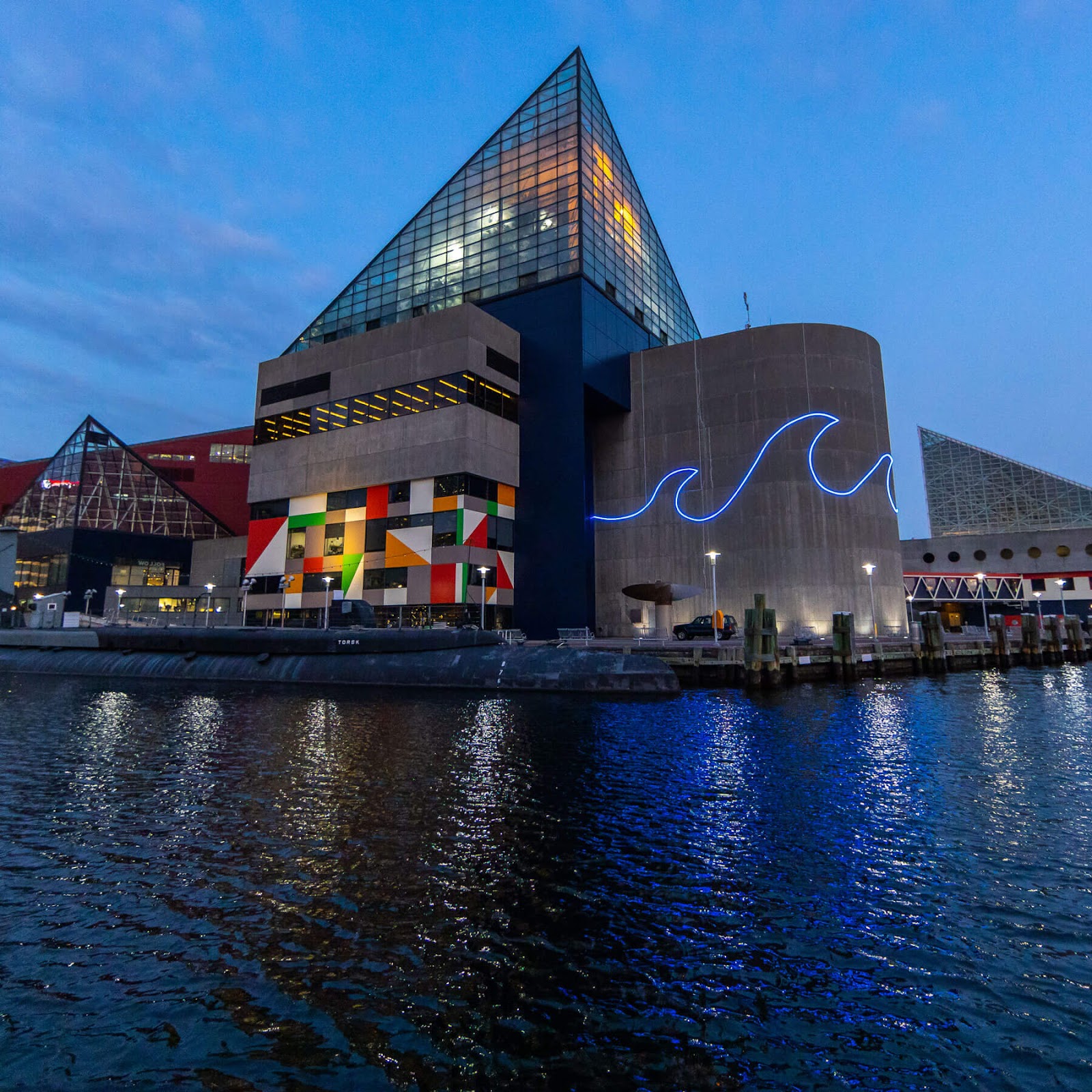
The National Aquarium, Baltimore: Four Ways Out of the Blue Light Problem
Tank light is blue, dim, moving and behind glass. Four problems, one source.
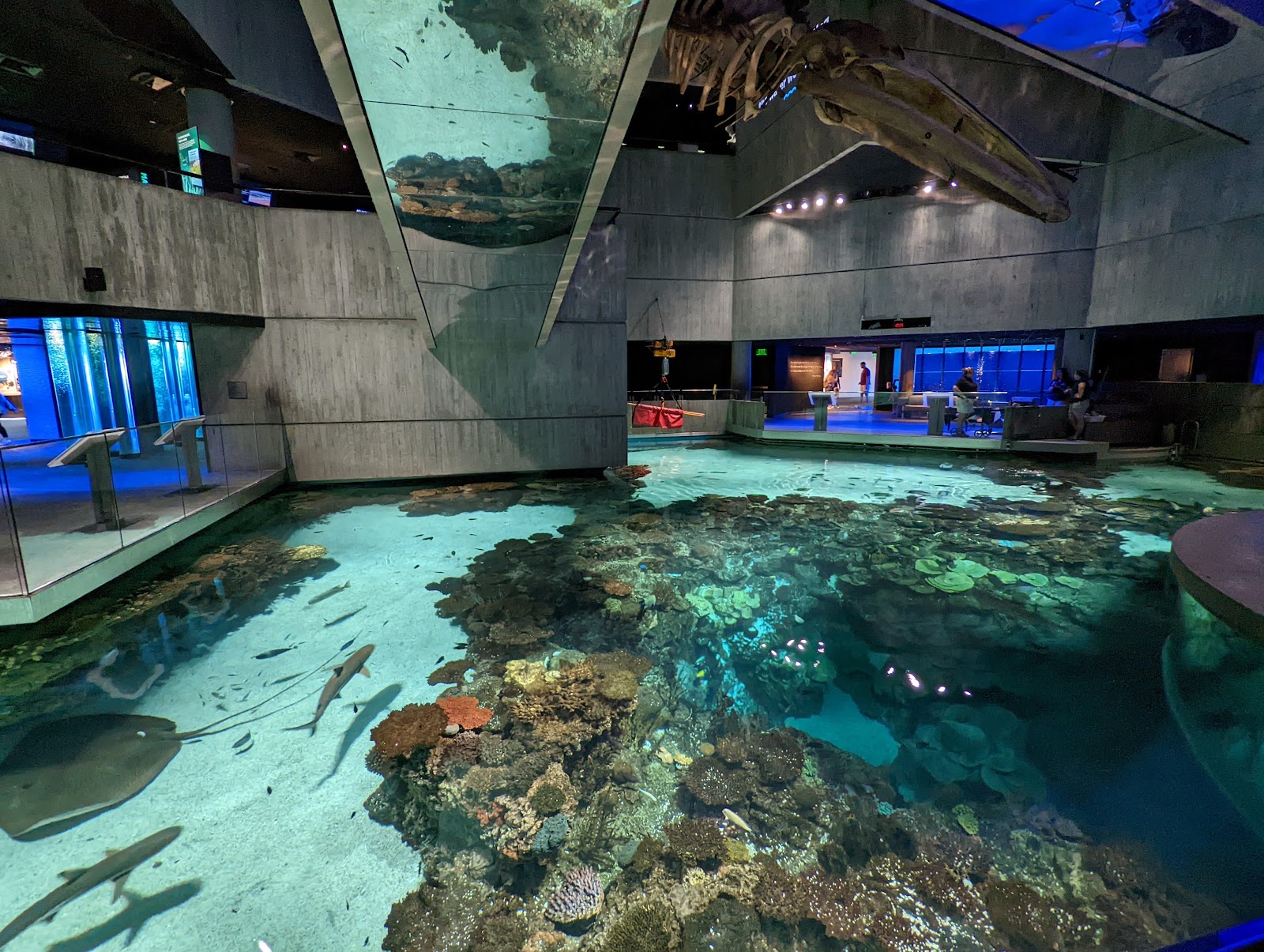
The National Aquarium’s most popular event space is its underwater viewing area, where guests can dine alongside views of sharks and tropical fish — which is a genuinely distinctive setting and a genuinely difficult one.
The difficulty is a single light source with four separate problems in it. Tank light is dim, because the level inside an exhibit is set for the animals rather than for a room. It is strongly blue-green, because water absorbs red wavelengths and exhibit lighting is chosen to suit that. It moves, because water moves and animals move through it. And it is behind glass, which reflects everything bright on your side of it back into the frame.
None of that makes the aquarium a bad venue. It makes it a venue with a very specific technical problem and a very distinctive payoff, which is the best kind. This is written as that problem and four ways out of it. We have not photographed a wedding at the aquarium; large public aquaria behave consistently. Whether flash is permitted near exhibits — it frequently is not, for the animals’ sake — is the first question, and it changes the approach entirely.
The National Aquarium at a glance
| Where | The Inner Harbor, Baltimore, Maryland |
| Character | An aquarium with underwater viewing areas used for events |
| The problem | Tank light: dim, blue-green, moving, and behind reflective glass |
| The payoff | A background no other venue in the city can produce |
| Ask first | Whether flash is permitted near exhibits — often it is not |
Why tank light is four problems
Level first. The light inside an exhibit is set for the animals living in it, which is typically well below what a room for people would be lit to — and the viewing area itself is kept dim deliberately, so that the tank reads as bright by comparison and so that the glass does not reflect the room. That means the ambient a face receives is low, and a raised ISO with a fast lens is the baseline rather than a fallback.
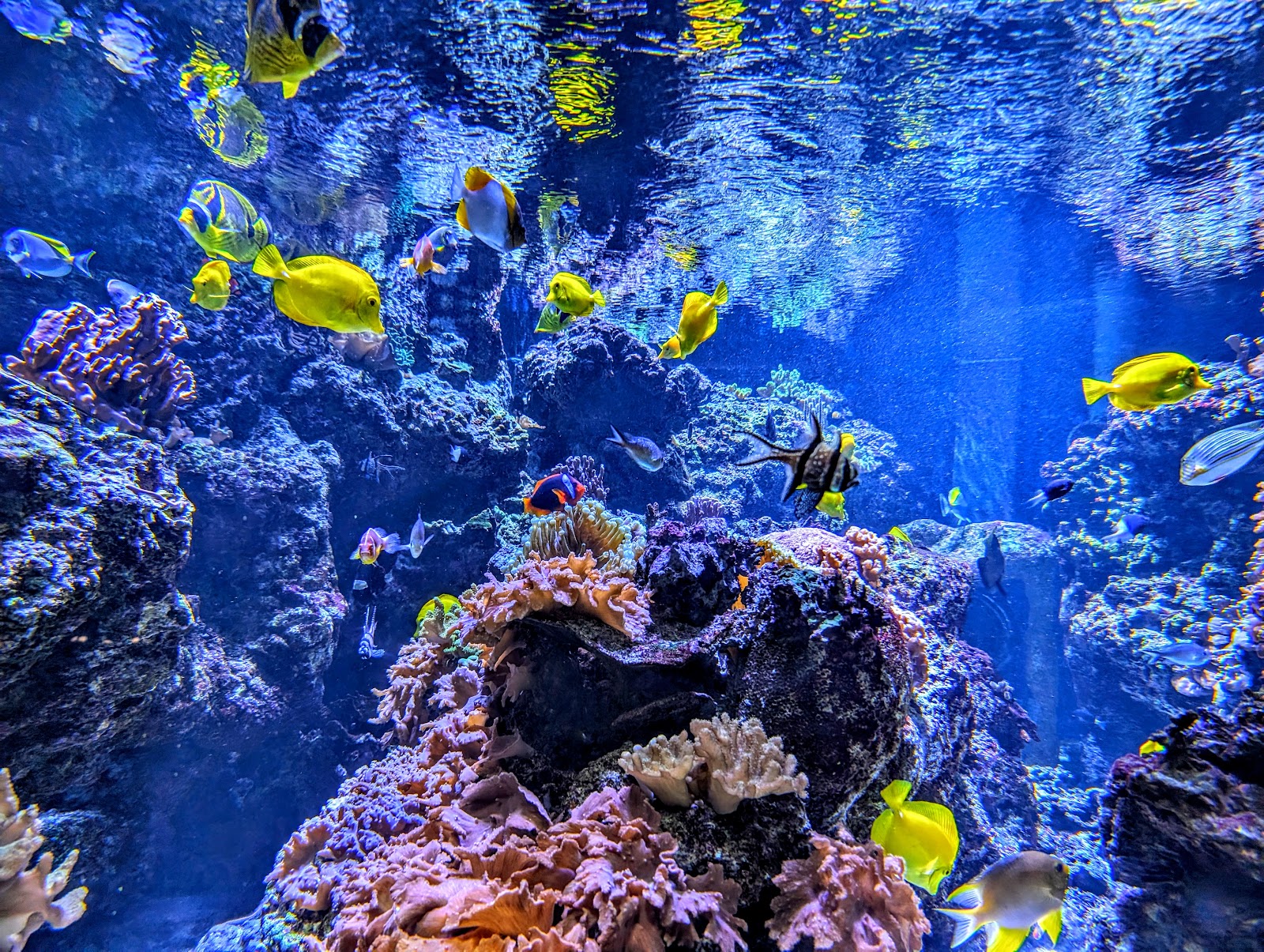
Colour second, and this is the one that surprises people. Water absorbs red wavelengths quickly, so light that has travelled through a tank arrives blue-green, and exhibit lighting is often chosen to enhance that. Blue-green light on skin is deeply unflattering, and it is not a white-balance problem in the ordinary sense: correcting a strong blue cast globally pushes everything else in the frame warm and yellow, including the water, which then no longer looks like water. Whichever way you correct, something looks wrong.
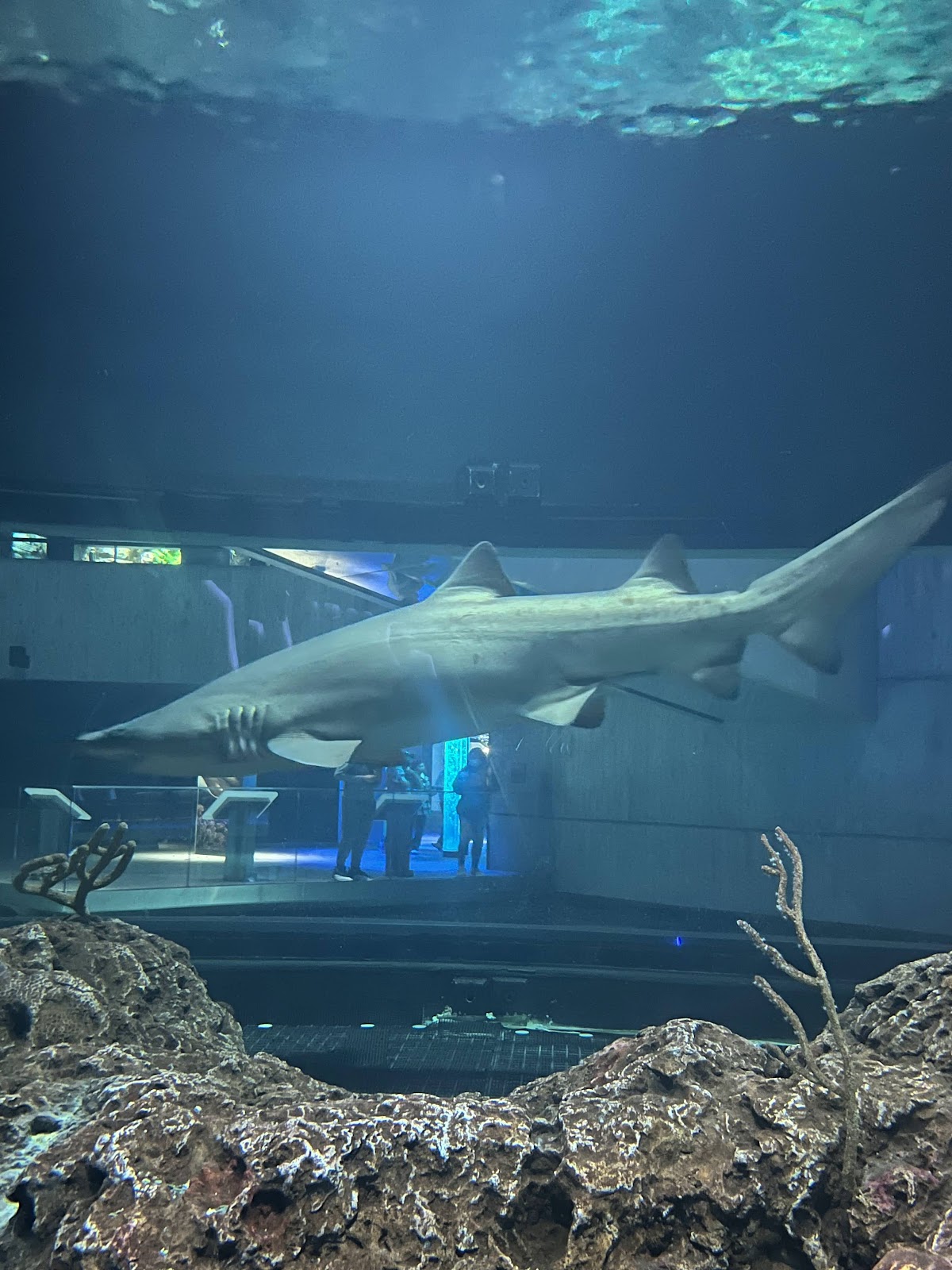
Motion third. Water moves, animals move through it, and caustic patterns of light shift continuously — so brightness and colour on a face can change measurably between consecutive frames. A burst of three is a burst of three different exposures.
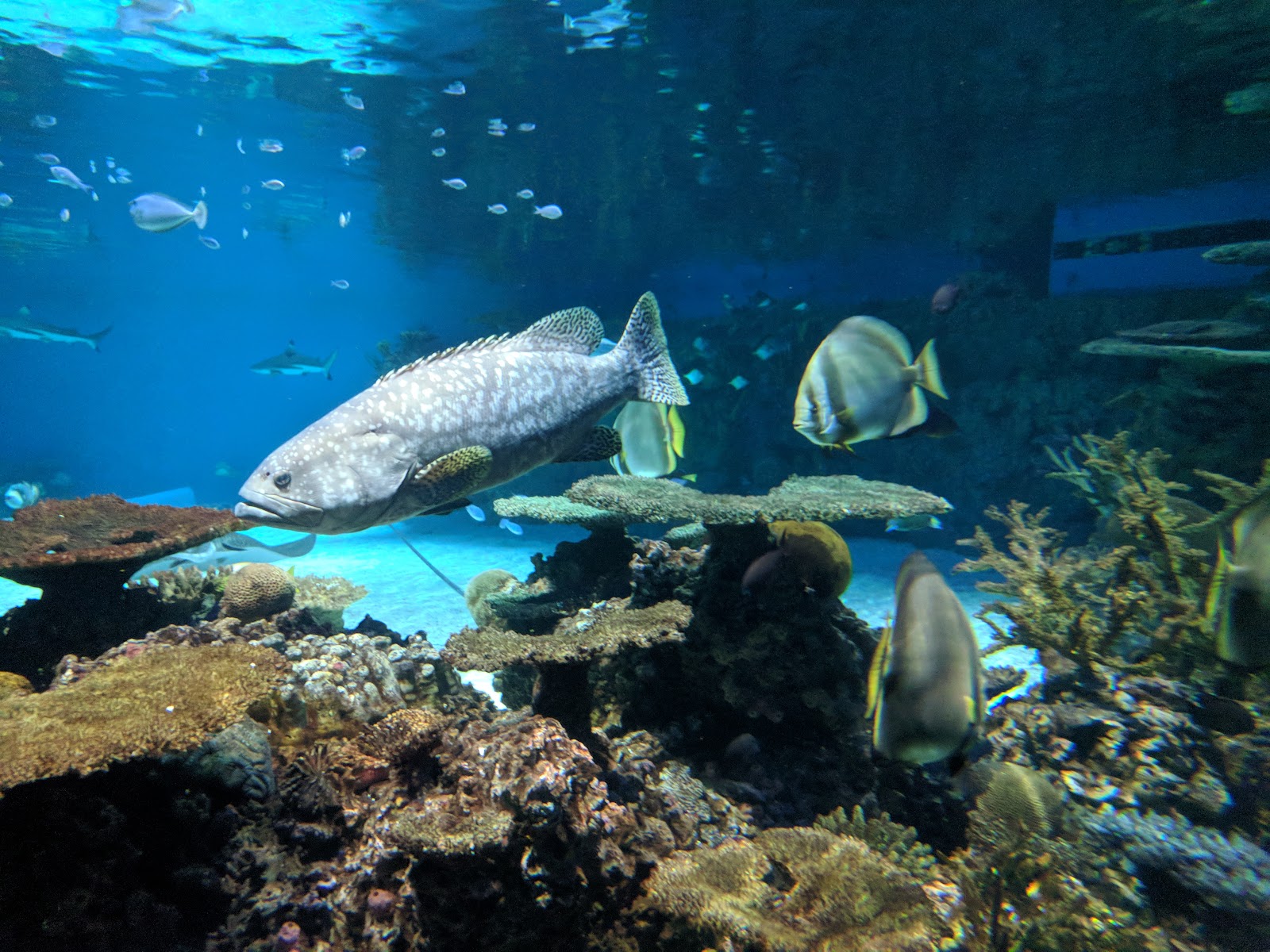
Reflection fourth. Tank glass is a large flat vertical reflector, and anything bright on the viewing side comes back into the frame: a lit sign, a phone screen, a window, a light stand, a photographer. It is also often slightly tinted and, in heavily visited areas, scratched.
Together those four make the underwater viewing area the hardest lighting environment in this entire list of venues — and also the most distinctive, which is why it is worth solving properly rather than avoiding.
Four ways out
The first way out is to bring your own light and let it own the faces. One source, off the camera axis at face height, gelled to a chosen temperature, set bright enough to dominate the blue falling on skin, with white balance set to the gel. The tank then stays blue behind the couple — which is what makes the frame — while their faces are neutral and consistent. This is the single most effective move and it turns the problem into the asset.
Two cautions come with it. It must be placed well off the camera axis and angled away from the glass, or it reflects straight back. And flash near exhibits may be prohibited entirely for the animals’ sake, which is why that is the first question to ask — a continuous LED source is usually the permitted alternative and works fine at these levels.
The second way out is to commit to the blue deliberately rather than fighting it. A frame that accepts a blue-green cast as the look, exposed for the tank and letting the couple read as shapes against it, is a strong photograph — silhouettes, profiles, a hand against glass, two figures in front of a wall of water. That approach needs no equipment and no permission, and it is often the better picture.
The third way out is the reflection, used on purpose. Tank glass reflects, so a couple standing near it appears twice — once directly and once in the water. Shot obliquely with the room dark, that doubling is a genuinely unusual frame. The technique for a clean view into a tank is the opposite: a rubber hood pressed flat to the glass, shooting perpendicular, which eliminates reflection entirely but only works for frames without people in them.
The fourth way out is the rest of the building. An aquarium on the Inner Harbor has glazed public architecture facing water, which receives light twice — from the sky and bounced up off the harbour — and is generously daylit with no exhibit constraint. Those spaces are where every flattering frame lives, and the honest plan is that the tanks supply two or three spectacular photographs while the public architecture and the harbourfront supply the rest.
- One gelled source owns the faces; let the tank stay blue behind
- Place it well off-axis and angled away from glass, or it reflects back
- Ask about flash first — a continuous LED is usually the permitted answer
- Commit to the blue for silhouettes and shapes; often the better picture
- Rubber hood flat to the glass, perpendicular, for tank-only frames
The harbourfront, the timing, and Baltimore weather
Outdoors the Inner Harbor is the counterweight and the place to put anything that needs to be flattering. Water bounces light up from below, which fills the shadow that open sky creates from above, and the harbour gives real depth — so a long lens stacks water, far shore and city into layers where a wide lens flattens them into a strip.
Harbour wind is stronger and gustier at the water’s edge than in the streets behind, which matters for a veil, for hair and for any stand, and it breaks the surface so a mirrored reflection frame is a morning proposition.
The running order follows from one fact: the aquarium interior does not change through the day and the harbour does. So the interior can be scheduled wherever it is convenient and the outdoor block belongs in the last ninety minutes, protected. The dusk crossing — roughly twenty minutes after sunset, when the harbour and city fall to the brightness of the building’s lighting — is the one frame that cannot be moved.
After the crossing, harbour water goes black except where quayside lights break across it into vertical coloured lines, which is a background specific to a waterfront. A long exposure smears them and a lit frame freezes them as texture; both are worth having.
Baltimore behind the harbour is a short walk and good material: brick rowhouse streets, narrow and low-rise, so low evening sun runs the whole length of a block, on a material that only shows texture when light runs along it. The white marble steps fronting so many rowhouses behave as low reflectors, bouncing light up into a face — a located frame that is also a lit one.
Mid-Atlantic conditions apply. Summer heat and humidity keep outdoor blocks short; afternoon thunderstorms are common rather than rare, which makes a large indoor attraction an excellent fallback — the day continues without a decision. And humidity produces fogging in both directions, as kit chilled by air conditioning fogs on going out and cold kit fogs on coming in, so equipment needs to come towards the temperature of where it is going before it gets there. A humid warm aquarium interior is a particularly reliable place to fog a lens brought in from a cold car.
More frames from The National Aquarium
The National Aquarium wedding photography: common questions
Why is tank light so difficult?
Four reasons at once: it is dim because the level suits the animals, it is blue-green because water absorbs red, it moves continuously, and it is behind glass that reflects everything bright on your side.
Can't you just correct the blue?
Not globally. Correcting a strong blue cast pushes everything else warm and yellow, including the water, which then stops looking like water. Whichever way you correct, something looks wrong.
What is the most effective solution?
One gelled source off the camera axis at face height, bright enough to dominate the blue on skin, with white balance set to it. The tank stays blue behind the couple and the faces stay neutral.
What has to be asked first?
Whether flash is permitted near exhibits — frequently it is not, for the animals’ sake. A continuous LED source is usually the permitted alternative and works fine at these levels.
How do you photograph into a tank cleanly?
A rubber hood pressed flat against the glass, shooting perpendicular. That eliminates reflection completely, but it only works for frames that do not include people.
Where do the flattering frames come from?
The glazed public architecture and the harbourfront. The tanks supply two or three spectacular photographs; the rest of the gallery comes from daylight.
More Baltimore, MD venue guides
We are writing a photographer’s guide to every venue we would happily shoot in Baltimore, MD. Here are three more, plus the full index:
- The Sagamore Pendry, Baltimore: How the Light Moves
- St. Ignatius Church, Baltimore: The One Decision That Governs Everything
- The Walters Art Museum, Baltimore: Four Ways Out of the Gallery Problem
All Baltimore, MD Wedding Venues →
Planning a wedding at The National Aquarium?
Ask about flash before anything else. Tell us your date and we will ask for you.