 Hotel Saint Louis: A Walk-Through of an 1893 Union Trust Building
Union Station Kansas City: Four Ways Out of the Great-Hall Problem
The Grand Hall is far too large to light. That is the whole problem, and there are four good answers to it.
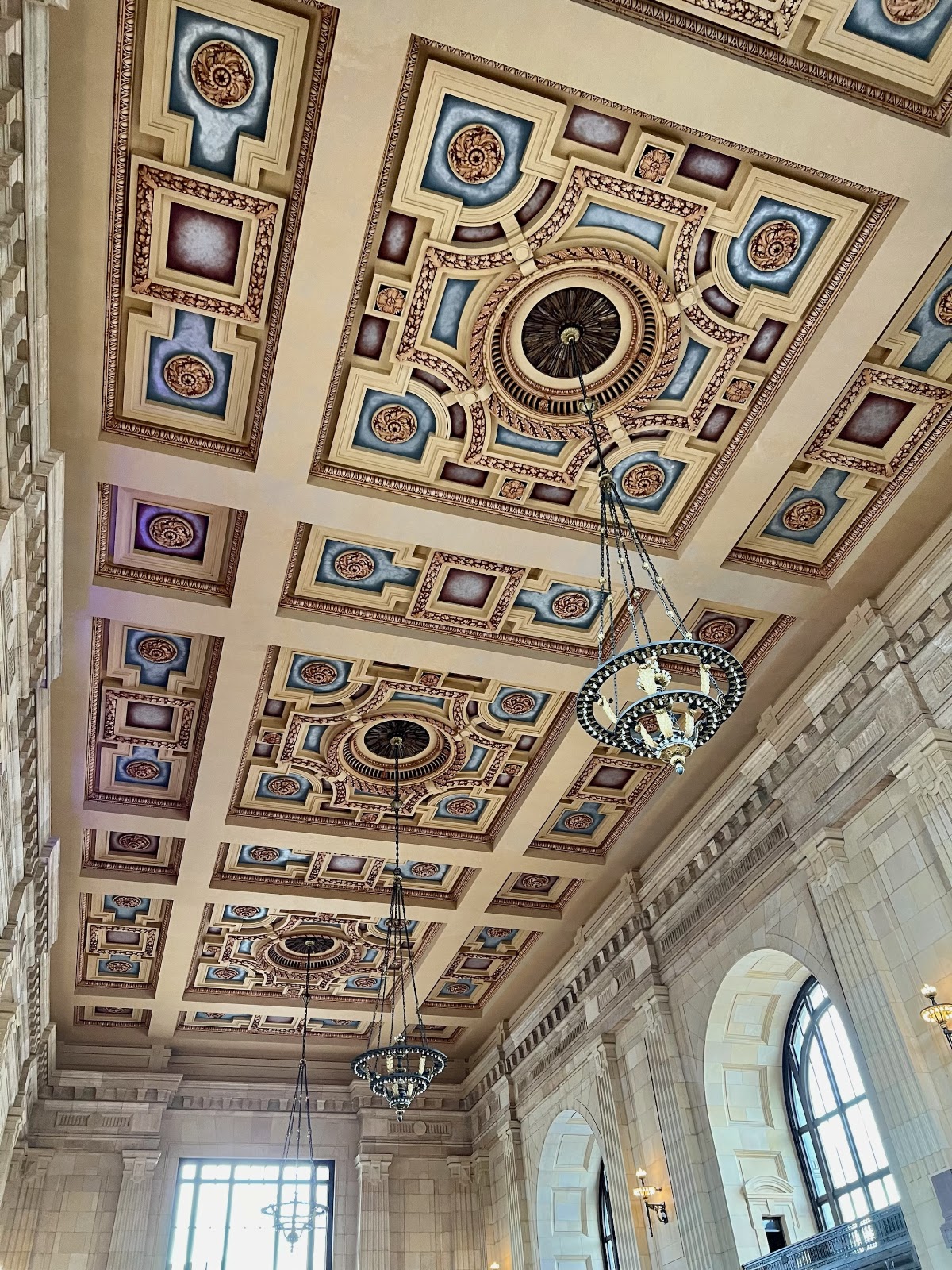
Union Station Kansas City opened in 1914, a Beaux-Arts railway terminal built around a Grand Hall whose ceiling stands many storeys above the floor, with a waiting hall, corridors and subsidiary spaces around it.
Railway stations of this generation present the same problem cathedrals do, and they present it at its most extreme: the room is too large for wedding lighting to affect. A strobe that comfortably fills a hotel ballroom disappears into a volume like this, because light falls off with the square of distance and there is nothing near enough to bounce the spill back. The ceiling is out of reach by an order of magnitude, the walls are far away, and the ambient is architectural lighting chosen to make the building look magnificent rather than to illuminate people.
The answer is not more power. There are four approaches that work and each suits a different frame. We have not photographed a wedding at Union Station; monumental railway halls behave the same wherever they survive. Which halls are available, what rigging is permitted and whether the public is present are questions for their events team — and the last one shapes the day.
Union Station Kansas City at a glance
| Where | Downtown Kansas City, Missouri |
| Character | A 1914 Beaux-Arts railway terminal with a many-storey Grand Hall |
| The problem | The hall is far too large for any practical lighting to fill |
| Ambient | Architectural lighting, chosen for the building rather than for faces |
| Ask first | Whether the public is present during the event |
Why a great hall defeats a flash
A source correctly exposing a subject at three metres is two stops down at six and four stops down at twelve. In an ordinary room that hardly matters because the walls and ceiling return the spill and lift the whole space. In a hall of this volume there is nothing close enough to return anything, so the spill travels outward and never comes back.
The visible result is the standard failure: two brightly lit people standing in an enormous dark cavity. The exposure on the couple is correct and the photograph is wrong, because the hall — the entire reason for choosing the venue — has disappeared into blackness. Increasing power makes the couple brighter without making the hall any more visible, because the hall was never being lit.
The second half of the problem is colour and evenness. A hall like this is typically lit by daylight from high windows plus warm architectural fixtures at low level, which means the upper part of the frame is cool and neutral while the lower part is warm and dim, with a gradient between. No single white balance serves both, and no single exposure holds both without help.
Once you accept that the hall cannot be lit, the four approaches follow — and none of them involves more flash.
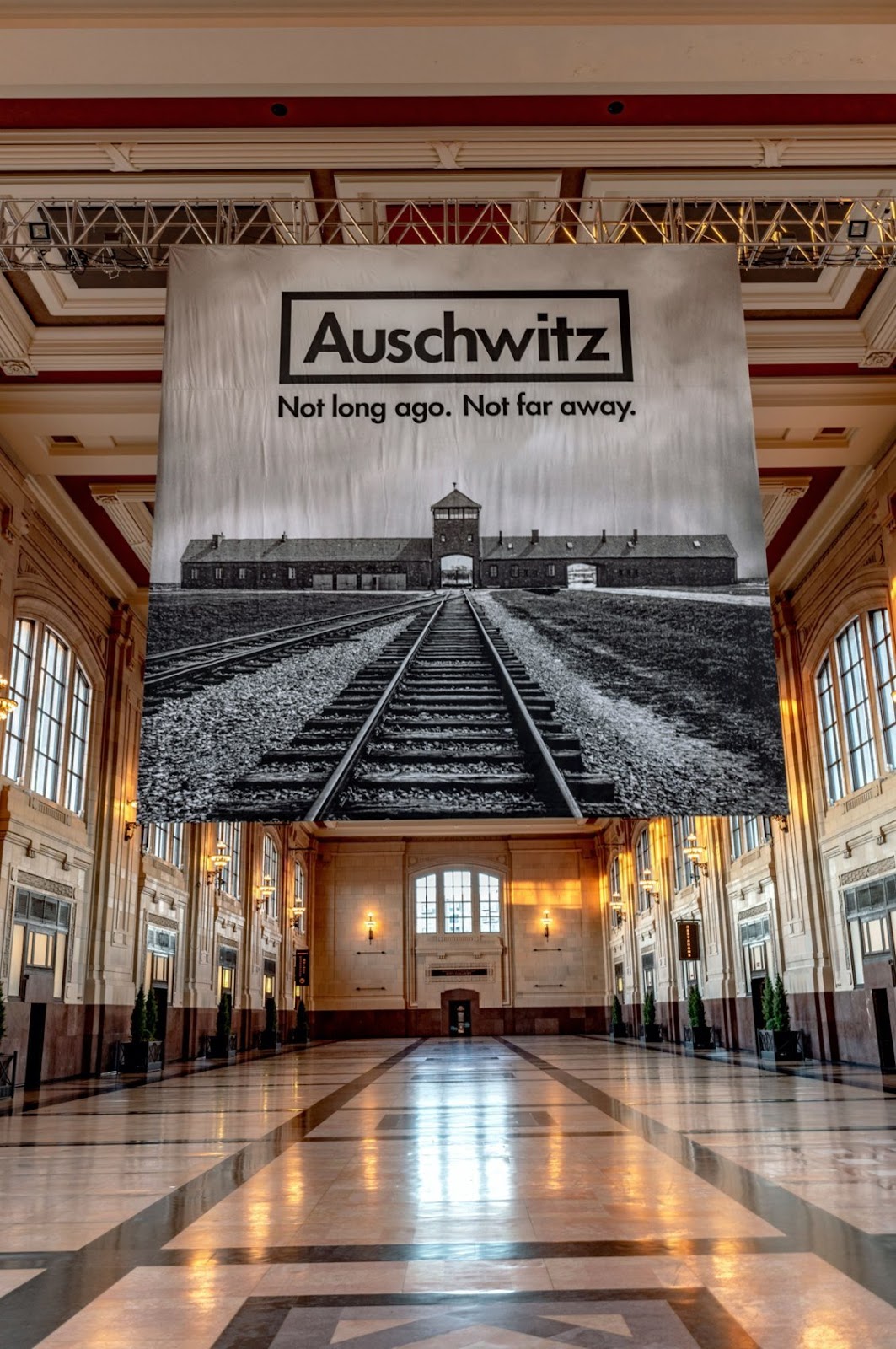
Ways one and two: let the scale be the subject, and work the edges
The first approach is to stop treating this as a portrait and treat it as an architectural photograph that happens to contain a couple. Expose for the hall as it actually looks, place the couple small and low in the frame, and use the scale as the subject. Two figures at the foot of a room this size is a genuinely arresting image and it is the one the building exists to give.
That requires a tripod and a slow shutter, because the ambient is dim and the aperture needs to be stopped down enough to hold the architecture. It also means the pose reads from posture and silhouette rather than from expression, since faces will be small — a clear gap between them, one turned slightly to the other, both still. And it wants symmetry: Beaux-Arts halls are built on an axis, and centring exactly on that axis gives the frame an inevitability an approximate position never achieves.
The second approach is to work the edges, where the hall becomes a normal-sized room. Colonnades, stair landings, ticket windows, archways and corridors all have surfaces close enough to bounce off and backgrounds near enough to stay in frame. Almost all the usable close portraiture in a building like this happens within two metres of a wall.
Upper levels are worth asking about specifically. Looking down into a hall from a balcony or a mezzanine gives a geometric frame no ground-level position offers, and it places the couple against the hall as a background rather than inside it as a component — which is a much easier exposure, because the background becomes a distant tone you can let fall dark.
- Expose for the hall and place the couple small; scale is the subject
- Centre exactly on the Beaux-Arts axis — near-centre reads as error
- Stay within two metres of a surface for close portraits
- Ask about balcony or mezzanine access; it turns the hall into a backdrop
- Light a slice of architecture rather than trying to light the volume
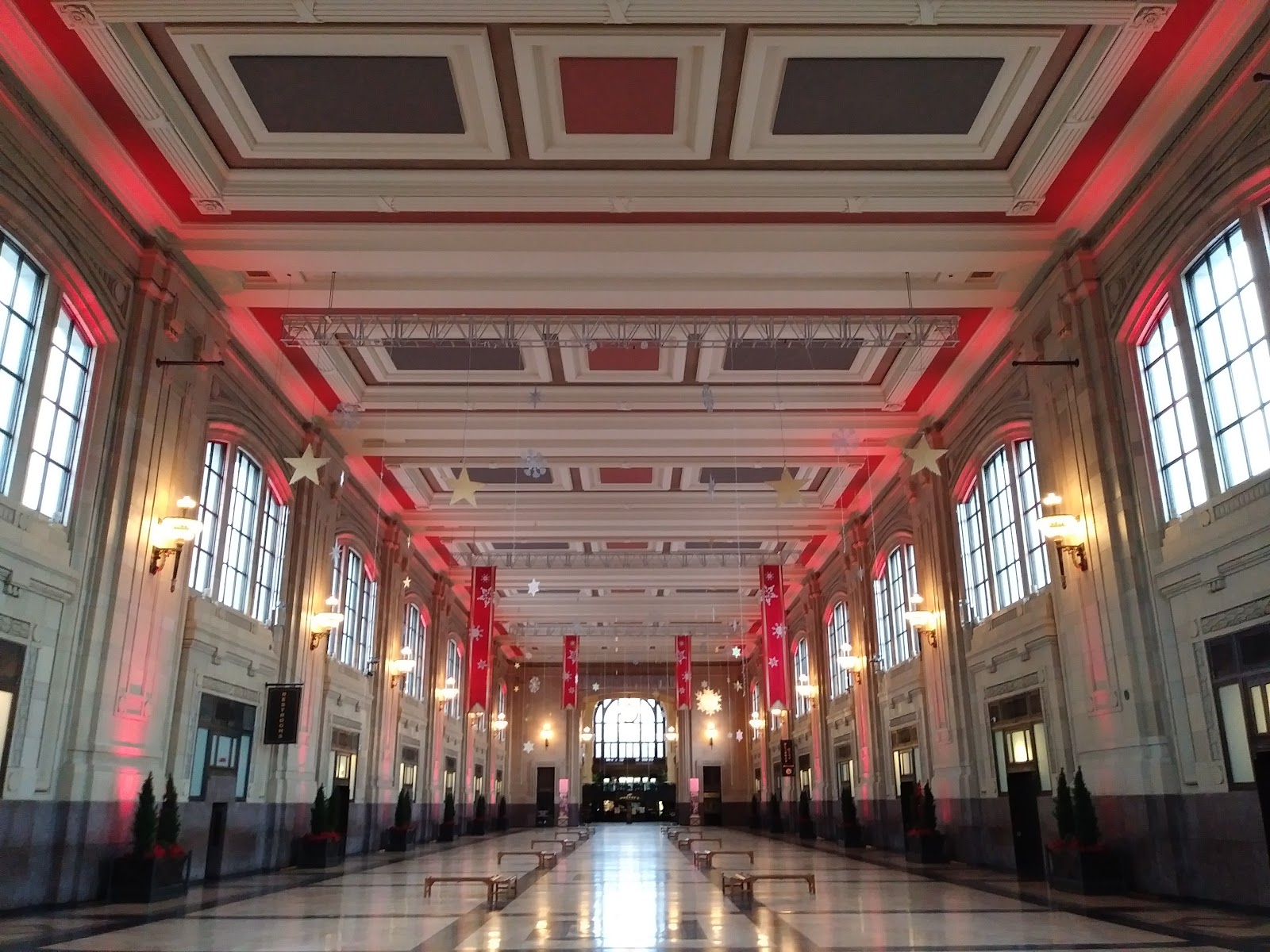
Ways three and four: light a slice, and find the shaft
The third approach accepts that the volume cannot be lit and lights a portion of it instead. One strong source raking across a run of columns, a stair or a section of stonework reveals the texture and depth of that part while everything else falls away dark. That is how architectural photographers have always handled monumental interiors — not evenly, but selectively, so the eye is led rather than informed. A couple placed in that raking light with a lit colonnade receding behind them gives you both the room and the people without illuminating the whole hall.
The fourth is free and needs only timing. Halls of this generation are lit by high windows, and on a bright day there is a period when the sun reaches the right angle to push defined shafts of light down into the space. Those shafts are the best light the building produces: directional, enormous, clean, and impossible to imitate with a strobe. The venue staff will know when it happens, because everyone photographs it — ask, and build the couple’s portrait block around that hour rather than around the schedule’s convenience.
There is a caution attached. A shaft from a high window is overhead light, which on its own gives dark eye sockets and heavy shadow under the nose and chin. It wants either a reflector bouncing a little back up into the face or a pose with the chin lifted and the head turned into the light. Used unthinkingly it produces dramatic photographs of people you cannot recognise.
Two practical matters. Internal distances in a railway terminal are long and load-in is a real walk, so plan one or two lighting positions rather than a tour and carry what each needs in a single trip. And these buildings are usually still public, at least in part — so unless an area is closed, every frame contains members of the public, and the usual answers apply: long lenses to compress them into unreadable background, tight framing, and the quietest hours available.
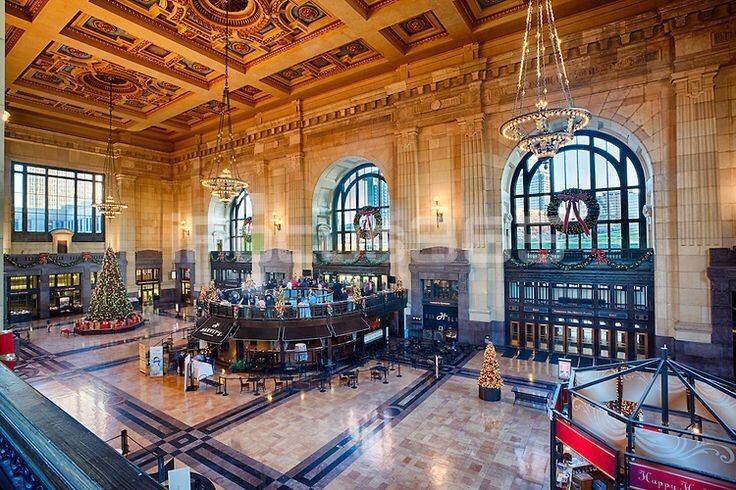
More frames from Union Station Kansas City
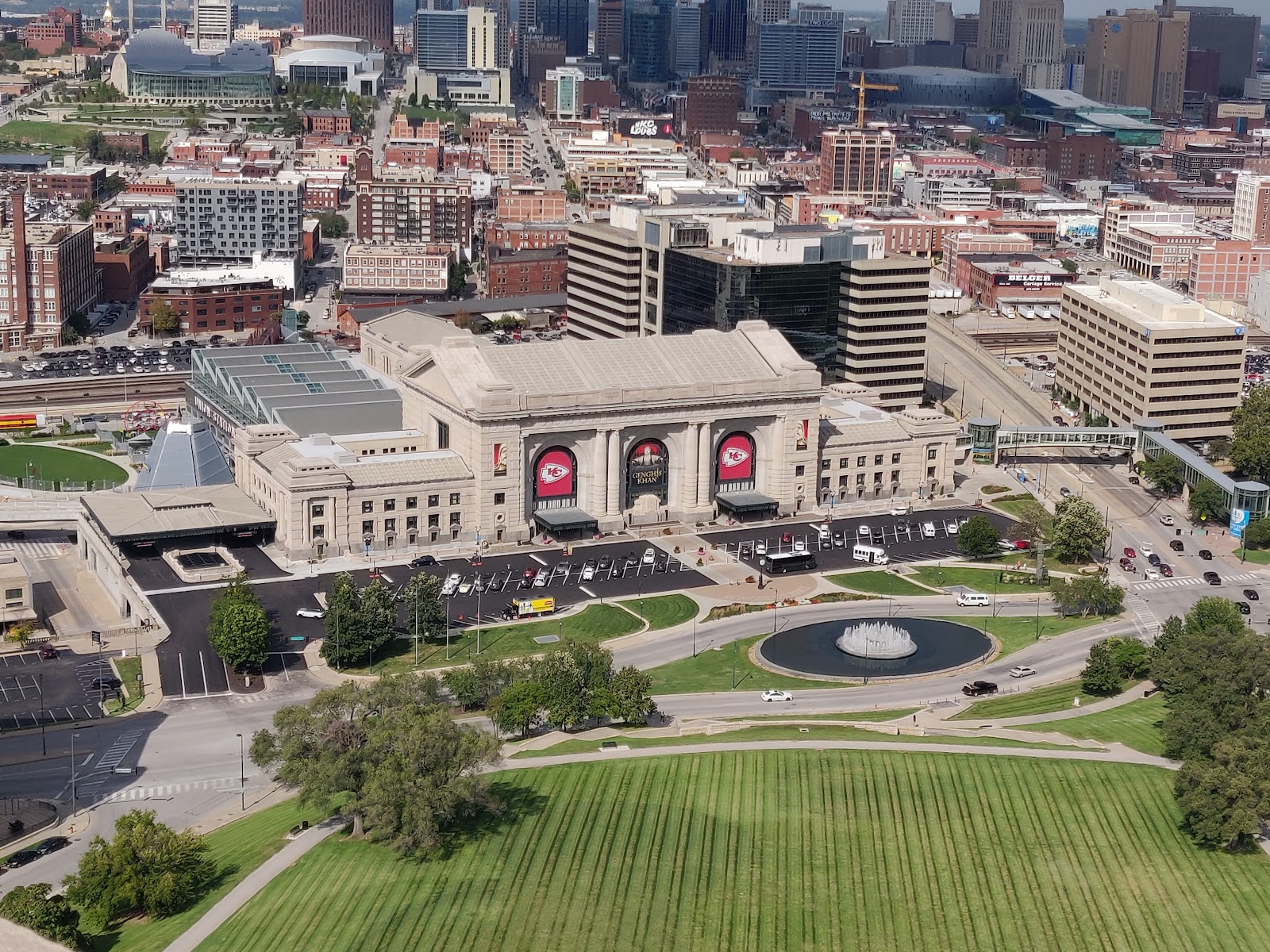
Union Station Kansas City wedding photography: common questions
Why does my flash do nothing in the Grand Hall?
Because light falls off with the square of distance and there is nothing close enough to bounce the spill back. In an ordinary room walls and ceiling return it; here it travels outward and never comes back. More power makes the couple brighter, not the hall visible.
What is the best frame in a hall this size?
The couple small and the room large. Expose for the hall as it really looks, place them at the foot of it, and let the scale be the subject — from a tripod, with the camera centred exactly on the building’s own axis.
Where do close portraits work?
At the edges. Colonnades, stair landings, archways and corridors have surfaces near enough to bounce from and backgrounds near enough to stay in frame. Almost all usable close work happens within two metres of a wall.
Is there any good natural light?
Yes, and it is the best in the building. High windows produce defined shafts at a particular hour on a bright day — directional, enormous and impossible to imitate with a strobe. Ask the staff when it happens; they will know.
What is the catch with those shafts?
They are overhead light, so on their own they give dark eye sockets and heavy shadow under the nose and chin. They want a reflector bouncing a little back up, or a lifted chin with the face turned into the light.
How many lighting positions should be planned?
One or two. Internal distances in a railway terminal are long and load-in is a real walk, so a three-position plan has fifteen minutes of walking hidden inside it.
More Kansas City, MO venue guides
We are writing a photographer’s guide to every venue we would happily shoot in Kansas City, MO. Here are three more, plus the full index:
- The Muehlebach Hotel: A Historic Wing Attached to a Modern One
- The Aladdin Hotel: What a 1925 Art Deco Interior Suits
- The Crossroads Hotel: Reading a Warehouse Conversion Through the Day
All Kansas City, MO Wedding Venues →
Planning a wedding at Union Station Kansas City?
A hall this size cannot be lit, only used. Tell us your date and we will find the shaft hour and plan two positions.