 Overhills Mansion: Who This Venue Suits, and Who It Doesn’t
La Banque de Fleuve, Baltimore: Photographing a Bank Building by the Water
A banking hall was built to look permanent. Height, symmetry and stone are the whole vocabulary.
La Banque de Fleuve sits by the Baltimore waterfront and combines historic character with modern elegance, which is an accurate summary of a building type whose logic is unusually consistent.
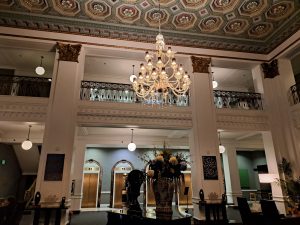
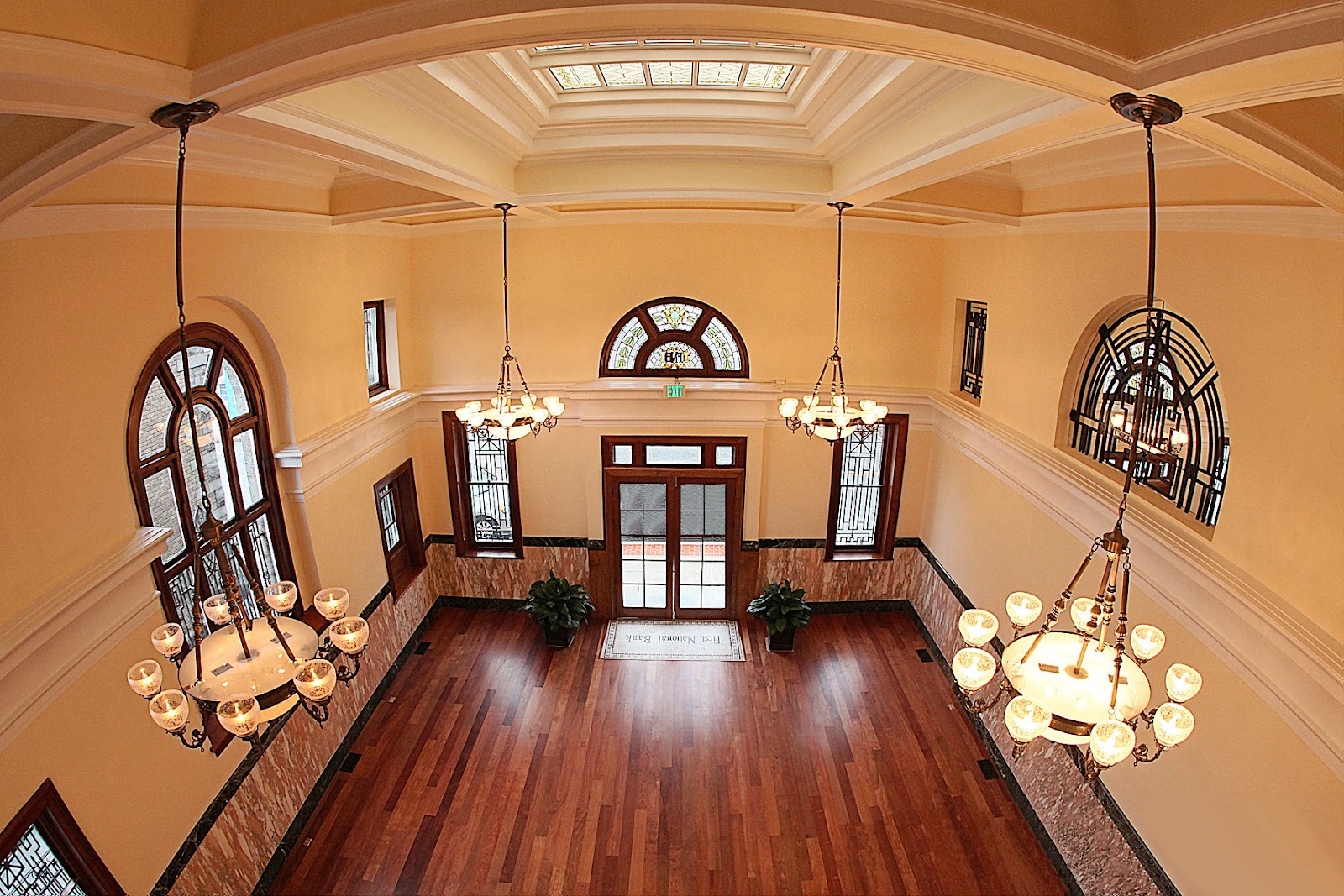
A bank building was designed to communicate one thing: permanence. That produced a specific and repeatable architecture — a tall single-volume public hall, strict symmetry, stone or marble rather than plaster, high windows set well above head height, and ornament concentrated at the cornice and around the entrance. Every one of those decisions has a direct photographic consequence, and together they make a banking hall behave unlike any other interior.
So this follows the venue’s own logic. We have not photographed a wedding here; converted banking halls behave consistently wherever they are found. Which spaces a wedding includes, whether the lighting is adjustable and what may be attached to stone are the questions for their team — stone almost never takes a fixing.
La Banque de Fleuve at a glance
| Where | The waterfront, Baltimore, Maryland |
| Character | A historic bank-type building with contemporary interiors, by the water |
| The logic | Permanence: tall single volume, strict symmetry, stone, high windows |
| Consequence | No bounce, hard separation, and precision matters |
| Ask first | Spaces included, lighting control, fixings to stone |
Height, stone and the absence of bounce
The single tall volume is the defining feature and its first consequence is that bounce flash does not work. A banking hall ceiling is far enough away that a flash aimed at it returns almost nothing usable, which removes the reflex move most photographers make indoors. The substitutes are a pale wall at a sensible distance, a reflector, or direct modified light, and it is worth finding out which in the first minute rather than the fiftieth.
Stone and marble are the second consequence and they behave differently from plaster or timber. Stone is a mid-tone that holds detail well, but polished marble is partly specular — it returns a bright reflection of any source rather than a soft scatter, which means a flash aimed near a polished surface produces a visible hot spot rather than a gentle lift. Angle sources away from polished planes, or use them deliberately so the reflection lands where it is wanted.
Stone also runs cool, which is unusual among historic materials. Where brick and timber bounce warm and need warming light to match, stone bounces neutral to cool — so a warm-gelled key set against a stone interior will look warmer than it would elsewhere, and a slightly cooler gel often sits better. Set white balance on a face in the position you are using rather than assuming the usual tungsten correction.
High windows are the third consequence and they are photographically excellent. A window set well above head height sends light down into the room at a steep angle from one side, which is close to a classical portrait lighting position — directional, elevated, soft by the time it has travelled. The position to find is the one where that light rakes across the space rather than falling straight down, which is usually further from the wall than instinct suggests.
The steepness does bring the standard problem in a milder form: light from above shadows eye sockets and marks under the nose. A reflector held low, a lifted chin, or a small source at face height solves it, and in a hall this size a reflector is often easier than a light.
Symmetry, and using a large empty volume
Strict symmetry is the fourth consequence and it changes how frames have to be made. A symmetrical hall photographed slightly off its axis reads as careless, because the eye detects a two-degree error in a symmetrical composition instantly while forgiving a large one in an asymmetrical composition entirely. The near-miss is the only failure available.
So the axial frame is worth a level, a moment of care and a tripod where permitted. Centre exactly on the axis or step clearly away from it — and once the frame is right, it is one of the strongest a city venue can offer, because it gives depth, repetition and a vanishing point at once.
The couple belongs in the depth of that frame rather than at the front of it. Placed two-thirds of the way into a tall hall they become the focal point of the architecture and read as two people in a very large room built for something else, which is the emotional content of a converted banking hall. Placed close to the camera they block the volume and the frame becomes a portrait with a ceiling.
A large empty volume also gives free separation, which is worth using deliberately. In a tall dim hall, light falls off steeply, so a subject three metres in front of anything else sits against natural darkness with no equipment at all. That is the opposite of the pale-hotel problem and it should be exploited rather than filled in.
Any surviving bank fittings — counters, screens, a vault door, brass, stone plinths — are the details that identify the building, and they are worth photographing in their own right on a fast lens at a raised ISO. A vault door in particular is a frame nobody has at their wedding, and it takes two minutes.
Contemporary fit-out over that shell is the fifth condition and it brings mixed sources: track lighting, decorative fittings and accent lighting on architecture, frequently at different colour temperatures and rarely agreeing with daylight from the high windows. Three colours of light in one frame cannot be resolved afterwards, so pick the source that should be correct, set a manual white balance to it, and switch off or overpower the rest where it lands on skin.
- Assume no ceiling bounce; find the pale wall or go direct immediately
- Angle sources away from polished stone, or place the reflection deliberately
- Stone bounces cool, not warm — check the gel rather than defaulting to it
- Level and centre the axial frame; the near-miss is the only failure
- Put the couple two-thirds into the hall and let fall-off separate them
The waterfront, the evening, and Baltimore weather
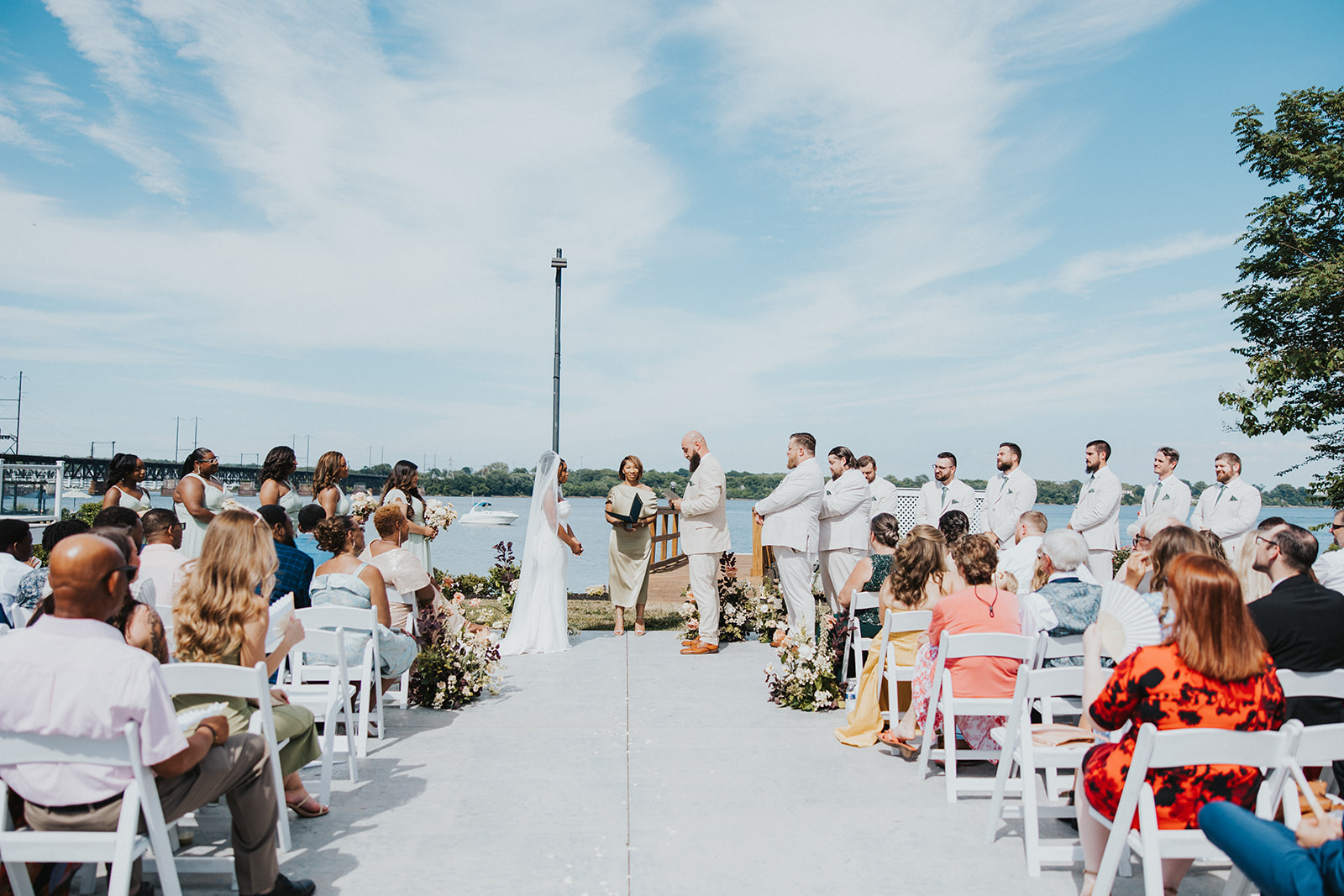
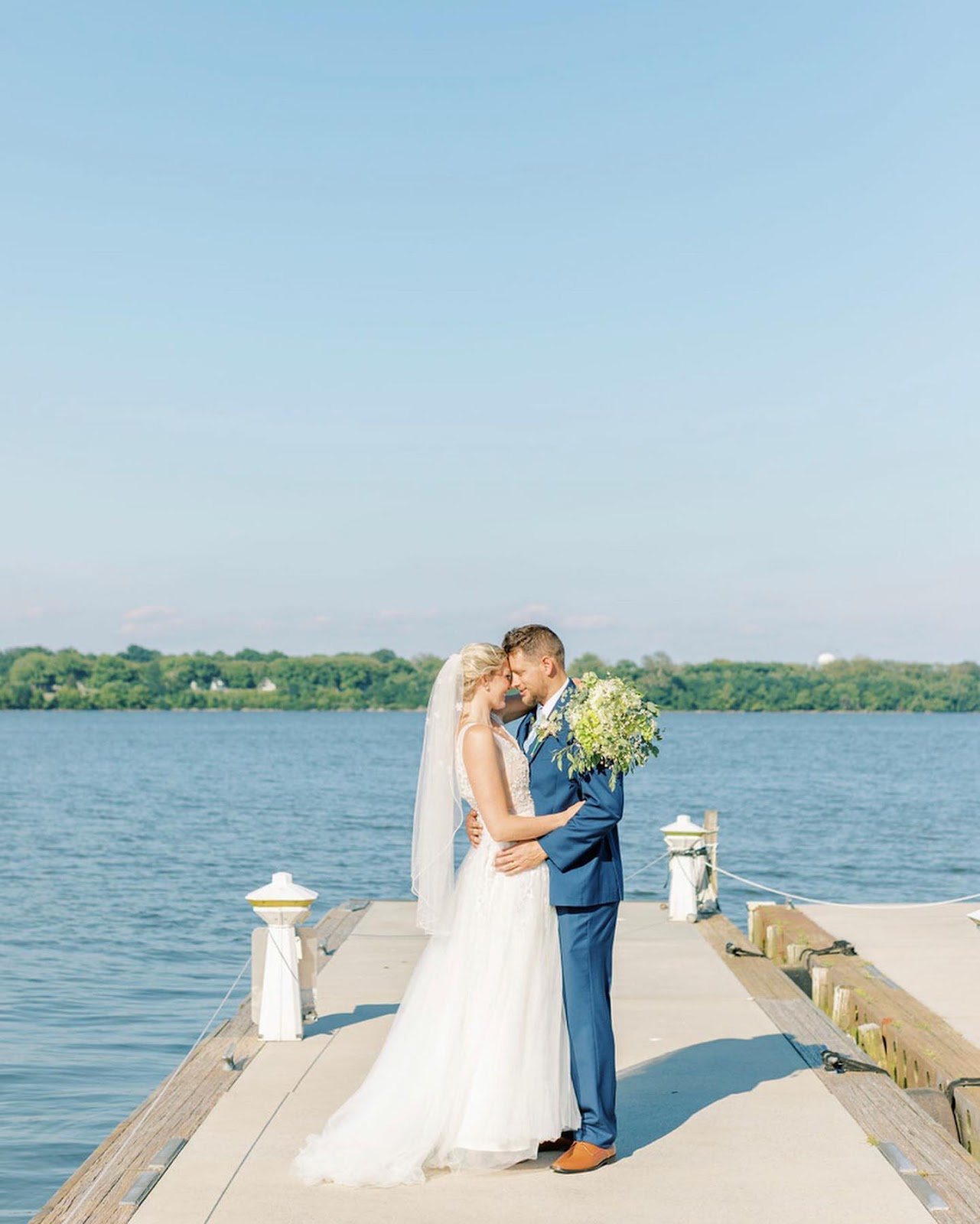
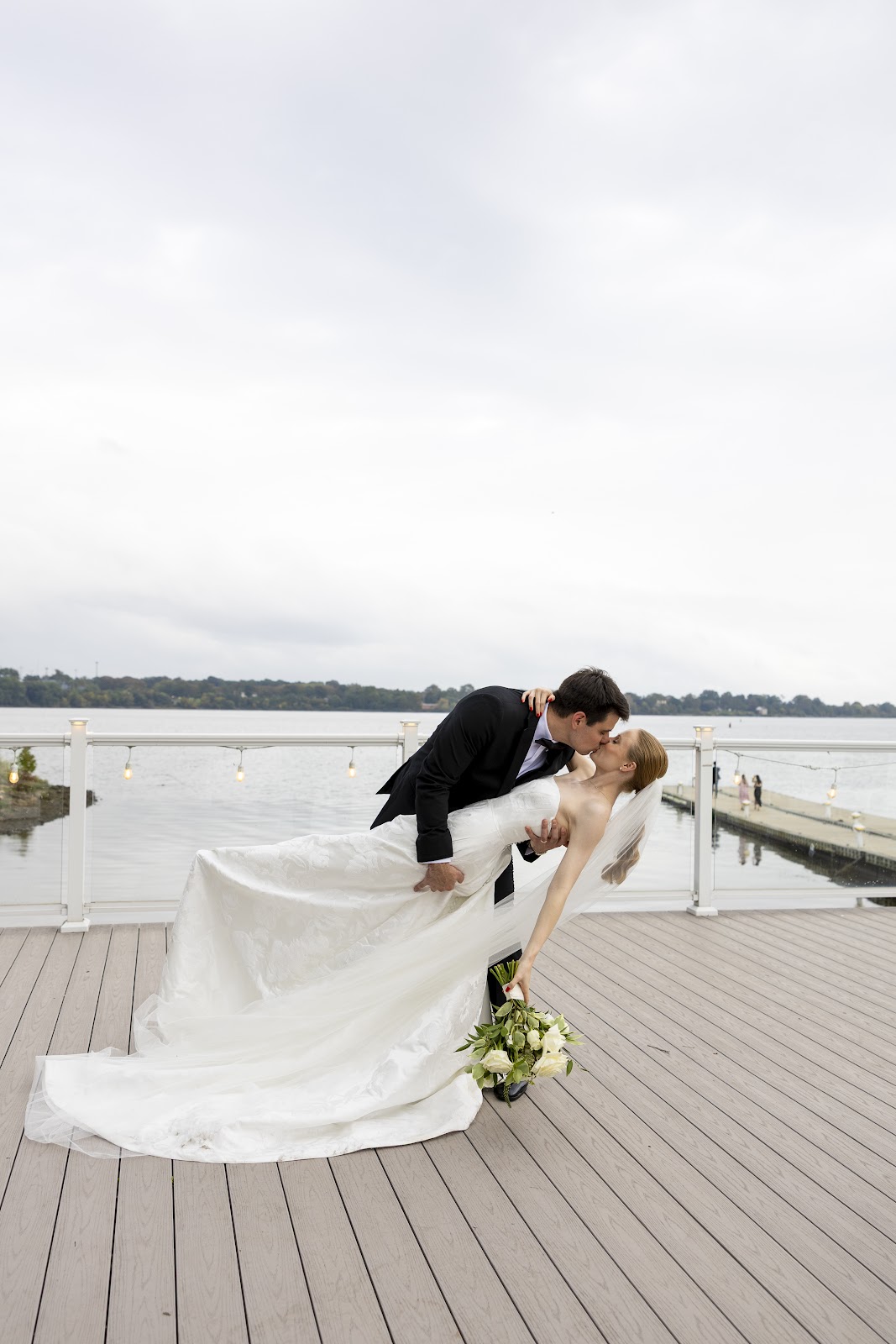
A waterfront position gives two things a landlocked venue does not. Water bounces light up from below, which raises ambient near any opening facing it and fills the shadow that high windows create from above — genuinely flattering, and specific to the location. And it gives an outdoor frame with real depth: a long lens along the quay stacks water, far shore and city into layers that a wide lens flattens into a strip.
Harbour wind is the constant. It is stronger and gustier at the water’s edge than in the streets behind, which matters for a veil, for hair and for any light stand — and it breaks the surface, so a mirrored reflection frame is an early-morning proposition rather than an afternoon one.
The dusk crossing is the one timed frame and at a building with high windows it is particularly good. For roughly twenty minutes after sunset the harbour and sky outside fall to about the brightness of the interior lighting, and one exposure holds the lit hall, the couple and the water beyond. Take the sunset time, add fifteen minutes, and be in position with the couple already there.
After it the windows become mirrors, which in a tall hall means large dark reflective planes high in the frame. Keep sources off the camera axis, shoot obliquely rather than square, and use the reflection deliberately where it helps.
Baltimore’s streets behind the waterfront are the counterweight and they are good material. Brick rowhouses are narrow and low-rise, so low evening sun reaches street level and runs the length of a block, and the white marble steps that front so many of them behave as low reflectors — bouncing light up into a face to fill the shadow overhead sun creates. That is a located frame and a lit one at the same time.
Mid-Atlantic conditions apply: summer heat and humidity keep outdoor blocks short, afternoon thunderstorms are common rather than rare — for which a stone building is an excellent fallback — and humidity produces fogging in both directions, as kit chilled by air conditioning fogs on going out and cold kit fogs on coming in. Let equipment come towards the temperature of where it is going before it gets there, and remember that the light after a summer cell passes over water, with wet stone and a dark sky, is frequently the best of the day.
More frames from La Banque de Fleuve
La Banque de Fleuve wedding photography: common questions
What is a banking hall's defining feature?
A single tall volume built to communicate permanence — which means no usable ceiling bounce, stone rather than plaster, high windows and strict symmetry.
How is stone different from brick or timber?
It bounces neutral to cool rather than warm, and polished marble is partly specular, returning a bright reflection of any source instead of a soft scatter. Angle lights away from polished planes.
What do high windows give you?
Light entering at a steep angle from one side — close to a classical portrait position, directional and soft by the time it arrives. The position to find is usually further from the wall than instinct suggests.
Why does symmetry demand precision?
Because a two-degree error in a symmetrical composition is detected instantly while a large error in an asymmetrical one is forgiven entirely. Centre exactly or step clearly away.
Where should the couple stand?
Two-thirds of the way into the hall, so they become the focal point of the architecture and read as two people in a very large room built for something else.
What does the waterfront add?
Light bounced up from the water, which raises ambient and fills the shadow high windows create — and an outdoor frame with real depth, provided it is shot long rather than wide.
More Baltimore, MD venue guides
We are writing a photographer’s guide to every venue we would happily shoot in Baltimore, MD. Here are three more, plus the full index:
- The Maryland Science Center, Baltimore: A Walk Through a Science Museum
- The National Aquarium, Baltimore: Four Ways Out of the Blue Light Problem
- The Sagamore Pendry, Baltimore: How the Light Moves
All Baltimore, MD Wedding Venues →
Planning a wedding at La Banque de Fleuve?
A banking hall rewards precision and one timed frame. Tell us your date.