 The Crosby Street Hotel, New York: A Walk Through a SoHo Hotel
The Whitby, New York: A Walk Through a Midtown Hotel
Pattern everywhere and one very dark room. Both are solvable if you know which is which before you arrive.
A hotel whose interiors are built on pattern — textiles, papers, upholstery, colour used deliberately rather than neutrally — gives a photographer a specific pair of problems and one unusually good asset.
The problems are pattern, which competes with faces, and the dark room, which most hotels of this design now include in the form of a screening room. The asset is tall windows, which some Midtown buildings of this generation have and which change what is possible in a public space entirely.
Walked in the order a day uses it, the building resolves into four stages and four specific tasks. This is that walk.
We have not photographed a wedding at the Whitby; patterned contemporary interiors, screening rooms and tall-window public rooms each behave consistently. Which spaces are included, whether the screening room is part of the offer and whether the lighting is adjustable are questions for their team.
The Whitby at a glance
| Where | West 56th Street, Midtown Manhattan |
| The sequence | Entrance, patterned public rooms, screening room, guest floors, street |
| The problem | Pattern, which competes with a face and rewards distance |
| The asset | Tall windows in a public room, if the building has them |
| Ask first | Spaces included, screening room access, lighting control, fixings |
The entrance and the patterned rooms
The entrance in Midtown is a fragment and there is no arguing with it: no room to stand back on a cross street means the facade cannot be photographed whole, so the arrival frames are the doorway, the canopy, the step and looking up.
The canopy is worth using properly rather than walking under. A roof with an open face is a directional soft source at the right size for two people — the same physics as a porch — and it is the one weatherproof position the venue has outdoors. A frame made at the canopy edge beats one made on the pavement most days of the year.
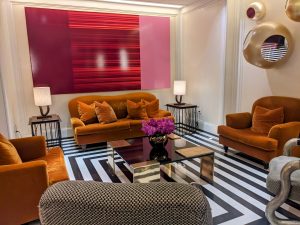
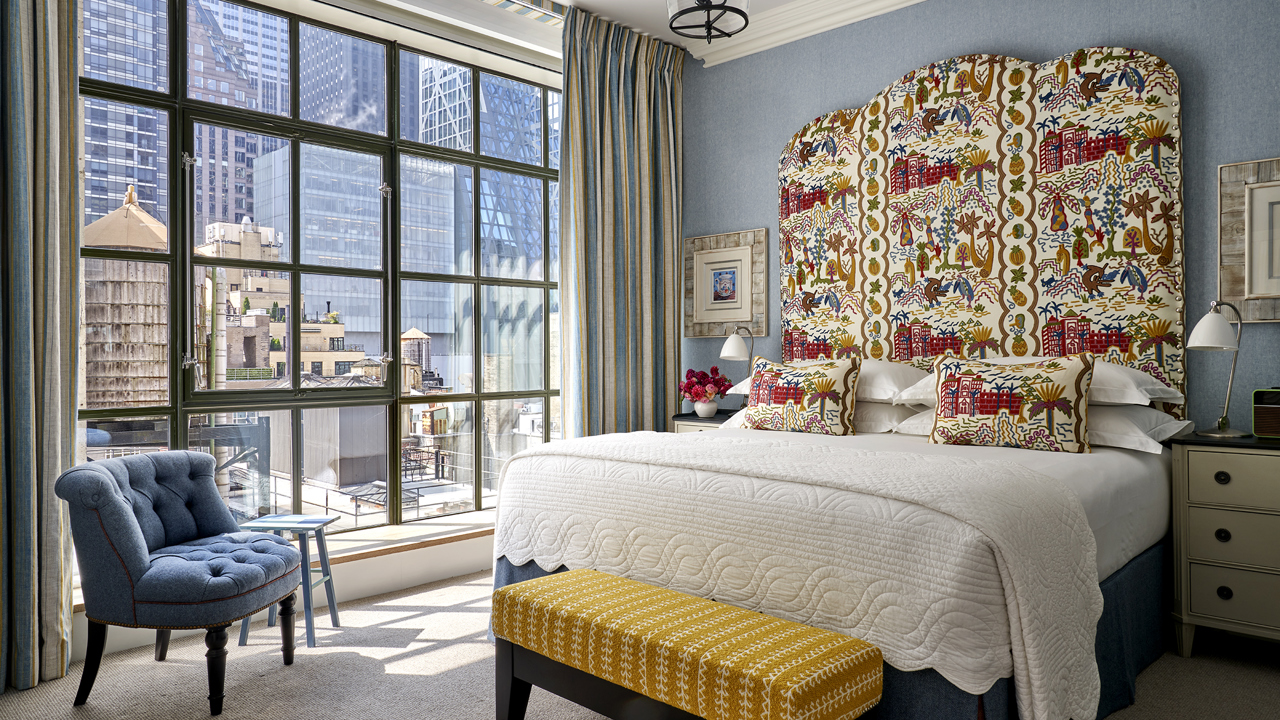
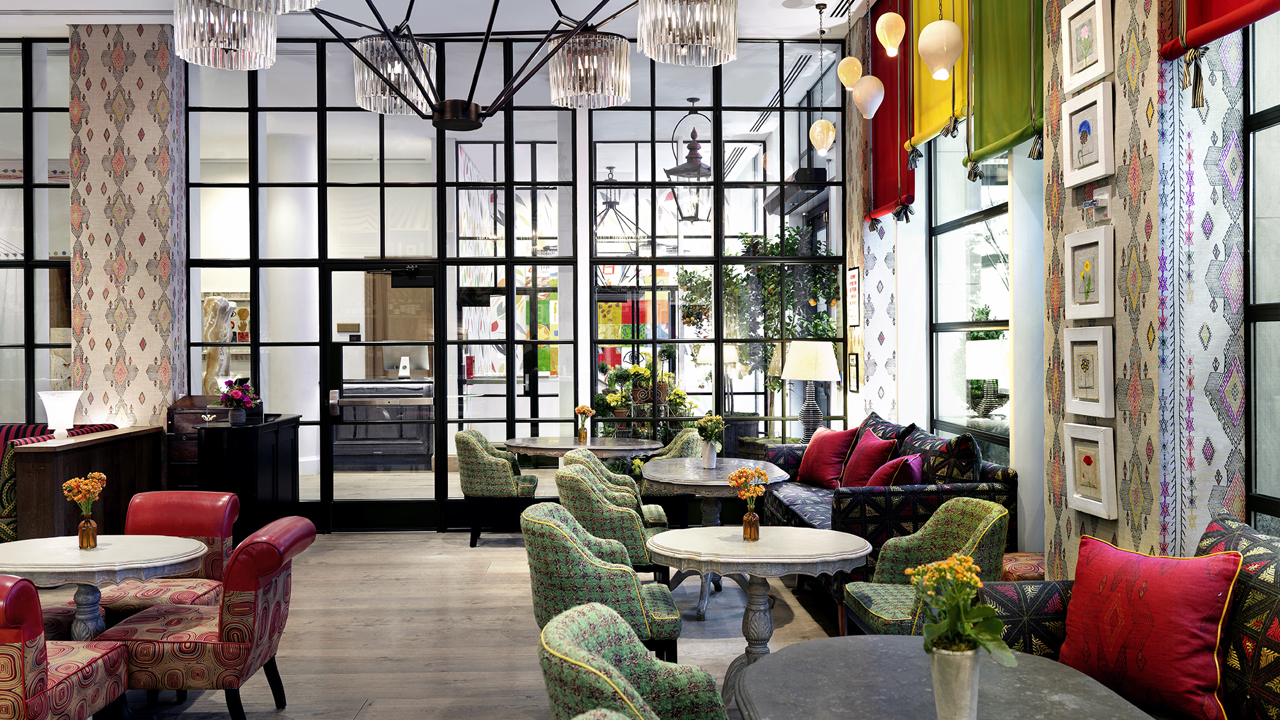
Inside, pattern is the governing condition and it needs a decision per frame rather than a general policy. A patterned wall, a patterned upholstery, a figured carpet: all of them carry detail at the same spatial frequency as a face, which is exactly why they compete. The eye cannot separate the two, and the picture reads as busy.
There are three working answers. Distance and aperture — a long lens at a wide aperture reduces pattern to tone while the face stays sharp, which is the most reliable fix and costs nothing but standing further back. Subject brightness — a face half a stop to a stop above the pattern behind it pulls the eye forward regardless of what the pattern is doing, which is what an added source is for. And plain ground — every patterned room has one unpatterned wall, door or curtain, and finding it on arrival takes a minute and solves the problem outright.
The frequent error is the wide frame from close range, which puts a face and a maximum amount of pattern into the same picture at the same scale. It is the one composition to avoid here.
Pattern also carries colour, and saturated pattern bounces its hue onto skin from whichever side it sits — localised, so global white balance cannot reach it. Let one gelled source own the faces, with white balance set to that source, or set a custom white balance on a face in the actual position being used.
And the ambient in a room of this kind is lower than it appears, because patterned textile and deep colour absorb rather than bounce. Test bounce with one frame on arrival; in a heavily furnished room it returns very little, and what it returns arrives coloured.
The compensation is steep fall-off, which is free separation: a subject three metres clear of anything else sits against natural darkness, which is also the simplest way to make pattern stop competing — at distance and out of focus it becomes texture, then tone, then nothing.
The screening room, the tall windows and the guest floors
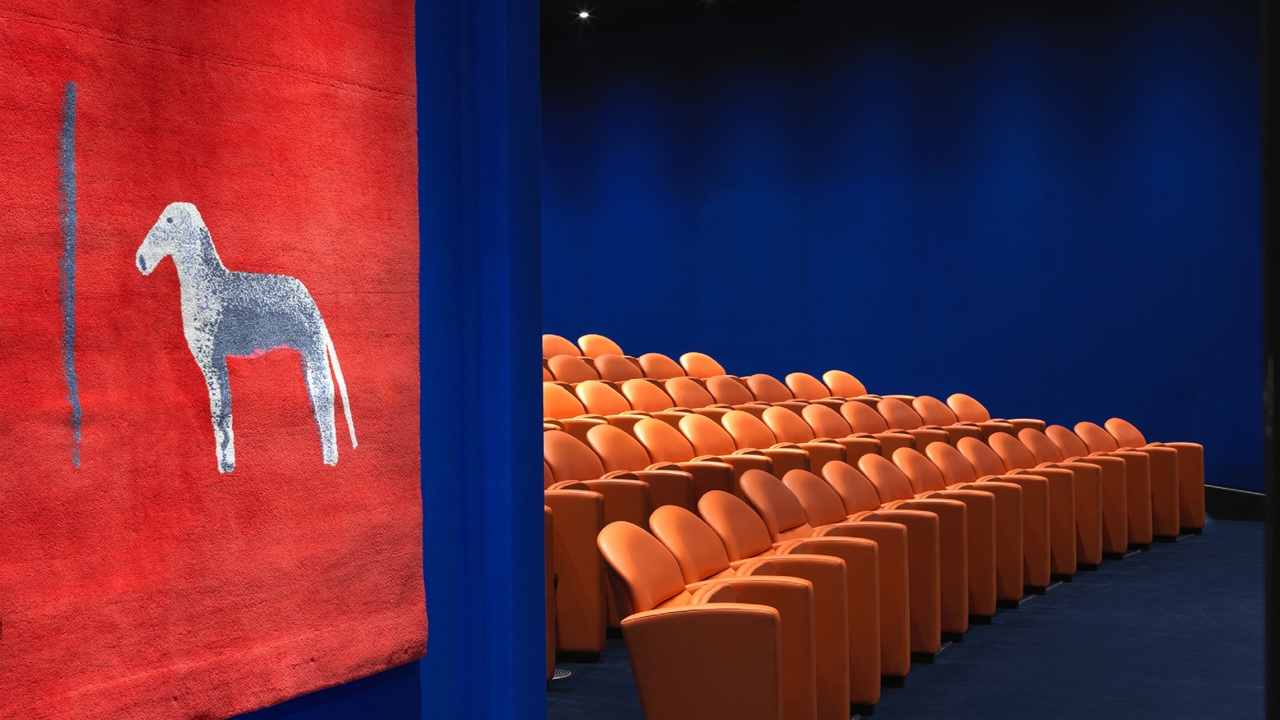
A screening room is the darkest space in the building and it is a different technical problem from a dim one. Dark absorbent walls, dim fittings by design, no daylight: the ambient sits several stops below a normal interior and bounce returns nothing at all.
It is also where the most dramatic separation in the building is available, which is why it is worth using rather than avoiding. One source, close, in a modifier, off the camera axis, exposed for the face with the room allowed to fall to black — the opposite of the advice for a warm furnished room and correct here, because this room is genuinely dark rather than dimly warm. Where the screen is lit it becomes a large soft source, and a couple in front of it is backlit by it; that frame is worth making once.
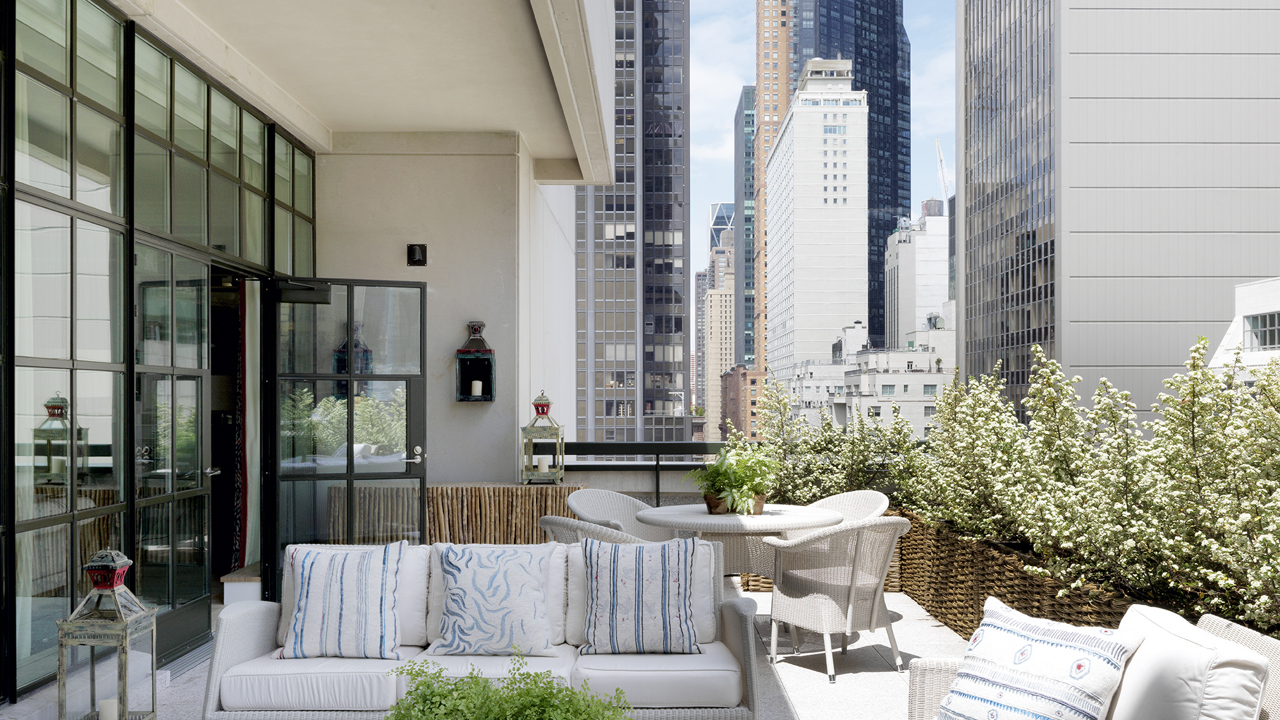
Tall windows, where a public room has them, are the best thing in the building and they change what a hotel can do. A window two or three times human height is a soft source that reaches a whole group rather than two people, which means the formals can happen in daylight in a public room — something most hotels cannot offer at all.
Two things govern them. Direct sun turns a tall window from a soft source into a hard one with a hard edge, so the usable version is the shaded side or a bright overcast day. And fall-off across a group is steep if the group is close to the glass: a row of people parallel to the window and three metres back is even, while the same row at a metre has a two-stop spread across it.
Tinted glass is worth checking on arrival, because a lot of Midtown glazing is tinted and it throws a localised green or blue cast onto anything near it that global correction cannot remove. A gelled source or a turned-away subject solves it; discovering it in editing does not.
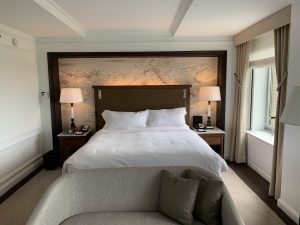
The guest floors are the reliable natural light and the requests are the familiar ones: largest window on the shaded side, every overhead fitting off so the room has one colour, lamps out of frame, two to three metres back from the glass. In Midtown, ask for a high floor specifically — the buildings opposite are very tall and close, and the sky reaching a high window is worth more than a stop of light, with softer and more even quality on top of it.
The one timed frame in the building is the dusk crossing at any tall or high window. For roughly twenty minutes after sunset the street falls to about the brightness of the interior, and a single exposure holds the lit room, the couple and the city beyond. It happens once and it cannot be rescheduled, which makes it the fixed point the rest of the evening moves around.
- Long lens, wide aperture: pattern becomes tone, the face stays sharp
- Find the one unpatterned wall in each room on arrival
- In the screening room, expose for the face and let the room go black
- Keep a group three metres off a tall window so the row is even
- Check the glazing for tint before it appears on skin
Out onto the street, and New York's year
Outside, Midtown gives fragments and one reliable effect. Most street-level light here is bounced down from lit facades above rather than direct, which makes it soft, directional and available for much of the day — genuinely good portrait light and not golden-hour light, and worth saying so in advance.
The reliable effect is the grid. Manhattan’s is rotated about twenty-nine degrees from true north, which means the cross streets run roughly east-north-east to west-south-west and take low sun down their full length while the avenues stay in shadow. The alignment is closest around the ends of May and the middle of July, and when it happens a Midtown cross street becomes a single long soft-edged light source pointed straight at you. It lasts about twenty minutes.
Recessed doorways, canopies and arcades are the small-scale positions and they are reliable in every season: a roof above, walls to the sides, one open face, the right size for two people, and rainproof.
New York’s seasons are four real ones. Summer is hot and humid with afternoon thunderstorms a real possibility, which for a fully indoor venue costs almost nothing — the running order written in March survives into July. Its real cost is comfort on any outdoor block, so shorter is better, and wet pavement returning reflections of lit signage is a better frame than the dry version rather than a consolation.
Autumn gives the clearest air and the best street light of the year, and the best visibility from any high window.
Winter is cold with short days, sunset in the middle of the afternoon in December, which compresses the outdoor block into a couple of hours and means the street positions must be chosen in advance rather than explored.
Snow is the compensation twice over. Outdoors it is the best natural fill there is, lifting exactly the shadows a low sun carves while fooling a meter by about two stops. Indoors it turns the street into a very large reflector, so the tall windows and the guest-floor windows — the two best light sources in the building — give softer, brighter and more even light in February than at any other time of year. In a building whose strength is its windows, that makes winter the season it performs best in.
And the fogging risk applies in both directions in this climate, so let a body come towards the temperature of where it is going before it gets there, and plan one excursion rather than several.
More frames from The Whitby
The Whitby wedding photography: common questions
What is the main difficulty?
Pattern. Patterned walls and textiles carry detail at the same scale as a face, so the eye cannot separate them and the picture reads as busy.
How do you solve pattern?
Distance and a wide aperture so it becomes tone; a face half a stop to a stop brighter than the pattern; or the one unpatterned wall every such room has.
What should be avoided?
The wide frame from close range, which puts a face and a maximum amount of pattern into the same picture at the same scale.
How do you use a screening room?
One source, close and off-axis, exposed for the face with the room allowed to go black. It gives the most dramatic separation in the building.
Why do tall windows matter so much?
Because a window two or three times human height is a soft source large enough to light a whole group — which means the formals can happen in daylight in a public room.
When is the building at its best?
February. Snow turns the street into a large reflector, and the windows that are the building’s main asset get softer and brighter light than at any other time of year.
More New York venue guides
We are writing a photographer’s guide to every venue we would happily shoot in New York. Here are three more, plus the full index:
- The William Vale, New York: How the Light Moves
- The Brooklyn Museum, Brooklyn: A Walk Through the Building
- The Oheka Castle, Huntington: The Venue’s Own Logic
Planning a wedding at The Whitby?
Pattern solved, and the windows used properly. Tell us your date.