 The Whitby, New York: A Walk Through a Midtown Hotel
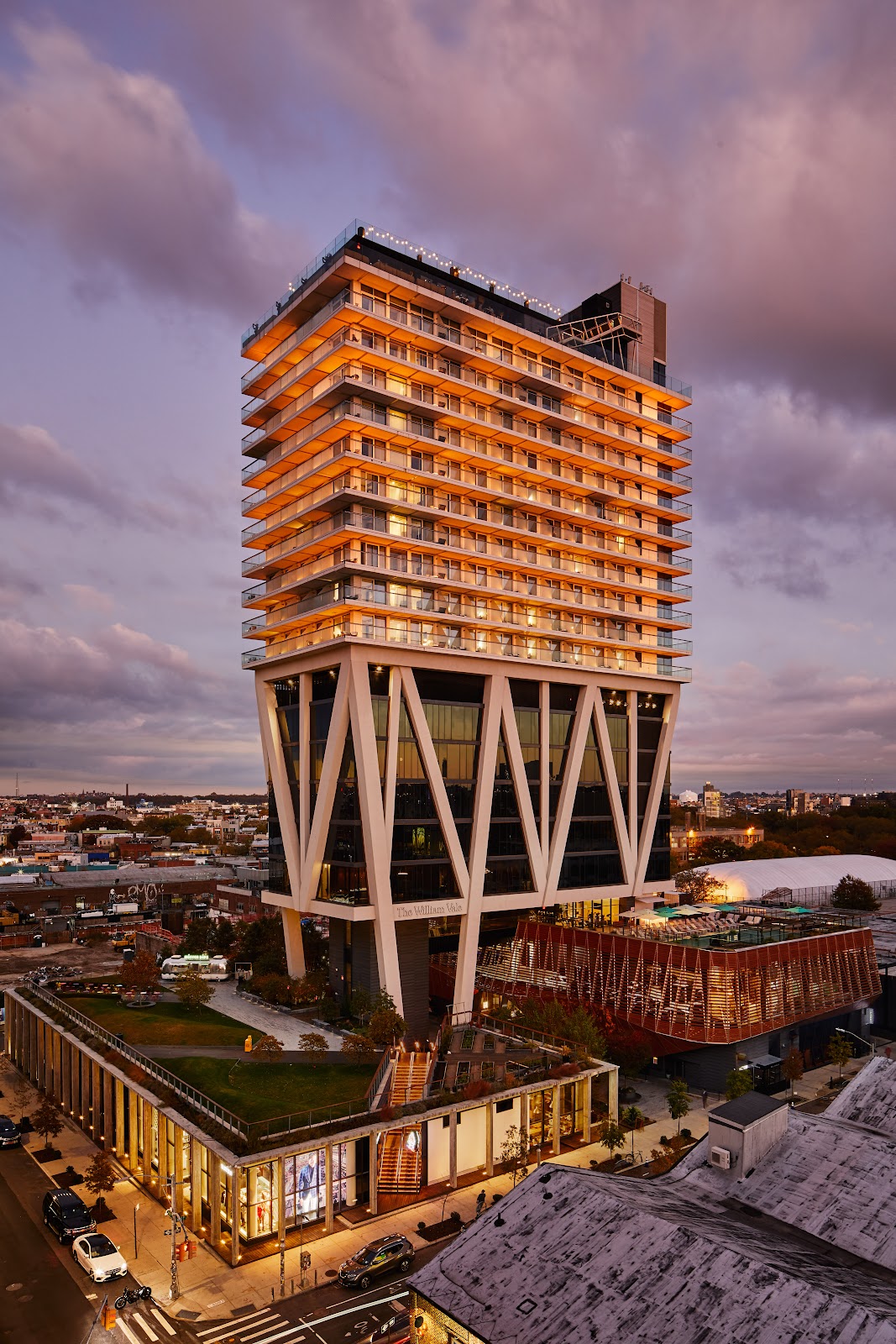
The William Vale, New York: How the Light Moves
A skyline across water is a background that changes every hour and is only itself twice a day.
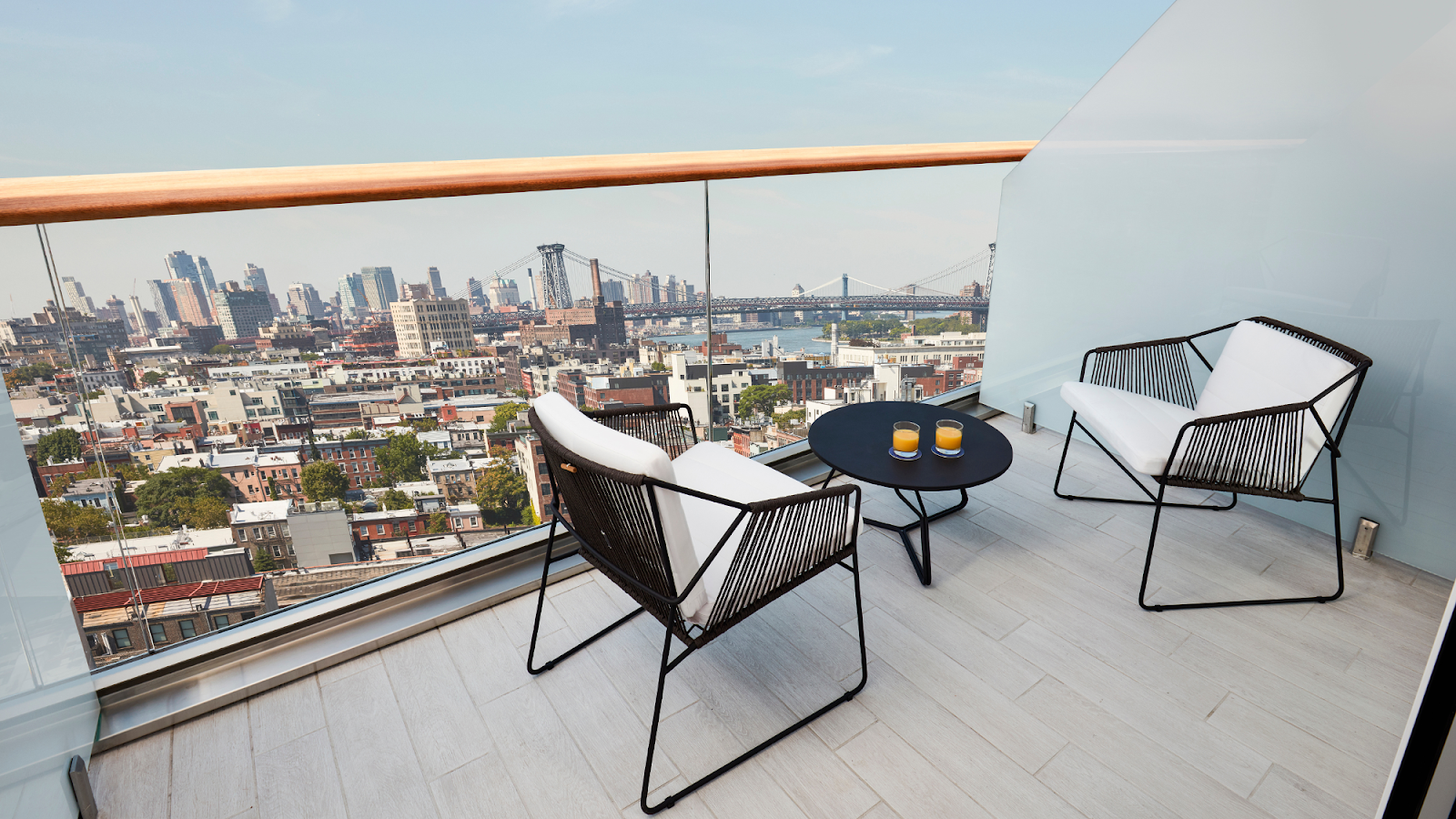
The panoramic views of Manhattan’s skyline are the icing on the cake, as the venue’s own description has it, providing a spectacular backdrop.
Read as a planning fact rather than a compliment, that means the defining asset is outside the building and on the far side of water — which puts the whole day on the sun’s clock rather than the hotel’s. A modern hotel interior is constant from mid-morning to midnight; a skyline across a river is not, and the difference between when it looks like a skyline and when it looks like a grey strip is entirely a matter of hour and direction.
There is also a geographic fact worth stating plainly, because it decides everything: looking at Manhattan from Brooklyn means looking roughly west. That puts the sun behind the skyline in the evening, which is a completely different proposition from a view that is lit from the front — and it makes the two good windows unusually well defined rather than approximate.
This is written as a day. We have not photographed a wedding at the William Vale; hotels whose asset is a skyline view behave consistently. Which spaces are included, whether any rooftop or terrace is exclusive and at what hour, and whether the function room lighting is adjustable are the questions for their team.
The William Vale at a glance
| Where | Brooklyn, New York |
| Character | A modern hotel with panoramic views across water to Manhattan |
| The governing fact | The view faces roughly west, so the sun is behind the skyline |
| Two windows | Late afternoon for lit facades; after sunset for lit windows |
| Ask first | Spaces included, rooftop or terrace access and hour, lighting control |
Daytime: why the view waits
A west-facing skyline view is backlit for the whole afternoon, and that is the fact to plan around rather than discover. With the sun behind the towers, the facades facing you are in shadow while the sky beyond is bright — so the skyline reads as a dark silhouette against glare, and any couple in front of it is either lit by open sky from the front, which is flat, or underexposed along with the city.
That is not unusable, but it is a specific frame rather than the frame most people expect: silhouette, shape and sky rather than detail on buildings. If that is wanted, it is available all afternoon; if detail on the towers is wanted, it is not available at all until the light changes.
In the morning the reverse applies. With the sun behind the camera, the towers are lit frontally, which gives detail and colour on the facades and a clear separation between buildings at different distances. That is the hour a skyline shows what it is — and at a wedding it is rarely used, because nobody schedules portraits for the morning. It is worth mentioning to a couple as an option rather than assuming it is unavailable.
Water sits between the venue and the view, and it does three things. It is a broad flat reflector, so any glazed space facing it receives light twice — directly from the sky and again bounced up off the surface — which raises ambient and fills faces from below, and is genuinely flattering. It gives an unobstructed foreground, which means the skyline reads as a distinct object at a distance rather than as the end of a street. And it carries colour: at the right hour the water holds the same hue as the sky, which doubles the colour in a frame and puts it below the horizon as well as above.
Indoors, the brightness difference needs a decision rather than a discovery. In daylight the view is four to six stops brighter than the room, so either let the glazing blow to a white shape — legitimate if chosen, and it gives the cleanest background available — or light the couple to match the view, which needs real power because you are competing with daylight; or wait for the crossing.
At a venue whose entire premise is the view, blowing the window to white is almost always the wrong answer. Match it or wait.
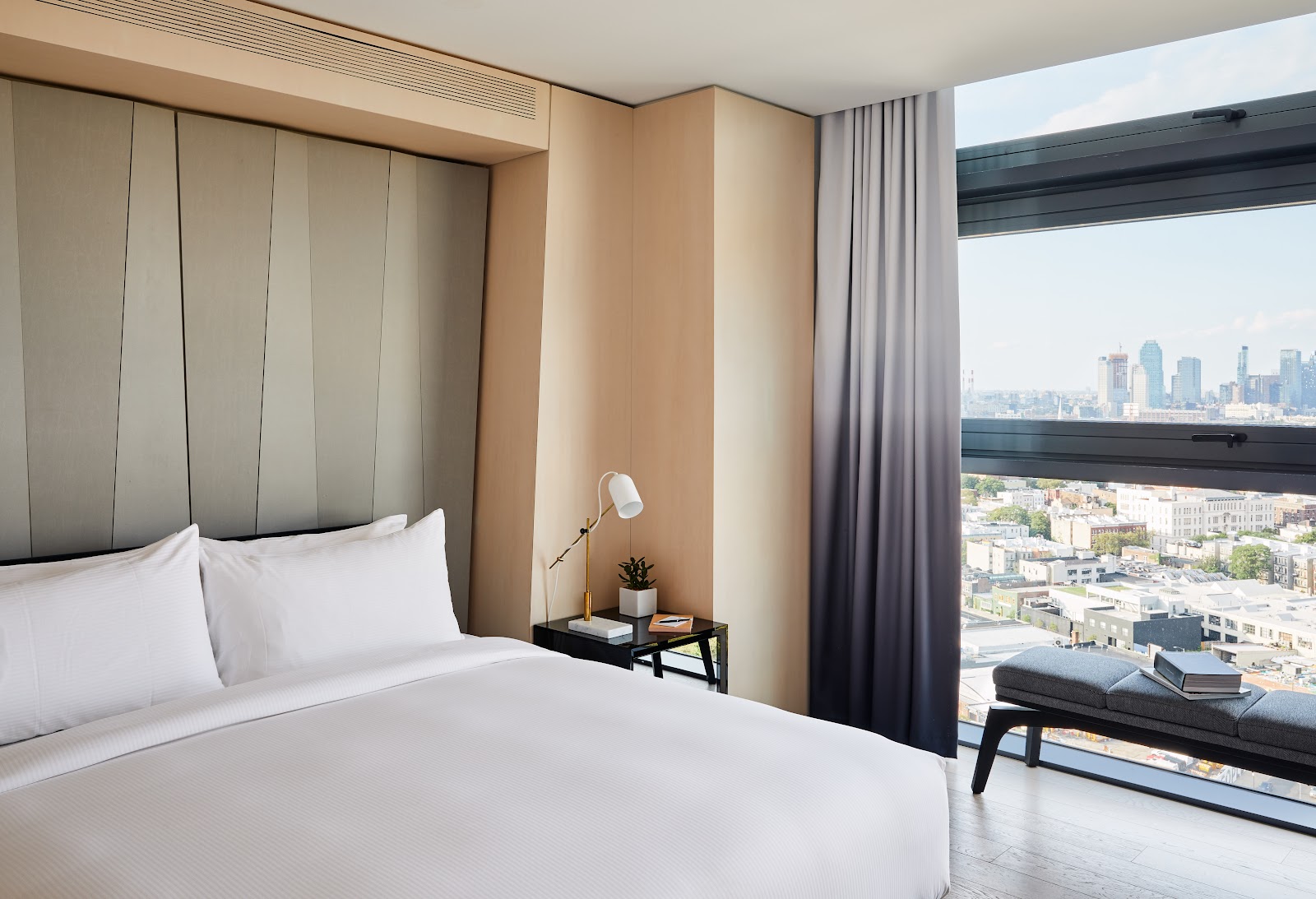
The position that makes any of it work is two metres back from the glass rather than pressed against it: pressed against a window a subject is lit from a very oblique angle with the far side of the face falling away, while two metres back the same glazing covers them evenly and the room behind still reads.
The two good windows
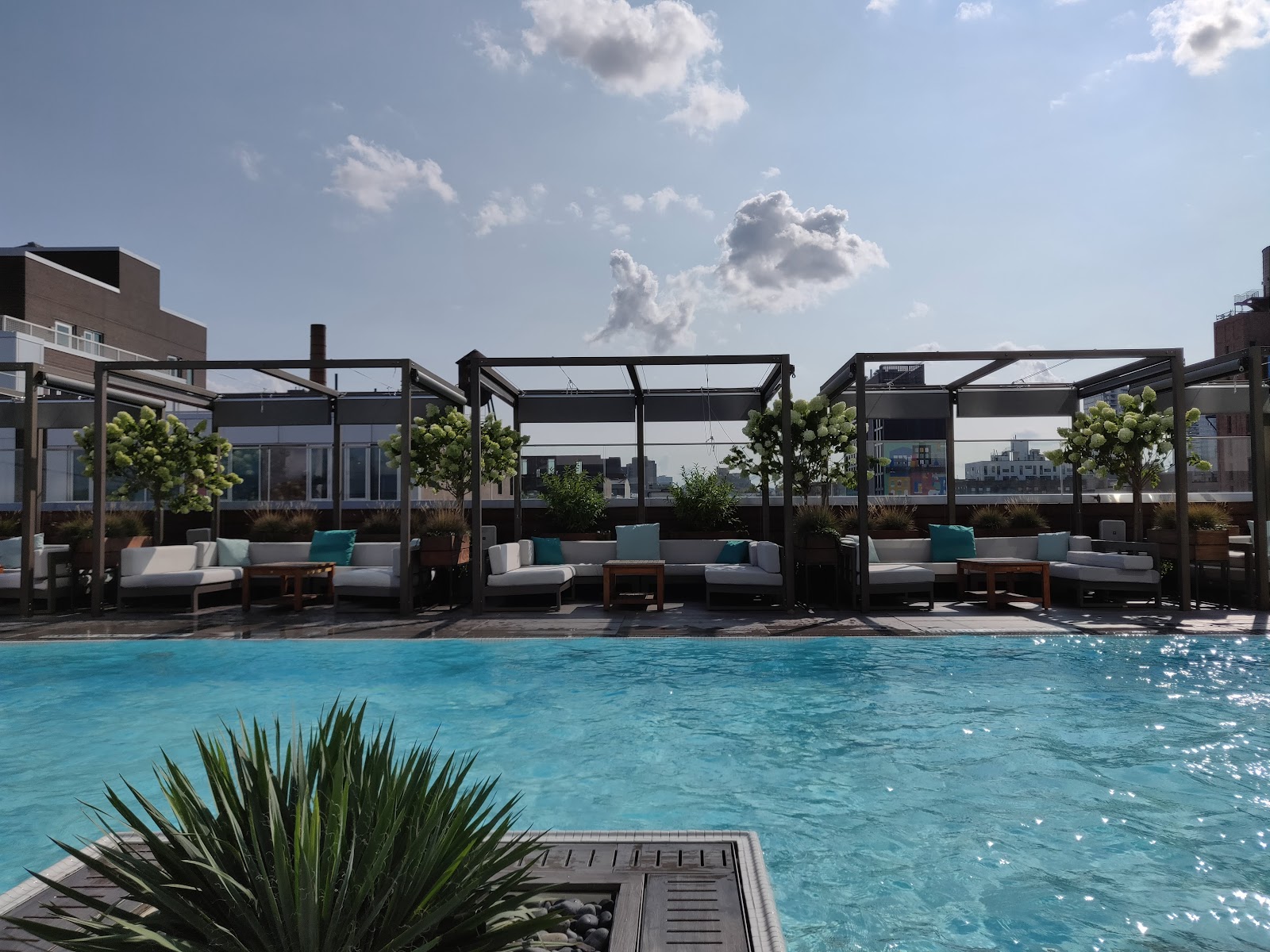
The first window is the last forty minutes of daylight and on a rooftop it starts earlier than at street level, because being above the surrounding roofline means low sun reaches the terrace while the streets below are already in shadow. That is worth thirty extra minutes in the schedule.
In that window the sun is low behind the skyline, which does something specific and good: it rims the towers, lights the water between, and turns the sky behind the city into a graduated field. A couple placed against it needs a source on the faces — one warm-gelled light at face height, about a stop under the sky — or they silhouette, which is itself a legitimate frame if chosen rather than accepted.
Long lenses matter here more than anywhere. Compression brings the skyline close behind a couple as a mass of vertical geometry; at a wide focal length the same towers shrink to a strip at the bottom of a large empty sky, which is the single commonest failure with a view of this kind. A view is a long-lens subject, which is counter-intuitive because the instinct is to include all of it.
A low camera is the complementary move: dropping close to a terrace floor or parapet puts decking or coping into the frame as a leading line and lifts the couple against sky rather than against rooftops.
The second window is roughly twenty minutes after sunset and it is the frame the venue exists for. The tower windows begin to light while the sky still holds colour and the water still carries it, so one exposure holds a lit skyline, a coloured sky, a reflection below and a couple. Four things that at every other hour are mutually exclusive.
It is an appointment rather than an opportunity: sunset time, add fifteen minutes, be in position with the couple already there, and bracket a sequence as the sky falls. And the same warm-gelled source at face height about a stop under the sky is what keeps the couple from becoming a silhouette.
After it the city stays lit while the sky goes black, which is a different and still good frame — and any glazing behind the camera inverts entirely, so indoors whole walls become mirrors and the view disappears. Lights go off the camera axis, frames go oblique, and glazed corners reflect from both sides at once, so check them before guests arrive.
Rooftop wind is the standing outdoor constraint and it is stronger over water than inland: a veil becomes a held-or-removed decision, hair needs managing, and any stand needs a sandbag rather than an intention.
- A west-facing skyline is backlit all afternoon — plan for silhouette, not detail
- Two metres back from the glass, and never blow the window at a view venue
- Go long: a wide lens turns a skyline into a strip at the bottom of the sky
- Sunset plus fifteen with a warm source on the faces; four things align once
- Weight the stands — rooftop wind over water is stronger than inland
Inside, outside, and New York's year
The interior is the ordinary modern problem and it needs the ordinary answers. Even light removes the gradient across a face that the eye reads as shape, so one directional source at close to ambient level restores it — half a stop in one direction does more than two stops overall. Pale surfaces remove separation, so depth, a wide aperture, placement against the darkest element available and negative fill restore it; and in a pale bright room, subtracting beats adding.
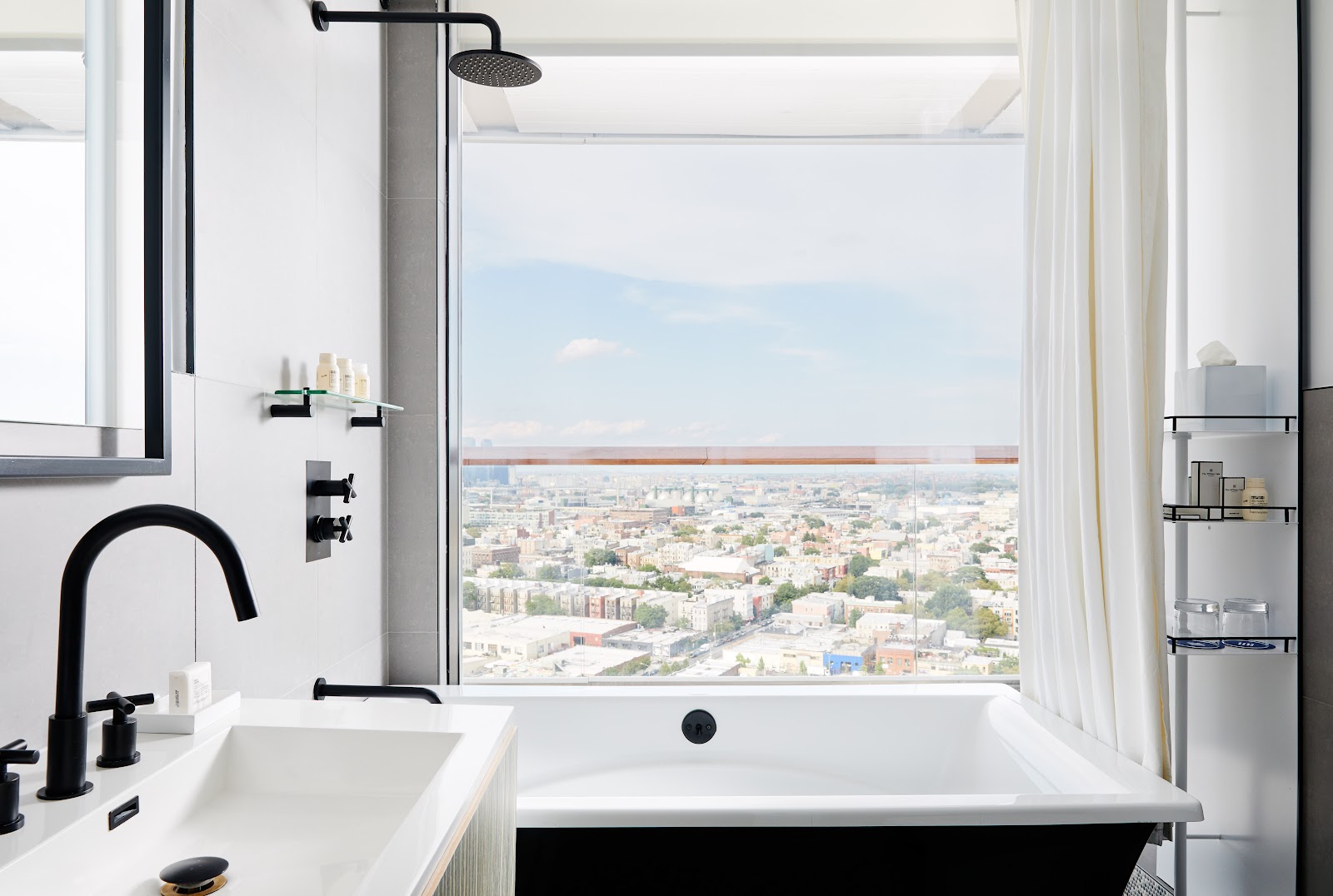
Guest rooms are the best portrait light in the building, and a water-facing one is better than a city-facing one for the reason above. Largest window on the shaded side, every overhead fitting off so the room has one colour of light, lamps moved out of frame, and the glass checked — at height a window that has not been washed shows as haze and flare in a way a ground-floor window does not.
The function rooms are the least specific spaces, as usual: expose for the room, one warm-gelled source at face height where legibility matters, white balance set to the gel and held, and steep fall-off used as separation. Asking whether the lighting can be dimmed to pools rather than set evenly is worth more than any equipment decision.
Outside at street level, Brooklyn gives something Manhattan does not: room to stand back, at least in the lower-rise districts. A whole building can sometimes be photographed entire, and industrial and warehouse fabric nearby gives brick, loading openings and alleys — which is a coherent counterweight to a glass-and-view gallery and is a short walk.
Brick shows its texture only when light runs along it, so a short walk to find which side is being raked is worth more than any accessory. And alleys give directional light from walls on both sides with a contained background.
New York’s seasons are four real ones and a view venue feels them sharply. Summer is hot and humid, which softens distant detail and makes a long-lens skyline hazier than it looks to the eye — the view is measurably less sharp in August than in October. Afternoon thunderstorms are a real possibility, and from a height across water a storm over a city is spectacular rather than inconvenient: a cell crossing Manhattan seen from a lit room is a frame very few weddings have.
Autumn gives the clearest air of the year and therefore the sharpest view frames, and the most stable weather — which for a venue whose best frame is timed to the minute is worth something.
Winter is cold with short days, sunset in the middle of the afternoon in December, which moves the crossing to the late afternoon and may put it before the ceremony. But cold clear air gives the deepest and longest-lasting sky colour of the year and the sharpest towers, so the crossing itself is better then — and a rooftop in a January wind across water is a two-minute proposition, which means the frame must be ready before anyone goes out.
Snow is the compensation and it is the best natural fill there is, while fooling a meter by about two stops — and a snow-covered city across water, seen from a warm lit room, is a frame very few venues anywhere can offer.
More frames from The William Vale
The William Vale wedding photography: common questions
What is the governing geographic fact?
The view faces roughly west, so the sun is behind the skyline. That means the towers are backlit all afternoon — silhouette and shape rather than detail on facades.
When does the skyline show detail?
In the morning, with the sun behind the camera. It is rarely used because nobody schedules portraits then, but it is worth offering as an option rather than assuming it is unavailable.
Wide or long lens for a skyline?
Long, always. Compression brings the towers close behind the couple; a wide lens shrinks them to a strip at the bottom of a large empty sky, which is the commonest failure with this kind of view.
What happens at the crossing?
Tower windows light while the sky still holds colour and the water still carries it — so one exposure holds a lit skyline, a coloured sky, a reflection and a couple. Four things that never otherwise align.
Should you ever blow the window to white?
Not at a venue whose premise is the view. Match it with a light or wait for the crossing; blowing it out discards the only reason for being there.
Which season gives the best view?
Autumn, and then winter. Humid summer air softens distant detail measurably, while cold clear air gives the sharpest towers and the deepest sky colour.
More New York venue guides
We are writing a photographer’s guide to every venue we would happily shoot in New York. Here are three more, plus the full index:
- The Brooklyn Museum, Brooklyn: A Walk Through the Building
- The Oheka Castle, Huntington: The Venue’s Own Logic
- The Queens Museum, Queens: The One Decision That Governs Everything
Planning a wedding at The William Vale?
One appointment, fifteen minutes after sunset, with a light ready. Tell us your date.