 The Detroit Opera House: A Walk Through a Restored Opera House
The Westin Book Cadillac, Detroit: A Walk Up Through a Restored 1924 Hotel
A 1924 grand hotel puts its architecture at the bottom and its views at the top. Both are worth the trip.
Restored to its original 1924 grandeur, the venue has a grandeur that can only be described as inspiring, as its own description has it.
A restored 1920s grand hotel is a consistent and generous building type, and its photographic logic is vertical. The architecture is concentrated at the base — a lobby, function rooms and a ballroom built when a hotel’s public floors were its public face — and the height is above, because a building of that era in a city like this is a tower. Those two things are different venues and they are reached by lift rather than by walking, which makes the day a sequence up the building rather than a route around one.
That is the useful way to plan it: the period rooms for the architecture, the guest floors for the light, and whatever height is available for the city. This is a walk up through the building.
We have not photographed a wedding at the Book Cadillac; restored 1920s grand hotels behave consistently. Which rooms are included, whether the ballroom lighting is adjustable, what upper-floor access exists, and what may be attached to restored fabric are the questions for their team — restored plaster almost never takes a fixing.
The Westin Book Cadillac at a glance
| Where | Downtown Detroit, Michigan |
| Character | A restored 1924 grand hotel with period public rooms and a tower above |
| The logic | Architecture at the base, views at the top |
| The plan | A sequence up the building rather than a route around it |
| Ask first | Rooms included, ballroom lighting, upper-floor access, fixings |
The base: the period rooms
The public floors of a 1920s grand hotel are where its architecture is, and they share four conditions.
Tall volumes remove bounce. A restored lobby or ballroom ceiling is far enough away that a flash aimed at it returns almost nothing usable, so the substitutes are a pale wall at a sensible distance, a reflector, or direct modified light — with real power, because the distances are real. One test frame in the first minute settles which. What height gives back is steep fall-off, which is free separation: a subject three metres in front of anything sits against natural darkness.
Ornament needs the opposite of what a modern restoration usually installs. Plasterwork, cornices, columns and coffers are three-dimensional and read only when light crosses them at an angle and casts small shadows — so under the even downward lighting that makes a room usable, the same ornament flattens into a pale field and the space photographs blander than it looks. One source placed to graze rather than face brings it back, and it is a one-light problem rather than a big-kit one.
Mixed sources are certain in a restored building of this age: daylight through tall windows, warm decorative fittings, cooler recessed downlights added in restoration, and possibly accent lighting on the architecture. Three colour temperatures in one frame cannot be resolved afterwards — pick the one that should be correct, set a manual white balance to it, and switch off or overpower whatever else lands on skin. Switching a few fittings off is frequently the cheapest improvement available.
And tall windows are the base’s best natural light, because a hotel built in 1924 predates reliable artificial lighting in its public rooms. A window of that height sends light further into a room and higher up a standing figure than a modern one, so two or three metres inside one on the shaded elevation is a broad soft key with steep natural fall-off.
A grand stair, where the restoration kept one, is the most useful single feature: elevation, a diagonal or curve, a handrail as a leading line, and rows for a group automatically, which a flat ballroom floor never provides. The frame from the top looking down, with the couple small inside the sweep, is the one most often missed.
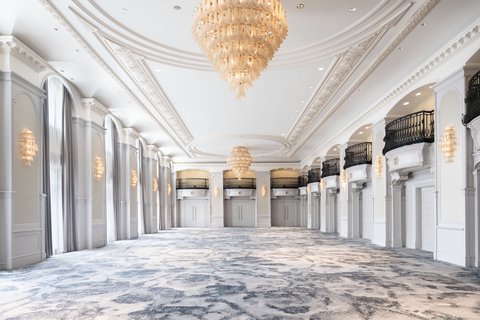
The ballroom is the evening and it is a known quantity: a high ceiling with no usable bounce, warm decorative fittings, overhead sources and a house scheme dimmed low. Expose for the room so it stays warm and dim, add one warm-gelled source at face height where legibility matters, set white balance to the gel and hold it, and let decorative fittings become warm points behind a subject at a wide aperture. Asking whether the lighting can be dimmed to pools rather than set evenly is worth more than any equipment decision.
Up the building: the rooms and the height
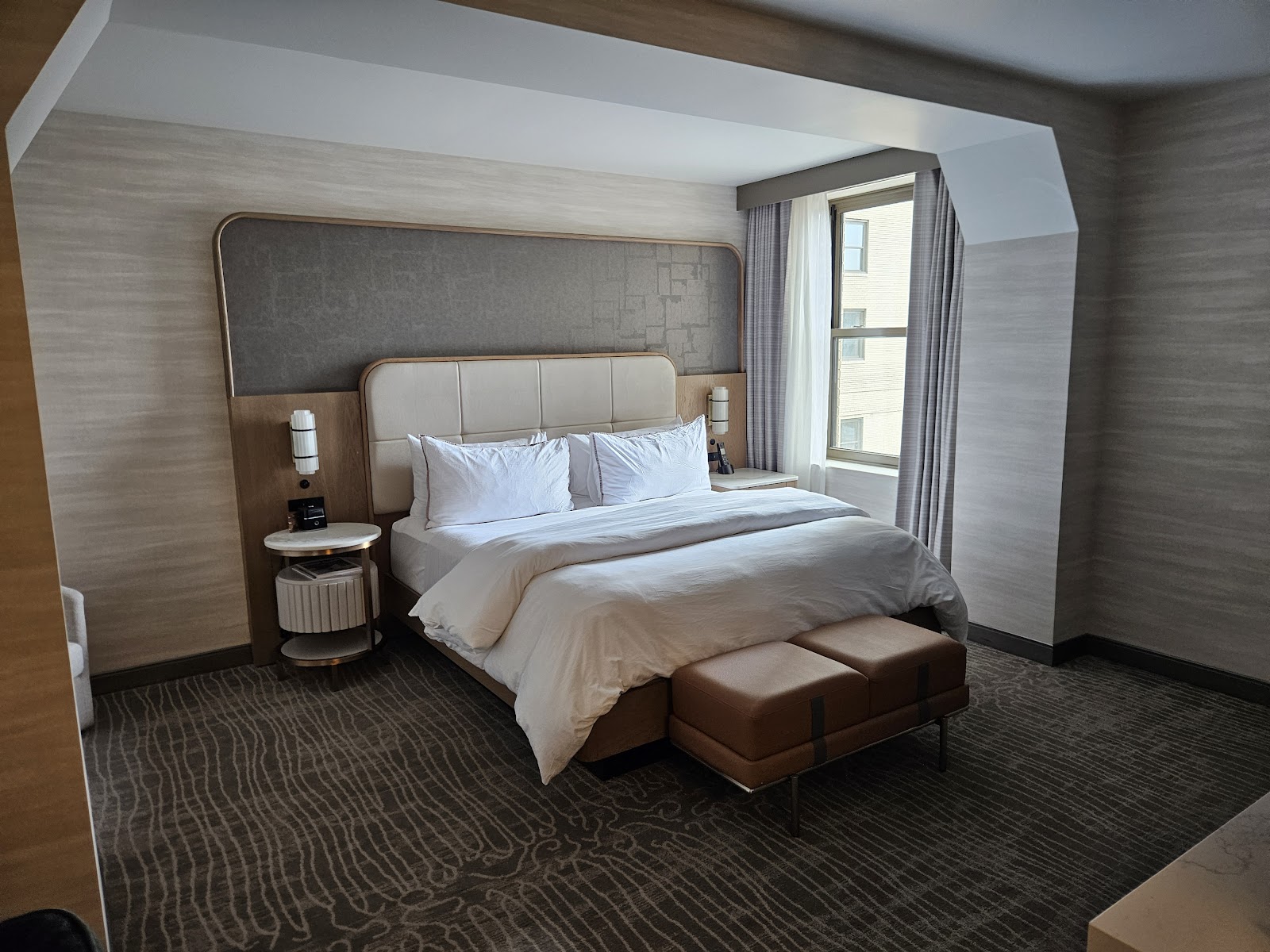
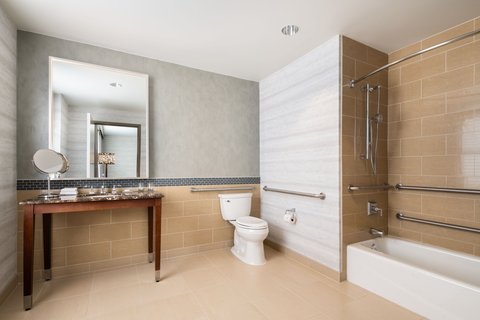
Guest rooms are the best portrait light in any hotel and in a restored period tower they have two advantages. The windows may be taller than modern ones, which sends light further into the room; and a high floor has more sky reaching its window than a low one, because the buildings opposite block less of it — so asking for a high room on the shaded side is worth doing rather than accepting whatever is allocated.
The setup is the usual three moves: largest window on the shaded side, every overhead fitting switched off so the room has one colour of light rather than three, and lamps moved out of frame. Mixed sources are the commonest single reason preparation coverage looks worse than the room did.
Corridor and lift-lobby windows are worth thirty seconds of checking on any upper floor, because in a tall hotel they frequently have the best view on the floor with no furniture in front of them — a better portrait position than any guest room.
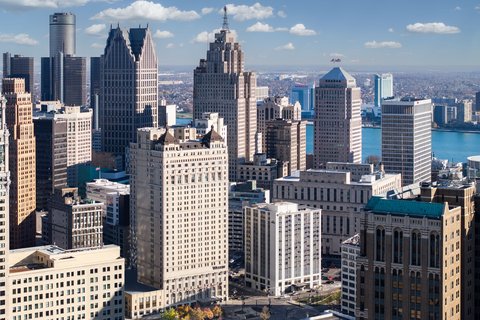
Height itself is the building’s other asset and it is worth pressing on. Detroit’s downtown has clustered towers with substantial open ground between them, which means from an upper floor the city reads as distinct masses at different distances rather than as a wall — exactly what a long lens wants. Compression stacks them into bands behind a couple; a wide lens reduces all of it to a strip at the bottom of a large sky.
Height also buys thirty or forty minutes of extra golden light, because the surrounding roofline is below — worth building into a schedule rather than discovering.
The view brings the usual brightness decision: in daylight it is four to six stops brighter than the room, so either let the window blow to a white shape, or light the couple to match it with real power, or wait for the crossing. And clean glass is the practical caution at altitude, because a window that has not been washed shows as haze and flare in a way a ground-floor window does not — check before, not during.
The crossing is the one timed frame and from a height it is exceptional: for roughly fifteen to thirty minutes after sunset the city falls to about the brightness of the interior lighting, and one exposure holds the lit room, the couple and a layered city with a coloured sky above. Sunset plus fifteen, in position, couple already there, bracketed as the sky falls.
After it, glass becomes a mirror — lights off the camera axis, frames oblique, and the reflection used deliberately where it helps.
- Test bounce once at the base; a 1924 ceiling returns almost nothing
- Graze the plasterwork or it flattens to a pale field
- Ask for a high guest room on the shaded side, not just any room
- Check the corridor windows; often the best view on the floor
- Sunset plus fifteen from a height, long lens, glass checked first
The street, and Detroit's year
At ground level Detroit gives an advantage almost no other American city does: there is room to stand back. Substantial open ground and surface parking mean a whole 1924 elevation can be photographed entire from across the street rather than in fragments — and a low camera close to the base lets the tower recede up the frame with the couple small at the bottom, which is the one frame where going wide is right and the one that connects the two halves of a day spent mostly indoors and upstairs.
That openness also means low sun reaches street level across a wider area than in a canyon city, so the last ninety minutes give raking light on masonry from more positions. Stone, brick and terracotta show their texture only when light runs along them, so a short walk to find which side is being raked is worth more than any accessory — and on a facade this large, which elevation is lit makes a substantial difference.
Detroit’s plan overlays radiating boulevards on a grid, so some streets run diagonally and take low sun at angles the grid streets do not — worth a look at a map rather than a walk on it.
Alleys are the dependable fallback: walls on both sides give directional light and a contained background with nothing distracting in it, plus shelter.
Michigan’s seasons are four real ones. Summer is warm and humid, which softens distant detail and makes a long-lens view from a height hazier than it looks to the eye — and afternoon thunderstorms are a real possibility, which from an upper floor is spectacular rather than inconvenient: a cell crossing the city below, seen from inside a lit room, is a frame very few weddings have.
Autumn gives the clearest air of the year and therefore the sharpest view frames, and the best raking light on masonry. It is the season both halves of the building are at their best in.
Winter is cold and snowy with short days, sunset falling in the middle of the afternoon in December, which moves the crossing to the late afternoon and may put it before the ceremony. But cold clear air gives the deepest and longest-lasting sky colour of the year, so the crossing itself is better then — and a snow-covered city seen from a height is a frame street-level venues cannot produce.
Snow is also the best natural fill there is outdoors, lifting exactly the shadows a low sun carves while fooling a meter by about two stops. Indoors it turns the street into a very large reflector, so the base’s tall windows give softer, brighter and more even light in February than at any other time of year — which makes the period rooms easier in winter than in summer.
And the fogging risk is severe in both directions, with the crossing unable to wait: get a body to ambient temperature well before the window rather than carrying it up cold.
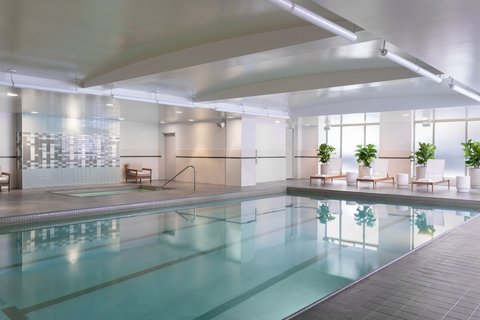
More frames from The Westin Book Cadillac
The Westin Book Cadillac wedding photography: common questions
What is the building's logic?
Vertical. The architecture is concentrated at the base, where a 1920s hotel put its public face, and the views are at the top — two different venues reached by lift.
Why does the plasterwork look flat?
Because even downward lighting gives three-dimensional ornament nothing to cast a shadow with. One source placed to graze rather than face a surface brings it back.
Which guest room should you ask for?
A high one on the shaded side. A high floor has more sky reaching its window because the buildings opposite block less of it, and period windows are taller than modern ones.
What is easy to forget at altitude?
Clean glass. A window that has not been washed shows as haze and flare in a way a ground-floor window does not, and the crossing will not wait while you discover it.
Wide or long lens from a height?
Long. Detroit’s clustered towers with open ground between them read as distinct masses at different distances, which is exactly what compression wants.
Why are the period rooms easier in February?
Because snow turns the street into a very large reflector, so the tall windows at the base give softer, brighter and more even light than at any other time of year.
More Detroit, MI venue guides
We are writing a photographer’s guide to every venue we would happily shoot in Detroit, MI. Here are three more, plus the full index:
- The Century Club, Detroit: Photographing a Small Club Room
- The Charles H. Wright Museum, Detroit: Four Ways Out of the Rotunda Problem
- The Detroit Club: Photographing a Restored Private Club
All Detroit, MI Wedding Venues →
Planning a wedding at The Westin Book Cadillac?
Architecture at the base, the crossing at the top. Tell us your date and we will sequence it.