 Dry Tortugas National Park: A Walk Through an Island Fort
The SeaWorld Orlando: Field Notes
Glass and water. Two problems, and one of them is the best light here.
A marine park sets four problems and the first two are both about glass and water, which are the reasons to be here.
Aquarium glass is the difficult one. A viewing gallery is a dark room with an enormous lit window into water, and that window is a mirror on the room side: it reflects the gallery, the visitors and the photographer, and at many angles the reflection is more legible than the tank behind it.
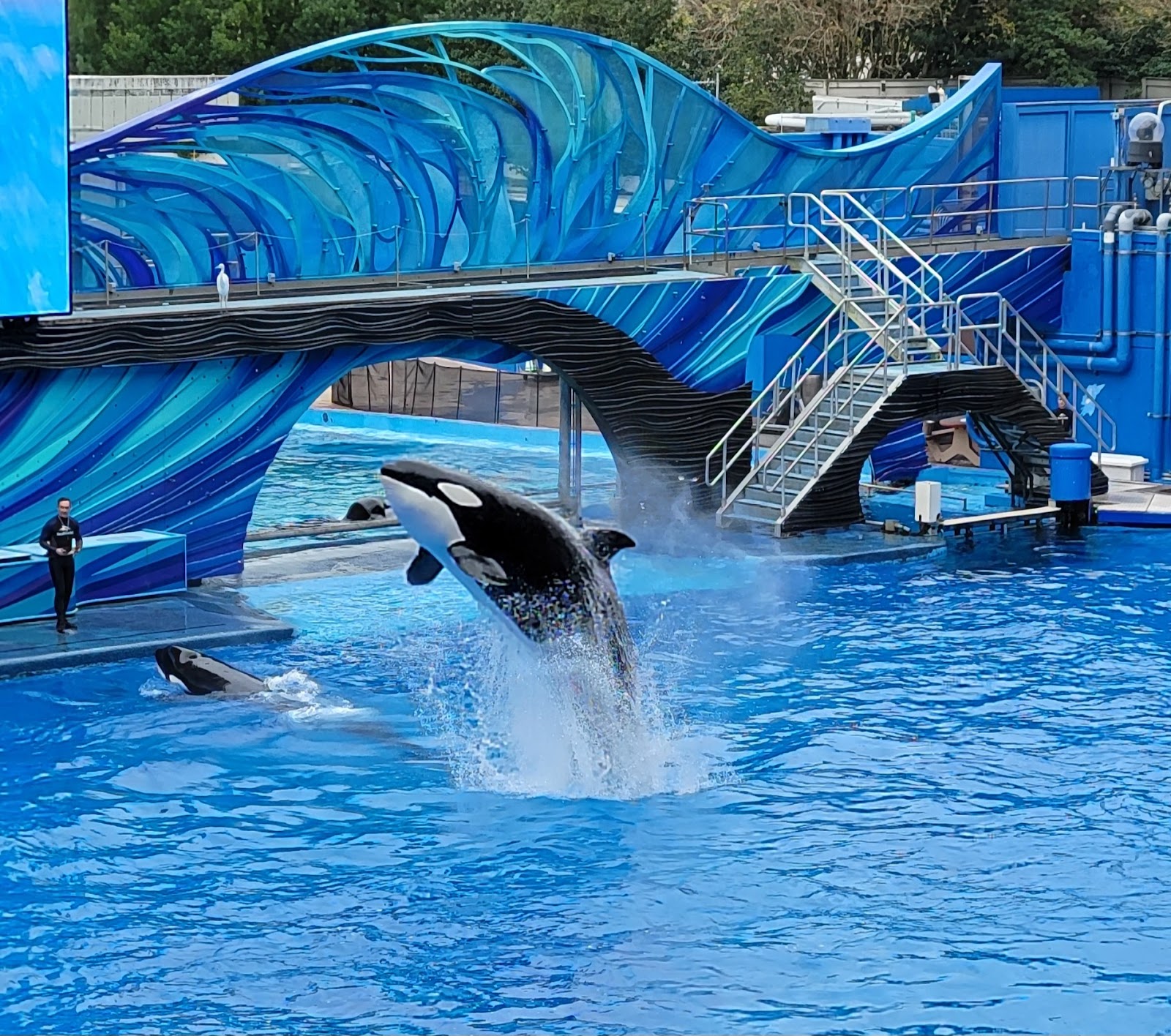
Open water is the easy one and it is genuinely excellent. A park of this kind is built around lagoons, and open water reflects the sky — which makes it a very large low-angle source, filling under the chin and lifting eye sockets, an effect that strengthens sharply at grazing angles.
So the same element is a problem when it is behind glass and a gift when it is open to the sky.
The third problem is crowds. A major Orlando park is busy at almost every hour it is open, which means strangers in the background of most frames and a photographer working tactically rather than choosing positions freely.
And the fourth is the permissions, which at any large themed attraction govern more than the light does. Commercial photography on a property of this kind is subject to specific terms — which photographers, which areas, which hours, what equipment — and those terms are enforced consistently rather than case by case.
That is the question to settle in writing before a booking rather than on the day, because the answer may confine coverage to the booked venue rather than the wider park.
The compensations are real. The aquarium galleries offer a light condition found almost nowhere else: a large soft blue-green source at close range, in a dark room, entirely independent of the weather and the hour. And the lagoons give water, a horizon and reflection in a landlocked city.
Orlando sits at about twenty-eight and a half degrees north at close to a hundred feet. The June noon sun reaches around eighty-five degrees, the December noon sun about thirty-eight, days run from about ten hours twenty to fourteen hours, and civil twilight is roughly twenty-one minutes — the shortest in this library.
What follows is four problems and what solves each. We have not photographed a wedding here; the photography policy, which areas are bookable and whether after-hours access exists are questions for the park.
The SeaWorld Orlando at a glance
| Where | A marine park in Orlando, Florida, built around aquarium galleries and lagoons |
| Problem one | Aquarium glass is a mirror on the room side |
| Problem two | Crowds — the park is busy at almost every open hour |
| Problem three | Permissions govern more here than the light does |
| The gift | A lit tank is a large soft source at close range, in any weather, at any hour |
Problems one and two: the glass, and using a lit tank
The reflection is the first problem and it has one reliable solution: physical contact.
A lens hood pressed against the glass eliminates reflections completely, because no light from behind the camera can reach the surface at that point. Shoot wide open so any surface marks blur out, and accept lower contrast — aquarium glass is thick acrylic and rarely optically clean, so a slight haze is inherent and best corrected afterwards rather than fought at the time.
A polariser helps at intermediate angles and does very little at forty-five degrees on a vertical surface, so angle and contact both beat filtration.
Where the frame has to include people rather than only the tank, contact is not available — and then the answer is to control what is behind the camera. A reflection shows whatever is bright on the room side, so switching off or shielding any light you have brought, and positioning so the dark part of the gallery is behind you, reduces it substantially.
The second half of this is the genuine gift, and it is the reason to book a marine park at all.
A lit aquarium tank is a very large soft source at close range in an otherwise dark room. That is a studio condition occurring naturally: a subject standing beside the glass, turned into it, is lit by a source several metres across at a metre’s distance — which gives extremely soft light with a rapid falloff and a dark surround.
It is also blue-green, strongly, and that is the decision to make rather than the problem to fix. Aquarium lighting is heavily biased toward the blue end because that is what penetrates water and what the exhibit needs, and a face lit by it is genuinely blue-green.
Two approaches work. Commit to it: set white balance on skin, accept a cool cast, and let the frame be what the room is — which in a dark gallery beside a lit tank is atmospheric and honest. Or gel a small source to match the tank and use it to fill the shadow side, which keeps the character while restoring some modelling.
What fails is correcting toward neutral. Neutralising a blue-green tank turns the water grey and the whole exhibit dead, which loses the reason the position was worth using.
The shutter is the discipline in a gallery. Tank light is bright relative to the room and dim in absolute terms, which tempts a photographer down to a thirtieth — and at that speed a standing subject who breathes is soft, while anything in the tank is a smear. Hold a hundred and twenty-fifth for people and a two-hundred-and-fiftieth if the animals matter.
Crowds are the second problem and scheduling is the only real answer.
Establish whether the booking includes access before opening or after closing. An open park has very large visitor numbers, which means every gallery frame has strangers in it and the good positions are occupied. Outside hours it becomes a private aquarium with nobody in it — a materially different venue, and worth paying for.
If the event falls during opening hours, work tight and low. A long lens at a wide aperture compresses the background and throws passers-by into unrecognisable colour; a low camera puts planting or water rather than crowds behind a head. Both are habits rather than tricks.
The galleries are also the busiest part of a marine park, because that is what people come for — so if the schedule is fixed during opening hours, the lagoons and the landscape are the more workable choice and the aquarium frames need a quiet window.
Problems three and four: the lagoons, and the permissions
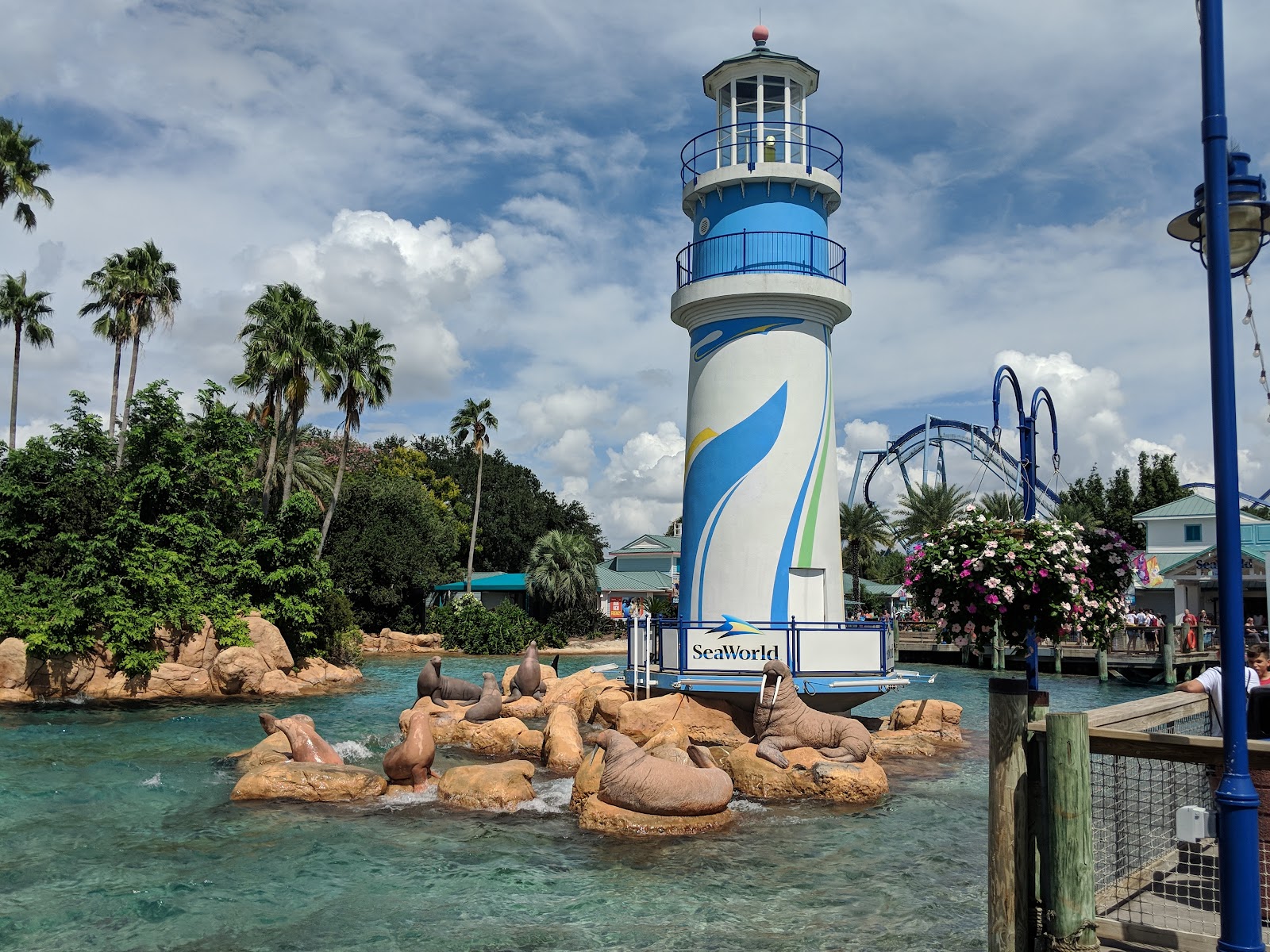
The lagoons are the park’s other half and they are straightforward in a way the galleries are not.
Open water reflects the sky, which makes it a large low-angle source that fills under the chin and lifts eye sockets — and the effect strengthens sharply at grazing angles, because water’s reflectivity rises as the light approaches the horizontal. So the fill is strongest in the last hour, which is also when the light is best.
That coincidence is why waterside positions flatter people, and it is worth building the outdoor portraits around.
A low camera turns a rippled surface into a bright specular path running toward the lens, and dropping to knee height lengthens that path across the whole frame rather than leaving it as a short patch. That is the cheapest improvement available on any waterfront and it applies here completely.
Whether the surface is still is a matter of wind, and in central Florida the sea breeze reaches inland in the afternoon — so mornings are calmer and the mirror frames belong there.
The planting around the water is better than people expect, because a park of this scale maintains its landscape to a standard few private venues match. In central Florida that means genuinely subtropical material: live oak with Spanish moss, sabal palm, crape myrtle, bougainvillea, bamboo and mature specimen trees.
Live oak is the important one. Evergreen, broad, dense and low-crowned, holding its leaves year-round, it casts genuine solid shade with no dapple in January as in July — which makes it the reliable midday position at any time of year. At a latitude where the June noon sun reaches eighty-five degrees, that is not a convenience but a necessity.
The trade is that the canopy is dark, several stops below open paving, so a subject under one with sunlit ground beyond is a four-stop frame needing a fill or a deliberate silhouette.
Dwarf palmetto in the understorey is worth backlighting: fan-shaped, translucent, and it places a frame geographically in a way an oak alone cannot. And sabal palm, the state tree, gives almost no useful shade — high crown, sparse fronds — but it is a strong graphic vertical against open sky.
The permissions are the fourth problem and they need settling first in practice, whatever order this guide puts them in.
Commercial photography at a large attraction is governed by specific terms, and a park may confine an outside photographer to the booked venue rather than the wider property. It may also restrict equipment — stands, modifiers and tripods are frequently limited in public areas for crowd-safety reasons rather than aesthetic ones.
That last point matters practically. If stands are not permitted in the galleries, then the aquarium frames are hand-held or assistant-held, which is workable and changes the plan. Establishing it in advance is the difference between a plan and an improvisation.
And there will be animal-welfare rules, which are absolute. Where a party may stand, what may be pointed at an exhibit, whether flash is permitted near animals — those are set by the park’s care standards rather than by its events team, and they are not negotiable.
Flash near aquarium glass is worth asking about specifically. Many facilities prohibit it entirely, both because it startles animals and because the glass returns it straight back into the lens.
- Press the lens hood to the glass; contact beats angle and beats a polariser
- A lit tank is a large soft source at close range — commit to the blue-green
- Hold a hundred and twenty-fifth for people, a two-hundred-and-fiftieth for animals
- Knee height lengthens the specular path across the whole lagoon frame
- Ask about flash near glass and about stands in public areas — both are often limited
The central Florida year
The park’s calendar is Florida’s and it runs opposite to most of this library.
December through April is the season: mild, dry, sunny and comfortable, with a December noon sun of about thirty-eight degrees that models rather than flattens. Because the planting is evergreen, a January frame looks much like an October one — so a winter date here is a positive choice rather than a compromise.
It is also the busiest time at an Orlando attraction, which cuts directly against the crowd problem. That trade is real: the best weather coincides with the most people, and the only resolution is access outside opening hours.
June through September is the constraint and it is severe. Subtropical summer brings afternoon temperatures in the nineties with dewpoints in the mid-to-high seventies, which for a party in formal clothing walking a park is a welfare matter rather than a comfort one.
A park is a walking venue, which makes the heat more consequential here than at a hotel. A route planned through shade, using the live oaks and any covered structures, is a route a party will actually walk — and finding it on arrival is the most useful five minutes of the day.
The aquarium galleries are the heat refuge and the reliable answer. Air-conditioned, artificially lit, and identical at any hour in any weather of any month — which means a summer wedding here has a genuine indoor half rather than a nominal one.
That is worth stating as a strength. Unlike most outdoor venues in this library, a marine park does not lose its best material to bad weather; the galleries are unaffected by anything happening outside.
The humidity has a real photographic effect and it is mostly favourable outdoors. Water vapour scatters light and fills shadows, so a sunlit path in July carries perhaps two and a half stops less contrast than the same sun angle in Arizona — soft shadow edges, eye sockets holding detail, and midday genuinely workable.
The costs are a pale washed sky, hazed long lenses across the lagoons, and one equipment problem that matters here more than anywhere: lenses fog within seconds moving from an air-conditioned gallery into outdoor air, and take minutes to clear.
On a site where the day alternates between cooled interiors and humid exteriors, that is not an occasional nuisance but a repeated one. The fix is to carry the camera warm — not leaving it in the air conditioning while waiting — and to accept a few minutes of lost time on each transition.
The cloud is the compensation and it is reliable. Central Florida afternoons generate convection from sea-breeze convergence almost daily in summer, and the half hour after a cell passes is the best light of the year: washed air, wet paving reflecting the sky, saturated planting, a low sun under a broken ceiling.
The hazard needs stating plainly. Central Florida receives more lightning than anywhere else in the United States, which for an outdoor ceremony in summer means the covered alternative must genuinely exist and be reachable in minutes. A park will have a lightning protocol of its own, and it will take precedence over a schedule.
Hurricane season runs June through November, which for a Florida date is a real planning consideration rather than a theoretical one.
And the twilight is the shortest in this library at about twenty-one minutes. On a park site where the good positions may be several minutes’ walk apart, that makes the end-of-day plan the most important thing settled in advance: two or three frames, known, with the walking time counted.
The frame worth scheduling then is a lagoon at the blue-hour balance point — the sky still holding deep blue, any park lighting on, and the water doubling all of it. Eight to ten usable minutes inside the twenty-one, and worth being in position before it starts.
More frames from The SeaWorld Orlando
The SeaWorld Orlando wedding photography: common questions
How do I beat reflections in aquarium glass?
Press the lens hood against it. Contact eliminates them completely, because no light from behind the camera reaches the surface at that point.
Why is a lit tank good light?
It is a very large soft source at close range in a dark room — a studio condition occurring naturally, with extremely soft light and a rapid falloff.
What about the blue-green cast?
Commit to it or gel a fill to match. Correcting toward neutral turns the water grey and the exhibit dead, which loses the reason the position was worth using.
What should I ask about permissions?
Whether an outside photographer may work the wider park, and whether stands and flash are permitted in the galleries. Both are frequently limited.
Is the heat a bigger problem here?
Yes, because a park is a walking venue. Plan the route through live oak shade, and use the galleries as the genuine indoor half of the day.
Any equipment warning?
Lenses fog within seconds moving from a cooled gallery into humid outdoor air, and take minutes to clear. Carry the camera warm rather than cool.
More Florida venue guides
We are writing a photographer’s guide to every venue we would happily shoot in Florida. Here are three more, plus the full index:
- The Universal Orlando Resorts: The One Decision That Governs Everything
- The Walt Disney World Resorts: What It Suits, and What It Does Not
- Dry Tortugas National Park: A Walk Through an Island Fort
Planning a wedding at The SeaWorld Orlando?
A tank that lights like a softbox. Tell us your date.