 Roxy’s Downtown: Photographing a Small Stage Room
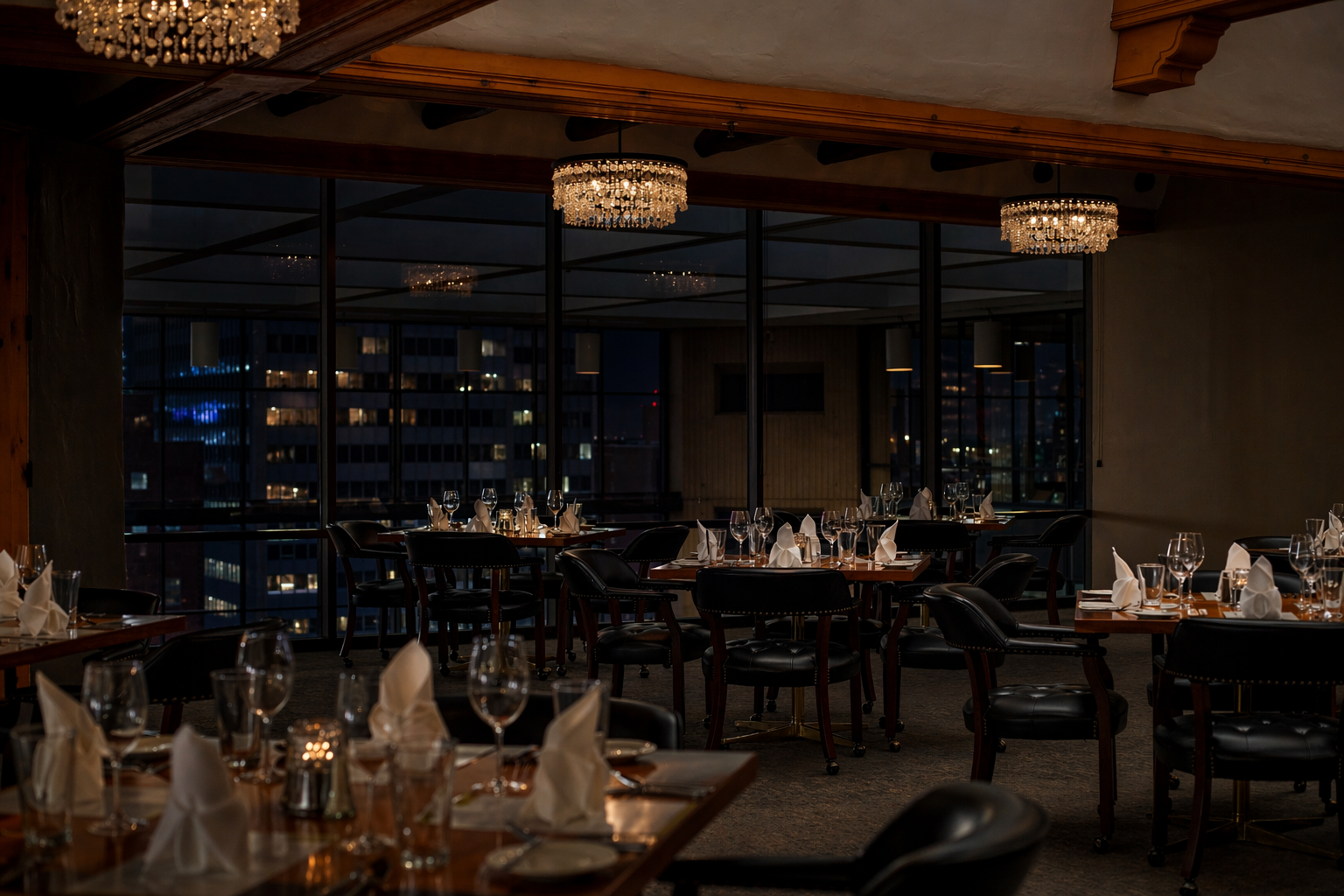
The Petroleum Club: Dark Panelling and a High Window
Dark panelling and a bright window in the same room is the widest contrast range in this whole series.
The Petroleum Club occupies an upper floor of a building in downtown Wichita, Kansas, a private club with wood-panelled interiors, warm fittings and windows looking out over the city and the open country beyond it.
Those two features — dark panelling and high-level windows — pull in opposite directions, and understanding the size of the gap is most of the job. Panelling absorbs light rather than returning it, so the room’s interior is dim and any fall-off is steep. A high window facing open plains receives light from a very large area of unobstructed bright sky, with no buildings opposite shadowing it. Between a panelled wall and that window there can be four stops or more, in the same frame.
That makes it a lighting problem rather than an available-light venue, and a solvable one. This follows the club’s own logic through the day. We have not photographed a wedding at the Petroleum Club; panelled club interiors and high plains windows behave the same wherever they meet. Which rooms are allocated, which way they face, and whether members’ areas are off limits are questions for their events team — and orientation is the useful one.
The Petroleum Club at a glance
| Where | An upper floor in downtown Wichita, Kansas |
| Character | Private club with wood panelling, warm fittings and high windows |
| The gap | Four stops or more between panelled wall and bright window |
| Consequence | Bounce flash barely works; the room must be lit directly |
| Ask first | Which way the windows face, and what is members-only |
The panelling: why bounce stops working
Dark-stained wood absorbs the light that lands on it and returns very little, and what it does return arrives strongly warm. Every pale-walled room a photographer has worked in has been quietly distributing light for free; panelling does the opposite. The consequences are a low ambient, a steep fall-off from any source, and a flash aimed at a timber ceiling returning almost nothing.
So light directly rather than by bounce — your own modifier, pointed where you want light, at a power suited to a room that will not help you. And place people near the windows, because with fall-off this steep a metre of position is worth more than a stop of ISO.
Colour needs a decision. Warm wood tints the little it bounces, tungsten fittings add their own cast, and a high window on the plains is neutral-to-cool. Three sources, no single white balance. Decide which owns the faces — normally your own light or the window — set for that, and let the wood read as warm wood, which is how it looks to the eye anyway. Correcting panelling to grey makes a club room look wrong.
The compensation is genuine: because the ambient is so low, a single well-placed light has enormous relative effect, and the frames are deep and enveloping in a way no pale room produces. A modest kit goes a long way in a club, which is the opposite of most photographers’ expectation walking in.
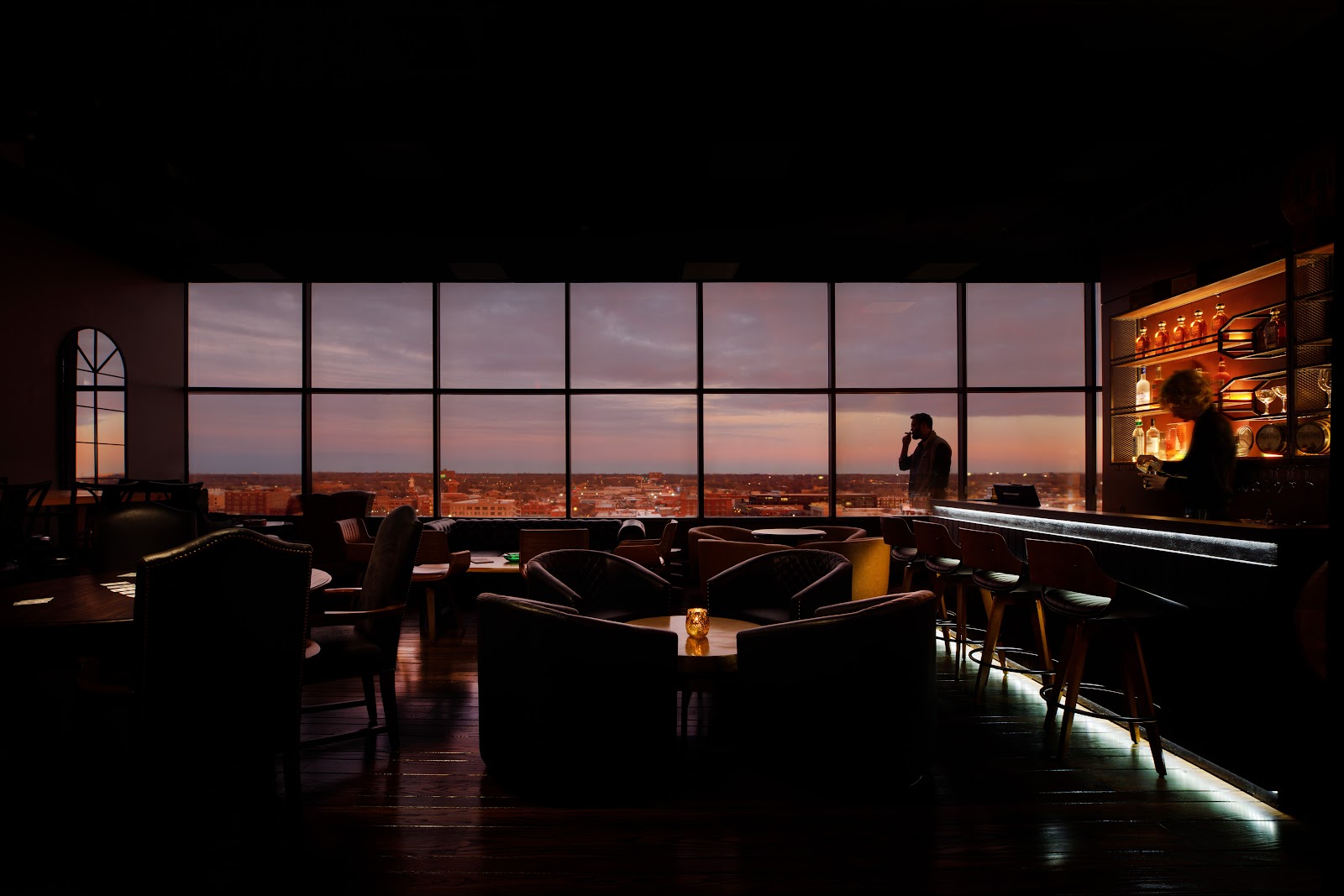
The window: a very bright source on an upper floor
A window well above street level facing open plains is an unusually good light source. Nothing tall is opposite to shadow it or bounce colour into it, and the sky area it sees is very large, so what arrives is clean, strong and directional — better than the same window would be at ground level in a built-up street.
Used as a key it is excellent. A subject a metre back, turned into it, gets a broad soft directional source with a natural fall-off into the panelled room behind, which separates them from the background with no equipment. That is the simplest good frame in the building and it is available for as long as the daylight lasts.
The problem is including both window and room in one frame. Expose for the panelling and the view blows to white, losing the city and the sky that are the reason for the window; expose for the view and the room is black. The resolution is the one every grand interior demands: light the interior up towards the window rather than exposing down to the room. Bring the couple to within two or three stops of the outside brightness, then expose for the view — and the room reads as warm wood rather than as a void.
That takes real power over a large area, which in a panelled room means the light is doing all the work with no help from the surfaces. It is worth knowing in advance, because a small on-camera flash will not achieve it.
After dark the relationship inverts and the window becomes a mirror showing the lit room, your lights and the back of the space. Reposition so the reflected cone misses the lens, or place a source behind the plane of the subject. Used deliberately — a couple and their reflection in dark glass with city lights beyond — it is one of the better frames the venue offers.
- Light directly; bounce off panelling returns almost nothing
- Place people near windows — a metre beats a stop of ISO
- Decide which source owns the faces, and let the wood stay warm
- Raise the room towards the window; do not expose down to the room
- After dark, check the glass for your own reflection before committing
The view, the hours and the club's own constraints
A high window over open country gives something a city club cannot: an actual horizon. That matters twice. It means the sunset is visible all the way down rather than disappearing behind a tower, so the warm light at the end of the day lasts longer and arrives lower than it would in a dense city. And it means the twenty minutes after sunset fill the sky with colour across the full width of the window rather than in gaps between buildings.
The dusk crossing is the frame to schedule. For roughly twenty minutes the sky outside falls to approximately the brightness of the room’s interior lighting, and for that period one exposure holds the panelled room, the couple and the sky with colour in it. That is the photograph a high-level club can make and a ground-floor venue cannot, it is dictated by sunset rather than the running order, and it is gone ten minutes later. Take the clock time from sunset and treat it as an appointment.
Before that, the last hour of direct sun through a high window is the strongest available light in the building — low, raking, warm, and coming in almost horizontally across the room. It lights panelling in a way that reveals the grain rather than flattening it, which is the only time the woodwork looks like wood in a photograph.
The club constraints matter and should be settled in advance. These are private premises with members present, which means some rooms and corridors may be off limits, photography in circulation areas may be restricted, and light stands may not be permitted in shared spaces. A grand stair in a members’ area is not available however good it looks. Clubs answer these questions clearly when asked, and discretion around members who have not agreed to appear in a wedding gallery is part of the job.
One vertical note: club buildings stack their functions, so moving between floors is a lift journey rather than a walk. Group everything on a floor into one pass, carry what you need for it at the start, and ask whether a service lift is available — that last question is the highest-return one at any vertical venue and almost nobody asks it.
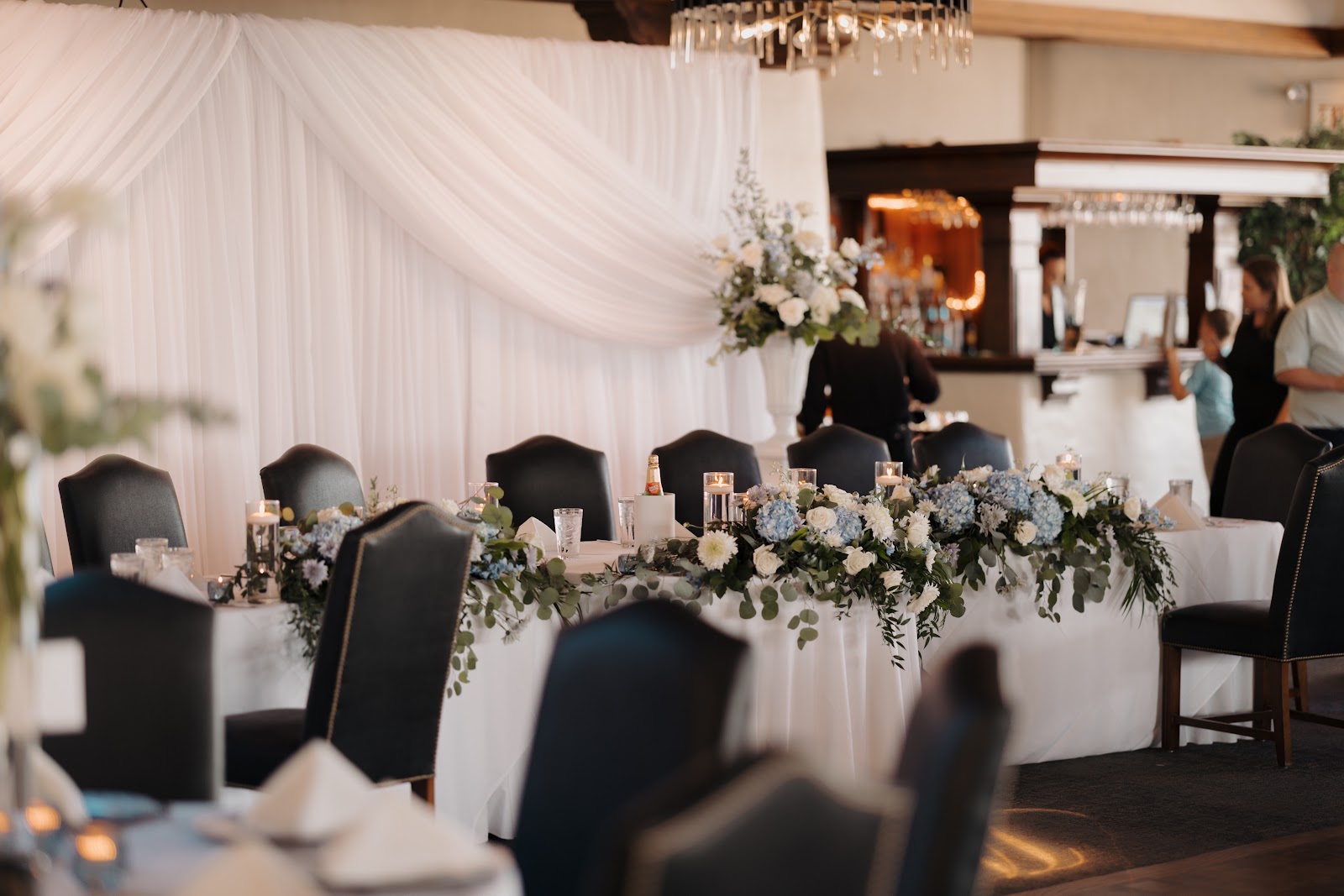
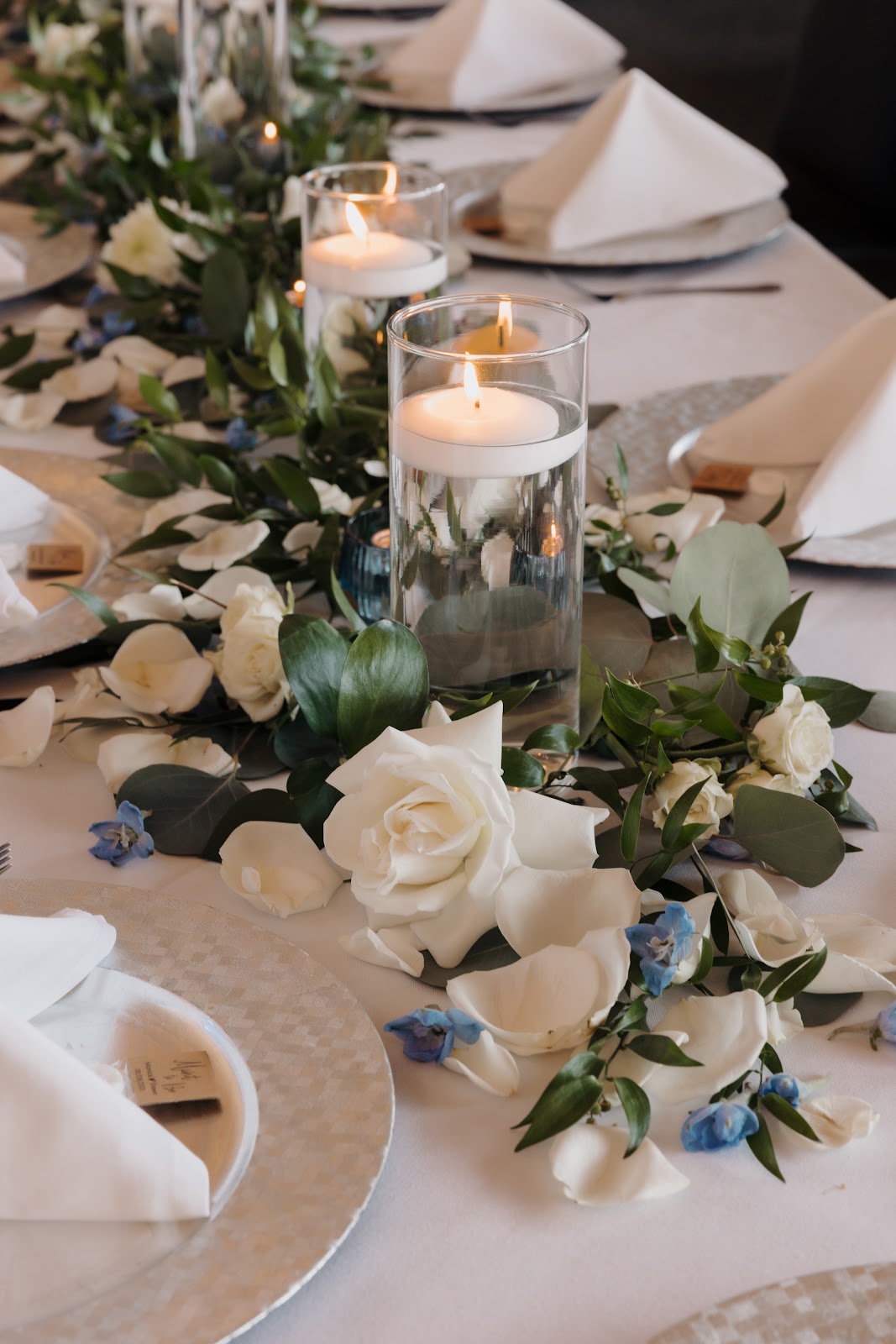
More frames from The Petroleum Club
The Petroleum Club wedding photography: common questions
Why does bounce flash fail in a panelled room?
Because dark-stained wood absorbs light rather than returning it, so a flash aimed at a timber ceiling sends almost nothing back. The ambient is low and the fall-off from any source is steep, so everything has to be lit directly with your own modifier.
How big is the contrast range?
Four stops or more between a panelled wall and a high window facing open plains — the widest in this series. That is why including both in one frame needs the room raised towards the window rather than the exposure dropped to the room.
How do you hold the view and the room together?
Light the couple and the interior up to within two or three stops of the outside brightness, then expose for the view. That takes real power in a panelled room because no surface helps distribute it — a small on-camera flash will not do it.
Is there an advantage to being high up?
Two. Nothing opposite shadows the window or bounces colour into it, so the light is cleaner and more directional than at street level. And there is an actual horizon, so sunset lasts longer and the post-sunset colour fills the full window width.
What is the frame worth scheduling?
The dusk crossing — about twenty minutes when the sky outside falls to the brightness of the interior, so one exposure holds the panelled room, the couple and coloured sky. Take the time from sunset; it is gone ten minutes later.
What should be agreed with the club beforehand?
Access. Which rooms and corridors may be used, whether members’ areas are off limits, whether photography is allowed in circulation spaces, and whether light stands are permitted. A stair in a members’ area is not available however good it looks.
More Kansas venue guides
We are writing a photographer’s guide to every venue we would happily shoot in Kansas. Here are three more, plus the full index:
- Reflection Ridge Golf Club: Reading Water on a Course Through the Day
- Roxy’s Downtown: Photographing a Small Stage Room
- Sedgwick County Zoo: What a Plains Zoo Suits and What It Does Not
Planning a wedding at The Petroleum Club?
Four stops in one room needs real light and one timed appointment. Tell us your date and which way the windows face.