 The Hotel Indigo Madison: What It Suits, and What It Does Not
The Milwaukee Art Museum: One Frame, and How It Is Made
One frame, under a roof that moves. It is on a timetable.
This guide is about a single photograph and it depends on something that exists at almost no other building in the world: a roof that opens.
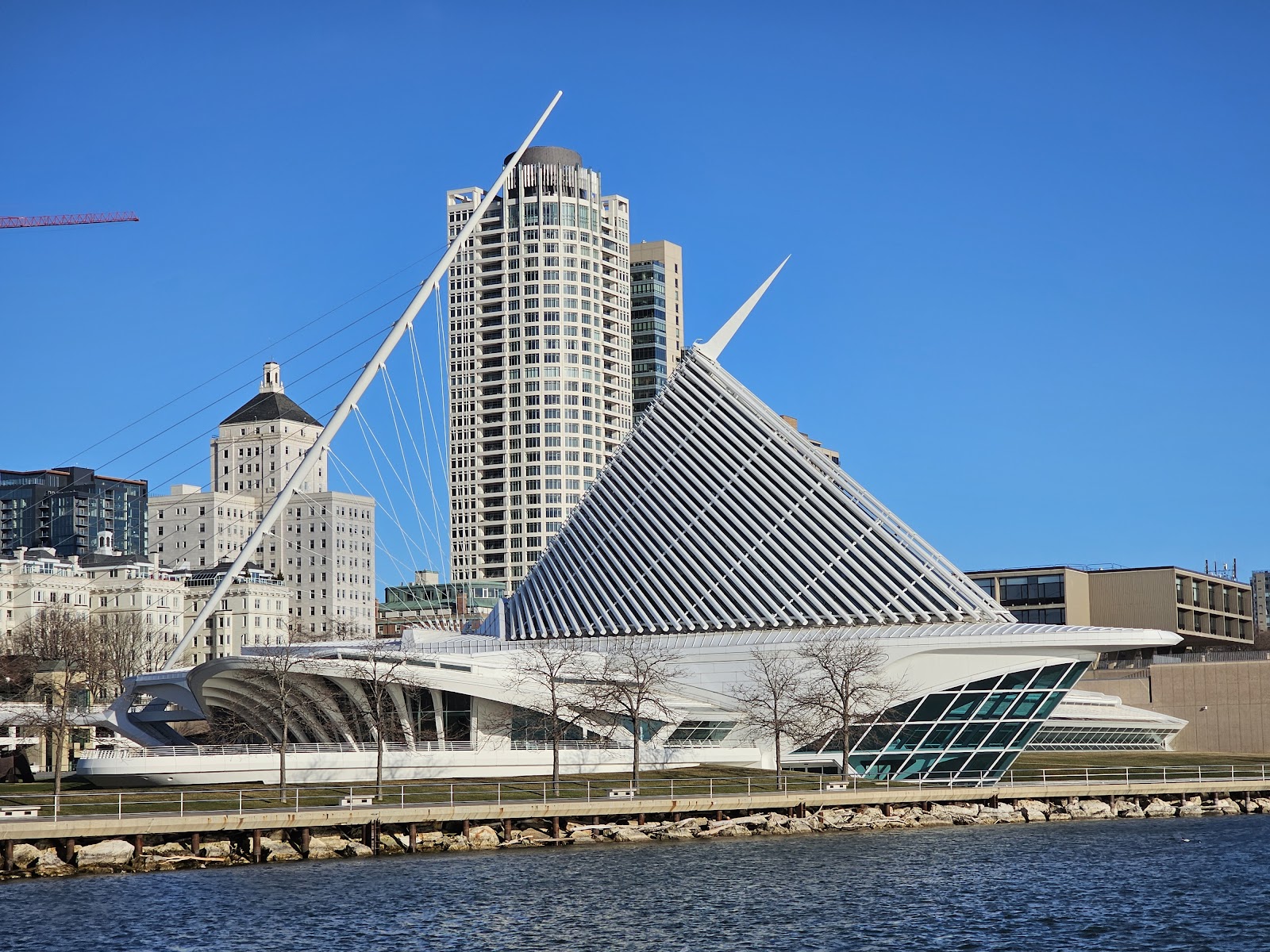
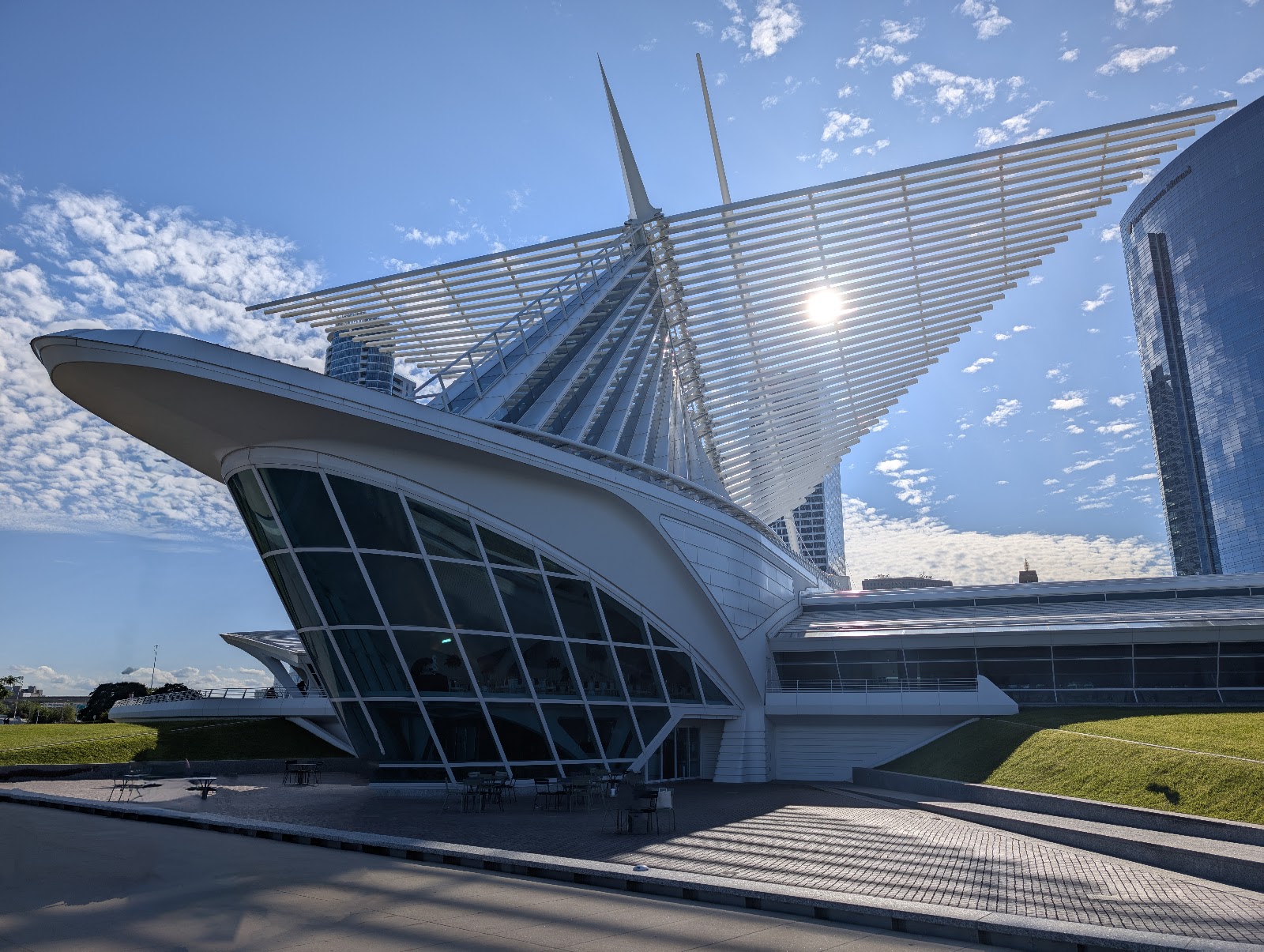
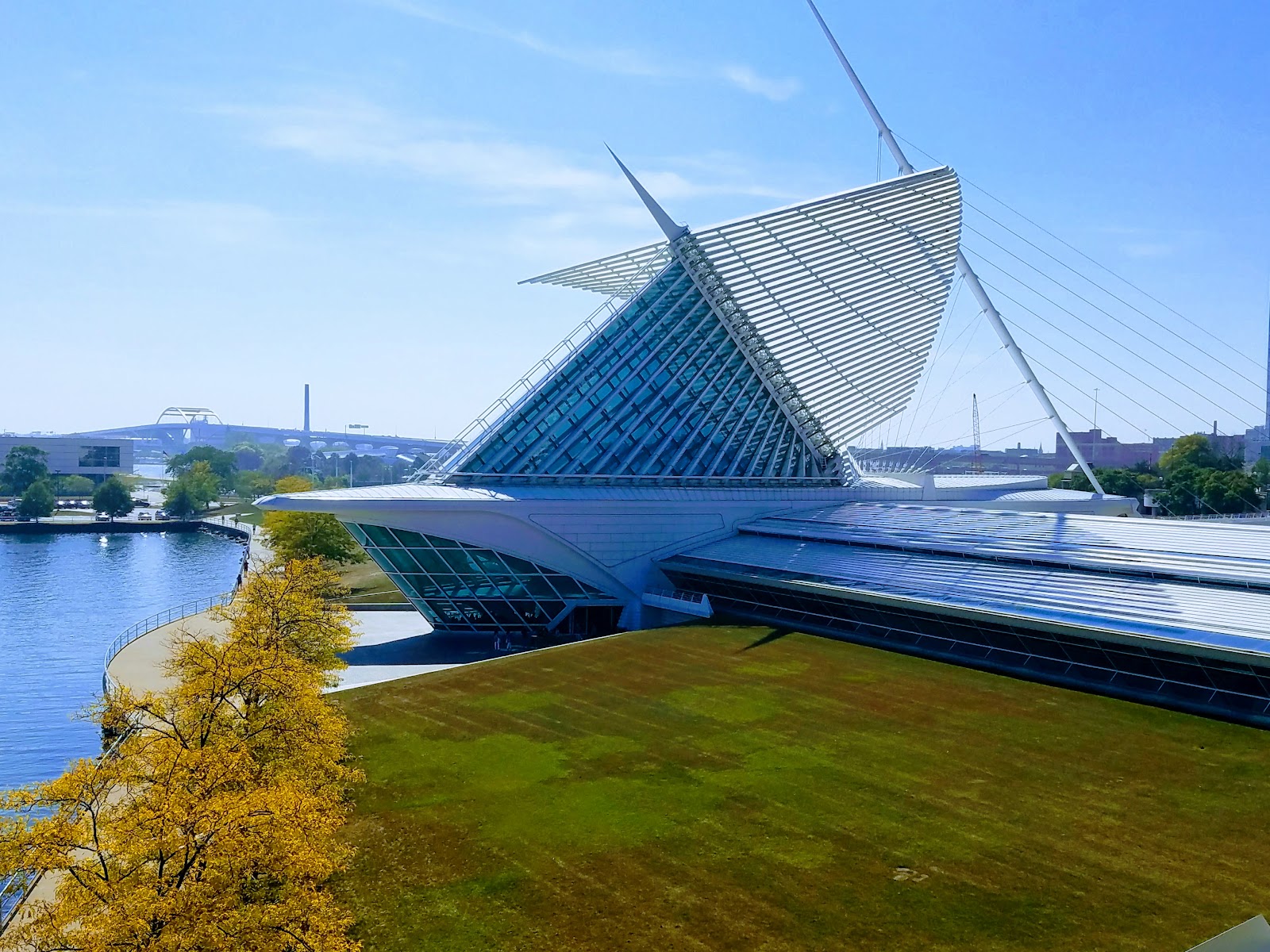
The museum’s pavilion on the lakefront carries a moveable sunscreen — a brise soleil of steel fins spanning something over two hundred feet, hinged along a spine and designed to open and close. It is white, it is enormous, and it moves.
It also moves on a schedule. The fins open in the morning when the building opens, close in the evening when it shuts, and — in normal operation — flap once around midday. That is the critical fact: the frame this guide describes is available at specific times of day and not at others, and it is a published timetable rather than a matter of luck.
The frame is the couple beneath the open fins, from below, with the structure spread overhead like a wing and the lake beyond.
It is difficult for three reasons. The fins are white and the sky is bright, which is a narrow tonal separation. The structure is enormous, which means a lens wide enough to contain it renders the people small. And the whole thing reads as a symmetrical object, which punishes an off-centre camera.
The second thing to know is that the building sits directly on Lake Michigan. That gives a horizon, a very large reflective surface, and the specific light of a great lake — cooler, cleaner and more variable than an inland city’s, with genuine fog in the right conditions.
Milwaukee sits at about forty-three degrees north at roughly six hundred feet on the western shore of Lake Michigan. The June noon sun reaches around seventy and a half degrees, the December noon sun about twenty-three and a half, days run from about eight hours fifty-five to fifteen hours twenty-five, and civil twilight is roughly thirty-three minutes — generous.
We have not photographed a wedding here. The fins’ operating schedule on your date, which spaces are bookable and the flash policy are questions for the museum — and the first is the one this guide turns on.
The Milwaukee Art Museum at a glance
| Where | An art museum on the Lake Michigan shore, Milwaukee, Wisconsin |
| The frame | The couple beneath the open steel fins, from below, with the lake beyond |
| The catch | The fins open and close on a published daily schedule, not on request |
| The difficulty | White fins against bright sky, enormous scale, and strict symmetry |
| Ask first | The operating schedule for your date; bookable spaces; flash policy |
Building the frame
Five decisions, and the first is not photographic at all.
**Confirm the schedule.** The fins operate on a daily cycle tied to opening hours, and they do not open on request for a private event. Nor do they operate in high wind — a moveable structure of that size has a wind limit, and above it the fins stay closed for safety.
So the frame depends on a date, a time and the weather, and two of those are knowable in advance. Ask the museum what the schedule is on your date and what the wind threshold is, because a wedding scheduled for six in the evening may find the fins already closed.
Closed is not useless, incidentally. The fins folded down against the spine form a completely different shape — tighter, more blade-like, more architectural — and it is a perfectly good frame. It is simply not the same one.
**Get underneath and get low.** The frame only works from below. From eye level at a distance the fins read as a white line against sky; from directly beneath, looking up past the couple, they spread across the whole frame and the scale becomes legible.
That means a wide lens, a low camera and the couple close — which is an unusual combination and the reason the frame is not obvious.
**Find the centre line.** A symmetrical structure photographed off axis reads as a mistake rather than a choice. The building’s own paving will usually mark the axis; use it. A camera a foot off centre turns a symmetrical wing into a lopsided one and the whole effect collapses.
**Anchor the exposure on the fins.** White painted steel against a bright sky is a narrow separation, and the fins are the subject — so expose so they hold detail just below clipping, around two thirds of a stop under maximum. A blown brise soleil is a white shape with no structure in it, which loses the ribs and the hinges that make it legible as a machine.
That will put the couple a stop and a half or two under, because they are shaded by the very thing being photographed.
**Fill them.** One source, front and slightly off the camera axis, through a modifier, at about a stop under the fins’ exposure. Not matching — a couple as bright as white steel reads as pasted in — and not more than two stops under, or they go muddy.
Gel it warm by about a quarter. Standing under a white structure beside a great lake means the light on them is entirely sky, and at this latitude a clear sky reads distinctly cool. An ungelled source gives faces that sit slightly green against warm-toned paving.
On an overcast day none of the fill is needed and the frame becomes easy: flat even light, a narrow range across the whole scene, and white fins that hold detail without help. Wisconsin gives a great many overcast days, and for this particular frame that is a gift rather than a compromise.
One further note on timing. The fins are most dramatic when the sun is low enough to rake along them, which picks out each individual fin as a separate plane rather than rendering the whole array as one white mass. Late afternoon does that — if the fins are still open.
The rest of the building, and the lake
Beyond the signature frame the pavilion offers two more things worth knowing, and both are consequences of the same architecture.
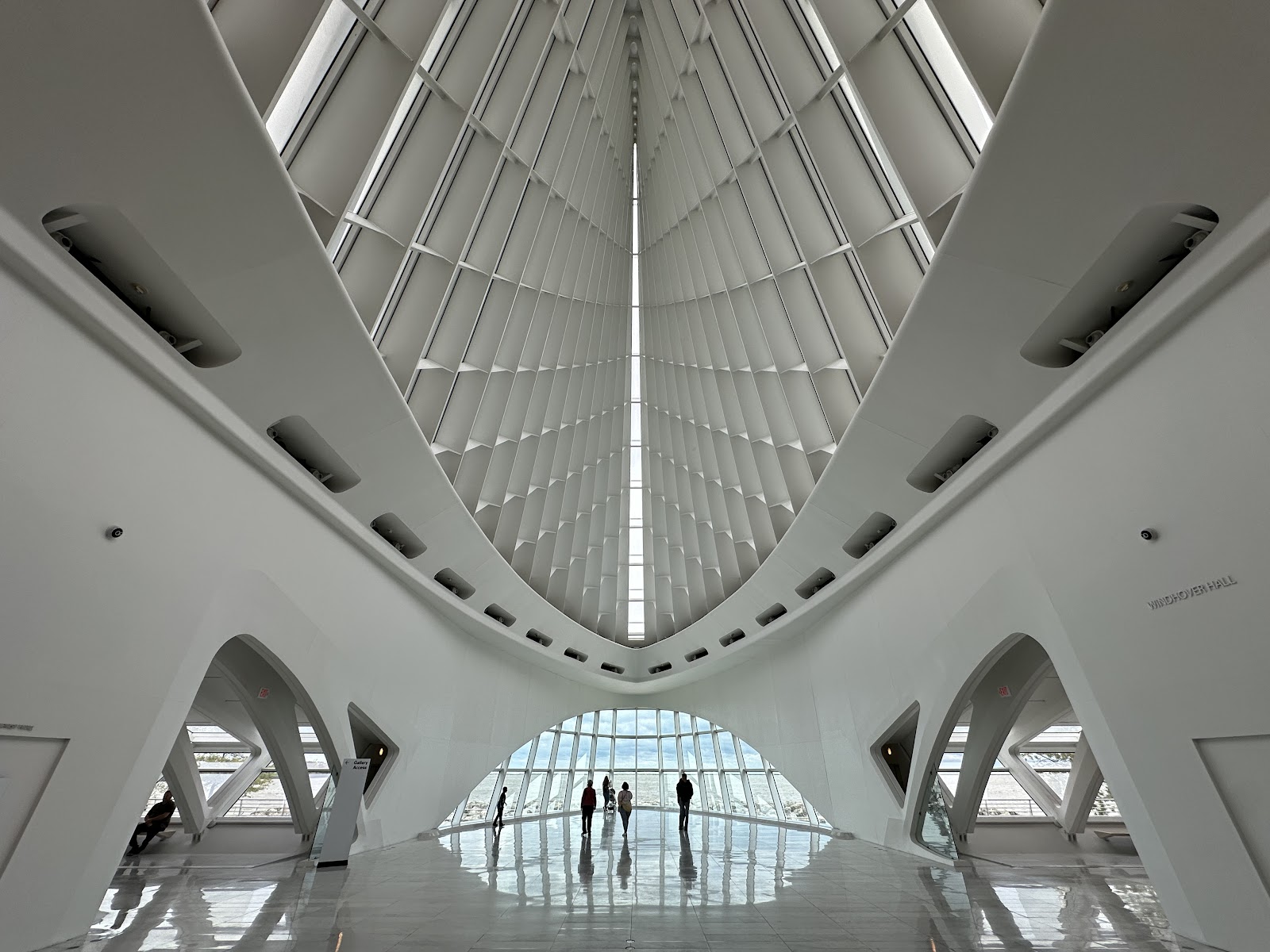
The interior beneath the fins is a very large glazed volume, which means it is lit by an enormous quantity of daylight from all sides and from above. That produces the brightest interior in this library and it is genuinely easy: a subject standing anywhere in it is well lit, and a subject three or four metres in from a glazed wall has strong directional light with a soft shadow edge.
The catch is that the light changes when the fins move. With them open, the overhead component is unobstructed and the space is bright and top-lit; with them closed, the overhead light is filtered and the space becomes side-lit from the glazing instead. That is a genuine difference in character and it is another reason to know the schedule.
Top-lit means the standard problem: even coverage with shadowed eye sockets. The fix is the floor, and here it is unusually effective — a pale stone or terrazzo floor under that much daylight is a very efficient low reflector, so turning a subject toward the brightest floor rather than away from it lifts the sockets noticeably.
The white ribbed structure is the other interior asset. Exposed structural ribs converging along a hall is a strong repetitive pattern, and a wide lens from low on the centre line renders them converging toward the far end — the same discipline as the exterior frame, and the same punishment for being off axis.
Groups arrange parallel to the glazing rather than across the space. Perpendicular puts one end of a row three stops below the other, and no care in post recovers it.
The galleries are a separate proposition and they follow museum rules. Conservation lighting is diffuse, indirect, low-level and deliberately directionless, which is difficult for faces because a portrait needs a shadow to describe a shape. The fix is positional: find the local brightest thing — a skylight, an uplit wall, a lit vitrine, a doorway into a brighter room — and put it on one side of the face.
Hold a hundred and twenty-fifth as a shutter floor and pay for it in ISO. And settle the flash policy room by room in writing, because many museums prohibit it among works entirely while permitting it in atria and function spaces.
Never bounce toward a glazed work; it is a mirror and a flash near its axis returns a bright rectangle.
The lake is the third element and it is the reason the building faces the way it does. Lake Michigan gives a true horizon — a sightline of tens of miles with nothing in it — which no inland city can offer, and a very large reflective surface.
Open water reflects the sky, which makes it a large low-angle source that fills under the chin and lifts eye sockets, and the effect strengthens sharply at grazing angles. So a subject at the lakefront in the last hour is lit from below as well as from the side.
Because the shore faces east, the sun rises over the water and sets behind the city. That is the opposite of most great-lake venues in this library and it has a clean consequence: sunrise is the water frame and sunset is the building frame. A couple facing east at dawn has a sun coming up out of the lake; the same couple at dusk has warm light on the white pavilion with the water behind them in shade.
Both are excellent and they are different pictures. Knowing which one a schedule permits is worth establishing early.
- Confirm the fins’ schedule and wind limit for your date — they do not open on request
- Get underneath, get low, and find the marked centre line
- Expose for the white fins just below clipping; fill the couple a stop under
- Overcast is the easy condition for this frame, not the difficult one
- East-facing shore: sunrise is the water frame, sunset is the building frame
Lake Michigan, and the Wisconsin year
A great lake changes the weather of the shore it touches, and the effects here are specific enough to plan around.
The lake is a thermal mass on an enormous scale, which means it lags the seasons. Spring on the shore is cold and late, because the water is still near freezing into May; autumn is mild and long, because the water holds summer heat into November. A Milwaukee lakefront in April is considerably colder than the suburbs five miles inland, and in October considerably warmer.
That produces the phenomenon worth knowing about: lake fog. In spring and early summer, warm air moving over cold water condenses, and fog forms over the lake and drifts onto the shore — sometimes as a wall that stops a few streets inland. A white sculptural building half-dissolved in fog is an extraordinary frame, and it is entirely unplannable.
It is also a genuine risk to the signature frame, because fog means no sun on the fins and often enough wind to keep them closed.
The lake breeze is the other effect. On a warm day the temperature difference between water and land drives an onshore wind that develops through the afternoon — which means the lakefront is reliably breezier than inland, and a moveable structure with a wind limit is more likely to be closed on a hot afternoon than a cool morning.
That is a counterintuitive and important point: the best weather for a wedding is the weather most likely to close the fins.
Practically, the wind means a five-hundredth of a second for anything with hair or fabric in it and no unweighted light stands anywhere on the lakefront.
The seasons rank clearly. Late September into mid-October is the best window. The lake keeps the shore mild while the inland hardwoods turn — sugar maple to scarlet and orange, oak to russet, basswood to yellow — and the air reaches its clearest of the year, which restores the long sightline across the water that summer haze removes.
October also has the calmest water. Autumn on the Great Lakes is a mix, but the early part gives more settled days than spring does, and a mirror-calm Lake Michigan doubling a white building is the best water frame available.
Summer is long-lit — fifteen hours twenty-five at the solstice — and humid enough to fill shadows: a sunlit plaza in July carries perhaps a stop and a half less contrast than the same sun angle in a dry climate. It also hazes the horizon badly, so the long view across the lake reads soft in August and sharp in October.
Winter is the dramatic season here and it is worth taking seriously. Milwaukee gets real cold and substantial snow, with about eight hours fifty-five of daylight in December — and the lakefront in winter produces things nowhere else does. Shelf ice builds along the shore in a hard winter, sometimes in genuinely strange formations; spray freezes on railings and structures; and steam fog rises off open water when the air is far colder than the lake.
A white sculptural building above ice, in flat winter light, is a strong frame and a rarely photographed one. The honest constraint is that standing on an exposed lakefront in a Milwaukee January is brief work, and the fins will very likely be closed.
Spring is the weakest season: cold, late, foggy and grey, with the lake at its coldest and the inland landscape not yet leafed. April on this shore is a difficult date.
Civil twilength here runs about thirty-three minutes, among the longer figures in this library, which makes the blue hour a genuine working session. The frame worth scheduling is the pavilion lit from within against a deep blue sky with the lake dark in front of it — glazing glowing, white structure catching the last colour, and the water doubling whatever light there is. In December that lands around five, before the reception; in June near nine-thirty, after dinner.
More frames from The Milwaukee Art Museum
The Milwaukee Art Museum wedding photography: common questions
What is unusual about this building?
It has a moveable sunscreen — steel fins spanning over two hundred feet that open and close on a daily schedule, and flap around midday.
Can we ask for the fins to open?
No. They run on a published cycle tied to opening hours, and they stay closed above a wind threshold. Ask the museum for the schedule on your date.
How do I photograph them?
From directly beneath, low, with a wide lens and the couple close — and precisely on the marked centre line, because off axis the symmetry collapses.
What do I expose for?
The white fins, just below clipping. A blown brise soleil loses the ribs and hinges that make it legible as a machine.
Is overcast bad for this?
The opposite. Flat even light gives a narrow range and white fins that hold detail with no fill at all — and Wisconsin provides plenty of it.
Which way does the shore face?
East. So the sun rises over the water and sets behind the city — sunrise is the water frame, sunset is the building frame.
More Milwaukee, WI venue guides
We are writing a photographer’s guide to every venue we would happily shoot in Milwaukee, WI. Here are three more, plus the full index:
- The Milwaukee Public Museum: The Problem, and Four Ways Out of It
- The Milwaukee Repertory Theater: A Walk Through the Building
- The Milwaukee Zoo: Field Notes
Planning a wedding at The Milwaukee Art Museum?
A roof that opens, on a timetable. Tell us your date.